1 Big Idea: Why Balance is About Tension, Not Equality
In Week 9, we talked about balance as if it were a checklist: acidity, tannin, alcohol, fruit, all accounted for, all present. And that 3-second test works. It gets you oriented. But orientation isn’t understanding.
The deeper truth about balance is that it has nothing to do with equality. A great wine doesn’t distribute its elements evenly like slices of a pie. It puts them in productive conflict.
Acidity pulls one direction, alcohol pushes another, tannin grips, sweetness softens, and the result is tension that feels alive. This is what separates a technically correct wine from one that stops you mid-conversation.
Most wine education teaches you to identify balance. Almost none teaches you to feel tension. This week, we go there. We get there by learning what happens when the elements argue with each other, and why the best bottles in the world are the ones where that argument never quite resolves.
When the 3-Second Balance Test Fails
In Week 9, I gave you the 3-second balance test. Today I want to tell you about the time it failed me.
Last fall I sat down with two wines. The first: a $75 Napa Cabernet Sauvignon, big name, great vintage, 94 points from two major publications. I swirled, I sniffed, I sipped. The acidity was present, the tannins smooth and polished, the alcohol warm but not hot, the fruit ripe and generous with dark cherry and cassis.
It passed the balance test. And I felt absolutely nothing.
The second glass was a $35 Beaujolais, a Morgon from Marcel Lapierre. The acidity was sharper than what most people call “balanced.” The tannin was almost scratchy. The fruit had this tart, crunchy quality that reminded me of biting into a cherry you picked too early.
By every metric I taught you six weeks ago, this wine was less balanced than the Cab. And it was ten times more interesting. I sat there for a full minute just trying to figure out what was happening in my mouth.
That’s when I realized: the test I gave you works for spotting bad wine. But it doesn’t explain good wine.
Smooth Wine vs. Balanced Wine: Why Ease Isn’t Greatness
In the wine world, intensity gets confused with quality all the time. That Napa Cab was engineered to impress. Every element was dialed to a comfortable middle. Nothing stuck out. Nothing challenged you. It was the wine equivalent of a luxury hotel lobby: pleasant, forgettable, designed so nothing offends.
The Beaujolais was a conversation. The acidity said one thing, the tannin said another, and they didn’t agree. But they weren’t fighting, either. They were...debating. Productively.
I spent years chasing the “smooth” wine. The one where everything disappears into everything else.
I thought that was what balance meant: if I couldn’t feel the tannin it must be perfectly integrated, if the acidity didn’t make my mouth water it must be in harmony, if the alcohol didn’t warm my chest it must be seamless.
What I was actually chasing was ease. And ease is fine. Sometimes you want it. A Tuesday night, a simple pasta, a glass of something that doesn’t ask questions. No judgment.
But ease is not the same as balance. And it’s definitely not the same as greatness.
The wines that have genuinely moved me, the ones I remember months later, the ones I’ve scribbled notes about at midnight, none of them were “smooth.” They all had edges and something slightly unresolved.
Functional Tension in Wine: The Bridge Analogy That Explains Great Bottles
The concept that changed everything for me: functional tension.
Balance means every element is pushing against the others in a way that creates something alive. Think about it like a bridge. A bridge doesn’t work because nothing is happening.
It works because massive forces are all pushing in different directions: compression, tension, gravity, resistance. The structure holds because of that opposition. Remove one force and the bridge collapses.
Wine works the same way.
In that Beaujolais, the bright acidity was pulling against the earthy tannin. The low alcohol let both of them speak louder than they would in a riper wine. Nothing was hiding or smoothed over. Because of that tension, every sip gave me something new to notice.
That’s functional tension: structure under pressure, a conversation between elements that holds itself together by refusing to resolve.
Once you feel it, you can’t unfeel it. You’ll start noticing that the wines you love most are the ones where everything holds together despite pulling in different directions.
3 Taste Experiments: Functional Tension in Your Glass
You already know what acidity, tannin, and alcohol feel like. Treat these three wines as exercises. Each one highlights a different kind of functional tension. Pay attention to how the elements interact, not just whether they’re present.
#1: Acidity vs. Sweetness
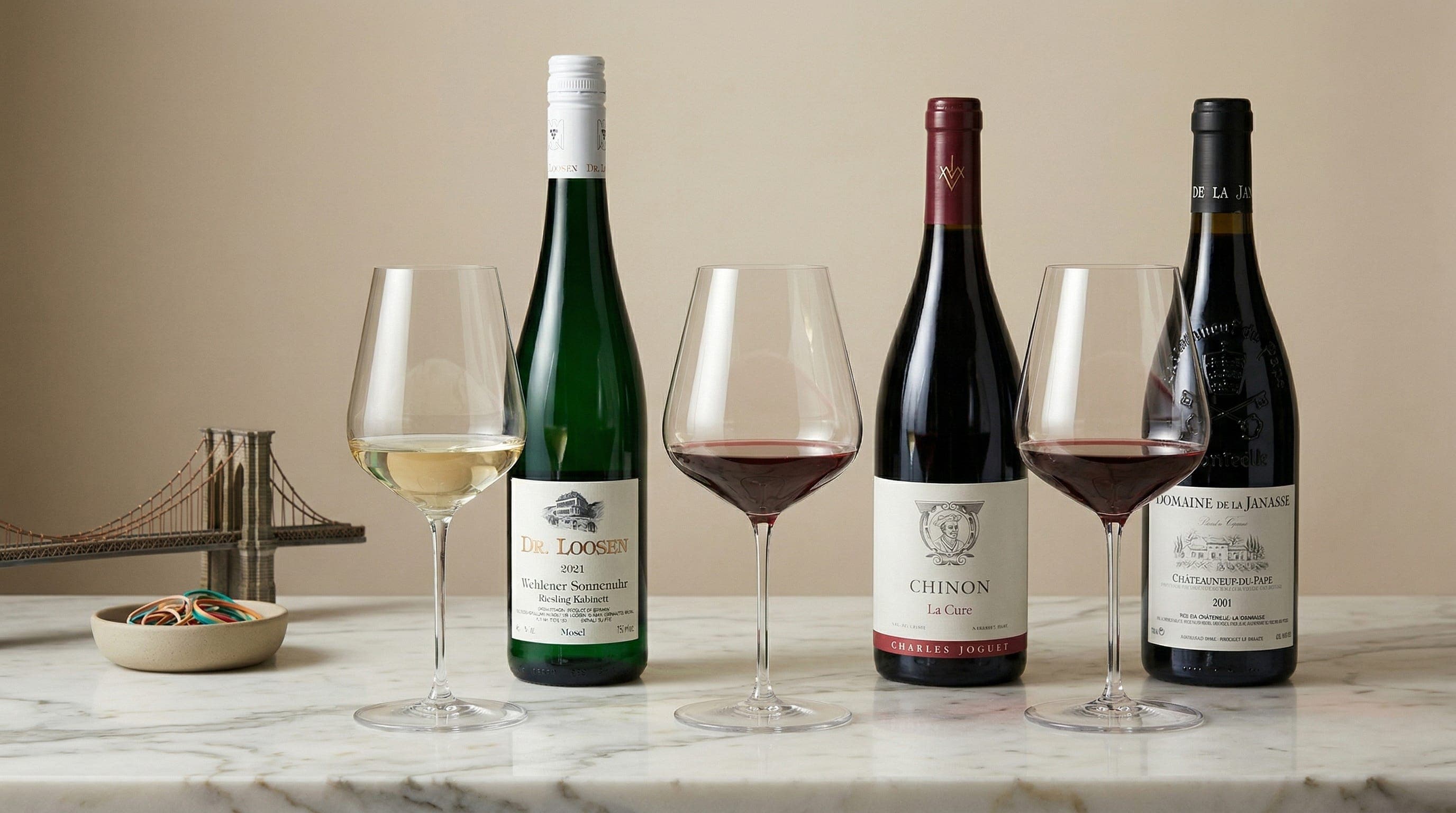
Wine: Mosel Kabinett Riesling ($20-40)
Look for: Joh. Jos. Prum, Dr. Loosen, or Selbach-Oster
What to notice: This is tension in its purest form. There’s residual sugar here, and you’ll taste it. But the acidity is so electric, so razor-sharp, that it pulls against the sweetness like a counterweight. Neither wins. The wine vibrates between the two. Notice how your perception shifts sip to sip: one moment it reads sweet, the next it reads dry. That oscillation is functional tension at work.
#2: Tannin vs. Acidity
Wine: Chinon Cabernet Franc ($30-50)
Look for: Charles Joguet, Bernard Baudry, or Domaine Philippe Alliet
What to notice: Cabernet Franc from the Loire is one of the best classrooms for tannin-acidity tension. The tannin is firm, grippy, and slightly green-edged, very different from plush Napa-style. The acidity is high and bright. They push against each other the entire time. This wine won’t “smooth out” in your glass. It stays taut. That’s the point. See if you can appreciate that tension while you’re drinking, without waiting for it to resolve.
#3: Alcohol and Fruit vs. Structure
Wine: Chateauneuf-du-Pape ($40-75)
Look for: Chateau de St. Cosme, Domaine Raymond Usseglio, or Domaine de la Janasse
What to notice: Here’s where it gets advanced. Chateauneuf-du-Pape can hit 14.5-15% alcohol. The fruit is generous, sun-baked, almost sweet. By all logic, this wine should feel like a fruit bomb. But the best producers layer in enough earthy tannin, dried-herb complexity, and mineral backbone that all that power gets held in check. The tension here is between sheer force and the structure that contains it. Notice how the wine feels big and restrained at the same time. That paradox is the whole lesson.
The Finish
The wines that stay with you are the ones that make you pause.
Your one step this week: open any bottle you have at home. Take a sip and ask “where’s the tension?” Find the place where two elements push against each other and sit with that spot. That’s where the wine is actually happening. That’s where you stop chasing ease and start chasing experience.
Go Deeper
If this week’s idea stuck with you, these five sources take the conversation further into the science and philosophy of why tension matters in what we taste.
- *Emile Peynaud, “The Taste of Wine: The Art and Science of Wine Appreciation”* Peynaud was the Bordeaux enologist who effectively invented modern wine tasting as a discipline. His chapters on balance and structure are where most of the vocabulary we use today originated, and he’s explicit that balance is a dynamic state, not a static one. If you read one book on this topic, read his.
- *Gordon M. Shepherd, “Neuroenology: How the Brain Creates the Taste of Wine” (Columbia University Press, 2016)* Shepherd is a Yale neuroscientist who argues that flavor is constructed by the brain from competing sensory inputs, which is effectively a neuroscience version of functional tension. Dense in places, but the chapters on retronasal olfaction and cross-modal perception are worth the work.
- *Adrienne Lehrer, “Wine and Conversation” (Oxford University Press, 2nd ed. 2009)* A linguist’s look at how we talk about wine and why that language is so slippery. Lehrer’s chapters on descriptive vocabulary help explain why “balance” ends up meaning so many different things to different drinkers, which is part of the reason the checklist approach breaks down.