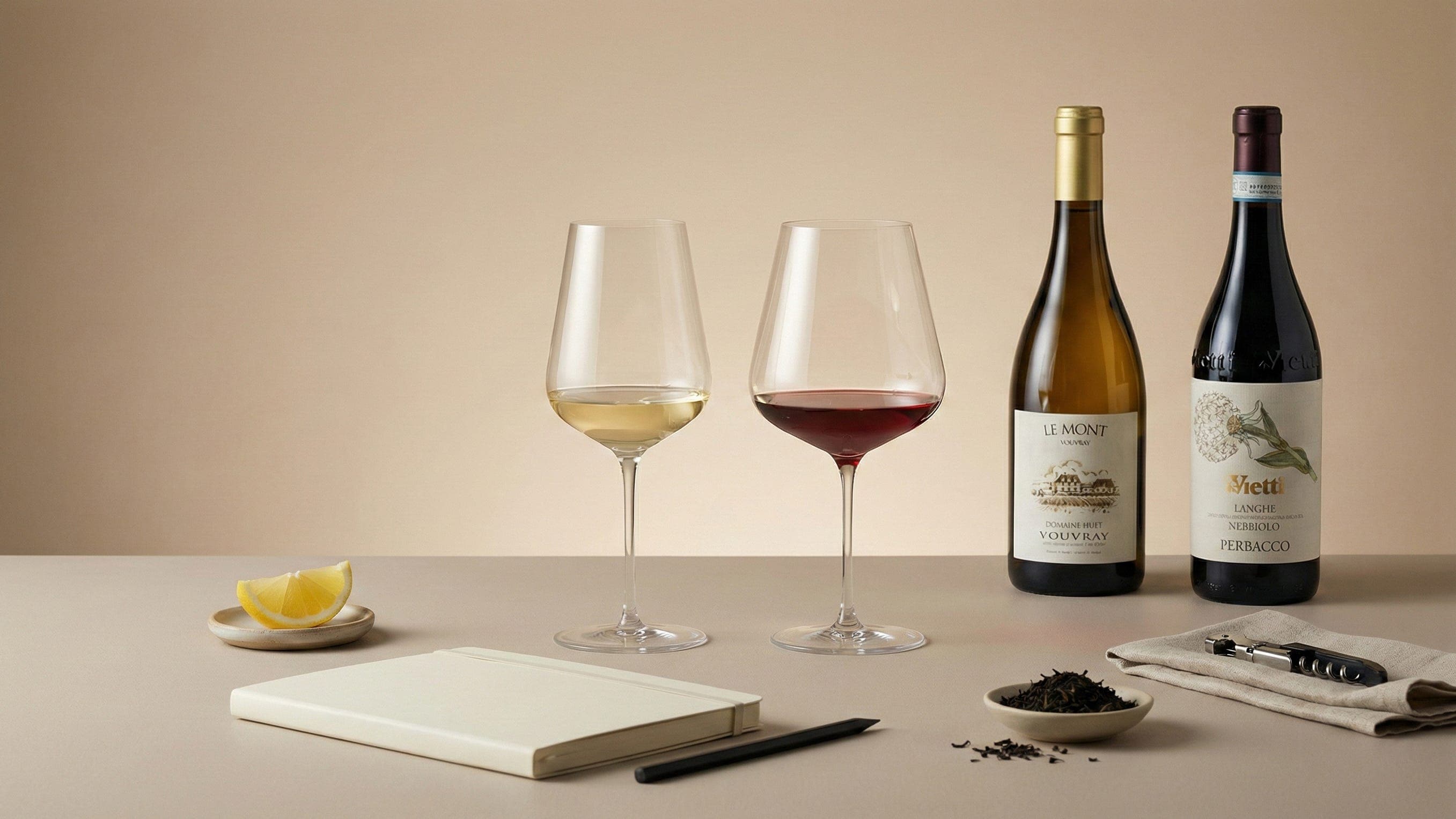
*Welcome to issue #036 of The Polished Palate. Each week, I help you develop your own taste and drink with confidence — no sommelier certification required.*
1 Big Idea
Years ago, a winemaker in Tasmania handed me two glasses of Pinot Noir from the same vineyard, same vintage. One aged in new oak, one in concrete. The flavors were nearly identical — bright red fruit, minerals, dried herbs. But one felt skeletal and sharp; the other felt plush and round. “Same grape, same dirt,” he said. “Different bones.”
Most wine education buries this under jargon: tannins, acidity, residual sugar, alcohol. The words sound technical but describe sensations you already recognize.
Structure is what you feel, not what you taste. You already know these sensations: the grip on your gums from tannin, the mouth-watering freshness of acidity, the weight and warmth of alcohol, the subtle sweetness or dryness.
These four elements combine in different proportions to create every wine’s personality.
Understanding structure changes how you evaluate wine. You stop asking “do I like this?” and start asking “what is this doing?” That shift from judgment to observation is the foundation of discernment.
This week, we’re isolating each element so you can feel it clearly.
3 Taste Experiments
#1: Feel the tannin
Objective: Isolate tannin so you can recognize it anywhere.
How: Brew a cup of black tea and let it steep for 8-10 minutes (over-steeped, bitter). Take a sip and let it sit on your tongue. Notice the drying sensation on your gums, inner cheeks, and tongue. That’s tannin.
Now open any red wine. Take a sip. Can you feel that same drying grip? Some wines have soft, velvety tannins (Pinot Noir). Others have firm, gripping tannins (Cabernet Sauvignon). The sensation is the same — only the intensity differs.
What to notice:
- Where do you feel the drying sensation most? (Front of mouth vs. back, gums vs. cheeks)
- Does the sensation fade quickly or linger?
- Is it pleasant (adds structure) or harsh (unresolved)?
#2: Feel the acidity
Objective: Isolate acidity so you can calibrate freshness.
How: Squeeze a lemon wedge into a glass of water. Take a sip. Notice how your mouth waters immediately — that salivation response is your body reacting to acid.
Now taste any white wine. Take a sip and notice: does your mouth water? High-acid wines (Chablis, Riesling, Sauvignon Blanc) trigger strong salivation. Lower-acid wines (oaked Chardonnay, Viognier) feel rounder, softer, less stimulating.
What to notice:
- How quickly does your mouth water after the first sip?
- Does the wine feel “refreshing” and “alive” or “soft” and “smooth”?
- Can you feel acidity on the sides of your tongue?
#3: Feel the alcohol weight
Objective: Recognize how alcohol contributes body and warmth.
How: Compare two wines at different alcohol levels. A German Riesling (~8-10% ABV) vs. a California Zinfandel (~14-16% ABV). Taste them side by side.
Notice the weight: the lower-alcohol wine feels lighter, almost delicate. The higher-alcohol wine feels fuller, richer, with more viscosity. You might also notice warmth at the back of your throat on the high-alcohol wine — that’s the ethanol.
What to notice:
- Which wine feels “heavier” in your mouth?
- Can you sense warmth or heat on the finish?
- Does the alcohol integrate smoothly or stick out?
The Finish
Most people describe wines by flavors: cherry, vanilla, citrus. Flavors are the easiest thing to talk about, but they’re the least useful for finding wines you’ll love.
Structure is harder to articulate but more predictive. Someone who loves high-acid wines will probably love Chablis, Riesling, and Champagne, even though they taste completely different.
This week, try describing one wine using only structure: “firm tannins, bright acidity, medium body.” Skip the fruit descriptors entirely. The language feels strange at first, like describing a person by their posture instead of their clothes. But posture tells you something clothes never could.