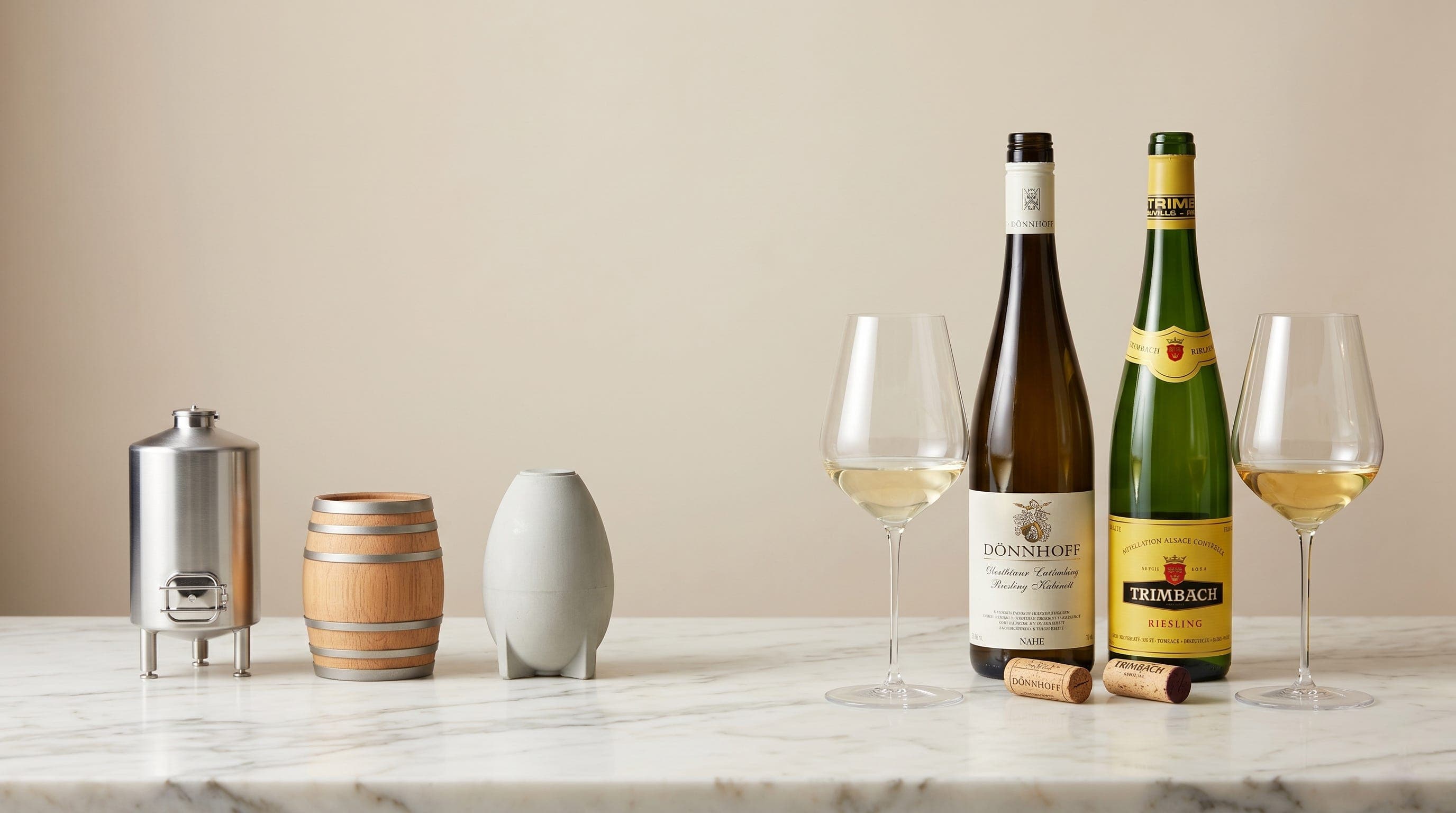
1 Big Idea: The Fermentation Fingerprint
Behind every wine you love is a short list of fermentation choices doing most of the work. Learn to read that list and you stop guessing at labels and start shopping for what you actually want.
Tasmania, 2017. A winemaker poured me two Pinot Noirs from the same vineyard, same vintage, same winery. I tasted them in silence.
The first felt like silk: round, creamy, weight that coated the tongue. The second was all angle: taut, linear, more mineral than fruit.
“Thirteen degrees,” he said. “Fifty-five versus sixty-eight.”
Same grapes. Same place. Same hands. Two entirely different wines. All because of the fermentation temperature.
Every Wine Has a Second Author
When people talk about what makes a wine taste the way it does, the conversation almost always lands on grape and place. Sauvignon from Marlborough. Nebbiolo from Barolo. Chardonnay from Meursault.
That conversation isn’t wrong. Grape and place are real variables, and they matter.
But there’s a second author, and most drinkers never see the byline.
Fermentation is a two-to-four week window where a winemaker makes hundreds of small decisions. Three of those decisions shape most of what you eventually taste: temperature, vessel, and yeast.
- Temperature sets the aromatic register. Cool fermentation, roughly fifty to sixty degrees, preserves delicate aromas. You get tropical fruit, white flowers, citrus zest. The wine feels lighter and fresher. Warmer fermentation, sixty-five to seventy-five degrees, trades some of that perfume for weight and texture. Aromas shift toward stone fruit, almond, bread dough. The wine feels rounder and more savory.
- Vessel sets the texture. Stainless steel is inert. It doesn’t participate in the wine; it just holds it. You taste fruit and acid with nothing in the way. The wine feels precise and focused. Oak barrels, even when the wine isn’t aged long enough to pick up obvious oak flavor, let in micro amounts of oxygen. That small exchange changes texture. The mouthfeel integrates. Butter, cream, hazelnut show up as textural impressions even when you can’t name them as oak.
- Yeast sets the personality. Commercial cultured yeasts are predictable. They finish fermentation cleanly and deliver the grape’s character without surprises. Native yeasts, the ambient population already living on the grapes and in the cellar, are unpredictable. They bring bread dough, honey, cheese rind, hay, mushroom. More individuality, more risk.
Those three decisions happen before the wine ever sees a label. All three are legible in the glass, if you know what to look for.
One Reason You Love What You Love
Here’s where it gets interesting.
When a wine surprises you, good or bad, the cause almost always traces back to a fermentation choice.
Take that silky Chardonnay you keep coming back to. The thing pulling you in is the warm ferment, the barrel, and the lees stirring. Those three moves build the same texture in a good Marsanne, a white Rioja, a Viognier, or a richer Grenache Blanc.
That Sauvignon Blanc that left you cold? Nine times out of ten, you hit a cool-fermented, steel-only build that stripped out the roundness you were after. The same grape, fermented warmer and aged on lees, can feel like a completely different wine.
That natural wine your friend raved about and you couldn’t get past? You hit a wild-yeast ferment that went somewhere your palate isn’t ready to follow yet. The same grape under cultured yeast could land completely differently.
This is the unlock. Once you can read fermentation, wine stops being a lottery of labels and turns into a map. Grape and region become useful starting points. What actually drives what you’ll love is upstream of both.
Reading the Fingerprint
When you find a wine that really works for you, before you file it under the grape, run three questions:
- Temperature: Does it read as aromatic and fresh, or textured and savory? (Cool ferment versus warm ferment.)
- Vessel: Does it feel linear and crisp, or rounded and integrated? (Steel versus barrel.)
- Yeast: Does it feel clean and consistent, or does something about it feel wilder and harder to describe? (Cultured versus native.)
Three data points, one profile. That profile will find you more wines you love than the grape name ever will.
Stage 3 of the Resonance Method is called Follow Curiosity. This is what it actually looks like in practice. You already know what resonates. Now you trace it back to a cause you can ask for by name.
3 Taste Experiments
#1: Temperature
Objective: Taste how fermentation temperature shapes aroma and body, with the grape held constant.
How:
- Buy a Mosel Riesling from Germany, Kabinett or Spätlese level. Dr. Loosen, Selbach-Oster, and Dönnhoff are widely available at around $20 to $30.
- Buy a Riesling from Alsace, France. Trimbach, Hugel, or Domaines Schlumberger, around $20 to $35.
- Taste them side by side. Before you pour, look at the alcohol number on each label. That number alone tells you most of the story.
What to notice: Mosel Riesling is the textbook case of cool fermentation. The tanks are kept cold to protect the grape’s most delicate aromatics. Expect lime, green apple, white peach, white flowers, wet slate. Alcohol is usually 8 to 10 percent. The wine feels light, electric, nervy.
Alsace Riesling ferments warmer. That choice is deliberate: more weight, more texture, a richer mid-palate. Expect stone fruit, honey, beeswax, sometimes a savory note. Alcohol usually runs 12 to 13 percent. The wine feels fuller and more grounded.
The point: Same grape. Same continent. Two fermentation philosophies. Cool protects aromatics. Warm builds texture. You don’t need a back label to tell you which is which. The alcohol level and the first sniff already have.
#2: Vessel
Objective: Isolate the vessel variable by holding the grape constant.
How:
- Buy an unoaked Chardonnay. Chablis is the cleanest example: stainless steel is the regional default. Domaine Laroche “Saint Martin,” William Fèvre “Champs Royaux,” or Joseph Drouhin Chablis, around $25 to $30.
- Buy a barrel-fermented Chardonnay at a similar price. A Bourgogne Blanc, Saint-Véran, or Mâcon-Villages from a quality producer works well. A Sonoma Coast Chardonnay (La Crema, Sonoma-Cutrer, Hartford Court) is a more affordable substitute.
- Taste them side by side. Same grape, same price band, one vessel difference.
What to notice:The Chablis will feel linear: sharp green apple, lemon, crushed stone, a chalky finish. Steel doesn’t participate in the wine, so what you taste is the grape and the acid, unfiltered.
The barrel-fermented Chardonnay will feel rounder. Baked apple, lemon curd, butter, hazelnut, a fuller mid-palate. Even if the oak flavor is subtle, the texture has shifted. That’s the micro-oxygenation from the barrel doing its work during fermentation, well before any extended aging begins.
The point: One variable changed. The grape is identical. What you’re tasting is the vessel shaping the wine from the inside out. Steel preserves precision. Barrel builds texture.
#3: Yeast
Objective: Taste the yeast variable on its own, with grape, producer, and site all held constant.
How:
- Buy Domaine Skouras Moscofilero (the standard bottling), around $15 to $18. Temperature-controlled stainless steel, cultured yeast.
- Buy Domaine Skouras “Salto” Moscofilero Wild Yeast Ferment, around $25 to $30. Same grape (100% Moschofilero), same site (Mantinia, on the high-altitude plateau of the Peloponnese), same producer, same stainless steel vessel. The only variable the winemaker changed is the yeast.
- Taste them side by side. Start with the standard, then the Salto.
What to notice: The standard Moscofilero leads with varietal character: rose petal, Turkish delight, citrus pith, white flowers. That clean, floral profile is what Moschofilero is known for, and cultured yeast preserves it faithfully. The texture is polished, the finish crisp.
The Salto keeps all of that DNA and layers something else on top. Bread dough, honeycomb, a savory or herbal edge, sometimes a gentle grip on the finish. More individuality, more cellar fingerprint, less predictability. Native yeast introduces the cellar’s own ambient microbial population into the wine, and you taste the signature of that population alongside the grape.
The point: Wild fermentation isn’t “better.” It’s a different set of tradeoffs. Cultured yeast prioritizes clarity and consistency. Wild yeast trades some of that for character and surprise. Your preference between these two glasses tells you something real about what you value in wine.
The Finish
This week, pick one wine you already love. Find out how it was fermented. Start your map there.
Go Deeper
- Do winemaking vessels really make that much of a difference? (Jamie Goode, winemag.co.za). A 1,200-word essay from the wine scientist behind wineanorak.com, PhD in plant biology, on how much the vessel actually matters. Goode draws a sharper line than most writers between fermentation and aging: during fermentation, the vessel’s shape and thermal behavior matter more than its material, while during aging, oxygen transmission through the material is where the real style gets built. Useful if the steel-versus-barrel framing in this issue leaves you wanting more nuance.
- The Science of Winemaking Yeasts (Paul Adams, SevenFifty Daily, 2018). A 2,500-word deep dive into how yeast selection shapes flavor, built from interviews with winemakers and researchers at Cornell and elsewhere. One expert in the piece estimates that yeast is responsible for roughly fifty percent of the flavor compounds in a finished wine. The article also complicates the romantic view of “native” fermentation: commercial Saccharomyces cerevisiae has colonized many wineries so thoroughly that what gets labeled “wild” is often a resident commercial population rather than the vineyard microbiome.