1 Big Idea: What Does Minerality Actually Mean?
Early in my sommelier training, I repeated the same line every wine student learns: Old World wines are mineral and earthy. New World wines are fruit-forward. The soil shows up in the glass. Limestone gives you chalk. Flint gives you flint. Simple.
I knew it was an oversimplification even as I said it. Soil affects wine, obviously. Drainage, vine stress, water retention, nutrient availability. But a direct one-to-one relationship where you literally taste the rocks? That never sat right. I just didn’t have a better explanation yet, so I kept repeating the old one.
Then I visited Luke Lambert in the Yarra Valley during my harvest internship in Australia. Lambert is known for growing Nebbiolo outside of Piedmont, which most people will tell you can’t be done well. His wines had a distinct minerality. Not fruit-forward, not the “New World” profile I’d been taught to expect from Australian wine. Stony, taut, structural.
Standing in his cellar, I remember thinking: if minerality comes from the soil, and this soil is nothing like the limestone slopes of Barolo, then either the explanation is wrong or the word doesn’t mean what we think it means. Turns out, it’s both.
Here’s the story most wine people tell: vines grow in mineral-rich soil. Over time, they absorb those minerals through their roots. The minerals get concentrated in the grapes. You taste them in the wine. That flinty quality in Sancerre? Flint soil. The chalky texture in Champagne? Chalk bedrock. The wet stone character in Chablis? Kimmeridgian limestone.
It sounds elegant. It feels like terroir made tangible. And it’s almost entirely fiction.
Plants take up nutrients through their roots, but only as simple ions dissolved in water. Those ions are tasteless at the concentrations found in wine. Multiple studies have tested wines for mineral content and found no correlation between soil composition and the “mineral” flavors people describe.
So what are you actually tasting?
Researchers point to several factors: volatile sulfur compounds from reductive winemaking (that flinty, struck-match quality), high acidity that makes wine feel crisp and elemental, the absence of oak and other flavors that leaves stark structure, and the power of suggestion. If someone tells you the wine comes from flinty soils, you’re more likely to “taste” flint.
Minerality is constructed by the winemaker, your palate, and the story you’ve been told. That doesn’t make it fake. But it does make it interesting.
And understanding what actually creates the sensation gives you something more useful than a beautiful myth: the ability to find more wines you love by looking for winemaking choices instead of hunting for specific vineyard soils.
When you can taste fermentation decisions in a glass, you cross a threshold. You go from someone who repeats wine stories to someone who reads what’s actually in the glass. And once you can read wine, you start reading everything more carefully.
3 Taste Experiments
#1: The “Minerality” Baseline
Objective: Establish your personal reference point for what you call “mineral” in wine.
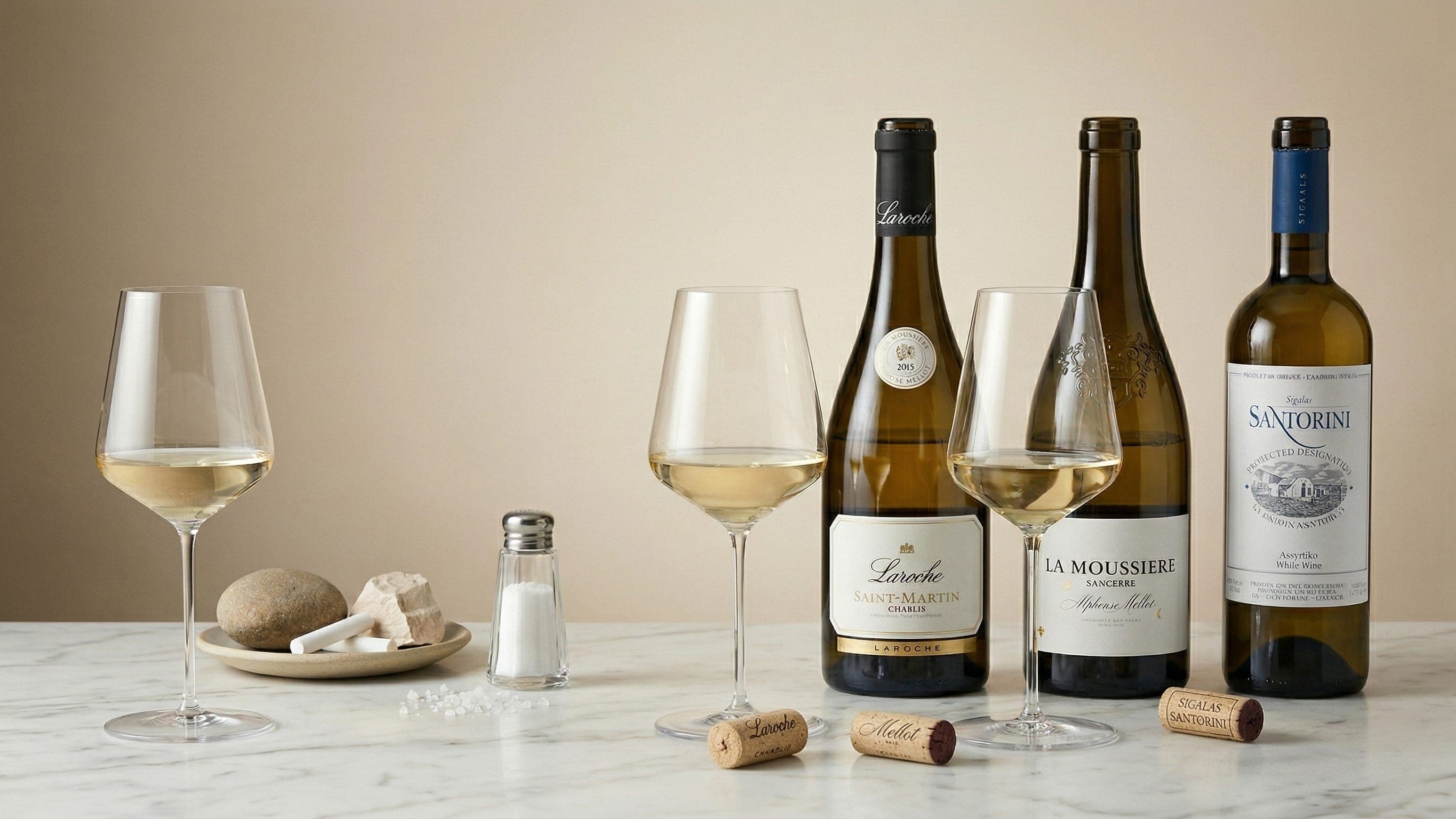
How: Pick up a bottle of Chablis ($25-40). Producers to look for: William Fevre, Louis Michel, Domaine Laroche. Pour a glass and let it sit for 5 minutes. Before tasting, write down what you expect “minerality” to taste like. Then taste. Write down what you actually experience.
What to notice: Most people expect something stony or chalky. What you’ll likely find is bright acidity, a clean absence of fruit sweetness, and a certain austerity. That’s high-acid Chardonnay aged in stainless steel with no malolactic fermentation. No oak, no butter, no tropical fruit. The limestone soil drains well and stresses the vines, but you’re not tasting the rock. You’re tasting the winemaker’s restraint.
#2: The Sulfur Compound Test
Objective: Isolate the “flinty” character that many people call mineral and identify its actual source.
How: Pick up a bottle of Sancerre ($25-35). Producers to look for: Pascal Jolivet, Domaine Vacheron, Alphonse Mellot. Pour a glass and immediately smell it before swirling. Then swirl vigorously and smell again.
What to notice: Before swirling, you may catch a struck-match or flinty quality. That’s volatile sulfur compounds (VSCs) produced during reductive winemaking, not flint from the soil. After swirling, those compounds dissipate and fruit comes forward. You just watched “minerality” evaporate because the molecules responsible are volatile. Geology doesn’t evaporate. Fermentation byproducts do. That distinction changes how you understand every wine someone describes as “flinty.”
Taste Experience 3: The Saline Exception
Objective: Experience a wine where geology actually does contribute something directly tasteable, and understand why it’s the exception that proves the rule.
How: Pick up a bottle of Santorini Assyrtiko from Greece ($20-30). Producers to look for: Santo Wines, Gaia Wines, Sigalas. Taste it alongside the Chablis or Sancerre from the previous experiments if you still have them open.
What to notice: Assyrtiko from Santorini has a saline quality that’s distinct from the “minerality” in Chablis or Sancerre. That salt-lick character comes from actual sodium chloride carried by sea spray onto the grapes. This is one of the rare cases where environment directly contributes a tasteable mineral element to wine. Compare it to the Chablis: one is structural austerity from winemaking choices, the other has a genuine saline note from geography. Being able to tell the difference means you’ve moved past the mythology and into real perception.
The Finish
I used to believe the story about vines pulling minerals from the soil. It’s a beautiful story. It makes terroir feel tangible, like you’re drinking the earth itself. But beautiful stories aren’t always true.
Once I understood what was actually happening, I became a better taster. Not because I learned more facts, but because I stopped looking for mysticism and started looking for patterns. Does the wine have high acidity? Was it aged reductively? Is there fruit, or is it stripped back to structure and sensation?
These are questions you can answer with your own palate. And answering them puts you in a different relationship with wine. You stop being someone who borrows explanations and start being someone who trusts what they taste.
That shift matters beyond the glass. How many explanations in your own field have you repeated because they sounded right, without testing whether they held up?
Minerality is real. It’s just not what you’ve been told. And the willingness to question a beautiful story because your own perception says otherwise? That’s discernment.
Go Deeper
- Maltman, A. (2013). “Minerality in Wine: A Geological Perspective” The definitive paper on why you can’t taste geology. Academic but readable, and it settles the debate with data.
- Parr, W.V. et al. (2018). “Minerality in Wine: Towards the Reality Behind the Myths”Cross-cultural study showing how differently French and New Zealand tasters interpret the same term. Fascinating look at how language shapes what we taste.
- Maltman, A. for GuildSomm (2025). “Musings on Minerals and Metaphors”Free overview article from GuildSomm that summarizes the science accessibly. Good starting point if the academic papers feel heavy.