1 Big Idea: Experience First. Perception Second. Knowledge Third.
In 2019 I failed WSET Diploma Unit 1 on the written exam.
I had started the Diploma in London and was taking two units in parallel. Unit 6 I passed with merit. Unit 1 I did not. When I sat with the failure, the thought that settled in was simple and unsettling: if I kept going, I would be studying to pass an exam, not to increase my actual knowledge of wine. The Diploma was going to take me further from wine as enjoyment and deeper into wine as a purely academic endeavor.
So I walked away.
Seven years on, the realization has only sharpened. Traditional wine education is built on a faulty assumption: that confidence comes from knowledge, and that knowledge comes from memorization. Memorize enough regions, grapes, appellations, vintage charts, and you’ll have earned the right to have preferences. The exams enforce the assumption. The scoring rewards it. The vocabulary of the field reflects it.
The problem wasn’t my effort. It was the order.
Knowledge is information you carry. Discernment is something you become.
I introduced The Resonance Method here in February. The short version, for the long-timers and the new readers alike: expose, notice, follow, articulate, apply. Experience before theory. Perception before memorization. Sovereignty before deference.
Experience first. Perception second. Knowledge third.
This isn’t anti-knowledge. The Diploma path is real and valuable for people whose work requires it. If your goal is a career in the wine trade, by all means take the exams. If your goal is to enjoy wine more, the academic arc optimizes for the wrong finish line.
The facts serve the feeling, not the other way around. The person who finishes this quarter won’t just know more about wine. They’ll trust their senses in ways they didn’t before. They’ll order with quiet assurance, not because they’ve memorized the list, but because they’ve learned to listen to themselves.
Three experiments this week to prove the order matters.
3 Taste Experiments
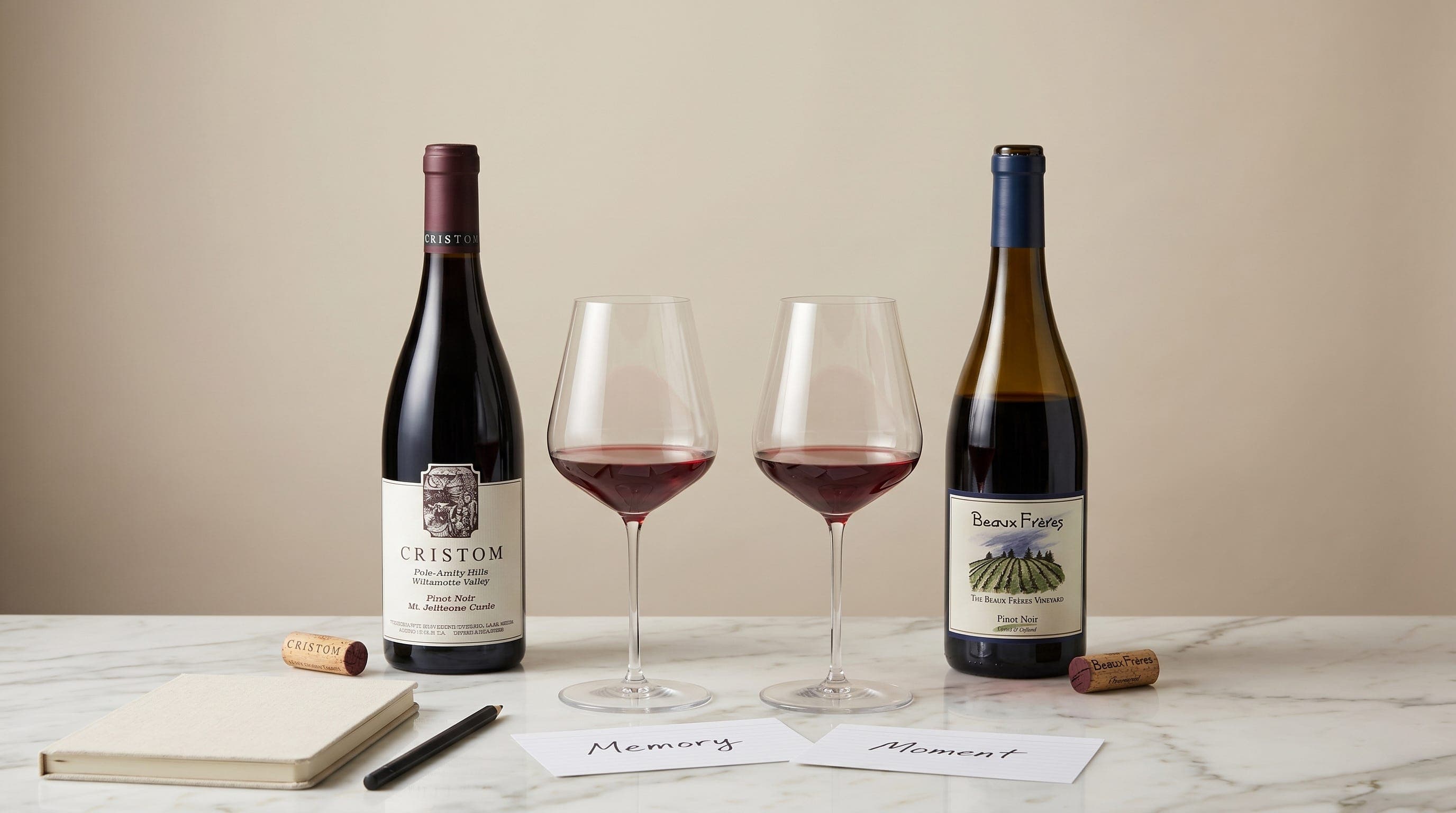
#1: Memory vs. Moment
Objective: Experience the difference between recalling facts and responding to what’s in your glass.
How:
- Open two wines from the same region, different producers. Two Sauvignon Blancs from the Loire Valley, or two Pinot Noirs from Oregon.
- Before tasting, write down everything you “know” about each wine: region, grape, typical style, whatever comes to mind.
- Then taste blind. Write only what you notice: sensations, textures, impressions. No facts.
- Compare the two lists.
What to notice:
- Which list feels more alive?
- Which one gives you more confidence describing the wine?
- The facts are static. The perception is yours.
The point: This is the shift from borrowed knowledge to lived experience. (Stage 2: Notice resonance.)
#2: The Preference Diagnostic
Objective: Identify a personal preference without external validation.
How:
- Choose two wines that represent a classic dichotomy: unoaked vs. oaked Chardonnay, Old World vs. New World Pinot Noir, fruity Beaujolais vs. earthy Burgundy.
- Taste side by side.
- After each, ask yourself: “Which one would I rather drink again?” No reasons needed. No right answer. Just the choice.
What to notice:
- Can you make the choice without justifying it?
- The urge to explain (”because it’s more balanced”) is often a mask for insecurity.
- The pure preference (”I like this one more”) is the foundation of taste sovereignty.
The point: Preference before prose. Name what you want before you explain why. (Stage 4: Articulate values.)
#3: The Curiosity Follow-Up
Objective: Practice following a sensory curiosity to its natural conclusion.
How:
- Pick one wine you’ve tasted before.
- Focus on a single element that intrigues you: the texture, the way aroma changes with air, the finish.
- Spend ten full minutes with it. Write down every observation about that one element.
- Don’t try to be comprehensive. Be specific.
What to notice:
- How deep can you go on one thread?
- Depth of attention builds confidence faster than breadth of knowledge.
The point: This is the muscle The Resonance Method trains, and the exact muscle you’ll use in next month’s Decoding Winemaking mini-course. (Stage 3: Follow curiosity.)
The Finish
Your palate has been taking notes this whole time. You just haven’t given it permission to speak.
This week, run Experiment 1 before your next dinner out. One round of Memory vs. Moment. Nothing else.
Reply to this email and tell me which list felt more alive. I read every one.
Go Deeper
- The Subtle Science of Wine Tasting (Wine Folly). A clear, visual explainer of how humans actually taste, and why perception varies so much from person to person. Useful if you’ve ever told yourself your palate is unreliable. It’s biology, not inadequacy.
- The Mindset Shift Every Wine Student Needs (Isabelle Lesschaeve, InnoVinum Academy). A sensory scientist on reorienting how wine students learn. Lesschaeve’s research focuses on how preferences form and how the senses train with practice. If the Big Idea above resonated, this is adjacent territory from the research side.
- Ignorant experts and erudite novices (Claudio Aqueveque, Food Quality and Preference, 2018). Peer-reviewed test of the Dunning-Kruger effect specifically in wine consumers. The finding: low-knowledge drinkers overestimate their expertise, and high-knowledge drinkers underestimate theirs. Self-reported wine confidence and actual wine competence barely correlate. Useful ground truth for anyone who’s ever wondered whether their palate is “good enough” to trust.