*Welcome to issue #039 of The Polished Palate. Each week, I help you develop your own taste and drink with confidence; no sommelier certification required.*
1 Big Idea
Tasting wines in isolation is an inefficient way to learn.
A single bottle tells you what’s in the glass. Two bottles, tasted together, tell you what makes each bottle different. And difference is where learning happens.
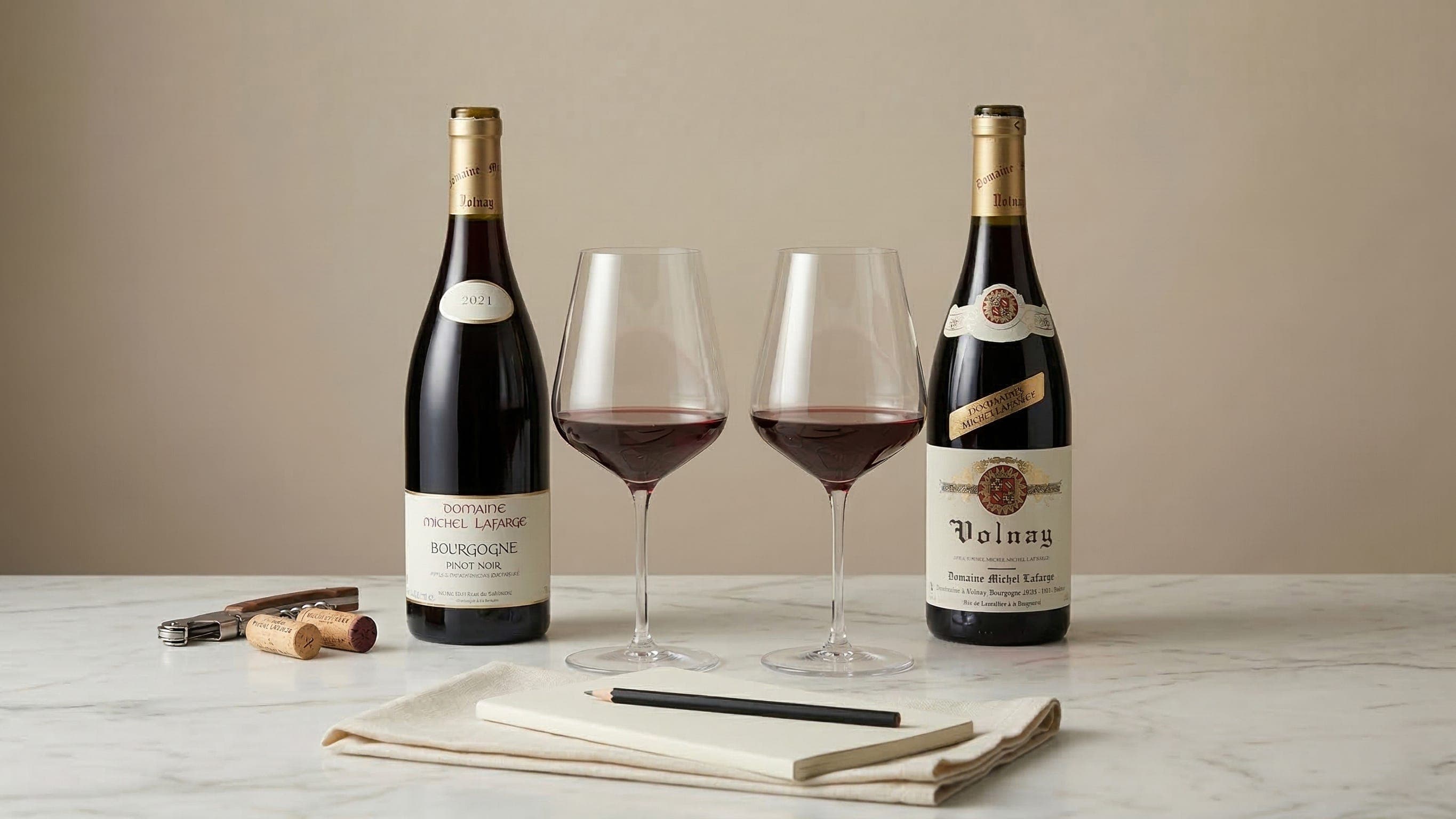
I didn’t fully understand Burgundy until I put a basic Bourgogne rouge next to a premier cru Volnay from the same producer. Reading about it taught me vocabulary. Tasting them side by side taught me what “concentration” and “precision” actually feel like in the mouth. The differences became obvious when they were sitting next to each other.
This is how professional sommeliers train. Not by tasting thousands of wines over decades and hoping patterns emerge. By running controlled comparisons: same grape, different climate. Same region, different winemaker. Same bottle, different vintage.
It’s the scientific method applied to taste: isolate one variable, hold everything else constant, and notice the difference.
Today, I’m giving you the framework I use. The one that compresses years of learning into months.
The Controlled Comparison Framework
Most wine education follows this path:
Path A (slow): Drink wine for years. Accumulate random experiences. Hope they cohere into understanding.
Path B (fast): Run structured comparisons. Isolate variables. Build your internal map deliberately.
Path B is how professionals develop palates quickly. Here’s the method:
Step 1: Pick your variable
What do you want to understand better? Choose one:
- Climate: Cool vs warm (e.g., Oregon Pinot vs California Pinot)
- Grape: Different varieties in the same style (e.g., Chardonnay vs Viognier)
- Region: Same grape, different terroir (e.g., Sancerre vs Pouilly-Fume)
- Price: Quality tiers within same category (e.g., $15 Chablis vs $40 Chablis)
- Winemaking: Oaked vs unoaked (e.g., Chablis vs Meursault)
Pick one variable. Only one.
Step 2: Control everything else
If you’re comparing climates, keep the grape the same. If you’re comparing grapes, keep the region similar.
When you change multiple variables at once, you can’t tell what’s causing the difference.
Bad example: Comparing Napa Cabernet ($50) vs Loire Cabernet Franc ($18). Too many variables.
Good example: Comparing Napa Cabernet ($50) vs Sonoma Cabernet ($48). Same grape, similar price, different climate.
Step 3: Taste blind (if possible)
Pour both wines into identical glasses. Don’t look at the labels while you taste. This forces you to rely on what’s actually in the glass, not your assumptions about it.
Step 4: Name three differences before you look
Before revealing the labels, write down three specific differences:
- Which one has more acidity?
- Which one feels heavier in your mouth?
- Which one has a longer finish?
- Which one tastes riper or fruitier?
Be specific. “One is better” isn’t useful. “One grips my gums more and leaves my mouth feeling dry” is.
Step 5: Check your work
Now look at the labels. Did your perceptions match the facts?
- If you said Wine A felt heavier and it’s from a warmer climate, you just calibrated your palate to climate.
- If you said Wine B had more acidity and it’s from a cooler vintage, you’re learning to read vintage variation.
Repeat this 10-15 times across different variables, and your palate will develop faster than years of casual drinking.
3 Tasting Experiments
Pick one of these three, buy both bottles, and taste them side by side.
Exercise 1: Climate (cool vs warm Pinot Noir)
- Cool: Willamette Valley Pinot Noir, Oregon (~$25-35). Try Elk Cove, Erath, or A to Z Wineworks.
- Warm: Russian River Valley Pinot Noir, California (~$30-40). Try La Crema, Kosta Browne, or Gary Farrell.
- What to notice: Which feels lighter? Which tastes riper? Which has sharper acidity?
Exercise 2: Winemaking (oaked vs unoaked Chardonnay)
- Unoaked: Chablis, France (~$25-35). Try William Fevre, Louis Michel, or Domaine Laroche.
- Oaked: Meursault or Puligny-Montrachet (~$40-60). Try Olivier Leflaive, Joseph Drouhin, or Louis Jadot.
- What to notice: Which feels rounder or creamier? Which has a more mineral, flinty quality?
Exercise 3: Price (quality tiers within Bordeaux blends)
- Entry: Bordeaux Superieur (~$15-20). Try Chateau Tour de Mirambeau, Chateau Penin, or Chateau Haut-Bertinerie.
- Mid-tier: Medoc or Haut-Medoc (~$35-50). Try Chateau Sociando-Mallet, Chateau d’Escurac, or Chateau Lanessan.
- What to notice: Is the difference in concentration? Complexity? Length of finish? Does the more expensive wine justify the price to you?
Why this works
There’s a framework psychologists use called the Four Stages of Competence. It maps perfectly onto developing taste:
Stage 1. Unconscious incompetence: You drink wine without noticing much. “Red or white” is the extent of your differentiation.
Stage 2. Conscious incompetence: You realize there’s a world you’re missing. Wine lists feel intimidating.
Stage 3. Conscious competence: You’re doing the work. Structured tastings, comparisons. You can identify differences, but it requires concentration.
Stage 4. Unconscious competence: The information flows. You pick up a glass and your palate tells you what’s going on without effort.
Comparison tasting is the fastest way to move from Stage 2 to Stage 3.
A 2019 study by Tempere found that wine training doesn’t just change what you know. It physically changes your perception. Trained tasters literally smell and taste differently than novices. The neural pathways get built through deliberate practice, not passive exposure.
You can read about the difference between Left Bank and Right Bank Bordeaux forever. Or you can put a Pauillac next to a Pomerol and let your palate teach you in one evening what months of reading couldn’t.
The Finish
I remember the exact moment I moved from casual taster to deliberate learner.
It was 2014. A dinner in DC. Someone ordered Barolo, and I nodded along like I understood. The wine arrived and it was all tar, roses, and something medicinal I couldn’t name. Everyone else at the table seemed fluent in a language I didn’t speak.
That discomfort was the best thing that ever happened to my palate.
I went home and bought two Nebbiolo-based wines: one Barbaresco, one Barolo. I tasted them side by side and forced myself to articulate three differences before I looked up what distinguished them.
That’s when wine stopped being a mystery and started being a skill. The confusion meant I’d finally noticed there was something worth learning.
If you’re in Stage 2 right now, aware of how much you don’t know, you’re exactly where you need to be. The discomfort is the price of admission to everything that follows.
Run the comparison. Name the differences. Check your work. Your palate will teach you the rest.