1 Big Idea: Heat Is Weather, Style Is A Decision
You go back for a bottle you liked five years ago. Same producer, same appellation. It’s somehow softer and rounder than you remember, the fruit seems heavier, and the alcohol on the label reads 14.5 where it used to read 13. No one told you the style had changed.
The warming behind that is not in dispute, and wine has one of the longest records of it anywhere in agriculture. Thomas Labbé and his co-authors reconstructed grape harvest dates in Beaune back to 1354. For six centuries the pickers went out around 28 September. Since 1988 they have gone out roughly 13 days earlier, and the hot dry years that used to be outliers now set the pattern.
Here is the part that gets skipped. Heat is the input. Everything you taste is what somebody decided to do about it.
A grower facing a hotter season has a short list of levers. Pick earlier and hold acid, at the risk of underripe flavors. Buy land higher up or on a cooler exposure, which costs a fortune and takes a decade. Change the plant material entirely: in January 2021 France’s INAO approved six new grape varieties for Bordeaux and Bordeaux Supérieur, four red and two white, capped at 5 percent of a property’s vineyard area and 10 percent of any final blend, and barred from appearing on the label. Or change nothing, let ripeness run, and sell the result as a generous vintage.
Some of those choices produce genuinely better wine than the same estates were making in 1990, and I would rather drink most of them. What the trade almost never does is tell you which lever was pulled on the bottle in your hand. Warming gets marketed as a quality story when the vintage is flattering and as a crisis when sympathy is useful, and either way the decision behind your glass stays out of the copy.
So this week takes three of those levers apart, one experiment each. You will taste what elevation buys. You will taste a classic style changing as its grapes get riper. Then you will run the picking decision yourself and say which version you actually want.
3 Taste Experiments
Three pairs, three different levers. Taste each pair side by side in one sitting, water and a plain cracker between them to reset. Read both labels before you open anything, and write the alcohol down.
#1: Valley Floor vs High Elevation
Objective: Taste what a producer buys by moving uphill, using the same grape in the same country so the only real variable is how cold the nights are.
What to try: A warm valley-floor Mendoza Malbec such as Alamos Malbec, Trapiche Oak Cask Malbec, or Trivento Reserve Malbec (Mendoza, Argentina), roughly $11 to $14. Then a high-elevation Uco Valley Malbec such as Salentein Reserve Malbec, Zuccardi Q Malbec, or Catena Alta Historic Rows Malbec (Uco Valley, Argentina), roughly $18 to $40.
What to notice: The valley-floor bottle is plush and dark, blue fruit and soft edges, with a warm finish that fades quickly. The Uco wine should come at you with brighter red fruit, firmer tannin, and a line of acidity down the middle that keeps the finish going. Swallow, count to five, and notice which glass leaves your mouth watering.
Lesson: Nicolás Catena planted the Adrianna Vineyard at 1,450 meters in Gualtallary in 1992 with one objective, finding the coldest ground in Mendoza to grow vines on. Elevation is the most expensive fix on the list, because you buy the land, replant it, and then wait years for an answer. The acidity you just tasted in the second glass is the return on that spending, and you can decide for yourself whether it justified the extra twenty dollars.
#2: Kabinett vs Trocken
Objective: Taste a classic style being rewritten in real time, by putting the lightest traditional German Riesling next to the ripe dry style that has taken over its home market.
What to try: A Mosel Riesling Kabinett such as Dr. Loosen Blue Slate Riesling Kabinett, Selbach-Oster Zeltinger Riesling Kabinett, or Willi Schaefer Graacher Riesling Kabinett (Mosel, Germany), roughly $22 to $32. Then a ripe dry German Riesling from a warmer region such as Villa Wolf Riesling Trocken (Pfalz), Dr. Bürklin-Wolf Estate Riesling Trocken (Pfalz), or Weingut Wittmann Riesling Trocken (Rheinhessen), roughly $13 to $28.
What to notice: Check the alcohol first. The Kabinett will usually sit between 8 and 9.5 percent, the trocken between 12 and 13. Now taste. The Kabinett is weightless, a thread of sweetness stretched over hard green-apple acid, gone almost as soon as you swallow. The trocken has no sugar at all, more body, a stony grip, and it stays in your mouth. That four-point alcohol gap is ripeness, and in a warmer Germany grapes reach that ripeness whether the grower wanted it or not.
Lesson: The German Wine Institute reports that dry wines were 40 percent of tested German quality and Prädikat wines in 2010, 48 percent in 2020, and 53 percent in 2025. Drinkers wanting dry wine explains part of that, and grapes that now reach full ripeness in ordinary years explains the rest. The featherweight Kabinett is the harder wine to make now, and it gets harder each decade, which is why the Mosel growers who still bother with it are worth your loyalty. If that style is the one that moves you, treat every good Kabinett vintage as a buying opportunity while they can still deliver it.
#3: The Picking Decision Is Yours To Judge
Objective: Hold the grape, the state, and roughly the vintage steady, move only the harvest date, and decide which ripeness you personally want in the glass.
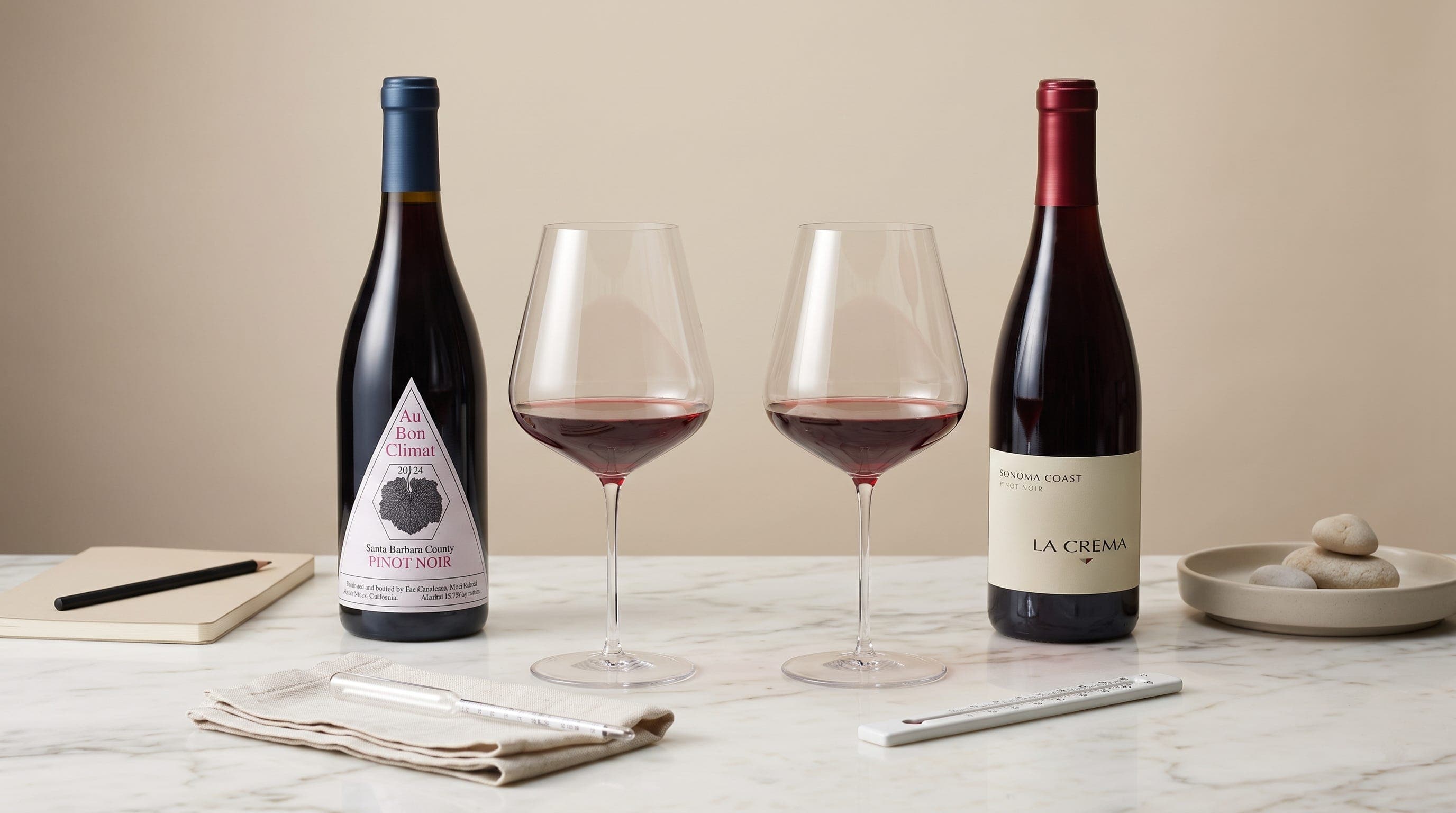
What to try: An early-picked, cool-site California Pinot Noir such as Au Bon Climat Santa Barbara County Pinot Noir, Sandhi Santa Barbara County Pinot Noir, or Calera Central Coast Pinot Noir, roughly $25 to $38. Then a late-picked, full-ripeness California Pinot Noir such as Belle Glos “Clark & Telephone,” Meiomi Pinot Noir, or La Crema Sonoma Coast Pinot Noir, roughly $20 to $30.
What to notice: Write down both alcohol numbers before you pull a cork. The early-picked wine tends toward tart red cherry, cranberry skin, a savory herbal edge, and a light body that finishes on acid. The late-picked wine gives you black cherry, cola, a sweeter middle, glycerol weight, and warmth at the back of the throat. Same grape, same coast, same warming season. One winemaker went in two weeks before the other did.
Lesson: Picking date is the cheapest and fastest lever a winemaker has, and it changes more of what you taste than any other single choice. The trade calls the ripe version generous and the fresh version elegant, which is copy written to make both sides feel flattered, and it tells you nothing about which one belongs in your glass on a Tuesday. You just tasted the actual difference. Trust the verdict you formed in the ten seconds after you swallowed, and buy accordingly.
Pocket Palate: what a grower can do about heat
Four levers and one thing to check, in the order they cost money.
- Pick earlier: The cheapest move and the biggest style change. Holds acidity, lowers alcohol, risks green flavors.
- Climb higher or cooler: Catena’s Adrianna Vineyard sits at 1,450 meters in Gualtallary, planted in 1992 to find Mendoza’s coldest ground. Cold nights, firmer acid, enormous cost, slow payoff.
- Change the grape: INAO approved 6 new varieties for Bordeaux in January 2021, capped at 5 percent of vineyard area and 10 percent of a blend, and never printed on the label.
- Let the style move: Dry wines rose from 40 percent of tested German quality and Prädikat wines in 2010 to 53 percent in 2025.
- What to check in your glass: Alcohol and acidity, read together. Note the number on the label, then taste, and check whether the two agree.
The Finish
The weather is doing something no grower asked for, and every bottle you open is somebody’s answer to it. Some of those answers are craft: picking a week early to hold acidity, farming a colder slope, working a new variety into a blend where the rules allow it. Some are a decision to let ripeness run all the way out and then sell the result as a generous vintage. You cannot read the difference off a label, and the people writing the labels have no reason to help you.
You can taste it. That is the whole reason to run these three pairs. Once you know what altitude tastes like, what ripeness costs a delicate style, and what two weeks on the vine does to the same grape, the vintage chart and the shelf talker stop being the authority on your own preferences.
So carry one habit out of this week. Before you open anything, look at the alcohol on the label and form an expectation. Then taste and see whether the wine confirms it or surprises you. Do that for a month and you will start reading bottles the way a grower reads a season, as a series of decisions that somebody made and that you get to judge. You taste the result, so you are the best judge of which of those decisions you want in your glass.
Go Deeper
If this week’s idea stuck with you, these take it further.
- Chris Mercer, What are the new Bordeaux grapes? (Decanter, 2021): A short, plain explainer on the six varieties France approved for Bordeaux and the limits attached to them, including why you will never see the names on a label.
- NASA Science Editorial Team, Climate change is shifting wine grape harvests in France and Switzerland (NASA Science, 2016): A readable summary of the NASA and Harvard work showing that since 1981 warming pulls harvests earlier even in years with no drought, which broke the old link between drought and a great vintage.
- Thomas Labbé, Christian Pfister, Stefan Brönnimann, Daniel Rousseau, Jörg Franke and Benjamin Bois, The longest homogeneous series of grape harvest dates, Beaune 1354-2018 (Climate of the Past, 2019): The 664-year Beaune harvest record, open access, and the source of the 13-day shift since 1988 cited above.
- Cornelis van Leeuwen, Giovanni Sgubin, Benjamin Bois, Nathalie Ollat, Didier Swingedouw, Sébastien Zito and Gregory A. Gambetta, Climate change impacts and adaptations of wine production (Nature Reviews Earth & Environment, 2024): The technical review of the adaptation toolkit, from harvest timing and canopy work to site selection and plant material, written by the Bordeaux viticulture research group.