1 Big Idea: Common in the Vineyard, Rare in Your Glass
In September 2020, with the Glass and Hennessey fires still burning, Augustus Weed reported in Wine Spectator that wineries were refusing contracted fruit until lab results came back clean. St. Supéry would not harvest reds from a vineyard near the Hennessey fire. Gallo left entire blocks hanging on the vine. Fruit that failed the tests was dropped, declassified, or sold off in bulk, and the wine it might have become never reached a shelf under a label you would recognize.
I am a Certified Sommelier and I have never knowingly tasted a smoke-tainted wine. Neither, almost certainly, have you. The most discussed fault of the wildfire era is one that most drinkers, and a good share of the trade, have never actually met. That gap between how much the industry worries about smoke and how rarely you encounter it is the story this week, because the reason for the gap decides who gets to judge what you drink.
The fault itself is real chemistry. Burning wood throws off volatile phenols: guaiacol, 4-methylguaiacol, the cresols, syringol. Grapes take them up through the skins and the leaves, and they are most vulnerable in the weeks after veraison. Then the vine does something inconvenient. It binds those phenols to sugars, forming glycosides that carry no smoky aroma at all.
James Osborne and Elizabeth Tomasino at Oregon State put the consequence plainly: enzymes in saliva break those glycosides apart, so a wine can arrive with no perceivable smoky smell and still turn ashy once it is in your mouth. That is why this fault lives on the finish. The nose reads clean and the aftertaste tastes like the inside of a chimney.
So why have you never tasted it? Because an entire apparatus exists to keep it away from you. Growers pick early and spray barrier coatings. Wineries send samples to labs and wait on the numbers before they will touch the fruit. Winemakers fine with activated carbon, blend marginal lots down, and bulk out anything questionable. Whatever slips through all of that and still shows ash mostly gets declassified or quietly dumped. Most of that is the right call, and it is why smoke taint stays common in the vineyard and rare in your glass.
The catch is what the apparatus uses to decide. A published sensory threshold reports the concentration at which half of a tested group perceives a compound. The other half need more. The Australian Wine Research Institute lists guaiacol at 23 micrograms per liter in red wine and m-cresol at 20, and states directly that some tasters are more sensitive to volatile phenols than others, whether they are winemakers or consumers.
Osborne and Tomasino make the spread concrete with cork taint: the published threshold for TCA is 1 nanogram per liter, some people find it at 0.01, and some need 1,000. A 2025 study in the Journal of Food Science reported that 15 to 20 percent of the population may be insensitive to smoke in wine entirely.
Every lab clearance and every panel rejection runs on the assumption that a group number predicts yours. It does not, in either direction. You may be the person who finds ash in a wine the lab cleared, or the person who happily drinks one a panel rejected. The filtering happens out of sight, so you have never been given the chance to learn which one you are.
So this week builds the equipment, on bottles you can actually buy. Name the aroma using things that are not wine, score a finish on its own scale, then put your palate next to someone else’s on one glass and watch the gap appear. None of it requires a tainted bottle, and all of it transfers to every wine you open from here on.
3 Taste Experiments
Three sessions, three different skills. The first two are solo. The third needs one other person and one bottle. Water and a plain cracker between anything you compare.
#1: Name The Compound Before You Find It
Objective: Build a memory for the guaiacol family using strong non-wine references, then find the same compound in a wine where it belongs.
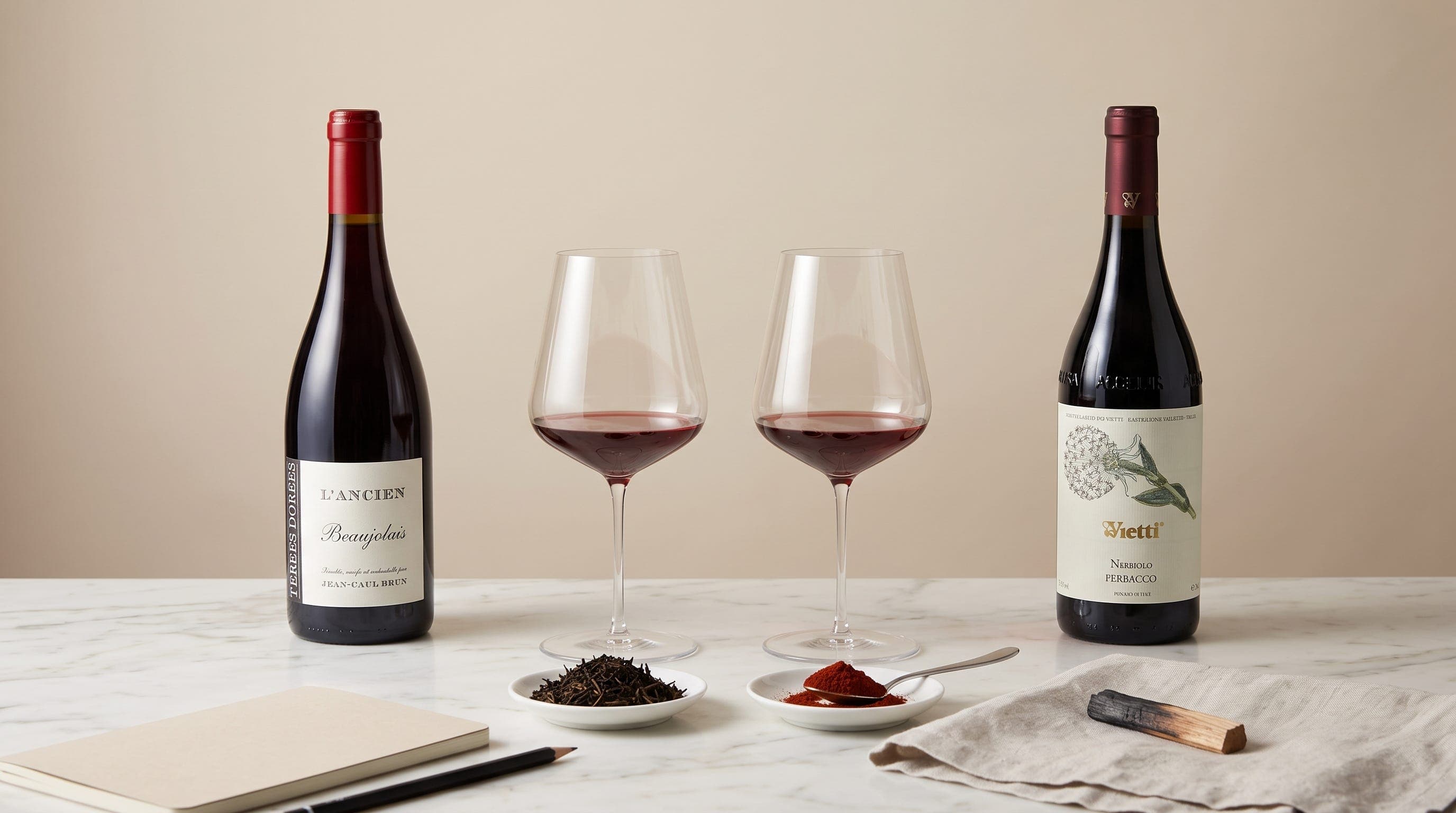
What to try: Three grocery-store references, roughly $6 to $18 total: Lapsang Souchong, the pine-smoked Chinese black tea (Twinings, Ahmad Tea, or a specialty shop’s loose leaf), smoked Spanish paprika (La Chinata or Chiquilín Pimentón de la Vera), and one hardwood barbecue smoking chip, hickory or oak. Then a wine with unmistakable barrel toast: a traditional Rioja Reserva such as La Rioja Alta “Viña Alberdi,” Bodegas Muga Reserva, or CVNE Cune Reserva (Tempranillo, Rioja), roughly $20 to $30.
What to notice: Brew the tea strong and smell it hot, open the paprika and smell it dry, snap the wood chip and smell the broken edge. Three different smoke signatures: tar and pine resin from the tea, sweet char from the paprika, dry ash from the wood. Now the Rioja. Under the dried cherry and leather you should find a warm, sweet smoke with vanilla and clove alongside it. That is guaiacol and 4-methylguaiacol, formed when the cooper toasted the barrel. Oregon State puts oak-matured wine at 10 to 100 micrograms per liter of guaiacol.
Lesson: The same molecule does two completely different jobs depending on dose and company. From a toasted stave at low concentration next to sweet oak lactones it reads as warmth, and people pay extra for it. From a fire, at several times that level, with cresols and a glycoside load underneath, it reads as an ashtray. Training on the reference buys you the distinction: that 2025 Journal of Food Science study found consumers who first smelled an “ashy” standard cut their detection threshold roughly fourfold.
#2: Score The Finish On Its Own Scale
Objective: Learn to judge a wine after you swallow, which is where in-mouth release puts smoke and where most drinkers were never taught to pay attention.
What to try: A loud-nosed, short-finishing red such as a Beaujolais-Villages or Beaujolais: Jean-Paul Brun “Terres Dorées” L’Ancien, Domaine Dupeuble Beaujolais, or Georges Duboeuf Beaujolais-Villages (Gamay, France), roughly $14 to $22. Then a quiet-nosed, long-finishing red such as a Langhe Nebbiolo: Produttori del Barbaresco Langhe Nebbiolo, G.D. Vajra Langhe Nebbiolo, or Vietti “Perbacco” (Nebbiolo, Piedmont), roughly $35 to $40.
What to notice: Work the nose first on both, 30 seconds each, no sipping, and write down what you get and how loud it is on a 0 to 5 scale. Then taste. Sip, hold it a beat, swallow, close your mouth, and breathe out slowly through your nose while you count to ten. Record only what arrives between count three and count ten. The Gamay opens bright and floral and thins out fast, often gone by count four. The Nebbiolo gives you very little at the rim, then builds after you swallow into tar, dried rose, orange peel, with tannin drying your gums the whole way. Rank the two on the nose, rank them again on the finish, and watch the ranking flip.
Lesson: Nose-first tasting is a habit the trade taught you, since swirling and sniffing is what expertise is supposed to look like, and it is the habit that misses smoke taint. The Australian Wine Research Institute correlates the “ashy” character specifically with the aftertaste, and the mechanism is the glycosides your own saliva cracks open once the wine is in your mouth. Score the finish as its own number on every bottle from now on. You just added a second measurement, and it tells you about faults, about whether a bottle is worth its price, and about whether you want another glass.
#3: Put Your Palate Next To Someone Else’s
Objective: Measure the distance between your perception and another person’s on a compound with a documented blind spot, so a disagreement at your table stops feeling like a contest.
What to try: One bottle of peppery, cool-climate Syrah, poured into two glasses at the same moment: Mount Langi Ghiran “Cliff Edge” Shiraz (Grampians, Australia), Qupé Central Coast Syrah (California), or Domaine Faury Saint-Joseph (Northern Rhône), roughly $18 to $35. One bottle, two people, no third variable.
What to notice: Do not talk. Each of you writes down on paper how strongly you get black pepper on a 0 to 5 scale, plus one other aroma. Trade glasses and repeat, which rules out the glass. Then read the numbers out loud together. Somewhere between “we both wrote 4” and “you wrote 4 and I wrote 0” is a real measurement of the two of you.
Lesson: The pepper in Syrah comes from rotundone, detectable at about 16 nanograms per liter in red wine, and 20 to 25 percent of people carry a specific anosmia for it. Hand those people a saturated glass and they get nothing. If your partner scored zero, the wine did not change between the two glasses, and neither of you owes the other an apology. Smoke behaves the same way across a population. The variation is physiological, and no panel, score, or lab certificate can tell you your own threshold.
Pocket Palate: what smoke taint actually is
Five facts, in case you ever meet it.
- The compounds: Guaiacol, 4-methylguaiacol, the cresols, and syringol, thrown off when wood burns and absorbed through grape skins and leaves.
- The hiding place: The vine binds them to sugars as glycosides, which carry no smoky aroma of their own.
- The trigger: Fermentation releases some, and enzymes in your saliva release more while the wine is in your mouth.
- The signature: Ashy, medicinal, cold-fireplace character that shows up on the finish and after you swallow, often with a drying mouthfeel.
- The variance: A published threshold is the level half a tested group can perceive. Roughly 15 to 20 percent of people may not register smoke in wine at all.
The Finish
Fire seasons are not going back to where they were, and the trade will keep managing the consequences out of your sight. Fruit gets tested, declassified, bulked, or left hanging, and the word never reaches a label. No filter catches everything, though. A bottle from a smoke year, a small lot that never saw a lab, a wine cleared by a panel less sensitive than you are: sooner or later, one of them lands on your table.
That possibility is what the three experiments train you for. They build sensory memory. The Lapsang, the pimentón, and the snapped wood chip give you three smoke signatures filed under names you chose, and the Rioja shows you where that family belongs in a wine. The effect is measurable: consumers who first smelled an ashy standard cut their detection thresholds roughly fourfold in that 2025 Journal of Food Science study. Scoring the finish on every bottle you open this month keeps the memory current.
Your threshold is a fact about your body, and a trained memory is what lets you use it. If ash ever arrives on a finish, you will know what you are tasting in one swallow, put a name on it, and need nobody at the table to confirm it was really there.
Go Deeper
If this week’s idea stuck with you, these take it further.
- Augustus Weed, How Will Weeks of Wildfire Smoke on the West Coast Impact the 2020 Vintage? (Wine Spectator, 2020): Contemporaneous reporting from the worst smoke vintage on the West Coast, including which wineries walked away from fruit and which mitigation tools they reached for.
- James Osborne and Elizabeth Tomasino, Impact of Smoke Exposure on Wine (Oregon State University Extension Service, 2019): The clearest free explainer of the glycoside mechanism, the saliva release, and why sensory thresholds vary so widely between people.
- Sensory Impact of Smoke Exposure (Australian Wine Research Institute, 2025): The institutional fact sheet, with the volatile phenol threshold table and the consumer study that found three distinct clusters of liking within one tasting panel.
- L. X. Lim et al., Discrepancy Between the Ability of Wine Experts and Consumers in Identifying Grape Smoke Exposure in Different Wine Matrices in California (Journal of Food Science, 2025): The peer-reviewed version of this week’s argument, showing both how far apart individual sensitivities sit and how quickly a reference standard closes the gap.