1 Big Idea: Season, Place, Person
You are holding a list with 150+ bottles on it, and you recognize 4. The rest are names you have never seen, from villages you could not find on a map, at prices that range from $75 to $1,100 with no obvious reason for the spread. Somebody is about to ask what you want.
The way through that list of bottles is a sentence: a few words that tell the person standing next to it, the merchant who stocked it or the sommelier holding the list, what you love and which of a wine’s causes it comes from. This issue teaches you to build it.
Every wine you will ever taste is the work of exactly three forces: a season of weather, a piece of ground, and a person in a cellar. Nothing else gets into the glass. Learn to tell which force made the thing you love, and you can say it to someone whose job is matching bottles to people.
In my work as a sommelier, the answers to these three questions are the most useful information you could give me to help you find a bottle you will love. Asked in order, they sort what you are tasting into the cause that produced it, and they work on bottles you have never heard of.
The first two take seconds: you taste the answer to one, and the other is printed on the label. The third is slower the first time you ask it, because it takes two bottles side by side, and it is the reason the experiments below exist. The comparisons happen at your own table, a bottle or two at a time. The questions are yours this week. The speed comes with use.
It is also the constructive half of a question this newsletter opened a few weeks ago. In the terroir issue you proved two things: place in the glass is real, and the word gets used as packaging for wines with no place in them. This issue assumes both and moves on. Given that place is real, here is how to work out what it, and everything else, actually did to the wine in front of you.
- The season question asks how warm the growing year was, and you answer it from the glass. Acid, alcohol, and the weight of the fruit move together on that dial, and they move the same way in every grape on earth.
- The place question asks how small the named piece of ground is, and you answer it from the label. An appellation is a promise about ground. The narrower it gets, the more of what you are tasting it can explain.
- The person question asks how much of what you are tasting was a decision. Oak, ripeness at picking, and extraction are choices a winemaker made, and they produce flavors that are easy to file under the wrong cause.
Ask them in that order and most wines stop being mysterious. Skip the third one and you will spend years crediting hillsides for things a winemaker did on a Tuesday in October.
The label does not help you. The grape and the brand name get the large type and the front of the shelf talker, and the appellation gets six points of legal minimum on the bottom of the label. Marketing departments make that choice deliberately, because the grape is what shoppers were taught to ask for and the appellation is where the actual commitment lives. The result is a package designed to keep the three causes blurred together.
Telling them apart is the skill, and it changes both what you buy and what you can ask for. A few flavors have only one possible cause. Vanilla, toast, and coconut come from oak and nowhere else, so if the wine you love is built on them, you are loving a winemaker’s decisions, and the village on the label is close to irrelevant.
But most of what you love in a glass could have more than one cause. Tension and nerve can come from a cool season on specific ground, and they can also come from a person who picks earlier and uses less new oak in a warm one. Napa Cabernet has both, running side by side: Cathy Corison has spent 4 decades making taut, nervy wines a few miles from cellars making plush, opulent ones, in the same warm appellation, from the same grape.
Same place, opposite glasses, because a person decided. That is why the questions come as a set of three, and why the third one exists at all. Most disappointing repeat purchases are attribution errors: crediting the place for a person, or the person for a place.
3 Taste Experiments
Three pairs, one per question. Do them in order if you can do all three, or pick the one that matches your week. Each pair is tasted side by side, same sitting, water and a plain cracker between glasses.
#1: Finger Lakes vs California Cabernet Franc
Objective: Learn what a season does to a glass by holding one grape steady and moving only the heat it grew in, using a grape whose green note is a direct readout of how much sun the fruit saw.
What to try: A Finger Lakes Cabernet Franc such as Dr. Konstantin Frank, Wagner Vineyards, or Damiani Wine Cellars (Cabernet Franc, New York), roughly $20 to $30. Then a warm-site California Cabernet Franc such as Michael David “Inkblot” (Lodi), Lang & Reed North Coast, or Titus Vineyards Napa Valley (Cabernet Franc, California), roughly $25 to $45.
What to notice: The New York glass leads with something green and unmistakable, bell pepper or tomato leaf, sitting over tart red currant and raspberry, with a graphite edge and acid that keeps the finish tight. The California glass has most of that green burned off. You get blackberry and black plum, a rounder middle, softer acid, and warmth at the back of the throat. Smell both before you sip and name the green one out loud. Then guess which is higher in alcohol and check the back labels.
Lesson: The green note has a name and a mechanism. Cabernet Franc is rich in methoxypyrazines, the compounds behind bell pepper and tomato leaf, and sunlight and heat break them down as the grapes ripen. Cool site, they survive. Warm site, they degrade. So the strength of that herbal edge tracks how much sun the fruit saw, which makes Cabernet Franc the most useful grape you can buy for calibrating the season dial. You get that answer from one smell, where Syrah and Chardonnay make you work it out from acid and alcohol. You now have a marker at each end of the dial, which lets you position an unfamiliar bottle somewhere between them.
#2: One House, Two Appellation Tiers
Objective: Learn what a narrower name commits a producer to by holding the grape and the producer steady and changing only how small the named place is.
What to try: A regional Bourgogne Rouge from a large house such as Louis Jadot Bourgogne Rouge, Joseph Drouhin “Laforêt” Bourgogne Pinot Noir, or Faiveley Bourgogne Rouge (Pinot Noir, Burgundy), roughly $18 to $26. Then a village wine from the same house such as Louis Jadot Savigny-lès-Beaune, Joseph Drouhin Chorey-lès-Beaune, or Faiveley Mercurey, roughly $32 to $45. Buy both from one producer so the cellar stays constant.
What to notice: The Bourgogne is broad, soft, red-fruited, and easy, and it finishes about where you expect. The village wine is narrower in flavor and longer in time. Count the seconds the taste holds after you swallow, in both glasses, and write the two numbers down. That gap is the clearest thing you will measure all week. The village wine will also carry more texture across the middle of your tongue and often a savory, earthy note the regional bottling never shows.
Lesson: A regional Bourgogne can be lovely, and plenty of them are worth the money. What it cannot do is explain much, because the grapes came from anywhere in a region the size of a small country. That breadth is why the back-label copywriters spend their whole paragraph on soil and family and craft: the front label is not committing to much, so the prose has to. When the named place shrinks, the producer is accepting accountability for a smaller piece of ground, and more of what lands on your tongue can be traced to it. Check how small the appellation is before you give any weight to the back-label story. And if this ladder feels familiar from the terroir issue, where a basic Bourgogne Blanc sat next to a Chablis, the two runs ask different questions. That issue asked whether the narrower place was worth your money. This pair asks how much of the glass the narrower name can explain.
#3: Two Producers, One Appellation
Objective: Learn to separate what the ground did from what a person decided by holding the place steady and changing only the hands.
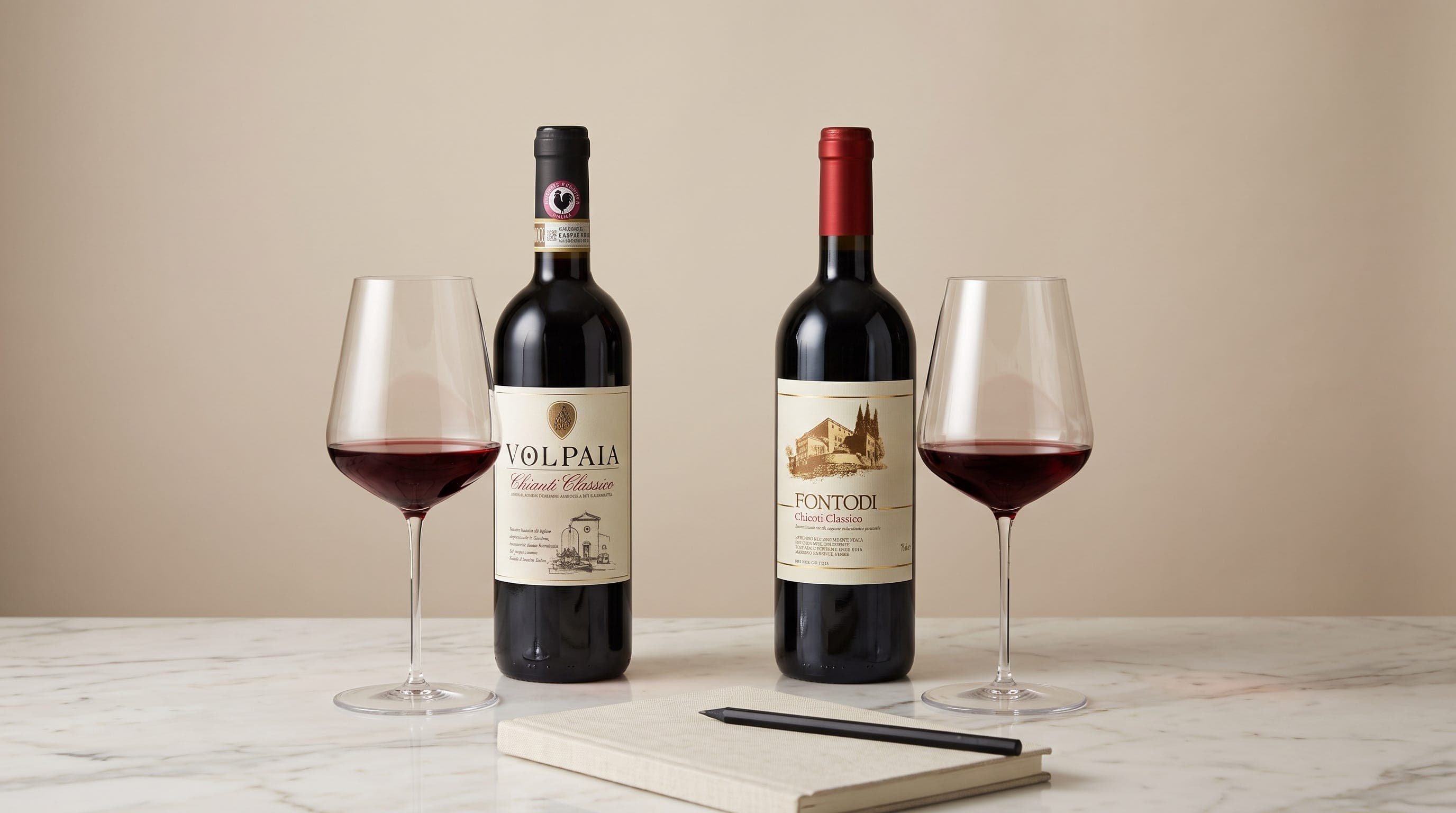
What to try: Two Chianti Classico Annata from different estates, same vintage if your shop has it, such as Castello di Volpaia, Rocca delle Macìe, Fèlsina “Berardenga,” or Fontodi (Sangiovese, Tuscany), roughly $18 to $32 each.
What to notice: Look for what shows up in both glasses. Sour cherry, dried herbs, a tomato-leaf green note, dusty tannin, and acid sharp enough that you start thinking about food. That shared set is Chianti Classico. Now find what appears in only one. Vanilla, toast, or coconut means new oak. Riper, sweeter fruit means a later pick. Fine-grained, polished tannin means a gentler extraction. Those belong to a person, not to a hillside.
Lesson: This is the question that keeps the other two honest, and almost nobody asks it. Producer style is the single easiest thing in wine to mistake for terroir, and the trade has no reason to correct you, because “our vineyards” is a better story than “our cooper.” Open two bottles from one appellation on one night and you can see which traits belong to the place and which belong to the winemaker. From then on, when someone tells you a wine tastes of its place, you will be able to tell whether they are describing the appellation or the producer’s decisions.
Pocket Palate: 3 causes, 3 questions
Every flavor gets filed under the cause that made it.
- The season: Mouth-watering acid, moderate alcohol, and tart fruit mean a cool year. Soft acid, warmth in the throat, and dark jammy fruit mean a hot one. In Cabernet Franc, Cabernet Sauvignon, and Sauvignon Blanc, a green bell-pepper note is the same signal, because heat burns it off.
- The place: Find the appellation, then ask how big it is. Region, then village, then single site. The narrower the name, the more of the glass it can explain.
- The person: Vanilla, toast, coconut, polished tannin, and sweet ripeness are cellar decisions. What shows up in two bottles from different producers in the same appellation is the place.
- In a shop: Lead with the cause: “the last wine I loved was cool-season Cabernet Franc with barely any oak” gives a merchant a real target. Browsing alone, read the appellation and the alcohol before the romance copy.
- On a list: Hand the sommelier the same sentence. They know the list, you know which cause you love, and the match is their craft. “Which of these is from the smallest place?” still works when you just want to explore.
The Finish
None of the three questions requires you to know the wine. That is the point of running them as a procedure. The answer to the season question is in your mouth, the answer to the place question is printed on one line of the label, and the person is revealed the moment you have two producers’ bottles from the same appellation to compare. None of it needs a phone, an app, or a critic.
The better reason to build this has nothing to do with picking bottles. The wine business is organized around telling you what a bottle is before you taste it, and most people never stop taking that description as the final word. When you can trace what is in your glass back to the season, the place, and the person, the label becomes one piece of evidence you weigh, and you supply the verdict.
It also solves the most practical problem in wine, which is finding the next bottle you will love among thousands you have never tasted. You do not have to do that alone. A merchant knows their wall and a sommelier knows their list, and what they need from you is the one thing only you have: which cause made the thing you loved.
“I want the cool-season style of this grape” or “I liked the winemaker’s hand more than the place” gives a professional everything they need to walk you to a bottle you have never tasted and are going to like. On my floor, the guests who can say that get a bottle chosen for them, and for them alone. The wine that thrills you may bore the next table, and that is exactly why the sentence matters.
When there is nobody to ask, the same knowledge works alone: follow the producer if it was the winemaking, follow the climate if it was the place. And if the honest answer is that the broad, cheerful, twelve-dollar bottle is what you want on a Wednesday, say that too. It is just as legitimate, and you got there by tasting, which means the judgment is your own.
Go Deeper
If this week’s idea stuck with you, these take it further.
- Vicki Denig, Alphabet Soup: Decoding Appellation Acronyms from 10 Major Wine Countries (VinePair, 2017): A plain-language tour of what AOC, DOC, DOCG, DO, and AVA actually promise, country by country, which is the fastest way to start weighing the size of a place claim.
- Bourgogne wines: decoding the AOCs (Bureau Interprofessionnel des Vins de Bourgogne): The trade body’s own breakdown of the four Burgundy tiers, from regional through village and premier cru to the 33 grands crus, which is the clearest working model of appellation specificity anywhere.
- Gregory V. Jones, Climate and Terroir: Impacts of Climate Variability and Change on Wine (Geoscience Canada, 2006): A climatologist maps how growing-season temperature governs ripening, style, and which grapes work where, and it is the technical backbone of the season question.