1 Big Idea: You Can Tell Them Apart
Somewhere this summer, you caught yourself mid-sentence. A wine tasted like a warm year, or the acid felt like altitude, and you paused, because you knew exactly what you meant by that. In June you would not have.
That pause is what this quarter built. Since late June, 11 issues have run under one banner, Climate & Character, and every one of them taught the same skill from a different angle. Ripeness taught you what heat does to fruit, acid, and alcohol. Altitude and aspect taught you the site’s levers. Cool and warm vintages taught you the year. Blind tasting gave you a method for checking all of it before you ever look at the label. And last Saturday’s capstone gave the skill its final form: every wine you will ever taste is the work of a season, a place, and a person, and three questions, asked in order, tell you which one made the thing you loved.
Wine marketing works hard to keep those three blurred. Back labels say “balanced,” “elegant,” and “smooth” because those words describe nothing specific and can be printed on any bottle in any vintage, so the marketing department never has to update them. A palate that can taste the difference between a cool year and a warm one, or between a hillside and a barrel program, has no use for those words, which is why nobody prints the useful ones.
You spent the summer becoming someone who checks claims against your own perception. This issue measures how far you have come, then names the next step. For the first time, the next step is not something you do alone at your counter: it happens live, this October, with me on the other end of it. Details below.
The quarter in 11 lines
- Ripeness: sugar, acid, and flavor ripen at different rates, and you can taste which one the winemaker picked for.
- Aromatics: most of what you call taste is smell, and warmth decides which aromas survive into the bottle.
- Sweetness vs fruitiness: ripe fruit registers as sweet with zero sugar; check the finish to know which one you are tasting.
- Altitude, aspect, and soil: a site can override its latitude; elevation keeps acidity alive in a warm place.
- Cool vs warm vintages: same site, different weather, different wine; the year is an ingredient.
- Old World vs New World: a style shorthand that is mostly a climate shorthand, and it blurs more every vintage.
- The terroir question: place is real in the glass, and most of what is sold to you as place is not.
- Blind tasting at home: the label changes what you taste; covering it shows you what you actually perceive.
- Climate adaptation: growers are re-engineering vineyards against heat, and the results are already in your glass.
- Smoke taint: two people can taste one glass differently, which is exactly why your own perception is the one worth training.
- Season, place, person: the capstone. Three questions that file every flavor in the glass under the cause that made it.
3 Taste Experiments
Three re-tastes, one per question from the capstone. Each stacks skills from several issues, so treat them as a measurement of the quarter and pick the one that fits this week’s budget.
#1: Cool vs Warm-Climate Sauvignon Blanc
- Objective: Measure the season question on the cheapest pair the method allows, for under $30 total.
- What to try: A Marlborough, New Zealand Sauvignon Blanc (Villa Maria Private Bin, ~$13, or Oyster Bay, ~$13) next to a warm-climate California Sauvignon Blanc (Joel Gott, ~$14, or Honig Napa Valley, ~$18).
- What to notice: Where the fruit sits (grapefruit and cut grass against melon and peach), how hard the acidity hits, where you feel the alcohol’s warmth, and which wine finishes longer on your palate.
- The lesson: In July this pair would have registered as “two Sauvignon Blancs, one sharper.” Now you can name the cause: one grew cold and kept its acid, one grew warm and traded acid for ripeness. The label lists a region and an alcohol percentage. You can now fill in the climate behind both.
#2: Decoding Sweetness: Burgundy vs California Pinot Noir
- Objective: Measure the person question where it hides best: ripeness and sweetness feel like nature, and this pair shows how much of each was a decision.
- What to try: A Bourgogne Pinot Noir (Joseph Drouhin Laforêt, ~$18, or Louis Jadot Bourgogne, ~$22) next to a ripe-styled California Pinot Noir (Meiomi, ~$22, or La Crema Sonoma Coast, ~$25).
- What to notice: Where sweetness registers (first sip or finish), whether the finish actually dries out, the alcohol difference on the back of your throat, and the fruit register: tart cherry against jammy plum.
- The lesson: Big brands engineer a sweet first impression because it wins the first-sip comparison, and that is a fine style to love on purpose. The skill is knowing whether you chose it or the marketing chose it for you, and you can check on the finish in about 6 seconds.
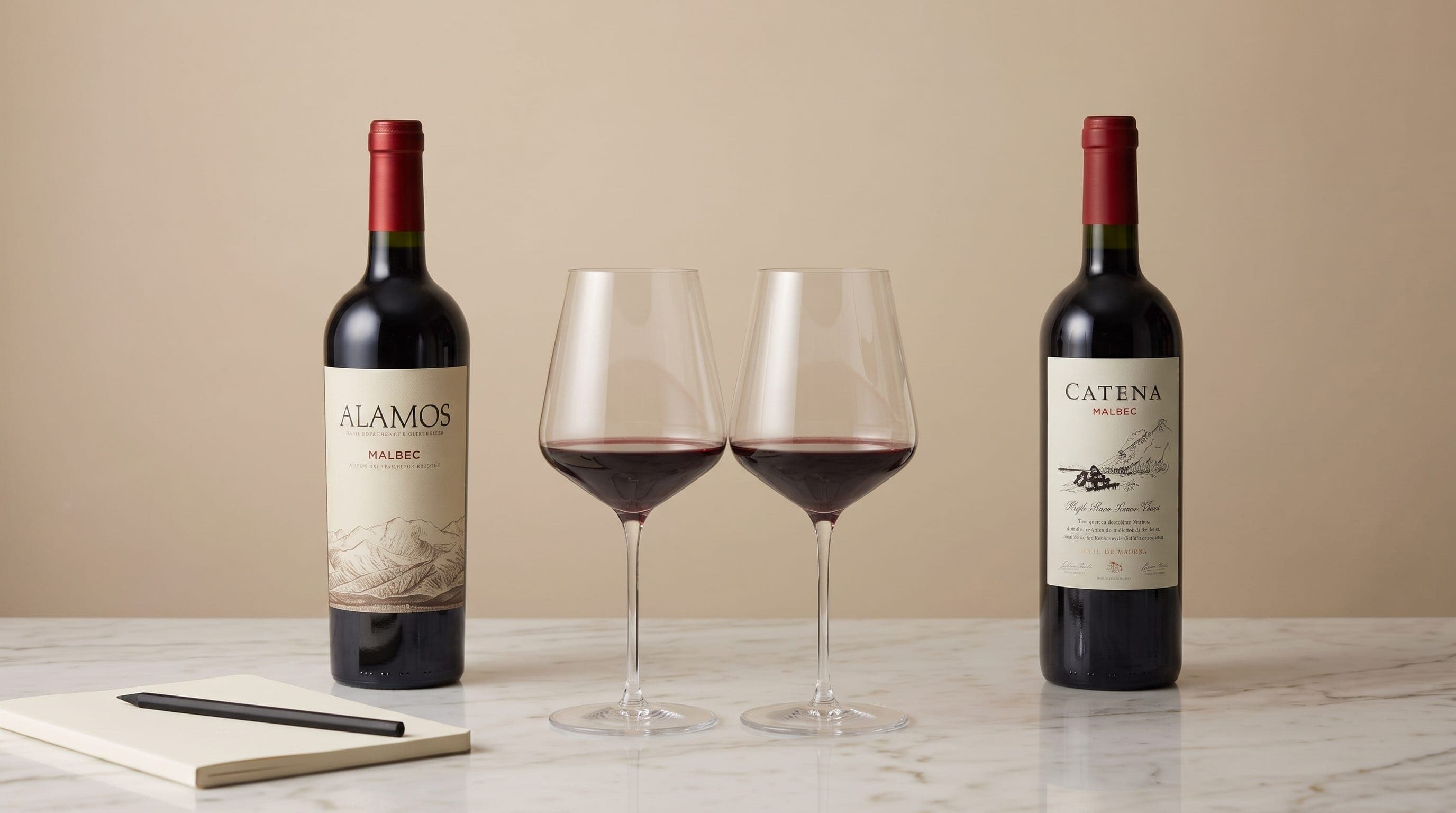
#3: Altitude: Mendoza Malbec Two Ways
- Objective: Measure the place question with one grape, one province, and one producer, so elevation is the only lever left.
- What to try: Alamos Malbec (~$13), the Catena family’s broad lower-Mendoza bottling, next to Catena Malbec High Mountain Vines (~$22), blended from the family’s vineyards at roughly 3,000 to 4,800 feet up the Andes. Same grape, same house, about $35 for the pair.
- What to notice: Where the fruit sits (baked dark plum and cocoa against tart red plum and violet lift), how much brighter the acid runs in the high-mountain glass, and the tannin: the altitude bottling grips with a finer, firmer grain, from skins thickened by mountain sun.
- The lesson: Mendoza is a desert at the latitude of San Diego; without elevation it could not make fresh wine at all. Every step up the Andes trades ripeness for acidity, which is why the plantings keep climbing as the climate warms. One grape, one house, one variable left: you just tasted elevation on its own, in a flight that costs about $35.
Pocket Palate: the quarter on one card
- Ripe fruit, soft acid, warm finish: warm site or warm year.
- Citrus or herbal fruit, bright acid, lower alcohol: cool site, cool year, or altitude.
- Sweet first sip that finishes dry: ripeness, and possibly a house style engineered around it; the finish is the tiebreaker.
- Bright acidity from a hot region: check the elevation; high vineyards stay cool in warm places.
- Not sure if it was the place or the person: two bottles, one appellation, same vintage; what only one glass shows is mostly the winemaker.
- Tasting blind: covering the label removes its influence before the first sip, so what you perceive is yours.
The next step: your first live tasting
Everything this quarter asked of you happened alone at your counter: two bottles, your own notes, your own verdict. That solitude was the point. You had to learn what you actually perceive before anyone else weighed in.
There is one thing a newsletter structurally cannot do: sit across the table while you taste and help you sort out whether what you noticed is acidity or alcohol, ripeness or sugar. The smoke taint issue showed why that matters: two people can taste the same glass differently, and you only find the edges of your own perception by comparing it against someone else’s in real time. Calibration moves faster with other palates in the room.
So this October, The Polished Palate goes live for the first time. A guided tasting built exactly like the experiments you already know: a designed flight you can shop for anywhere, real-time discussion with other palates on the same wines, and me walking you through it. The quarter you just finished is the preparation; October is where you use it.
Full details arrive later in September: the date, the flight, and how many seats. Seats will be limited, and the people who raise a hand early hear first. I want a seat at the first one.
And the calendar keeps moving: Q4 starts next Saturday with Time & Mastery, a quarter on how age transforms wine, why serving choices distort it, and how sommeliers train recall. By the time we sit down together in October, you will have both arcs to draw on: the climate skills you just built, and the first month of aging and serving skills.
The Finish
In July, ripeness was a word on a shelf talker. Now it is something you can identify with your own palate, and once you can identify it, vintage, site, and style start being easier to notice.
Scroll back through the 11 lines above and notice which one changed how you actually buy wine. That line points at what your own taste already prioritizes, and it is worth knowing on purpose.
One action this week: pick the re-taste that fits your budget and pour it before the October details land in your inbox. Arrive with a fresh side-by-side in your memory.
Go Deeper
If this week’s idea stuck with you, these take it further.
- VinePair Staff, Wine 101: Old World vs. New World (VinePair, 2025): A quick, listenable refresher on the style shorthand this quarter complicated, including why the old binary is blurring.
- Smoke Taint (Australian Wine Research Institute): The primary industry resource on how smoke exposure is measured and managed, from the researchers vineyards actually call.
- Michele Faralli et al., Four Decades in the Vineyard: The Impact of Climate Change on Grapevine Phenology and Wine Quality in Northern Italy (OENO One, 2024): Forty years of harvest data showing the warming trend you learned to taste, quantified in one region.