1 Big Idea: You Remember What You Name
Someone at dinner asks about that wine you loved a few weeks back. You remember the restaurant, who you were with, that the bottle was Italian and somewhere north of $50. The wine itself is gone. Grape, producer, how it actually tasted: nothing comes back. You loved it once and you cannot find it again.
Your palate is fine. What failed is retrieval, and retrieval is a trainable skill. It is the skill under every blind-tasting party trick you have watched a sommelier perform, and under something far more useful: ordering with confidence because you can consult a record of what you like.
I spent two years in blind tasting groups while working through my certifications, before I walked away from the WSET Diploma in 2019. The drill never changed, though: a flight of unlabeled glasses, and you call the wine out loud before the reveal. Grape, place, age, and your evidence for each.
Within months I could feel my recall reorganizing. A wine I tasted and named stayed with me for years. A wine I drank that same week with full attention and real pleasure, but no words, was gone by Sunday.
Certification programs do teach tasting. The WSET and the Court of Master Sommeliers both hand you a structured tasting grid early and test you on blind wines. What class time cannot give you is volume. A few wines a session teaches the method; the hundreds of flights that make recall automatic happen after hours, in study groups students run themselves. That part of the training is on you, not the syllabus, and it is also the part anyone can do at home.
The mechanism is simple to state. A taste you name while you taste it becomes a memory you can search. A taste you never put words on leaves a vague impression you cannot retrieve on demand. This week trains the conversion on three separate axes: one anchor bottle, words before the reveal, and a next-day recall test. No certification required, and nothing over $40.
3 Taste Experiments
Three drills, one axis each. None needs a partner, none needs more than 15 minutes, and two of them use the same bottle twice, so three bottles cover the whole week.
#1: One Anchor Bottle
Objective: Build one reference standard your palate can measure every future wine against.
What to try: One textbook Marlborough Sauvignon Blanc: Villa Maria Private Bin Sauvignon Blanc, Brancott Estate Sauvignon Blanc, or Whitehaven Sauvignon Blanc (Marlborough, New Zealand), roughly $10 to $18. Taste it twice this week, two nights apart. Screwcap means the second glass holds up fine in the fridge.
What to notice: Night one, name what you find out loud: grapefruit pith, passion fruit, cut grass, and an acidity that hits the sides of your tongue first. Night two, predict the wine before you open it, then check yourself. Notice which descriptors came back on their own and which you had to rebuild from scratch.
Lesson: Working sommeliers memorize benchmarks, one textbook example per style, and file every new wine as a distance from the nearest one. Your memory holds comparisons far better than it holds free-floating impressions. Once Marlborough Sauvignon Blanc is an anchor, every other Sauvignon Blanc becomes “greener than my anchor” or “riper and softer, less pungent,” and phrasing like that is exactly what your recall can store and hand back to you at a wine shop.
#2: Words Before the Reveal
Objective: Prove that committing to your own words before you see anyone else’s turns a vague impression into a memory you can retrieve.
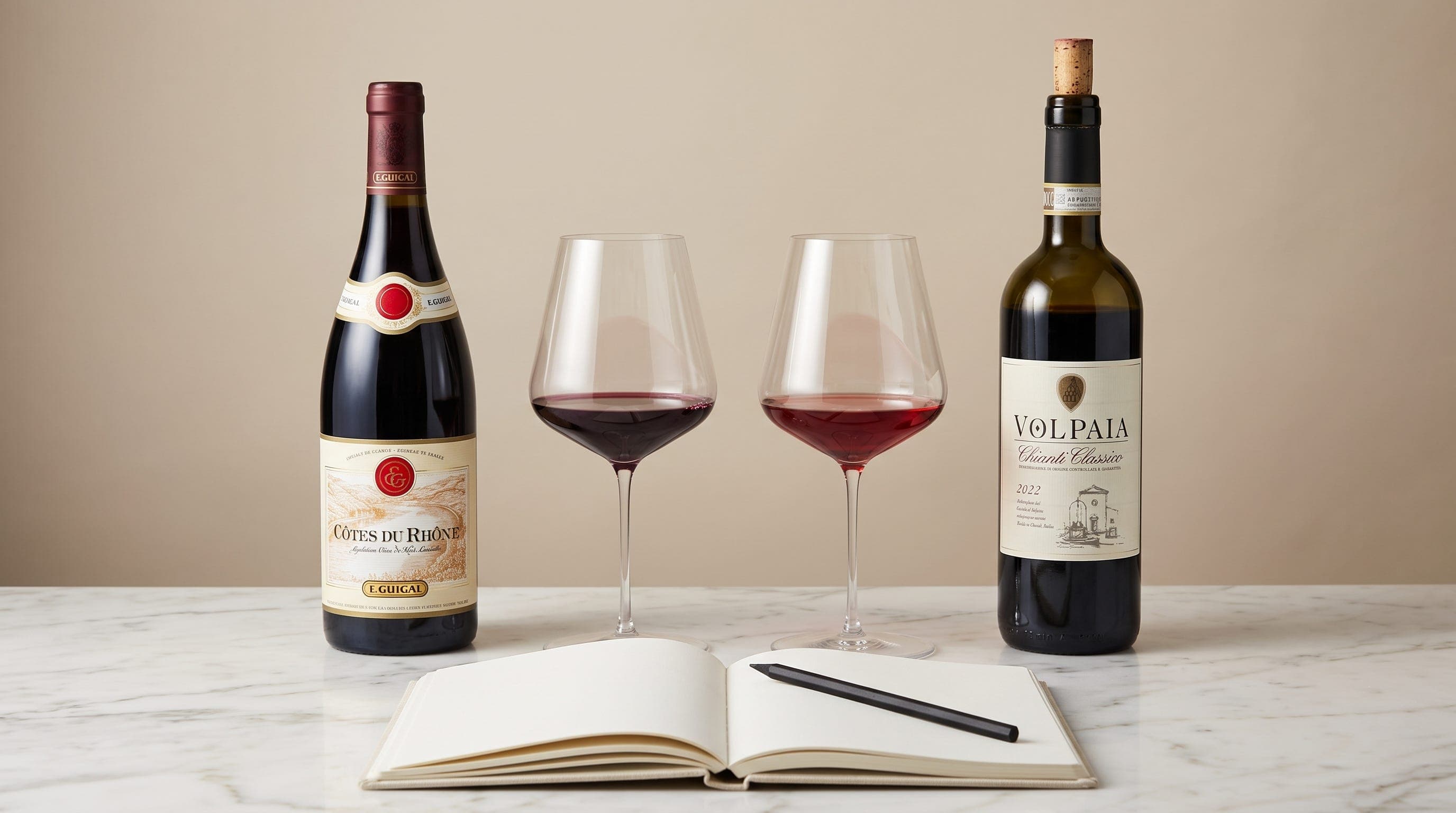
What to try: A Côtes du Rhône with a well-documented profile: E. Guigal Côtes du Rhône, Famille Perrin Réserve Côtes du Rhône, or Delas Saint-Esprit Côtes du Rhône (Grenache and Syrah blends, southern Rhône, France), roughly $13 to $18. Pour a glass, taste, and say three specific words out loud before you read the back label or look anything up. Then check what the label and the tech sheet say.
What to notice: The pull to stay vague. “Smooth” and “dark” feel safe because nothing can contradict them. Push to committed words: black pepper, raspberry jam, dried herbs, licorice. Then notice tomorrow how easily the wine comes back once the words exist. On some later bottle, read the back label first and watch the printed words take over while your own never form.
Lesson: In 2016 the researchers Ilja Croijmans and Asifa Majid asked wine experts, coffee experts, and ordinary consumers to describe the same wines and coffees. The wine experts described wines far more consistently than anyone else, and the coffee experts showed no such edge with coffee. The researchers’ explanation is that wine culture runs on talk, in tastings, menus, and magazines, and that practice with words is part of what makes an expert. Naming is a skill you build with reps, and you just did one.
#3: The Next-Day Recall Test
Objective: Strengthen recall directly by testing it: retrieve a wine from memory a full day after tasting it.
What to try: A structured Chianti Classico: Castello di Volpaia Chianti Classico, Fèlsina Berardenga Chianti Classico, or Castello di Monsanto Chianti Classico Riserva (Sangiovese, Tuscany, Italy), roughly $25 to $40. Night one: taste, name five things out loud (two structural, like acidity and tannin, and three flavors), then recork it and write nothing down. Night two, before touching the bottle: write everything you remember about how it tasted. Then pour again and grade yourself.
What to notice: Which memories survived 24 hours. Almost always the ones you said out loud. Whether structure outlasted fruit: the tart cherry may blur while the drying grip of tannin and the acidity that floods your mouth usually survive. And whether the second tasting locked in what the first one only sketched.
Lesson: The act of retrieving a memory is what strengthens it, which is why the blind-tasting groups that produce working sommeliers run on one loop: taste, call it, get the reveal, taste again. Each successful retrieval makes the next one easier, the same way it works with names, languages, and every other learned skill. One deliberate 24-hour cycle does more for your recall than a week of attentive drinking without the test.
Pocket Palate: training taste recall
The sommelier recall method in five lines.
- Anchor one benchmark: Learn one textbook bottle so well you can predict it before opening. File every future wine as a distance from it.
- Name it before you check it: Three specific words out loud, before the back label. Printed words read first take over, and your own never form.
- Test yourself at 24 hours: Write what you remember from yesterday’s glass, then retaste and grade. The retrieval attempt is the training.
- Comparisons beat absolutes: “Greener than my anchor” stores and comes back on demand; a free-floating impression fades within days.
- Structure usually outlasts fruit: Acidity and tannin tend to survive in memory after the flavor notes blur, so name them every time.
The Finish
All three drills run the same conversion: sensation into language into memory. Sommeliers get years of structured reps at it, and none of the machinery is reserved for them. One anchor gives your comparisons a fixed point, naming before checking makes the words yours, and the 24-hour test proves the file actually saved.
So try the retrieval right now. Think of the last wine you genuinely loved and pull back everything you can. If what returns is a feeling and a color, that was your filing system before this week, and it is exactly what these drills change.
One action to carry forward: for the next month, commit three words out loud to every glass you pour, before you read a single thing about it. Do that and you will walk into a restaurant with a memory you can actually consult, and you can order from it with the same confidence a sommelier does, because you built it the same way they did.
One more ask before the launch note, and it takes thirty seconds. If you had to describe this newsletter to a friend in a single sentence, what would you say? Reply to this email or leave it in the comments. I am rewriting the About page, and I would rather it use your words than mine.
Last thing, and it is the reason this issue’s drills matter: the first live Polished Palate tasting is Monday, February 15, 2027. I said October, and my fall filled up faster than I planned, so the first one waits until I can give it my full attention. A guided tasting where you name what is in your glass out loud, in real time, against other palates doing the same. Everything you drill between now and then is the preparation. Hold the date, and the people on the list hear first. I want a seat at the first one
Go Deeper
If this week’s idea stuck with you, these take it further.
- The Secret to Blind Tasting? Learn the “Tasting Grid” (Wine Folly): A free version of the deduction grid sommeliers use to structure the call-it-out-loud drill, ready to use with this week’s experiments.
- Gordon M. Shepherd, Neuroenology: How the Brain Creates the Taste of Wine (Columbia University Press, 2016): A Yale neuroscientist’s short book on how flavor is constructed in the brain, including why language and memory sit so close to taste.
- Ilja Croijmans and Asifa Majid, Not All Flavor Expertise Is Equal: The Language of Wine and Coffee Experts (PLOS ONE, 2016): The open-access study behind Experiment 2: wine experts describe wines far more consistently than coffee experts describe coffee, and the authors credit wine’s culture of talking about flavor.
- Sarah J. Banks, Karthik R. Sreenivasan, David M. Weintraub, Deanna Baldock, Michael Noback, Meghan E. Pierce, Johannes Frasnelli, Jay James, Erik Beall, Xiaowei Zhuang, Dietmar Cordes and Gabriel C. Leger, Structural and Functional MRI Differences in Master Sommeliers: A Pilot Study on Expertise in the Brain (Frontiers in Human Neuroscience, 2016): Brain imaging of Master Sommeliers showing measurable differences in regions handling smell and memory, consistent with tasting training changing the brain itself.