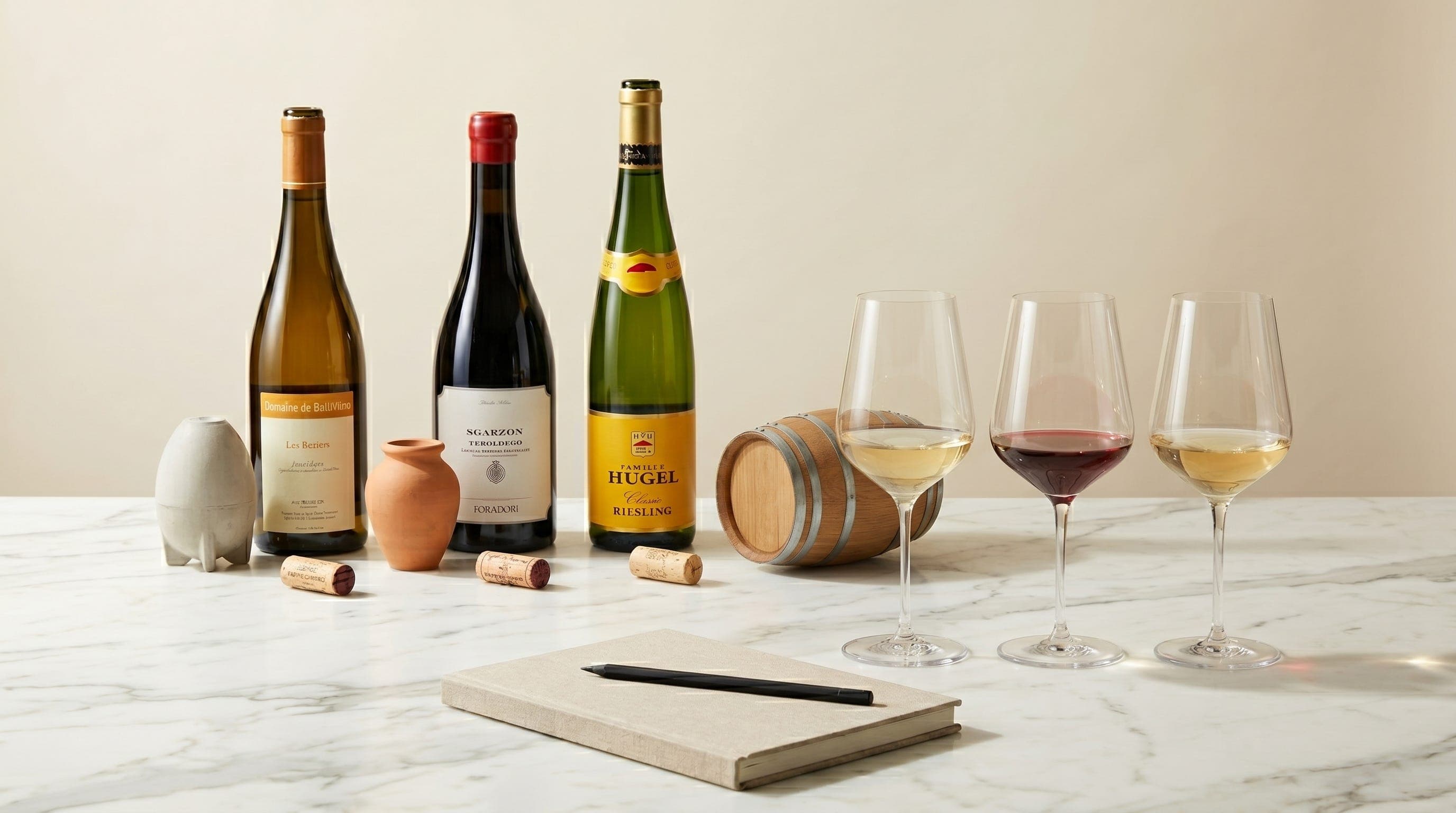
1 Big Idea: The vessel spectrum
Steel and new oak are the two endpoints most drinkers know about. The vessels in between are where the real winemaking decisions live, and reading them changes how you understand wine.
London, 2018. A Diploma seminar on white winemaking. The instructor poured three Chenin Blancs from the same producer, same vineyard, same vintage. The only variable was the vessel. Stainless steel. Concrete egg. Foudre.
I had walked into the room carrying a binary in my head: oaked or unoaked. The flight broke the binary in the first three sips. Three wines. Three textures. Three completely different aromatic registers.
None of them were “oaky” in the way the word usually gets used, and yet two of the three had been shaped by their vessel in ways the steel example simply hadn’t been.
That seminar reset something. The question stopped being “did this see oak?” and became “what was this wine in, and what is the vessel doing?”
The Vessels You Don’t Read About
Last week we walked through the three big fermentation decisions: temperature, vessel, and yeast. The vessel section pointed at the binary most drinkers actually use, steel against barrel. That binary is fine for the basics. It is also a flattening of a much wider line.
There are at least three vessels working in the middle of that line, and each one is a specific bet about two variables: how much oxygen the wine sees, and how much the vessel itself contributes flavor.
Steel sits at one end. Maximum neutrality, near-zero oxygen during fermentation, no contribution from the vessel. What you taste is grape and acid, unmediated.
A new small oak barrel sits at the other end. Moderate oxygen through the staves, lots of flavor (vanilla, toast, coconut, spice from American oak; finer toast and clove from French), and a strong textural shift from the micro-oxygenation.
Between those two endpoints, three vessels do most of the interesting work:
- Concrete egg. Roughly inert, like steel, but with thermal mass that holds fermentation temperature steady, and a smooth interior shape that creates gentle convection currents during fermentation. The wine moves on its own. No oxygen exchange to speak of, no flavor added. What you get is a textural rounding without any oak fingerprint at all. Loire Chenin producers (Domaine de Bellivière, Nicolas Reau) and Rhône whites lean into this hard. The signature is “creamy without being oaky,” which is a sensation most drinkers can’t place because they’ve been trained to read creaminess as oak.
- Terracotta amphora. Porous walls let in slow, steady micro-oxygenation, more than concrete, less than oak. No flavor added because clay is neutral. The texture builds, and the aromatics get a slightly oxidative complexity (bruised apple, almond skin, dried herb, savory undertones) without ever crossing into actual oxidation. Think of it as oxygen without wood. The signal is identical regardless of grape color, but the experiment we’ll run uses a red on purpose. Most amphora wine you see in shops is qvevri-style: Georgian or Georgian-inspired whites fermented on their skins for months. What you taste in those bottles is dominated by skin contact, not by the clay vessel itself. Tannin, oxidative color, dried-fruit flavors. Those are real and good, but they teach you about amber wine, not about amphora as a vessel. Reds in clay solve this cleanly. Skin contact is the normal expectation in red wine, so when you put a clay-aged red next to a steel- or large-oak-aged red of similar weight, the vessel signal is the only thing that’s different. We’ll use a Foradori Teroldego for that.
- Foudre and other large-format oak. Big oak (500L casks, 20+ hectoliter foudres, 2,000-liter botte grande) is still oak, but the surface-area-to-volume ratio is so different from a 225-liter barrique that the contribution flips. Less oxygen exposure per unit of wine. Far less flavor extraction, especially after the first one or two uses. What you get is the textural integration of oak (longer finish, weight, polished mouthfeel) without the new-oak taste. Alsace Riesling (Trimbach, Hugel), Northern Rhône whites, German Auslese and Spätlese all live here.
Three Vessels, One Reframe
Once you map vessels onto two axes, oxygen exposure and vessel contribution, the binary breaks. The choice isn’t oak or no oak. The choice is: how much oxygen do I want this wine to see during fermentation and aging, and how much do I want the vessel to speak in the final glass?
Steel says nothing. New small barrel says a lot. Concrete, terracotta, and foudre each let oxygen and time do their work without putting the vessel’s voice on top of the wine.
That reframe matters because it changes what you do with a back label. “Unoaked” stops being a quality marker. “Concrete-aged” stops being a marketing word. “Aged in old foudre” stops being something you skim past. Each of those phrases is a specific decision about a specific axis. You can shop for them.
This is also why “neutral oak” is a phrase worth learning. A barrel that’s been used four times has lost most of its flavor compounds but still allows oxygen exchange. A winemaker reaching for neutral oak is making the same kind of bet a foudre user is making, just at a smaller scale.
3 Taste Experiments
#1: Concrete Egg
Objective: Taste what a vessel does to texture when it is not adding any flavor.
How:
- Buy a Chenin Blanc fermented or aged in concrete egg. Domaine de Bellivière “Les Rosiers” (Jasnières) is pretty widely available at $30 to $40. If it’s not in stock, ask your shop for a Loire Chenin with concrete on the label.
- For contrast, open it alongside a steel-only Loire white. A Muscadet Sèvre-et-Maine sur lie from a quality producer (Domaine de la Pépière, around $18) works well.
What to notice: The Muscadet will read sharp and linear. Lemon pith, oyster shell, salt, a quick finish. Steel keeps the wine on rails.
The concrete-aged Chenin will feel rounder in the mouth without ever showing oak character. There is no vanilla, no toast, no spice. What you get is a creamy mid-palate, a longer finish, and an oddly polished texture that is hard to attribute to anything you can name.
The point: concrete teaches you that “creamy” and “oaky” are not the same word. The texture you get from a concrete egg is the work of thermal stability and gentle internal motion, not flavor extraction. Once you learn to feel it, you can name what concrete does in a glass even when no one tells you the wine saw concrete.
#2: Terracotta Amphora
Objective: Isolate the clay vessel signal by using a red wine, where skin contact is the normal expectation.
How:
- Buy Foradori “Sgarzon” Teroldego ($45 to $55) or, if you can find it, “Morei” at a similar price. Both are single-vineyard Teroldegos from Trentino, fermented and aged in Spanish tinaja (large clay vessels). Same grape, same producer, same site. The thing that makes these wines different from the rest of the lineup is the vessel.
- For contrast, open it alongside a similar-weight, mountain-climate Italian red aged in steel or large neutral oak. Hofstätter Lagrein from Alto Adige ($22 to $28) is a clean stylistic foil. A simple Trentino DOC red or a cool-climate Pinot Nero from Alto Adige also works.
- Important: don’t substitute a Georgian qvevri amber wine for this experiment, even though those are the easiest “amphora” bottles to find.
What to notice: The Lagrein will read as a polished, modern alpine red. Dark cherry, blueberry, violet, smooth tannin, clean mid-palate, oak or steel-driven structure that holds the fruit in shape.
The Sgarzon will be the same kind of wine on a different chassis. Dark cherry and pomegranate are still there, but the texture is silkier and somehow more breathing. Dried alpine herb, almond skin, a subtle savory or oxidative note that isn’t oxidation. The tannins feel rounder, less linear. The finish lingers without the polish-and-spice fingerprint of small oak.
The point: amphora’s contribution is identical regardless of grape color. Porous walls let in slow oxygen during fermentation and aging. The clay itself adds nothing. What you taste is the wine plus time plus oxygen, with the vessel kept silent. In a red, where skin contact is already part of the recipe, that signal stands cleanly on its own. Amphora isn’t a style of wine. It’s a way of letting wine breathe without speaking over it.
#3: Foudre / Large-Format Oak
Objective: Taste oak contact without the new-oak flavor punch.
How:
- Buy an Alsace Riesling aged in foudre. Trimbach “Réserve” (around $25 to $30) or Hugel “Classic” (around $22 to $26) are both classic examples and easy to find. If you want to spend a little more, Trimbach “Frédéric Émile” ($60 to $80) is the textbook bottle.
- For contrast, open it alongside a Riesling that has seen no oak at all. A dry Mosel Riesling Trocken from Selbach-Oster or Dr. Loosen, around $20, is a clean foil.
What to notice: The Mosel will be electric. Lime, green apple, slate, low alcohol, prominent acidity. Steel-fermented Riesling at its most precise.
The Alsace Riesling will be the same grape, dialed in a different direction. Riper fruit (yellow apple, peach), more weight in the mid-palate, a longer finish, a subtle savory or honeyed note. There is no vanilla, no toast. The oak is doing structural work, not flavor work.
The point: a wine can sit in oak for years and not taste “oaky.” If you’ve been avoiding oaked whites because you’ve assumed they all taste like buttered popcorn, foudre is the door back in. It’s the way most great Northern Rhône whites, most Alsace Rieslings, and most great Burgundian estates handle their best cuvées.
A Note on Hybrid Approaches
Some of the best winemakers split a single batch across multiple vessels and blend back: 60 percent concrete, 40 percent old foudre. Or steel for fermentation, terracotta for aging. The aim is to capture more than one axis at once: precision and texture, oxygen and flavor neutrality, structure and aromatic clarity.
When this is done well, the wine reads as more complete than any single-vessel version of itself. When it is done poorly, the wine reads as confused, neither one thing nor the other. The back label phrase to look for is “fermented in X, aged in Y.” That sentence is a winemaker telling you which axes they cared about most.
The Finish
This week, find one bottle whose back label names a vessel that isn’t steel or new oak. Concrete, terracotta, foudre, neutral oak, amphora. Buy it. Read what the vessel is supposed to be doing before you taste, then see if you can hear it in the glass.
Go Deeper
- What is an Amphora? A Master of Wine Explains (Bree Stock MW, 2022). A short, lucid video explainer from a Master of Wine on what an amphora actually is, why winemakers reach for one, and what the vessel contributes that wood and steel don’t. The most accessible starting point if the clay-vessel section of this issue made you want a visual walk-through.
- Domaine Gayda’s Nine Vessel Tasting (Jamie Goode, wineanorak.com). Goode documents a Languedoc producer who fermented the same wine, from the same harvest, in nine different vessels: stainless steel, concrete tank, concrete egg, used barrique, new barrique, foudre, terracotta amphora, sandstone vessel, and a ceramic clayver. The tasting notes are the primary-source version of the argument this issue makes. If you only click one link, click this one.
- Why do winemakers use amphorae, dolia, qvevri and other clay vessels? (Wine Spectator). A trade-publication overview of the clay-vessel revival, with regional sections covering Georgian qvevri, Italian dolia, Spanish tinaja, and Portuguese talha. Useful for understanding why the same underlying idea (porous clay) shows up under different names in different traditions.
- Clay Vessels Making a Comeback for Fermenting and Aging Wine (SevenFifty Daily). A trade-facing piece on why the modern wine industry is reaching back for ancient clay, what producers actually report after switching, and where the marketing claims outrun the chemistry. Pairs well with the Goode tasting for a more business-side view of the revival.