1 Big Idea: Wine is grown, then made
When I was studying wine production for the WSET Diploma in London, one page in the coursework stopped me. It listed every substance a winemaker is legally allowed to add to a wine, or take out of it, and the roster ran to dozens of entries. I had been drinking and selling wine for years, and the full length of it surprised me because almost none ever reach the label.
Wine is an agricultural product, and it is also a manufactured one. A grape arrives at the winery with sugar, acid, and potential, and from there a long series of choices shapes what ends up in your glass: cultured yeast or wild, acid added in a hot year or sugar added in a cold one, color and tannin extracted hard or gently, fining agents to clear it, filtration to polish it, and sulfur dioxide to keep it stable on the way to you.
The label admits almost none of this.
In the United States the only ingredient most bottles disclose is sulfur, and only because the law requires “Contains sulfites” above ten parts per million. Everything else is invisible.
The natural wine movement is the reaction to all of it: grapes, fermentation, and as close to nothing else as a winemaker dares. The useful idea here is the spectrum itself. Intervention runs from heavy to almost none, it’s real, and you can taste roughly where a wine sits. Virtue doesn’t enter into it. Once you can place a wine on that scale, you stop drinking by reputation and start choosing on purpose.
3 Taste Experiments
# 1: The preservative and the spectrum
Objective: Taste the gap between a conventionally made wine and a low-sulfur, low-intervention one, using Beaujolais, where the natural movement was born.
What to try: Buy one conventional Beaujolais and one benchmark low-intervention bottle. Same grape, Gamay, opposite philosophies.
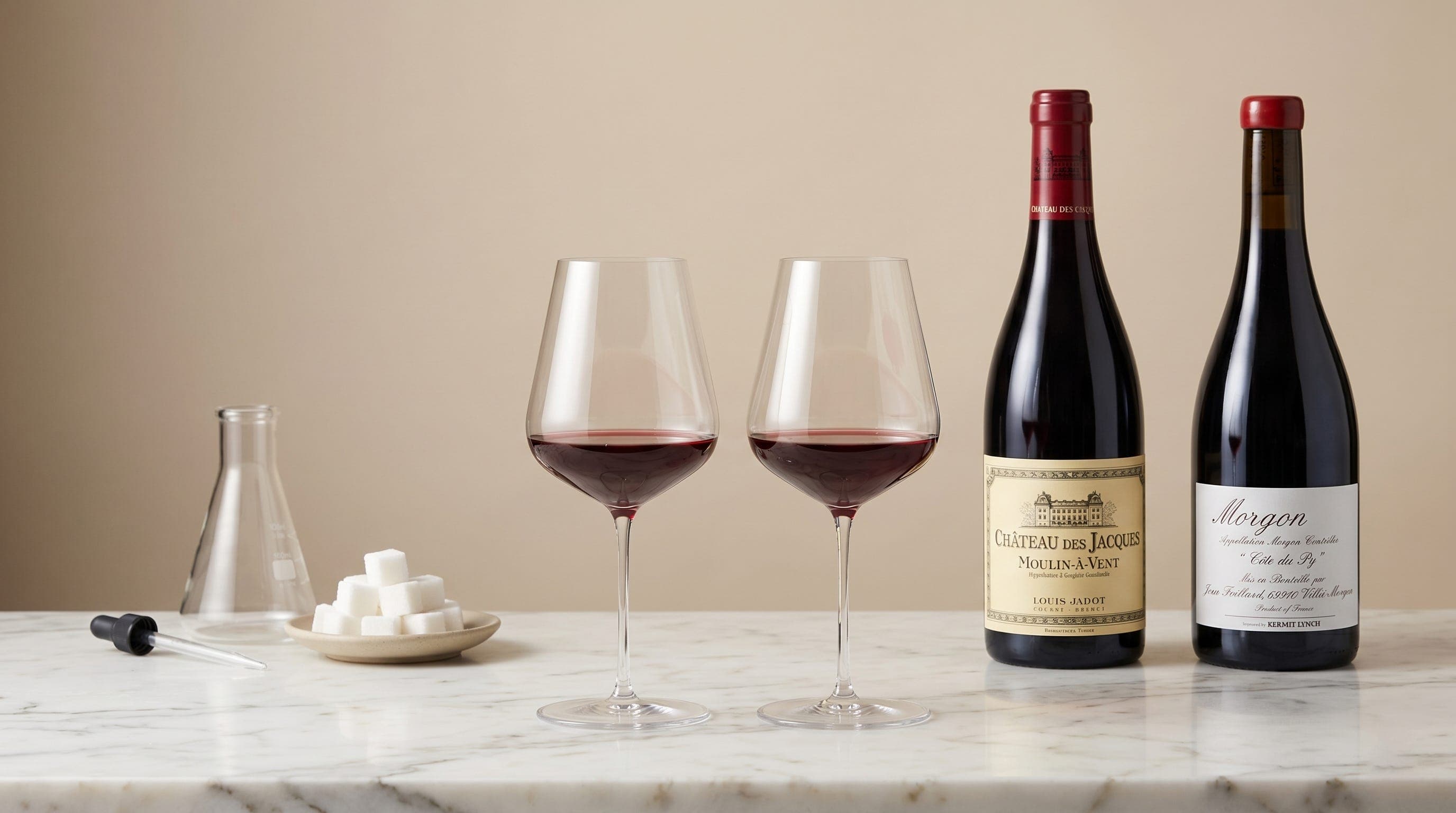
- Conventional: Louis Jadot Beaujolais-Villages “Combe aux Jacques,” Château des Jacques Moulin-à-Vent, or Joseph Drouhin Beaujolais-Villages ($12 to $16).
- Low-intervention: Marcel Lapierre Morgon, Jean Foillard Morgon “Côte du Py,” or Domaine de la Grand’Cour (Jean-Louis Dutraive) ($30 to $42).
What to notice:
- Fruit that tastes closer to crushed fresh grapes in the low-intervention wine.
- Sometimes a faint prickle of CO2 or a wild, earthy edge.
- Brighter, more nervous acidity and less of the smooth, uniform polish.
- The conventional wine is rounder, cleaner, and more consistent bottle to bottle.
The lesson: Low-intervention means little or no added sulfur and minimal correction along the way. The freshness and the funk you taste are the absence of the usual safety net. Marcel Lapierre and Jean Foillard, students of the chemist Jules Chauvet, showed a generation what Gamay tastes like with almost nothing added. Use this pair as your calibration for the whole spectrum, and notice which end your own palate leans toward.
# 2: Fined, filtered, or left alone
Objective: See and feel what fining and filtration remove, and learn why some wines are vegan and some are not.
What to try: One white labeled “unfined and unfiltered” and one conventionally fined and filtered, same broad weight.
- Unfined and unfiltered: Broc Cellars “Love White,” Donkey & Goat “Stone Crusher,” or any low-intervention white whose back label carries those words ($25 to $38).
- Fined and filtered: Santa Margherita Pinot Grigio, Kim Crawford Sauvignon Blanc, or most supermarket whites ($14 to $25).
What to notice:
- A slight haze or fine sediment in the unfiltered wine against the water-clear conventional one.
- A broader, slightly grippier texture where nothing was stripped out.
- Cleaner, more linear fruit in the filtered bottle.
The lesson: Fining drops proteins and harsh compounds out of a young wine using agents like bentonite clay, egg white, casein from milk, or isinglass from fish. That last group is why a wine can fail to be vegan, and why “unfined” shows up on bottles aimed at vegan drinkers. Filtration then polishes for clarity and stability. Both steps make a wine cleaner and steadier on the shelf, and both can shave away a little texture on the way.
# 3: The sugar added at the end
Objective: Taste an addition you would otherwise never detect: the dosage of sugar that finishes most sparkling wine.
What to try: A Brut sparkling and a Brut Nature (zero dosage) of the same type, side by side.
- Brut: Segura Viudas Brut Reserva Cava, Roederer Estate Brut (California), or any Cava or Crémant labeled Brut ($14 to $25).
- Brut Nature or Brut Zero: Raventós i Blanc “de Nit,” Gramona Brut Nature, or Drappier Brut Nature ($20 to $35).
What to notice:
- The Brut feels faintly rounder and softer on the entry.
- The Brut Nature reads leaner and drier, more chalk and citrus pith.
- The whole difference is a few grams of sugar per liter, added after the bubbles were already made.
The lesson: Dosage is a small splash of wine and sugar added at disgorgement, the last decision before the cork goes in. A Brut can carry up to about twelve grams of sugar per liter; a Brut Nature has essentially none. You are tasting a deliberate addition that no front label puts a number on. Notice it once and you will feel dosage in every sparkling wine you drink after.
The Finish
A bottle of wine is a stack of decisions, some made in the vineyard and some made in a tank with lab equipment. Most of those decisions never reach the label, which is why two Cabernets at the same price can taste like they came from different planets.
Knowing the intervention spectrum exists is the whole unlock. It explains the differences you have been tasting for years without a name for them.
Here’s the part worth sitting with. Across these three tastings, did you lean toward the cleaner, more corrected wines, or the rawer, less-adjusted ones? There is no right answer, and that preference is real information about you. Plenty of thoughtful drinkers love a polished, conventional bottle, and plenty love a wild, barely-touched one. The trap is letting the word “natural” or the word “premium” decide for you before the wine reaches your tongue. That instinct to outsource the verdict is the same one we keep coming back to.
One action this week: buy one bottle that tells you how it was made, an unfined white, a zero-dosage sparkling, a low-sulfur red, and drink it next to your usual. Place yourself on the spectrum on purpose, just once.
Go Deeper
If this week’s idea stuck with you, these resources take the conversation further.
- *University of California, Davis, “Why does red wine cause headaches?” *The current science on red wine headaches, which points away from sulfites and toward other compounds, from the leading U.S. wine-research university.
- *Jamie Goode and Sam Harrop, “Authentic Wine: Toward Natural and Sustainable Winemaking” (University of California Press, 2011). *A scientist and a Master of Wine give the most evenhanded account of natural winemaking, sulfur, and the line between character and fault.
- *Jamie Goode, “Natural wine, a primer” (wineanorak.com). *The same science-minded writer lays out the low-intervention case in full, sulfur, additives, and all, free to read start to finish.
- *U.S. Alcohol and Tobacco Tax and Trade Bureau (TTB), “Wine Labeling”. *The government rulebook for what a U.S. wine label must disclose, including the sulfite statement and the long list of things it does not require.