1 Big Idea: Curiosity is a Method
A 2014 Dujac Nuits-Saint-Georges 1er Cru Les Damodes stopped me mid-conversation at a friend’s dinner table about a decade into drinking Pinot Noir seriously. I knew Burgundy by reputation. I did not know it could land like that. I kept going back to the glass between bites, trying to figure out why it smelled like crushed rocks and dried roses at the same time.
The next week, I bought what a magazine had told me was the next great thing on the shelf at my wine shop. Different grape, different region, different producer. It was fine. I learned nothing.
The wine that stops you is a doorway. Walking through it is a skill.
The reflex most drinkers follow
When a bottle resonates, the standard move is horizontal at random: the next critically acclaimed wine, the next on the recommended list, the next bottle picked by somebody else. That reflex trades the one wine you actually felt something about for a chance to feel something about a wine you did not choose.
The wine that landed was a piece of evidence about you. The wine the critic picks is a piece of evidence about the critic.
Curiosity as a method
Curiosity, treated as a method, has three directions:
- Vertical. The same wine across vintages, so you start to see what the producer can and cannot do with time. Holding the maker fixed lets the year speak.
- Horizontal. The same appellation by a neighbor, so you start to feel the difference between the producer’s hand and the place. Holding the place fixed lets the choices speak.
- Axial. The same grape grown somewhere else, so you start to hear what the grape itself sounds like in a different climate. Holding the grape fixed lets the location speak.
Three moves. One wine. Months of useful exploration that all flow from a bottle you already chose.
Why method beats taste-of-the-month
The Dujac told me something about Burgundy I would not have heard otherwise. The wine was the data. What I did next was the experiment.
Horizontal at random would have given me one more impression of one more bottle.
Vertical, horizontal, and axial gave me, over the following year, a working sense of Pinot Noir as a grape, of Nuits Saint Georges as a village, and of Domaine Dujac as a producer.
That sense lives in my mouth now, and it cost me less than what most drinkers spend in a year chasing scores.
3 Tasting Experiments
The same lesson, taught three times, in three different directions. Each pair is a controlled comparison: hold two variables steady and let the third one speak. You are not trying to decide which side is “better.” You are training your ear to hear one variable at a time.
#1 Vertical: Same Producer, Two Vintages
Objective: Hold the producer constant. Hear what the vintage did to the wine.
What to try:
- Wine A - Famille Perrin “Réserve” Côtes du Rhône 2021 ($16-20). Look for Famille Perrin “Réserve” Côtes du Rhône, Guigal Côtes du Rhône, or Delas Saint-Esprit Côtes du Rhône, all available with multiple vintages in stock at most retailers.
- Wine B - Same producer, 2023 release ($16-20). The same label, two years younger. Almost every supermarket and wine-shop carries two or three vintages at once.
What to notice:
- Fruit ripeness. Which side reads more sun-ripened, which more bright and red?
- Acid sharpness on the entry.
- Tannin grip in the mid-palate.
- Oak presence (or absence) at the back of the nose.
- Finish length and warmth.
The lesson: When the maker stays fixed, the difference you taste is the year. The vintage leans warmer or cooler, riper or fresher, more or less generous on the finish. That is the first reading skill of this method: hearing weather under the label.
#2 Horizontal: Same Appellation, Two Producers
Objective: Hold the appellation constant. Hear what the producer’s hand does.
What to try:
- Wine A - Henri Bourgeois “Les Baronnes” Sancerre ($26-30). Look for Henri Bourgeois “Les Baronnes,” Pascal Jolivet Sancerre, or Domaine Hippolyte Reverdy Sancerre.
- Wine B - A second Sancerre from a different producer ($26-30). Look for Domaine Vacheron Sancerre, Domaine Daniel Chotard Sancerre, or Pascal Jolivet Sancerre (if Bourgeois was Wine A).
What to notice:
- Texture: chalky, creamy, or wiry?
- Where the wine sits on the palate: front-loaded or building toward the back?
- Aromatic lift: grapefruit and gooseberry, or stone fruit and herbs?
- Finish: bright and short, or long and saline?
The lesson: Same place, same grape, same vintage. What separates the two is choice: when to pick, what soil orientation, neutral steel or older oak, lees contact or no. The producer’s hand becomes audible when everything else holds still. Once you can hear it in Sancerre, you can start hearing it in any village you care about.
#3 Axial: Same Grape, Two Regions
Objective: Hold the grape constant. Hear what the place does.
What to try:
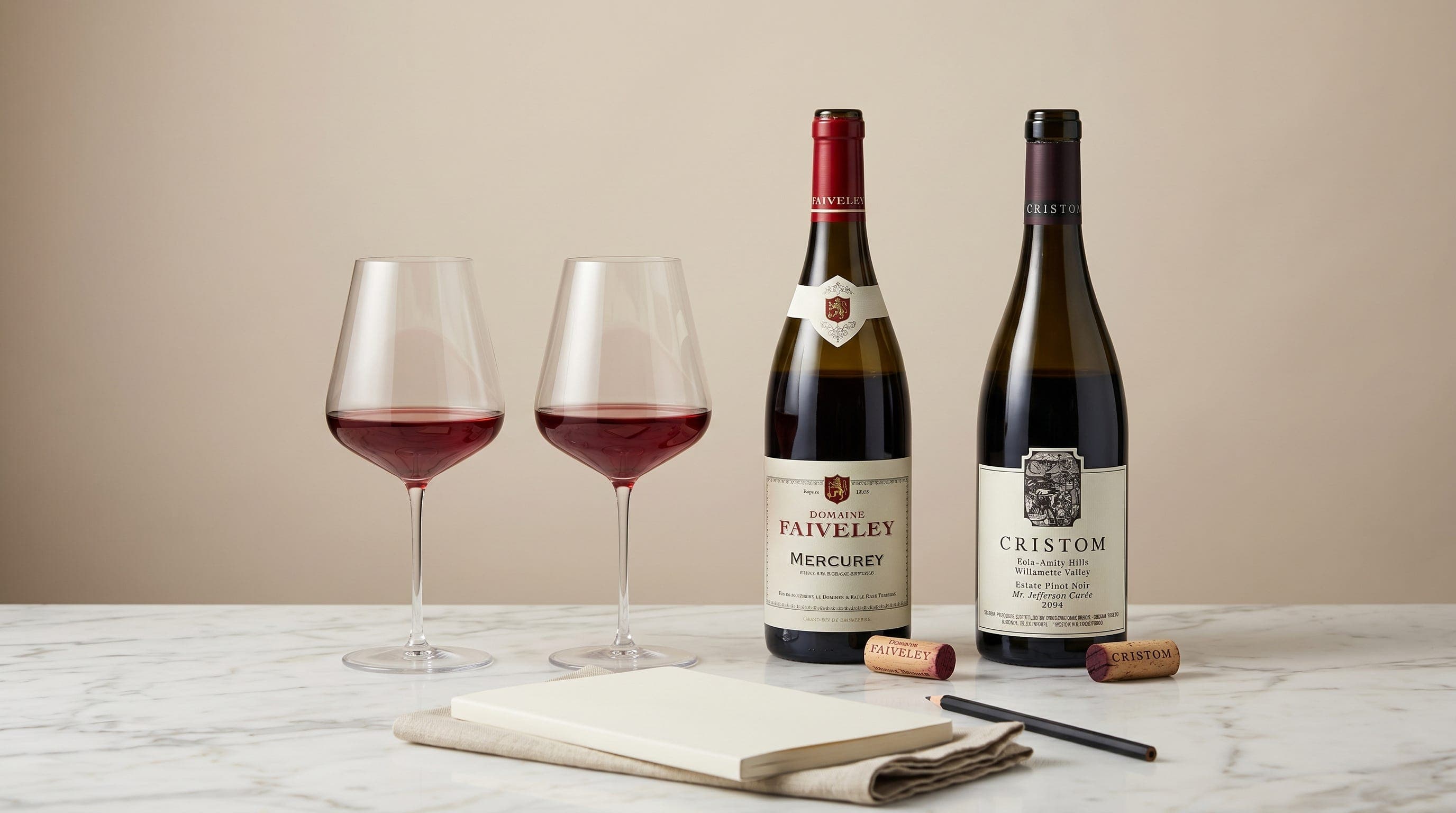
- Wine A - Burgundy village Pinot Noir ($45-60). Look for Maison Joseph Drouhin Mercurey or Côte de Beaune-Villages, Domaine Faiveley Mercurey, or Maison Louis Jadot Bourgogne Rouge.
- Wine B - Oregon Willamette Valley Pinot Noir ($35-45). Look for Cristom “Mount Jefferson Cuvée” Pinot Noir, Bergström “Cumberland Reserve” Pinot Noir, or Domaine Drouhin Oregon “Roserock.”
What to notice:
- Fruit register: red (cranberry, cherry, raspberry) or darker (plum, black cherry, cola)?
- Earth on the nose: forest floor and mushroom, or sage and pine?
- Acid line: tight and quick, or longer and rounder?
- Tannin texture: fine and brushed, or grippier and chewier?
- Alcohol weight on the finish.
The lesson: Same grape, two climates and two soil families. What changes is the place speaking through the grape. You start to hear the grape itself as a translator, with the location supplying the text and the producer choosing which lines to underline. Once a grape becomes audible this way, you can carry it anywhere in the world and still recognize its voice.
The Finish
Across three different moves, the same act: take one wine that resonated and use it as a benchmark you can compare against. Vertical taught you the year. Horizontal taught you the hand. Axial taught you the climate and the grape’s own voice.
The map you build this way is yours. Critics start theirs in someone else’s vocabulary. Yours starts in your mouth.
Your three directions are vertical (loyal to the producer), horizontal (loyal to the place), and axial (loyal to the grape). Your answer about which to walk next is a small piece of self-portrait. It tells you what you actually came to wine for: the artist, the terroir, or the varietal voice.
Most drinkers I admire are loyal to the producer first and the place second. A few are grape obsessives. None of them got there by trying everything once.
This week, before you buy the next “highly rated” bottle, find a wine you have loved in the past six months and pick one direction. Pick one bottle and make one move. Write down what you noticed. That note is the first page of the map.
Go Deeper
If this week’s idea stuck with you, these three free resources take the conversation further.
- Tablas Creek Through Three Eras: Tasting Every Esprit de Beaucastel and Esprit de Tablas, 2000-2023, Jason Haas, Tablas Creek Vineyard Blog (July 2024). Tablas Creek’s general manager walks through a 23-vintage vertical of the estate’s flagship red and explains what they are trying to learn each summer by holding the maker fixed and varying the year. The cleanest primary source on the vertical move you can read in a sitting.
- How—and why—to blind taste, Samantha Cole-Johnson, JancisRobinson.com (February 2026). The argument for why side-by-side comparison teaches more than any single bottle ever will. Sets the intellectual frame behind this week’s method and explains why a “right answer” is the wrong goal.
- How to Level Up Your Blind Tasting Skills, Caitlin A. Miller, SevenFifty Daily (September, 2025). A working-sommelier piece on the daily habit of holding variables steady and the discipline of repetition. The cultural cousin of this week’s reframe, from people who do this for a living.
Looking Ahead
This Wednesday, The Polished Palate adds a second weekly slot called The Decant.
When wine has its cultural moments, the translation work that follows usually gets scattered across trade press and wine blogs the new audience doesn’t read. The Decant is an attempt to do that work in one place, every week, before the next moment arrives.
The first twelve issues cover the wine world that Netflix’s *Uncorked* is about to land in: Napa’s actual history, the 100-point scoring system, and the real winemakers the show’s protagonist is built from.
Same publication, same email list. Substack lets you choose Saturday only, The Decant only, or both, via your account preferences. The first issue lands Wednesday May 20 at 10am CT.