A few weeks ago, the wine internet held a fiftieth birthday party. The Judgment of Paris turned fifty on May 24, and the retrospective pieces arrived on schedule. The blind tasting, the French judges, the American upset, the morning Napa supposedly grew up. You have probably read three versions of that story by now. I am not going to write a fourth.
Everyone agrees Napa won in 1976. The more useful question, the one the anniversary coverage mostly skipped, is what Napa actually won. The answer is permission. That afternoon, Napa earned the right to be taken seriously on the same terms as France.
The trophy and the price tags came later, and they came for their own reasons. Fifty years on, that permission is still the most important thing on the table, and it explains the region you are looking at when you stare down a wine list today.
Sommelier training teaches you to taste blind, and the first thing it teaches is humility. You sit with a glass you cannot see the label of and build a verdict from the wine alone: its fruit, its structure, where and when it might have grown. What you learn fast is that the verdict is never certain. Two well-trained palates can taste the same wine and reach different calls, and both can defend theirs. The training does not hand you a number to hide behind. It makes you reason in the open and own the conclusion.
That is the lens I want to put over 1976, because the Judgment of Paris did the opposite of what blind tasting trains you to do. It took a room full of professionals and asked them to collapse each wine into a single number, then added the numbers up. Hold that thought. It matters more at the end than the trophy does.
The story everyone just retold
Here is the version you already know, compressed. On May 24, 1976, an English wine merchant named Steven Spurrier staged a blind tasting at the InterContinental Hotel in Paris. Spurrier ran a wine shop and a wine school in the city, and his colleague Patricia Gallagher, an American, helped organize the event in the year of the United States Bicentennial. A panel of nine French judges, all of them serious figures in the trade, tasted California against France without seeing the bottles. The reds put California Cabernet Sauvignon against red Bordeaux. The whites put California Chardonnay against white Burgundy.
The judges were not lightweights. They included Aubert de Villaine, co-director of Domaine de la Romanée-Conti, Pierre Tari of Château Giscours, and Odette Kahn, director of La Revue du Vin de France.
When the scores were added up, a Napa wine topped each flight. Stag’s Leap Wine Cellars 1973 Cabernet won the reds. Chateau Montelena 1973 Chardonnay won the whites. Both were from the Napa Valley. Both beat first-growth Bordeaux and grand cru white Burgundy in front of French judges on French soil.
One journalist was in the room. George M. Taber of Time was there because it looked like a slow news week, and his short article ran in the magazine on June 7, 1976. That single piece of coverage became the seed of a fifty-year legend.
The anniversary essays this spring retold all of it again, usually as a triumph, often as the moment American wine arrived. Fair enough. It happened. The trouble is that arriving was the least interesting part of the day.
What Napa actually won was permission
Before 1976, American wine carried a structural inferiority complex toward France. The assumption ran one direction. France set the standard, and everyone else was measured against it, usually at a discount. A California Cabernet could be very good “for California.” The comparison to Bordeaux was a comparison a California wine was expected to lose.
The Judgment changed the direction of the measurement. After nine French judges ranked Napa above Bordeaux blind, the region earned the right to be evaluated on the same axis as France, at full price and full seriousness. That is the prize. Permission to belong in the conversation as a peer.
This is also where I think the anniversary coverage and the cork-popping retrospectives go soft. They treat the win as the end of a story, the day Napa became great. The win was the beginning of a much harder story.
Permission is a standard you have to keep meeting, every vintage, forever. The morning after you beat Bordeaux blind, you have to keep being worthy of having beaten it. France stopped being the ceiling and became the yardstick, and a yardstick does not go away.
That is the quieter prize the parties this spring mostly missed. Napa won more than an afternoon. It took on a permanent obligation to be as good as the best wines in the world, by the world’s own measure. Everything the region has done since, the ambition and the anxiety in equal measure, runs back to that obligation.
The bill that came with the permission
Here is where I want to be careful, because the easy version of this essay is the angry one, and the angry one is wrong. It goes like this: the Judgment of Paris created modern Napa, including the four-figure Cabernets and the prestige arms race, so 1976 is where the region’s problems began. That story is tidy and it does not survive scrutiny.
I go back and forth on how much weight that single afternoon can hold. Some weeks I think 1976 gets too much credit for a shift the region was already moving toward. The reading I keep returning to is that the Judgment was a catalyst. The authorship of Napa’s prices belongs to forces that arrived a decade later.
The cult Cabernet phenomenon, the mailing-list scarcity model, the hundred-dollar bottle as a category, those are a story of the late 1980s and the 1990s, driven by Robert Parker’s hundred-point scores, by a handful of small producers, and by a market that learned to treat rarity as a feature. Crediting all of it to a tasting in 1976 is the same kind of tidy myth the anniversary coverage trades in, just with the sign flipped from celebration to complaint.
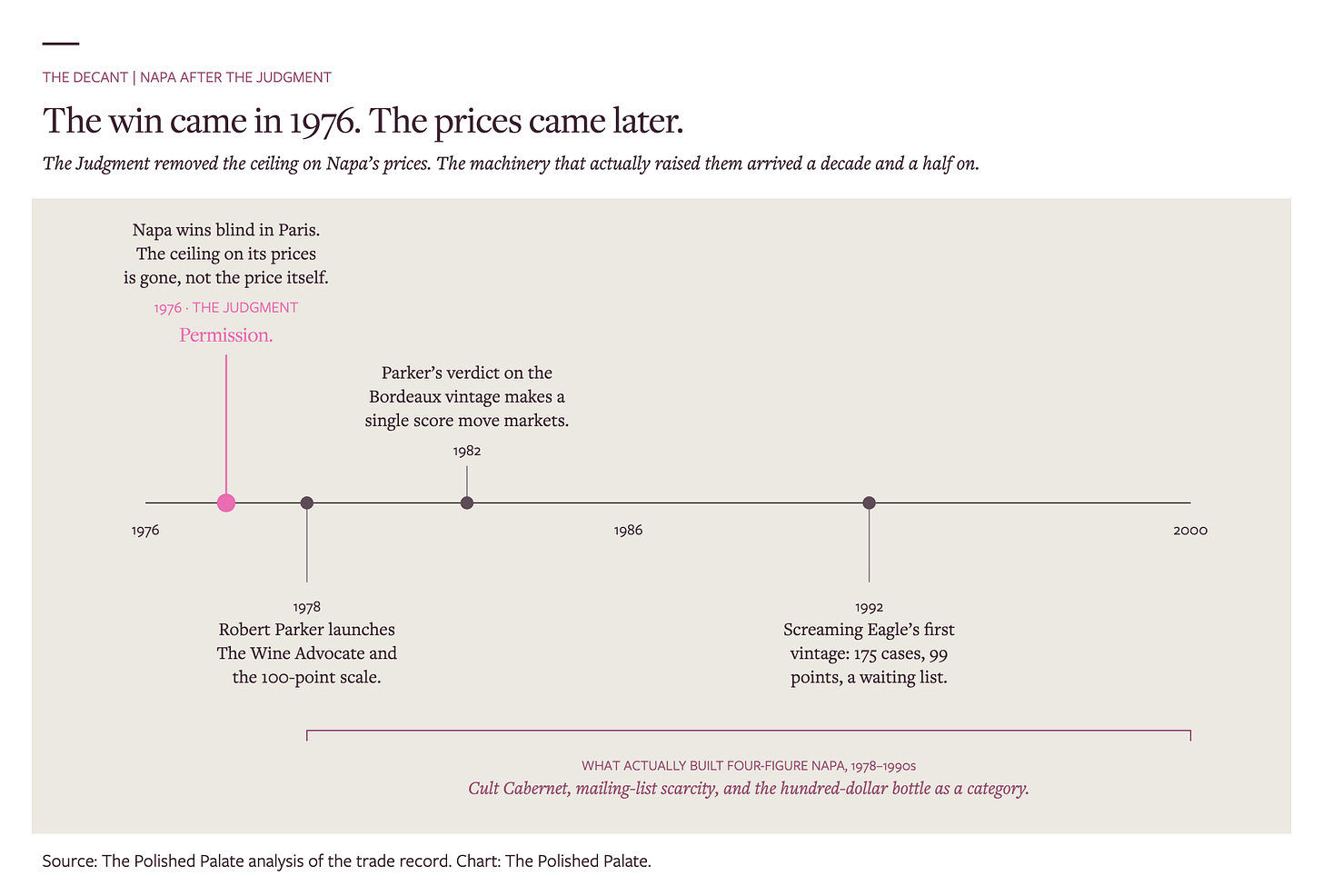
What 1976 did was remove the ceiling on what Napa could credibly charge. The Judgment proved the region could justify a seat at the Bordeaux table. Proving you can command a price and actually commanding it are separated by fifteen years and several other causes.
Price is the most visible expression of Napa’s prestige, and the prestige is the thing 1976 set in motion. The dollar figure is downstream of that, and it is not the whole of what is interesting or troubling about the region. The more durable questions are about style, about whether a place spends its permission chasing a flavor that scores well, and those questions belong to the reader’s own palate more than to any auction result.
A number beat a name
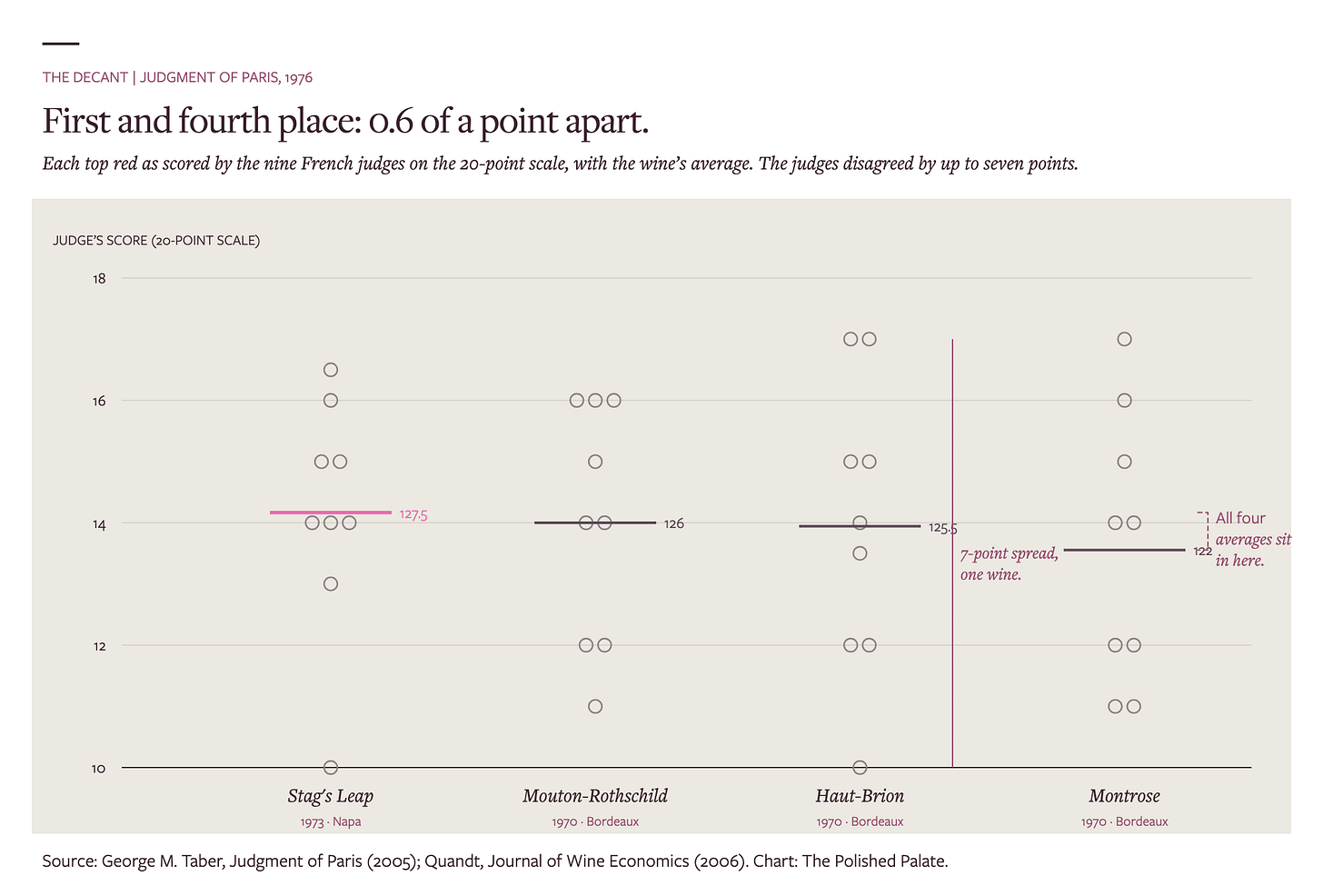
Now back to that room full of professionals assigning numbers. The detail the legend tends to skip is that the Judgment of Paris was, mechanically, a scoring event. The judges rated each wine on a 20-point scale. There was no shared framework for how to spend those points, and the scores were simply added up.
A number, aggregated, publicly overturned a reputation. That is the most relevant part, because it is the ancestor of the wine culture we’ve been living in for decades now.
The judges themselves seem to have understood the stakes of the number in real time. As Taber recounted, Odette Kahn, the one woman on the panel and the editor of a serious French wine magazine, asked for her scorecard back once she realized she had ranked California highly. She was refused. The scores stood, and the scores made the story.
The methodology, though, was thin. Wine economists have spent years pointing this out, and they are the most interesting skeptics in the room. Orley Ashenfelter and Richard Quandt reanalyzed the 1976 results and showed that a ranking built by summing 20-point scores, from judges who disagreed sharply with one another, does not hold up as a confident result. Quandt laid out the broader statistics in the Journal of Wine Economics in 2006.
The short version is that most of the wines were separated by margins too small to mean much. The famous order of finish was, in a real sense, statistical noise wearing a crown.
Here’s the irony - the event that taught a generation of wine drinkers that a score could beat a pedigree was itself built on a score too fragile to trust. We learned the wrong lesson from the right result.
The right lesson is the one blind tasting teaches you early. A score is a tool with wide error bars, useful for organizing a thought, dangerous when you mistake it for the truth.
Every time you let a 95-point rating decide what is in your glass, you are trusting the same kind of instrument that crowned Stag’s Leap, and you are trusting it more than the people who built it ever did.
The Finish
Fifty years later, the Judgment of Paris is still working on you, and not in the way the anniversary pieces suggest. The next time you stand in front of a wall of Napa Cabernet and reach for the one with the highest score on the shelf-talker, you are standing downstream of a permission slip signed in a Paris hotel in 1976, and you are leaning on a number that the wine’s own crown was never strong enough to bear.
So try the experiment the French judges ran, with one change. Pour something blind this week, a Napa Cabernet if you have been curious, and give it your own score before you look at anyone else’s. Then check the bottle and the critics. See whether your number and theirs agree, and notice which one you trust more after the wine is gone. That gap, between the score on the label and the verdict of your own palate, is the whole inheritance of 1976. Napa won the right to be measured. You have the same right, and nobody can taste the wine for you.
Go Deeper
- George M. Taber, Judgment of Paris (Scribner, 2005): The firsthand, book-length account from the only journalist in the room, and the source for the Odette Kahn scorecard story.
- Remembering Steven Spurrier and the 1976 Judgment of Paris Tasting (UC Davis Library): A reputable institutional retrospective on the organizers, the format, and why the tasting mattered.
- Richard E. Quandt, “Measurement and Inference in Wine Tasting,” Journal of Wine Economics (2006): The free, rigorous statistical case for why summed tasting scores cannot support a confident ranking, which is exactly what the 1976 result was.