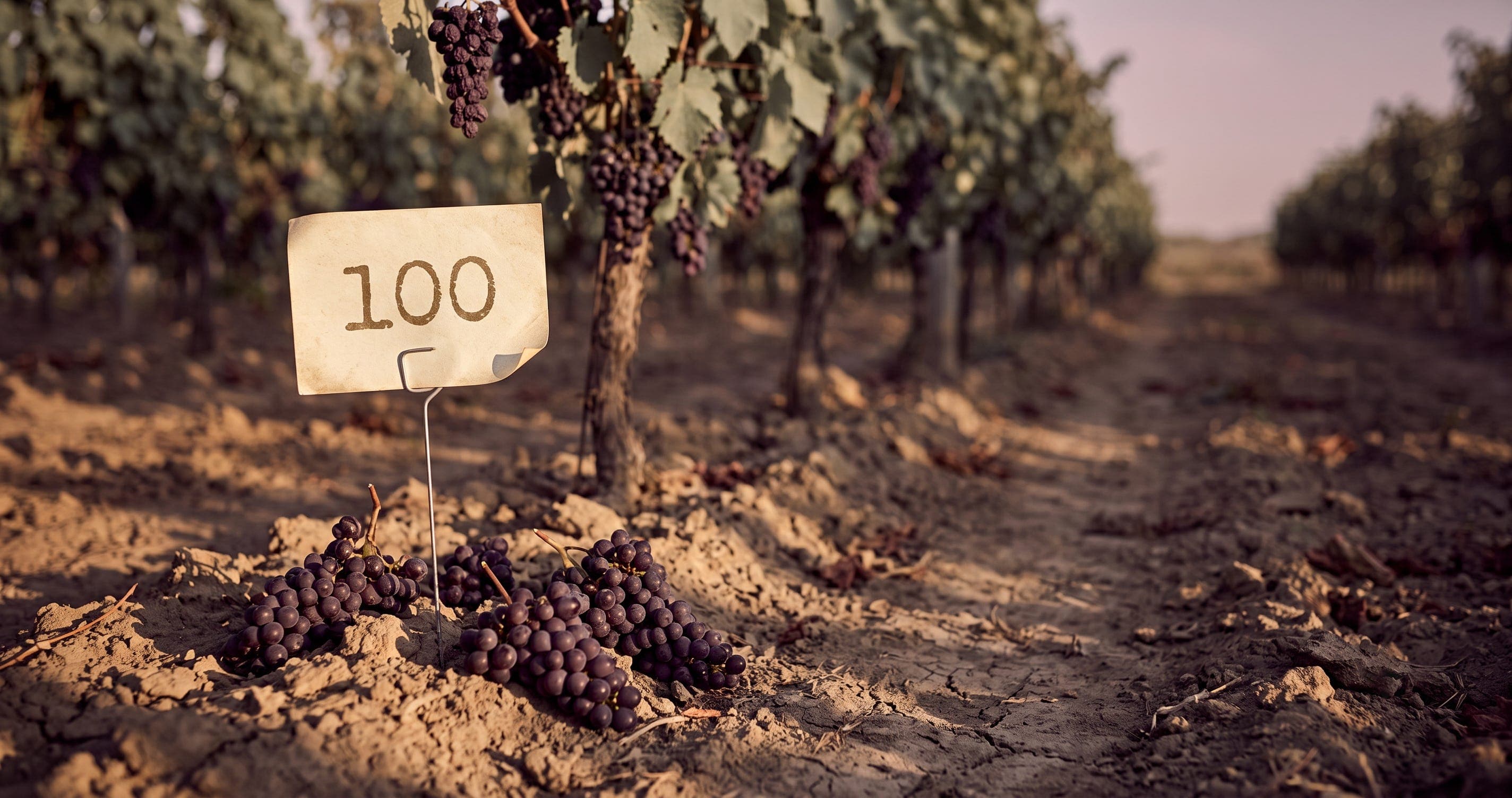
If you have opened a Napa Cabernet or a Saint-Émilion in the last twenty years and found it darker, riper, and warmer than you were expecting, you were tasting somebody’s decision about money.
In June I wrote about how the 100-point score works, and why 90 points is a price cliff, which was about what the number does to a buyer standing in a shop with thirty dollars and no way to taste first. This one is about the other end of the chain, where the number stops being advice and becomes an instruction.
The chain is short. A critic tastes a wine and assigns it a number. The number moves the price. The price is the clearest signal a grower ever receives from a market of strangers, so the grower reads it as a specification - make more of whatever earned the points. This is Goodhart’s Law (when a measure becomes a target, it ceases to be a good measure) in action.
Proving how strong that signal was would take an accident, because a score comes tangled up with everything else that makes a wine expensive: the name on the gate, the reputation of the vintage, three hundred years of history, etc. The accident happened the year Robert Parker missed his customary spring tasting trip to Bordeaux.
What one point is worth
Every spring the Bordeaux chateaux publish prices for a vintage still sitting in barrel. It is a strange market known as “En Primeur”. The wine will not be bottled for two years, so nobody is buying on their own experience of it. They are buying on the reputation of the estate and on what the critics said in April, and for two decades the critic who mattered most was Parker.
The year he skipped the trip, his grades appeared in the autumn, after the chateaux had already set their opening prices. Three economists at INRA, Hela Hadj Ali, Sebastien Lecocq and Michael Visser, saw what that handed them: one year of prices formed with Parker’s numbers in hand and one year formed without, roughly 250 wines from a single large Bordeaux broker, everything else held constant. Writing in the Economic Journal in 2008, they put the Parker effect at 2.80 euros a bottle, about 15 percent of the average opening price, largest in Pomerol, the corner of Bordeaux that Parker loved most.
Robert Ashton later ran the question across more than 1,700 red Bordeaux from the 2004 through 2012 vintages. In the Journal of Wine Economics in 2016 he reported that one additional Parker point was associated with roughly a 12 percent higher futures price on the Left Bank and 16 percent on the Right Bank, after controlling for classification status and vintage.
Twelve percent, for one point, on a scale whose working range is about twenty-five rungs wide, awarded from a barrel sample of a wine that will not be finished for two years.
The clearest single receipt comes off the trading floor. Anthony Maxwell of Liv-ex documented what happened when Parker published a perfect 100 for the 2009 Chateau Haut-Bailly in November 2014. Within three days the trade price of a twelve-bottle case went from 775 pounds to 1,125, a gain of just over 45 percent, on wine that sat in the same warehouse, unchanged, the whole time.
The effect ran in reverse too, and the producers it had lifted said so. Jean-Luc Thunevin built Chateau Valandraud out of a rented garage and less than an acre and a half in Saint-Emilion, on Parker’s scores. Asked by Decanter what became of the wines that followed him, he was blunt: “Some garage wines were only as good as the last Parker rating. And they suffered because they became too expensive.”
Pierre Dubois and Celine Nauges have shown that studies unable to account for quality the researcher cannot observe will overstate a critic’s influence, since a genuinely better wine attracts both the higher score and the higher price. The real effect is probably smaller than these numbers suggest. It was still large enough to reorganise an industry.
Given that arithmetic, a grower who changes how he farms is making a rational business decision.
What it cost the vines
Julian Alston and three colleagues at UC Davis went looking for the consequences in the least romantic place available: sugar readings taken at the crush.
In the Journal of Wine Economics in 2011 they reported that the average sugar content of California wine grapes climbed from 21.4 degrees Brix in 1980 to 23.3 in 2008. Cabernet Sauvignon went from 22.8 to 25.0. Using the paper’s own conversion, where finished alcohol runs to about 0.55 times the sugar reading, that Cabernet figure is close to a full extra 1.2 percent of alcohol in the glass, arriving over a single working lifetime.
The obvious suspect was the weather, and they tested it. Adding a growing-season heat index barely dented the trend, and the index itself implied about 0.04 degrees Brix per degree of warming, which the authors call a comparatively small effect. Their language about the cause is careful and I will keep it that way: the pattern is consistent with growers picking later in response to demand for riper flavours, of the kind reflected in higher Parker scores. Consistent with. Nobody has run the regression that would prove it, and I am not going to pretend otherwise.
Translate two degrees of Brix into farming and it means leaving fruit hanging into the heat of September, dropping bunches so the survivors concentrate, and buying new barrels every year. Each of those costs money before anyone tastes anything. New French oak runs to the price of a used car per barrel, and dropping fruit means growing a crop and throwing part of it on the ground on purpose.
Refusing costs money too. Cathy Corison has farmed Kronos, an eight-acre Cabernet vineyard in St Helena planted on St George rootstock at the start of the 1970s, and she has kept the old vines in the ground. Betsy Andrews reported the numbers in SevenFifty Daily in 2018: Kronos yields about 1.25 tons an acre, where a replanted vineyard might give three to five. Corison’s Cabernets sit near 13.5 percent alcohol, and for most of the 1990s and 2000s that put her on the wrong side of fashion. She told Andrews, “Even five years ago, it wasn’t fashionable to make wines like this, but I couldn’t make myself do anything else.”
Chasing the style costs money, and so does refusing it. The score created both bills.
One honest complication. Peter Godden and colleagues at the Australian Wine Research Institute looked at 24,066 bottled Australian wines and found the long climb in red wine alcohol has gone into reverse. The demand that pushed alcohol up for thirty years has stopped pushing.
The man who said it was not him
The consultant most often blamed for the style died on March 20 of this year, of a heart attack, at 78.
Michel Rolland was born in Libourne in 1947, trained under Emile Peynaud, and built a laboratory in Pomerol into the most influential consulting practice the trade has had. By the count published in Jane Anson’s Inside Bordeaux last year, he advised more than 150 estates across 14 countries, with roughly 250 more using his lab.
Wine Spectator’s obituary listed his California clients: Harlan, Araujo, Dalla Valle, and for a period the Robert Mondavi Winery. Jonathan Nossiter’s 2004 documentary Mondovino put him on screen riding between properties telling clients to micro-oxygenate, and made “Parkerization” a word ordinary drinkers used.
He rejected the charge for the rest of his life, and he was funny about it. “It’s not true that I made wine to suit Parker,” he told 67 Pall Mall in January 2025. “It’s completely fake.” On the criticism itself: “But if you have no critics, you may as well not exist. I prefer to exist.” On the accusation that he flattened the differences between places: “It’s not possible to make a Saint-Estephe in Pomerol, or a Pomerol in Saint-Estephe.”
Christian Moueix of Petrus and Dominus put the independent position more coldly to Decanter, naming the cost he saw in the wines that chased the number: “They are stylistically dangerous because people are picking at super-ripe levels.”
Eric Asimov of the New York Times has stated the mechanism as plainly as anyone. Nobody ever forced winemakers to make those wines, he told PUNCH in 2022, and the reason many of them did is that they wanted high scores.
The chainsaw
The costs so far have been financial. The clearest example of the other kind is in Piedmont.
In 1983 Elio Altare carried a chainsaw into his family’s cellar in La Morra and cut up the large Slavonian casks his father used to age Barolo, so he could age the wine in small French barriques instead. He believed Barolo had to change to be taken seriously abroad. His father disinherited him, died in 1985 without reversing it, and Altare bought the estate back from his siblings.
To be precise about the score’s role: Altare did not do this because a critic scored him. The fight in Piedmont was about what Barolo ought to be, and it split families up and down those hills for twenty years, fathers against sons. The scores came in afterward.
When critics rewarded the modernist style, the producers who had switched could charge more, and the traditionalists could not. I went looking for families broken by chasing scores. I did not find any. I found families broken by arguments over style, and a scoring system that then decided which side of the argument made money.
What it cost in court
Where the pressure did leave a paper trail is Saint-Emilion, and the trail runs through a courthouse.
The public phase opened in 2003 over a single wine. Parker rated Chateau Pavie, remade by its owner Gerard Perse in the rich modern style, in the high nineties from barrel. Jancis Robinson gave it 12 out of 20 and called it a ridiculous wine, closer to a late-harvest Zinfandel than to red Bordeaux. Parker broke his usual silence to attack her note in public, Decanter covered the argument as news for months, and a decade later he raised his own score on the wine to 99.
Underneath the noise sat the real prize. Saint-Emilion reclassifies its estates roughly once a decade, and a promotion is worth more than any review, so the appellation has spent twenty years litigating its own hierarchy. Four demoted producers challenged the 2006 classification, and in 2008 a court found the tasting procedure had not been impartial. The ranking was annulled and the 1996 version reinstated for the vintages in between.
The 2012 classification produced a conviction. In October 2021 a Bordeaux tribunal found Hubert de Bouard de Laforest, co-owner of Chateau Angelus, guilty of illegal conflict of interest. He had chaired the regional committee of the INAO and the appellation’s own management body while taking part, as the court found, at every stage of the procedure that produced the ranking, and his estate had been elevated to Premier Grand Cru Classe A. He was fined 60,000 euros, 20,000 of it suspended. “Everything I have done, I have done for the collective,” he said afterward. “This is an injustice.”
By then the classification was losing the estates it existed to rank. Ausone and Cheval Blanc had already said they wanted no part of the 2022 ranking, and Angelus withdrew six months later. Three of the four estates at the very top of the classification walked away from the thing every estate below them was still fighting to enter.
What the man with the pen says
Parker has been more candid about the limits of his instrument than most of the people who quote it. Asked by the drinks business in 2015 how often a re-tasting confirms one of his own perfect scores, he answered: “Probably about 50% of the time.” He also rejects the indictment entirely. “Parkerization is a word used by people who don’t read the Wine Advocate,” he told an audience of wine writers in Napa in 2014.
Both things can be true. The man who built the instrument says his top mark reproduces about half the time, and the market moved a case of Haut-Bailly 45 percent in three days on the strength of one.
Pocket Palate: what a score costs
Five things the record shows about chasing critic points.
- What one point is worth: roughly 12 percent on a Left Bank Bordeaux futures price and 16 percent on the Right Bank, across more than 1,700 wines from 2004 to 2012.
- What a perfect score is worth: a case of 2009 Haut-Bailly went from 775 to 1,125 pounds in three days, on wine that never moved.
- What it asked of the vines: California grape sugar rose from 21.4 to 23.3 degrees Brix between 1980 and 2008, Cabernet reaching 25.0, and the heat index does not account for it.
- What refusing costs: Corison’s Kronos yields about 1.25 tons an acre where a replant might give three to five, and her style was out of fashion for two decades.
- What the chase cost in court: one classification annulled, a 60,000 euro fine for conflict of interest, and three of the four top estates quitting the ranking.
The Finish
The score was invented to spare a buyer from having to know anything, and that was a real gift. What nobody designed was the return path, where a shortcut meant for strangers in a shop arrives at a vineyard in Pomerol as a specification for how ripe the fruit should be when it comes off the vine.
There is no villain here. Parker published honestly and said out loud how often his top mark repeats. Rolland gave the advice his clients paid for. The growers followed the only clear price signal they had. Every actor behaved reasonably, and the aggregate was two degrees of Brix, a courtroom in Bordeaux, and a generation of wines that tasted more alike than the ones before them.
So the question worth carrying out of this is how much of what you like you actually chose. If the only Cabernet you have ever drunk was made in the style that scored well after 1990, you are holding a preference somebody handed you.
This week, open something the scale never rewarded. A Corison if you can find one, a traditional Barolo, a Loire Cabernet Franc at 12.5 percent, anything lean enough that a system trained on power would have marked it down. Drink it slowly, with food, and ask whether you miss the density or feel relieved by its absence. Whatever you answer is worth more to you than any number on a shelf card, because the score was assigned at a tasting bench, and your answer came from your own table.
A pairing for reading this one: something under 13.5 percent that nobody has ever scored above 91.
Go Deeper
If this week’s idea stuck with you, these take it further.
- Anthony Maxwell, Five Times Robert Parker Moved the Bordeaux Market (Robert Parker Wine Journal, 2019): The Liv-ex trading data behind the Haut-Bailly jump, case by case, including the times a score moved prices down.
- Patrick Schmitt, Parker: Not Awarding 100 Points Irresponsible (the drinks business, 2015): The interview where Parker discusses what a perfect score does to readers and how often he reproduces one.
- Betsy Andrews, Cathy Corison Leads by Example (SevenFifty Daily, 2018): The Kronos yield figures, the old vines she declined to replant, and Corison in her own words on staying unfashionable.
- Hubert de Bouard of Chateau Angelus Convicted in St.-Emilion Classification Case (Wine Spectator, 2021): The court findings, the fine, and how a ranking worth millions ended up in front of a judge.
- Julian M. Alston, Kate B. Fuller, James T. Lapsley and George Soleas, Too Much of a Good Thing? Causes and Consequences of Increases in Sugar Content of California Wine Grapes (Journal of Wine Economics, 2011): The Brix data, the climate test, and the authors’ own careful language about what caused the rise.
For the mechanics of the scale itself, see how the 100-point score works and why 90 points is a cliff, which this issue picks up from the producer’s side.