1 Big Idea: Real Place, Sold Story, Your Verdict
The first time terroir stopped being a vocabulary word for me, I was standing in a cellar in the Loire with a glass of Chinon in one hand and a fistful of the vineyard’s soil in the other. Cool, chalky, faintly damp. The wine seemed to smell of exactly that. The grower did not say a word. He just watched me connect the two and smiled. One caveat before the romance runs away with us: I told you in April that minerality does not come from minerals, and I stand by every word. What I was tasting was the signature of the conditions that soil creates, cold nights showing up as lean acidity, poor stony ground showing up as restraint and grip.
That is the honest version of terroir. A wine can carry the fingerprint of where it grew, the soil and the slope and the coolness of the nights, and when it does, you can feel it in the glass without anyone narrating it for you.
Then I came home, walked into a shop, and found the word stamped on a $12 bottle blended from grapes grown across four hundred miles of warm valley floor. Same word. Completely different thing. One wine actually tasted like where it grew. The other used the word to sound serious without the wine backing it up.
Here is what makes terroir the most abused word in wine. It is doing three jobs at once, and the trade has no incentive to keep them apart.
The first job is real. Some wines genuinely taste of somewhere specific, and a trained palate can pick that up.
The second job is packaging, and it is the one paying the bills. The word sells bottles, so it lands on wines built in the opposite direction from place: blended across hundreds of miles, corrected in the cellar, engineered to taste identical every vintage, then sold with a word that promises the opposite.
*There’s an important distinction here, though. A specific appellation on the front label is real information, and the smaller the named place, the more the producer is agreeing to answer for. Oakville says more than California. Chinon says more than France. If you read the recent issue on why Oakville Cabernet tastes different from Stags Leap, that was the first job working at a scale of a few miles. The unregulated word terroir on a back label carries no such commitment.*
The third job is the one nobody talks about, and it belongs to you. Even when the terroir in a glass is unmistakably real, you still get to decide whether that difference is one you enjoy, one you would pay for, one that changes your Tuesday night at all. Place-driven is not the same as better-for-you.
This week pulls those three jobs apart, one experiment each. You will taste terroir that is real and legible. You will taste a wine that uses the language of place on the label without delivering any of it in the glass. And you will run the only test that actually matters, the one where you decide whether any of it moves you.
3 Taste Experiments
Three pairs, three different questions. The first asks whether you can taste place at all. The second asks whether the label is telling the truth about it, and it is the heart of this issue, the one to run if you only have one evening. The third hands the verdict to you.
#1: Terroir You Can Actually Taste
Objective: Confirm that “tastes of somewhere” is a real, perceivable thing before we go hunting for the fake version. Chardonnay in both glasses: a transparent, place-driven Chablis against a California bottling built for consistency.
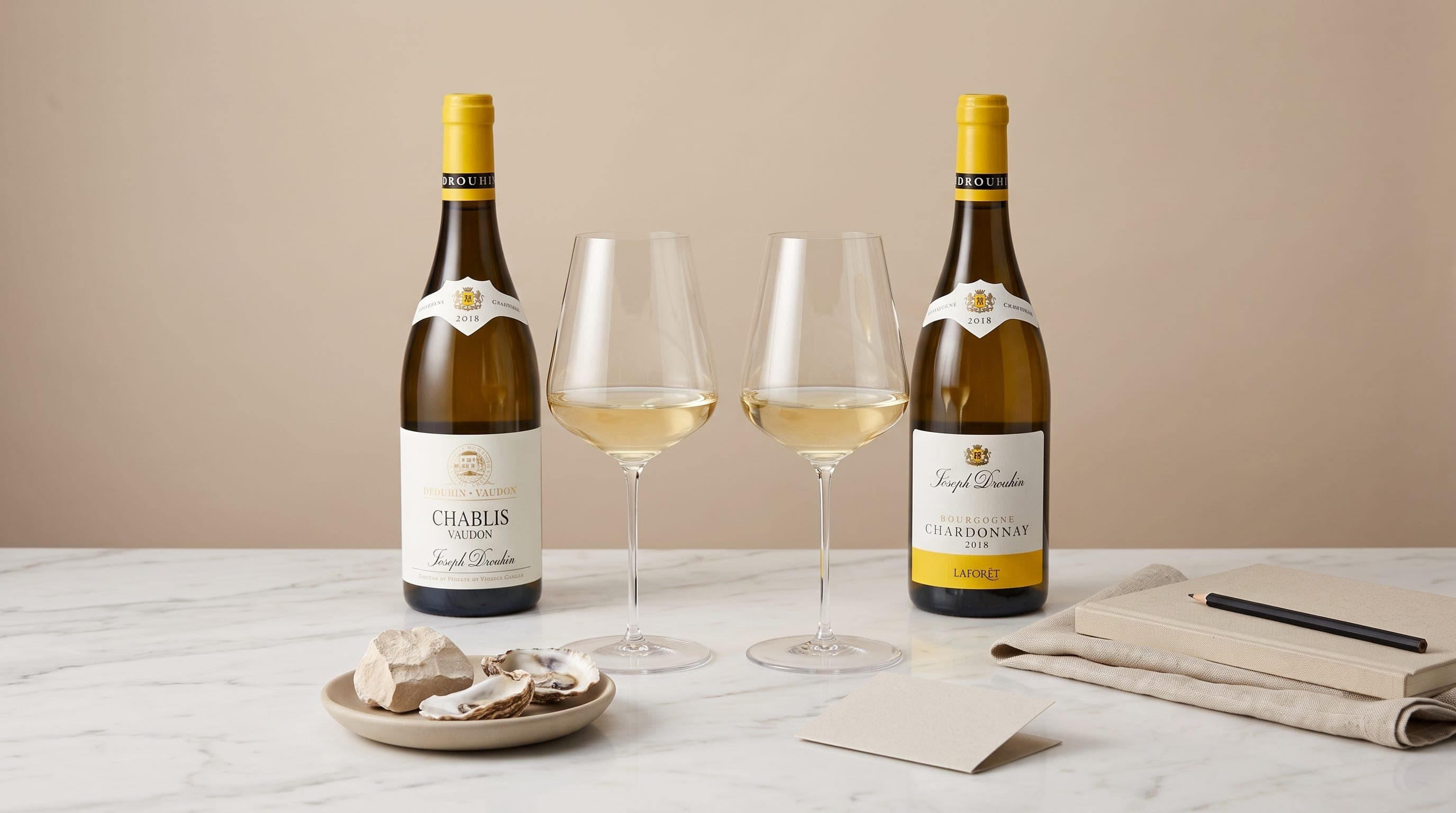
What to try: A stainless-steel Chablis such as Louis Michel, William Fèvre Champs Royaux, or Joseph Drouhin Vaudon, roughly $22 to $32. Then a warm-climate, house-style California Chardonnay such as Kendall-Jackson Vintner’s Reserve, Josh Cellars, or Cupcake, roughly $10 to $16. One grape across both glasses, so nothing you taste can be blamed on variety. If you plan to run all three experiments, buy the Vaudon, because the third experiment calls for that exact bottle.
What to notice: The Chablis comes at you lean and cool, with a wet-stone edge under the citrus and a finish that feels like it belongs to a cold place. The California Chardonnay is rounder, softer, and riper, often with a whisper of vanilla. Ask one question of each glass: does this taste like it came from a particular place, or like it was made to taste good anywhere?
Lesson: The first wine shows its origin plainly, cold nights in the lean edge, limestone in the stony grip. The second was built toward a reliable house flavor, and the team hit the target. Both can be delicious, but only one tastes like the place on its label, and now that you can feel the difference you can stop taking the label’s word for it. Keep that calibration for the next pair, where the label dresses this same style of wine in the language of place.
2: Terroir As Marketing
Objective: Catch the word being used as a costume, in a fair fight. Two California Pinot Noirs, both dressed in coastal language: one grown in a single cool appellation, one blended across three counties to a house recipe. Grape and state match, so the difference you taste is site and intent.
What to try: A single-appellation, estate-minded California Pinot Noir such as Au Bon Climat Santa Barbara County, Balletto Russian River Valley Estate, or FEL Anderson Valley, roughly $25 to $38. Then a mass-market California Pinot Noir built on coastal storytelling such as Meiomi, Böen, or Mark West, roughly $12 to $25. Check the fine print as you buy: the first group names one place, and the second names several counties at once, or simply California.
What to notice: Read both back labels first, out loud. Notice how similar the romance is, the talk of fog and coastline and craft. Then count what each label actually commits to. Costume copy runs on mood words, sun-drenched, rugged, time-honored, hand-crafted, plus a founding story, and its place claims stay wide: several counties hundreds of miles apart, or the whole state. A real place label is usually plainer: one appellation, maybe one vineyard, and not much adjective cover. Now taste. The single-appellation wine is paler and tarter, red cherry with tea and forest-floor notes and acid that carries into the finish. The mass-market bottle is darker, plusher, and often noticeably sweet, with mocha and vanilla riding over the fruit.
Lesson: Almost nobody checks the back label against the glass, and the teams writing that copy are counting on it. The word terroir is completely unregulated, and so is most place language outside the appellation line. A blend from three counties can devote its whole back label to coastal fog; the appellation line is the only sentence that commits to anything. So take a rule out of this pair: read the claim, taste, and only credit the label once the wine confirms it. Lush storytelling with a generic wine behind it means the premium went to the copywriter. Of the three experiments this week, this is the one that will save you the most money, because the costume version outsells the real thing many times over.
#3: Does The Difference Matter To You
Objective: Run the only experiment that is actually about you. Hold the grape, the region, the house, and the winemaking steady, move only how specific the named place is, and decide for yourself whether the more place-driven wine is worth the extra money to your palate.
What to try: Joseph Drouhin Laforêt Bourgogne Blanc, the regional bottom rung of Burgundy’s ladder, roughly $15 to $18. Then Joseph Drouhin Vaudon Chablis, the same grape from the same house at one cool, specific address, roughly $28 to $35. Both are predominantly stainless, so the cellar stays out of the comparison. If the Drouhins are not on your shelf, Louis Jadot Mâcon-Villages against Louis Jadot Chablis runs the same ladder. And if you bought the Vaudon for the first experiment, it pours double duty here.
What to notice: Taste the Laforêt first. It is clean, pleasant, gently fruity, easy. Now the Vaudon. It should feel tenser, saltier, more cut, with that cold-stone finish the broader wine does not reach for. Sit with the gap for a minute, then ask yourself honestly: does the extra fifteen dollars of place-specificity give you fifteen dollars of extra pleasure? Some nights it will and some nights it will not, and knowing which is what the test is for.
Lesson: Terroir can be real and still not be for you, or not tonight. The trade treats place-driven as automatically superior and prices it that way, which is a statement about prestige, not about your pleasure. You are the only authority who can confirm that verdict or overrule it, and you do it glass by glass, with your own money. With one house behind both glasses, the verdict is about as clean as tasting gets: one cellar, one grape, and only the address changed.
Pocket Palate: real place vs. rented word
Three questions, in order, and the third one is yours.
- Real terroir: Lean and cool, a wet-stone edge under the citrus, a finish that belongs to a cold place.
- Rented terroir: Blended across hundreds of miles, corrected in the cellar, engineered to taste identical every vintage.
- The back-label test: Read the romance first, taste second. Credit the claim only once the wine confirms it.
- The tier test: Same grape, same house, only the place gets smaller. Bourgogne Blanc first, then Chablis.
- The point: Place-driven is not the same as better-for-you. You decide what the gap is worth.
The Finish
Terroir is real, and most of what gets sold to you as terroir is not. Hold that as your default until the glass proves otherwise. Some wines genuinely carry the signature of a place, and learning to taste that is one of the quiet joys of drinking attentively. Plenty of other bottles use the word on the label without any place character behind it. The skill is telling them apart, and this week gave you three ways to practice it.
Underneath the tasting sits the thing that actually matters. Once you can perceive place, you get to decide what it is worth to you. That is the core of The Resonance Method, noticing the real sensation first, then forming your own verdict and trusting it over an inherited one.
So carry one question out of this week. The next time a label promises you somewhere special, taste before you believe it, and then ask whether you actually enjoy what that place tastes like. If it is, wonderful, you have found something worth paying for. If it is not, you just saved your money and trusted your own tongue. Either way you answered it yourself, and that is the part no label can do for you.
Go Deeper
If this week’s idea stuck with you, these take it further.
- Keith Beavers, What Is Terroir? (VinePair, 2016): A plain-language starting point on what the word actually describes, climate and soil and topography, with no jargon and no reverence.
- Mark A. Matthews, Terroir and Other Myths of Winegrowing (University of California Press, 2015): A UC Davis viticulture professor applies scientific scrutiny to the received wisdom of winegrowing, including the terroir explanation itself, and it is the best skeptic’s companion to this week’s tasting.
- Alex Maltman, Minerality in Wine: A Geological Perspective (Journal of Wine Research, 2013): A geologist takes apart the popular idea that you can literally taste rocks and soil, the technical backbone for separating real terroir from wishful narration.