1 Big Idea: Oxygen on purpose
It’s Friday night and the bottle you opened Tuesday is still in the fridge door, a third full, cork pushed back in at an angle. You pour a glass and cannot tell whether it is fine, a little tired, or gone. Or someone pours you a glass of something golden that smells like an apple slice left on the counter since lunch, with walnut skins behind it, and you are not sure whether it was made that way or went wrong.
Both glasses are the same lesson. When wine meets air, a little of its alcohol is converted into a compound called acetaldehyde: the cut-apple smell, which at higher levels reads as nuts, dried fruit, and Sherry. At the same time the wine’s phenolic compounds, the family that includes tannins and pigments, oxidize and brown, so a white drifts from straw toward amber and a red from ruby toward brick, the way the apple slice browns on the plate.
Wine people file this under two words. Oxidized means the air got in by accident, in the cellar, through a tired cork, or on your counter, and the wine is worse for it. Oxidative means the winemaker let the air in on purpose and built a style around it.
The test is intent. The cut apple in both glasses is the same molecule; what differs is whether someone meant it to be there. You usually learn the intent from the label, because Sherry, Madeira, and Tawny Port are named on it. Everything after that is your own senses: the color, the cut apple, and how far the wine has moved from the night it was opened.
Sherry shows the difference with one grape in one region. Fino ages for years under a living veil of yeast called flor, which consumes the oxygen at the surface and keeps the wine pale and sharp. Amontillado starts under that veil, loses it, and finishes in open air, and picks up its walnut and amber there. Madeira goes further: it is heated to around 115°F for at least 3 months, or left for years in warm lofts, with air reaching it the entire time. Oloroso, Tawny Port, and Jura’s vin jaune belong to the same family, and the card at the end groups them by how they meet air.
Once you know a wine was made without air in mind, the next question is how long it has. Five things in the wine, call them buffers, decide that. You can taste four of them, and the fifth is printed on nearly every label.
- Tannin soaks up oxygen before the aromas do, which is why a big red usually gives you an extra day or two over a light white.
- Acid makes the sulfur more effective.
- Sugar masks some of the damage, because sweetness softens the flat, bitter edge oxidation leaves behind.
- In fortified wines the alcohol is too high for the bacteria that turn open wine into vinegar.
- The fifth one is sulfur dioxide, the small addition almost every winemaker makes. It works a little like the zinc coating on galvanized steel: it reacts with what the oxygen produces and gets used up first, so the wine’s aromas are spared for a while. That is the “contains sulfites” line on the back label.
A $12 Pinot Grigio has little of any of these. Madeira has high acid, real sugar, close to 19 percent alcohol, and years of air already inside it, so a week on your counter changes almost nothing. Read the buffers and you can predict, before the cork comes out, which wines can sit open and which are on a clock.
On restaurant floors, the by-the-glass bottles were the running lesson: you taste before you pour, and by Friday you can smell exactly what 3 days of air did to the bottle opened Tuesday. Once you can name it, you can say what happened to a wine with your own nose, starting with the bottle in your fridge door.
3 Taste Experiments
#1: Fino vs Amontillado Sherry
- Objective: Taste what a veil of yeast keeps out and what open air puts in, using two dry wines from the same region and grape.
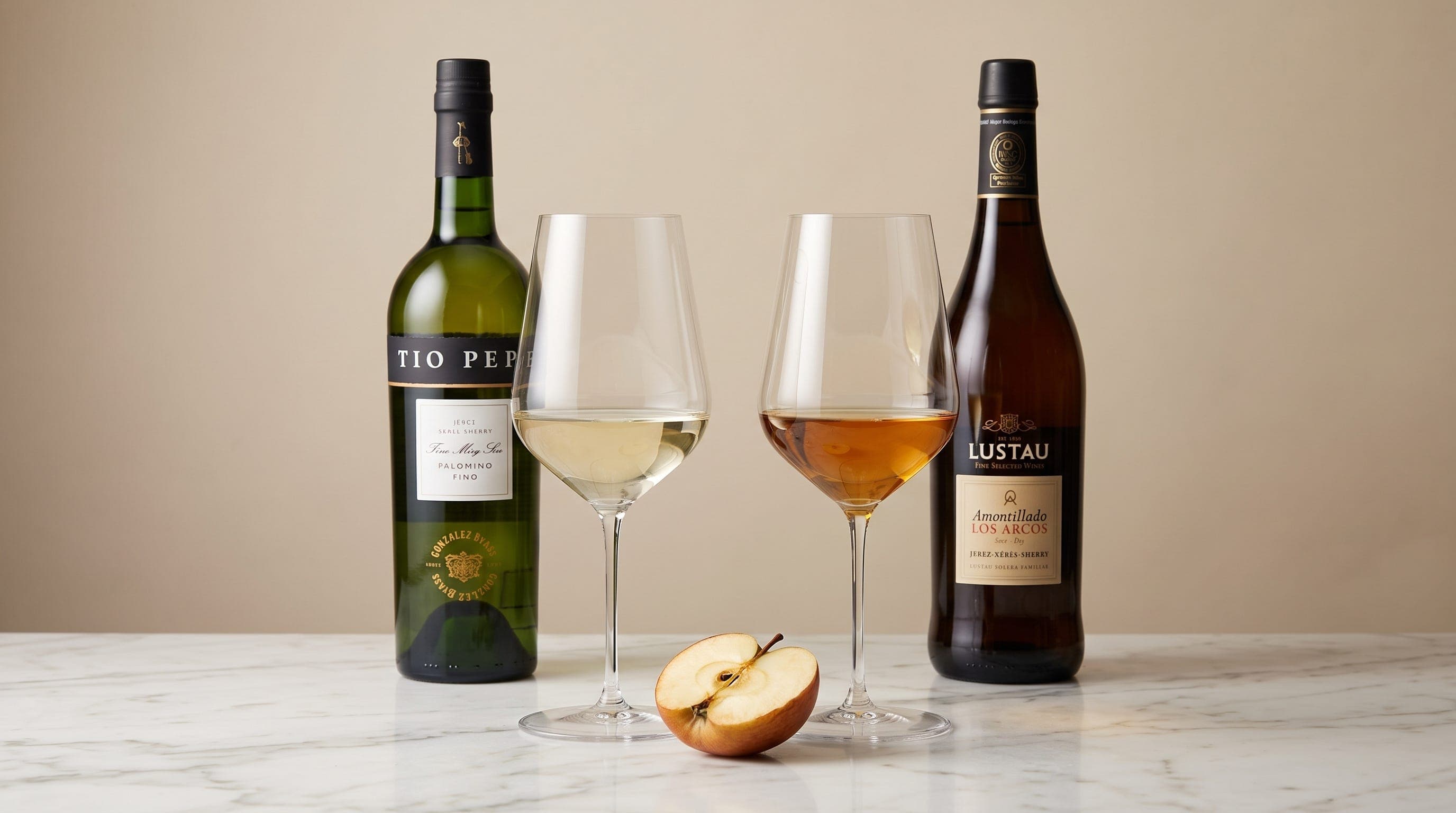
- What to try: One Fino: Tio Pepe (González Byass, Palomino, Jerez, $18-24) or La Ina (Lustau, Palomino, Jerez, $20-24). One Amontillado: Lustau Los Arcos (Palomino, Jerez, $18-24) or Hidalgo Napoleón (Sanlúcar, 500 ml, $20-30). Tio Pepe with Los Arcos is the pair under $50. Chill both and pour side by side over a white napkin.
- What to notice: Color first: pale straw against amber. Smell the Fino for green apple, almond, bread dough, and a salty edge; the Amontillado for toasted walnut, dried fig, and orange peel. The Amontillado is rounder and holds longer after you swallow. Both are dry, so check whether the “sweet” impression is aroma or sugar on your tongue.
- Lesson: Same grape, same region, two ways of aging. The Fino stayed under flor and stayed pale and sharp. The Amontillado lost its veil and finished in open air, and every walnut and amber note in the glass is oxidation someone chose and managed. One wrinkle: the flor yeast makes acetaldehyde too, so the Fino’s green-apple sharpness is the same compound, made there by the yeast. You now have a reference for what oxygen smells like when it was meant, and that is the reference you hold the leftover white against.
#2: One white, fresh, then 3 days on the counter and 3 days in the fridge
- Objective: Smell the fault form, and see what slows it.
- What to try: Two bottles of the same inexpensive white: Kris Pinot Grigio (Veneto, $12-15), Ecco Domani Pinot Grigio (Veneto, $11-13), Toad Hollow Francine’s Selection unoaked Chardonnay (Mendocino, $13-16), or Four Vines Naked Chardonnay (Central Coast, $10-14). Open both tonight, taste a glass from each, and write down 3 words. Recork bottle A and leave it on the counter. Pour bottle B into a clean half bottle or a jar filled to the top, cap it, and refrigerate. On night 4, taste A, then B, then read your 3 words.
- What to notice: Bottle A: dulled fruit, a color one shade deeper, and there is the cut apple, with a flat, faintly bitter finish; some bottles pick up a sharp vinegar edge too. Bottle B sits closer to night one, with less lift than fresh but still clearly the same wine.
- Lesson: Nothing about bottle A was built to meet air: little acid to spare, no tannin, no sugar, and a small sulfur dose used up in the first day or two. The fridge slowed the chemistry, and the full container left the oxygen almost nothing to work on. The household rule follows: cold, and as little air as possible. Kept that way, a table wine holds 3 to 5 days. On the counter, it is usually a different wine by night 4.
#3: Madeira vs a young red, a week apart
- Objective: Learn to read, from the label and the first sip, how long a bottle will last open.
- What to try: One Madeira: Broadbent Rainwater ($18-22) or Blandy’s 5 Year Verdelho ($25-32); Taylor Fladgate 10 Year Tawny or Graham’s 10 Year Tawny ($35-40) makes the same point if you prefer Port. One young dry red: Ruffino Chianti (Sangiovese, Tuscany, $12-15) or Bogle Cabernet Sauvignon (California, $9-11). Open both the same night, taste, write 3 words for each, cork both, and leave them side by side on the counter for 7 days.
- What to notice: Day one: the red is fresh fruit and grip; the Madeira is amber, tangy, and smells of caramel, orange peel, and nuts. Day 7: the red’s fruit has gone dull and flat, the tannin feels harder with less around it, and it may have turned stewed or faintly sharp. The Madeira should taste very close to the way it did a week ago.
- Lesson: The red had tannin on top of the acid and sulfur any table wine carries, and a week was still more air than those could absorb. The Madeira has high acid, sugar, close to 19 percent alcohol, and years of heat and air before bottling; the oxidation happened before the cork went in, and an open bottle keeps for months. Sweetness, alcohol, tannin, and acid show on the label or in the first sip, so the label and the first glass are enough to judge how long a bottle will last open.
Pocket Palate: Style or fault
- The smell: Cut apple, walnut, dried fruit, and a Sherry-like edge mean acetaldehyde, the compound wine makes when it meets air. Fino and Manzanilla carry some too, made by the flor yeast.
- The color: Whites drift from straw toward amber and reds from ruby toward brick as they oxidize. Sherry, Madeira, and Tawny Port are amber by design.
- The question: Was this wine built around air, or did a table wine meet air by accident?
- The family: Under a yeast veil: Fino, Manzanilla, and Jura vin jaune (its veil is called voile, and the barrels are never topped up). In open air: Amontillado, once it loses its veil; Oloroso, fortified to about 17 percent so the veil never forms; Madeira; and Tawny Port, where a 10 or 20 Year label is the average character of a blend aged in casks that let oxygen in slowly. Some skin-contact whites are made with deliberate air and less sulfur. Cut apple in a fresh Pinot Grigio is a fault; walnut in an Amontillado is the style.
- The buffers: Acid, tannin, sugar, alcohol, and sulfur dioxide decide how long a wine can take air. More of them buys more days.
- The household rule: Cold, and as little air as possible: recork, move to a smaller container filled to the top, refrigerate. Table wines hold 3 to 5 days, tannic reds toward the long end; Fino and Manzanilla, aged away from air, 1 to 3 days, like a white; Amontillado, Oloroso, and Tawny Port weeks; Madeira months.
The Finish
Three pairs this week, and by the end you have tasted oxidation three ways: chosen, accidental, and absorbed before the bottle was ever sealed. The chemistry is identical in every glass. The verdict comes from one question: was this wine built to meet air? If it was, the walnut and amber are the style. If a table wine met air by accident, the cut apple is a fault, and the buffers on the label told you roughly when to expect it.
Your preference comes after that line is drawn. Some people taste that first Amontillado and find the walnut and dried fig they had been missing. Others want the Pinot Grigio back, cold, on the day it was opened. Both are settled answers. Enjoying a tired white does not turn it into a style, and disliking Amontillado does not turn it into a fault. Those are two separate calls, and both are yours.
One action for tonight: whatever bottle is open in your kitchen, pour a glass, smell it for the cut apple, tilt it against something white, and say out loud what happened to it. Use what bottle A taught you. If the fruit is quieter and a faint cut apple has crept in, the wine is tired: drink it tonight or cook with it. If the fruit has gone, the color has moved a full shade, and the finish is flat and bitter or carries a vinegar sting, it is gone, and it goes down the sink. Nobody else needs to be in the room for that call.
Go Deeper
If this week’s idea stuck with you, these take it further.
- Courtney Schiessl, Why Oxidized Wines Are Bad but Oxidative Wines Are So Good (VinePair, 2017): The plain-language version of this week’s distinction, with the Jura’s vin jaune as the worked example.
- Julie H. Case, The Science of Wine Oxidation (SevenFifty Daily, 2017): A trade-level walk through where oxygen enters during winemaking, why sulfur dioxide is the standard defense, and the styles that invite it.
- Ageing (Sherry Wines): The Consejo Regulador’s own page on biological aging under flor and oxidative aging in air, the two aging paths behind your Fino and your Amontillado.
- Andrew L. Waterhouse and V. Felipe Laurie, Oxidation of Wine Phenolics: A Critical Evaluation and Hypotheses (American Journal of Enology and Viticulture, 2006): The chemistry under the browning: how iron and hydrogen peroxide drive the oxidation of a wine’s phenolics, and where sulfur dioxide interrupts the chain.
One quick question before you go: do you work in wine or hospitality? Tap your answer in the poll below. It takes one second, and it tells me who I’m writing for.