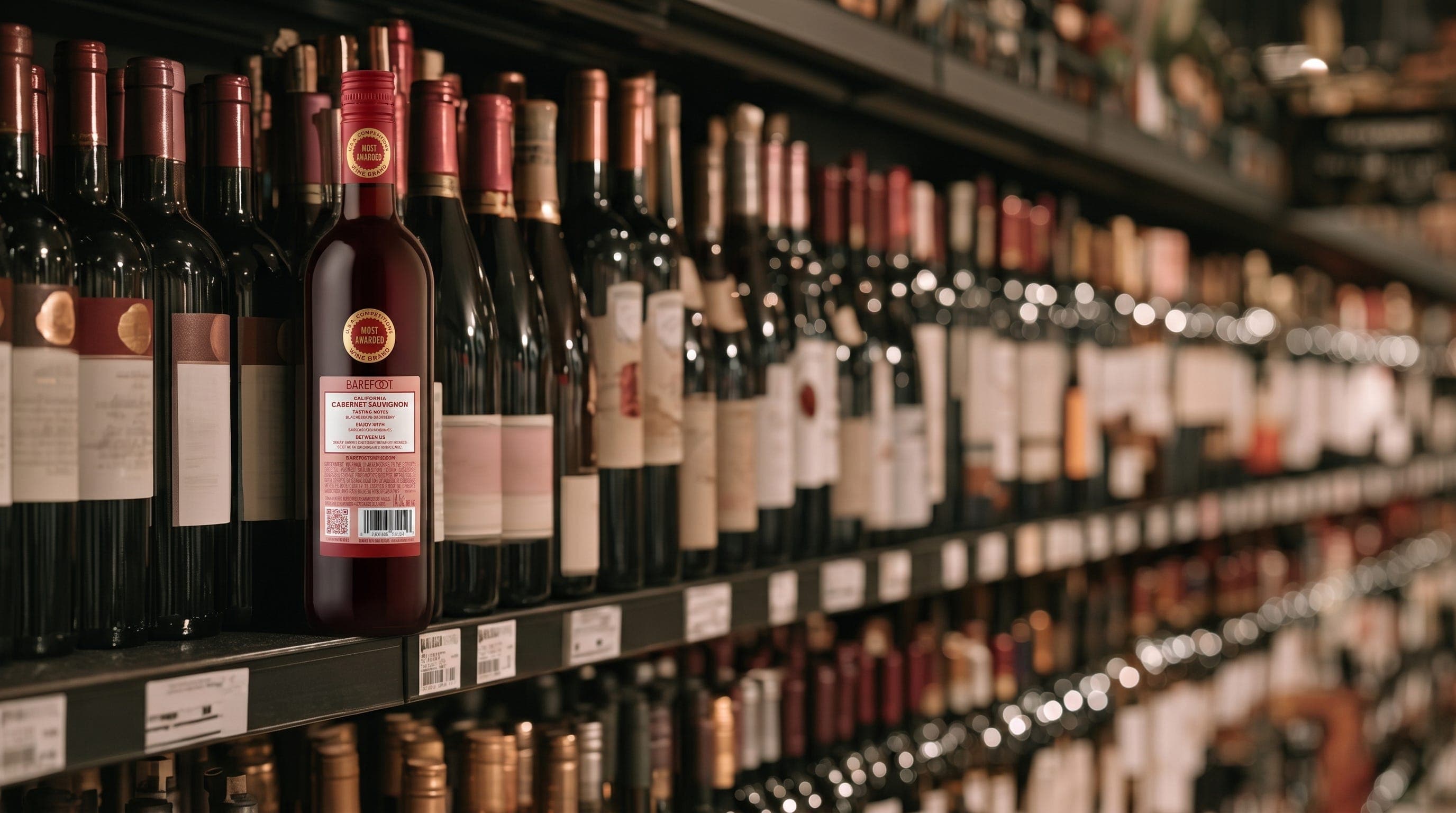
If there is a bottle in your kitchen with a footprint on the label, a black wine box in the fridge door, or a dark red blend with gothic lettering that you grabbed because it was $11 but looked more expensive than that, you have been buying wine from the Gallo family. Nothing on the front of any of them says so.
That anonymity is recent, and it is deliberate.
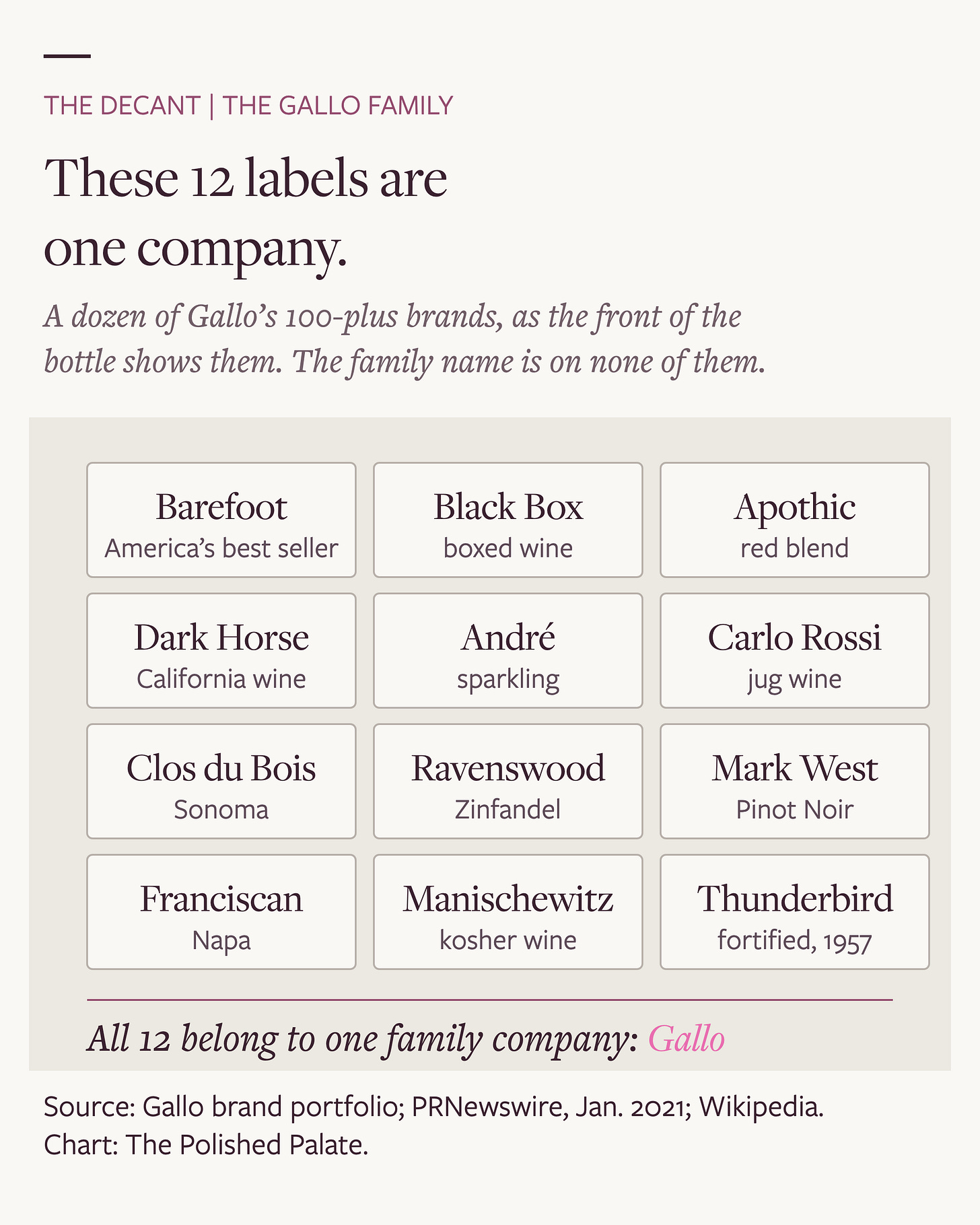
For most of the 20th century, Gallo was the most heavily advertised name in American wine. Ernest and Julio Gallo put it on jug wine, on Thunderbird, on radio jingles, and eventually on 1 in every 4 bottles of wine sold in the United States, the share The Seattle Times reported when Julio died in 1993. The company they founded is still the largest winery in the world. It owns more than 100 brands. Almost none of them say Gallo anywhere a shopper would look.
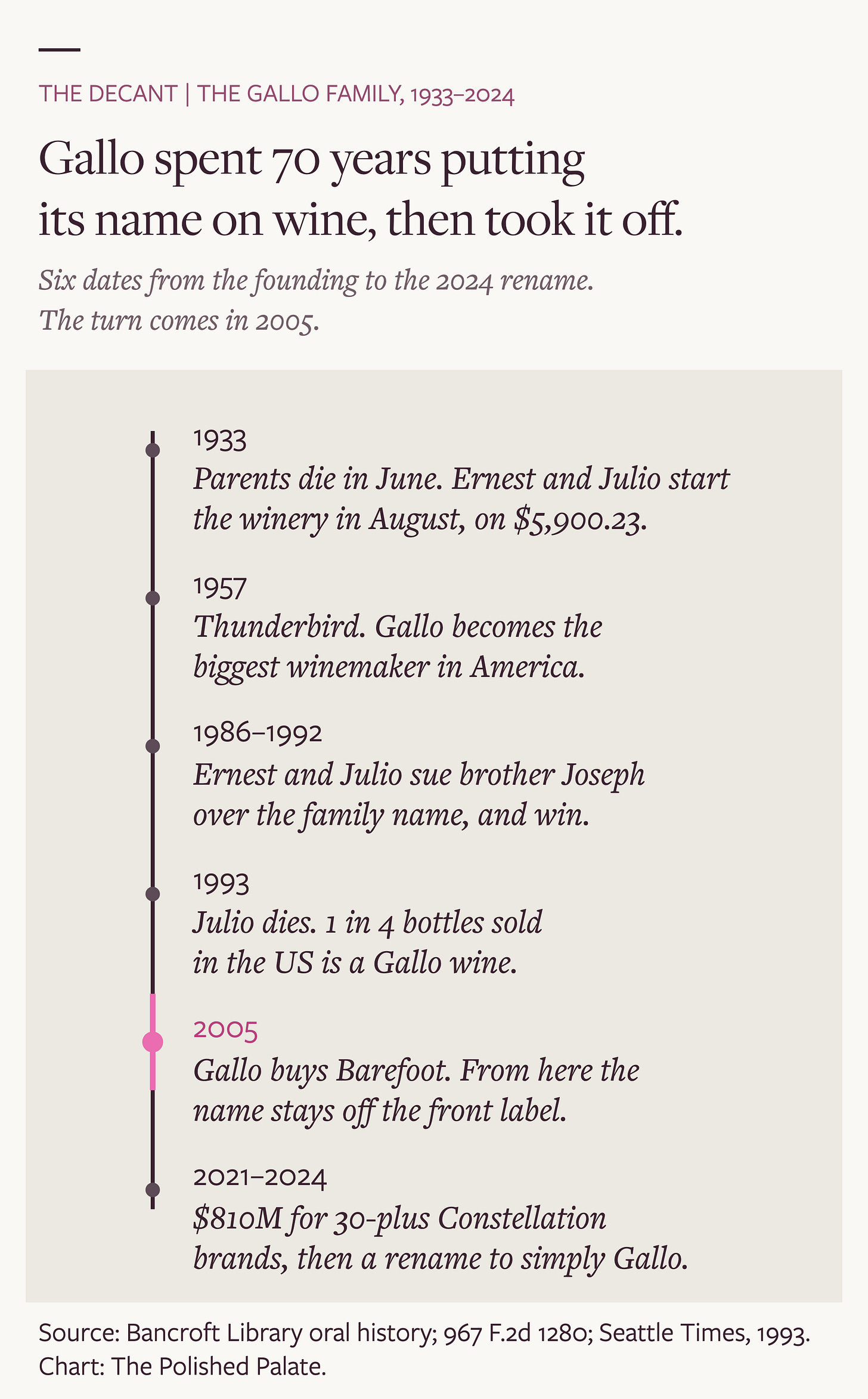
The family behind that company left one of the most heavily documented trails in American business: a murder-suicide that orphaned 3 brothers in 1933, a winery started 2 months later on pooled savings and 2 pamphlets from a public library, a 6-year federal lawsuit in which the older brothers took the family name away from the youngest, and a 21st-century pivot in which the company took its own name off most of its products.
One moment from Ernest Gallo’s oral history, recorded by UC Berkeley’s Bancroft Library, explains more about wine buying than most books on the subject. In December 1933, weeks into the business, Ernest offered an East Coast merchant a sample of his wine at 50 cents a gallon. The man refused it: he wanted no cheap wine, only good wine. Ernest told him he also had a very good wine at 90 cents, poured a second sample of the identical wine, and watched him taste it and declare it exactly what he wanted. He bought 100 barrels at 90 cents.
Ernest’s verdict, decades later: “They didn’t know anything about the product, and they judged it by the price.” That sentence is the founding insight of the most successful wine company in history. Everything the Gallos built, from Thunderbird to Barefoot, rests on the observation that most people buy the label and the price point, and the wine comes along for the ride. This issue is the story of the family that saw it first, and a chance to notice how much of your own buying runs on the same reflex.
June 1933
Giuseppe Gallo arrived in California from Piedmont in the early 1900s and worked his way from running a boarding house for Italian miners in Jackson, where Ernest was born in 1909, to grape farming in the Central Valley. Prohibition, which killed commercial wineries, was good to grape growers: the law allowed households to make up to 200 gallons of wine a year, and every fall California growers shipped fresh grapes east by railcar to Italian and Jewish home winemakers in Chicago, Boston, and New York. Ernest worked those sales young. In the San Francisco Chronicle’s account, his father sent him to Chicago at 17 with a boxcar of grapes, and he came home with $17,000.
The Depression reversed all of it. Grape prices collapsed, and by 1933 the family’s farm near Fresno was deep in debt. On June 21, 1933, Giuseppe and Assunta Gallo were found dead there. Assunta had been shot in the yard. Giuseppe was found inside the house, his revolver nearby. Authorities ruled that he had shot his wife and then himself. Ernest was 24, Julio was 23, and Joseph, the youngest brother, was 13.
The brothers buried their parents and took guardianship of Joseph. Prohibition ended on December 5 of that same year, five and a half months after the deaths. And on August 21, 1933, by Ernest’s own dating, 2 months to the day after their parents died, he and Julio started the winery.
Two pamphlets and $5,900.23
Neither brother had ever made wine commercially. Ernest went to the Modesto public library and came back up from the basement with 2 pre-Prohibition pamphlets by Frederic T. Bioletti, a University of California viticulture professor: The Fundamentals of Fermentation and The Fundamentals of Clarification. In Ernest’s words, “this was the beginning of our knowledge of the wine business.”
They pooled $5,900.23. Part of it was borrowed from Ernest’s mother-in-law, Teresa Franzia, whose family winery stayed tangled with the Gallos for generations (Fred Franzia, the Two-Buck Chuck founder we covered in Decant #15, was Ernest’s nephew by marriage). They rented a shed from the Modesto and Empire Traction Company for $60 a month, bought a crusher, a press, and 100,000 gallons of redwood cooperage on trade credit, and paid growers in barter: deliver a ton of grapes, receive 50 gallons of finished wine.
Old-time winemakers passing through Modesto that fall told them the new wine was too young to ship east and would blow the ends out of the barrels in transit. The brothers shipped anyway. In the first days of December 1933, Ernest received a letter from a Chicago merchant named Charles Barbera asking whether he knew anyone entering the wine business. Ernest drew samples from the tanks, boarded a plane the same day, walked into Barbera’s office the next morning, and sold him 100 barrels at 50 cents a gallon. From Chicago he continued to New York, where the 90-cent lesson happened in a merchant’s sub-basement.
The first vintage, roughly 100,000 gallons, sold out entirely, and grossed about $50,000 in the depths of the Depression. Two brothers who had been to a double funeral in June were selling wine in Chicago and New York by Christmas.
Ernest sells, Julio makes
The division of labor set early and held for 60 years. Julio ran the vineyards and the winemaking in Modesto. Ernest ran sales and built a national sales force that drilled distributors and audited shelf placement store by store. The brothers described the arrangement as a standing contest, with Julio trying to make more wine than Ernest could sell and Ernest trying to sell more wine than Julio could make.
For 2 decades the product was honest, cheap table wine. Then, in 1957, came Thunderbird. A Gallo salesman in Los Angeles had noticed liquor store clerks keeping concentrated lemon juice behind the counter because customers were mixing it into white port. Ernest had the company build the combination into a single product: a lemon-flavored fortified wine at 20 percent alcohol, priced around 60 cents.
It sold on a radio jingle: “What’s the word? Thunderbird. How’s it sold? Good and cold.” Ernest liked to tell of driving through a skid-row neighborhood, calling “What’s the word?” out the car window, and getting “Thunderbird” back from a stranger on the sidewalk.
Thunderbird made Gallo the biggest winemaker in America, and it drew criticism the company spent decades answering, because fortified wines like Thunderbird and Night Train sold hardest in the poorest neighborhoods. The scale kept compounding either way. By 1971, Ernest told his Bancroft interviewers, the company was crushing about 650,000 tons of grapes a year. Gallo had become the price leader for California grapes, announcing its prices ahead of each season and signing growers to long-term contracts years before that became industry practice.
By the time Julio died in May 1993, when his Jeep went off a narrow hilltop road on the family ranch and down a 35-foot embankment, the company was the largest winery in the world, and 1 in every 4 bottles of wine sold in the United States was a Gallo product.
Gallo v. Gallo
Joseph Gallo, the 13-year-old his brothers raised, grew up working the family ranches, served in the Army during World War II, and came back in 1946 to manage cattle and vineyard land. In 1940 a court had closed the guardianship over his inheritance with a payment of $20,000. Nobody revisited that payment for 46 years.
By the 1980s Joseph ran one of the largest family dairy operations in the country. In 1983 his company began making cheese. In 1984 it began selling that cheese in retail packages labeled Joseph Gallo. The winery, which had held a federal trademark on the Gallo name since 1942 and had spent hundreds of millions of dollars advertising it, asked him to change the label. Negotiations ran for a year and failed. In April 1986, Ernest and Julio sued their brother.
Joseph answered with something far larger than a trademark defense. He counterclaimed that the winery itself had grown out of their father’s grape business, and that as an heir he owned a third of it. The court never let that question reach trial: the 1935 probate records listed the winery as a creditor of their father’s estate, and the judge ruled the matter had been legally settled when the guardianship closed in 1940 with that $20,000 payment.
The trademark half went to a 17-day bench trial, where a consumer survey put nationwide confusion between the cheese and the wine at 40 percent. In June 1989 the district court ruled for the winery, and in 1992 the Ninth Circuit affirmed: Joseph was permanently barred from using Gallo, or even Joseph Gallo, as a trademark on retail cheese. His company rebranded as Joseph Farms, and still sells cheese under that name.
Obituaries for both men noted that the brothers stayed estranged. Joseph died in February 2007, at 87. Ernest died 17 days later, 12 days short of his 98th birthday.
The biggest name you never see
The company kept growing after the founders were gone, and its naming strategy inverted. In 2005 it bought Barefoot Cellars, a brand 2 wine-industry outsiders had built to 600,000 cases a year on a beach-day label and a low, consistent price. Under Gallo, Barefoot became the best-selling wine brand in America, and Apothic, the dark, sweet-edged red blend, followed in 2010.
In January 2021 the company completed an $810 million purchase of more than 30 brands from Constellation: Black Box, Clos du Bois, Ravenswood, Franciscan, Mark West, Manischewitz, and the rest of a shelf you already recognize. The company now generates roughly $5.3 billion a year, remains family-owned, and in 2024 shortened its corporate name to simply Gallo.
Yet the name itself has nearly vanished from the wine aisle. Barefoot’s front label gives you a footprint. Apothic gives you moody typography. Dark Horse gives you a horse. The grocery world calls this a house of brands: the cereal aisle looks like 40 independent companies and is mostly 3 large ones, and the wine wall works the same way, with Gallo running the biggest house. A company that once put its own surname in radio jingles now sells most of its wine through labels built to feel like small, separate wineries.
The Mondavi family, whose rise and fall we traced in the Mondavi dynasty issue, made the opposite bet: they spent everything making the family name mean quality, and lost the company while the name kept its value. The Gallos kept the company and let the name recede. Both choices answer the same question, which is what a name on a label is actually worth to the person holding the bottle.
Ernest answered that in 1933, in a sub-basement, with 2 samples of the same wine. Shoppers judge the wine by the label and the price. A famous corporate name on the front reads as industrial, and a small unfamiliar one reads as a discovery, so the company that owns the shelf prints small unfamiliar names. The buyers have turned over several times since 1933. The strategy has not changed.
Pocket Palate: the Gallo empire in 5 facts
- The founding stake: $5,900.23 in pooled cash, a $60-a-month rented shed, and 2 winemaking pamphlets from the basement of the Modesto public library, in 1933.
- The division: Julio made the wine, Ernest sold it. The family framed it as a contest: make more than he can sell, sell more than he can make.
- The peak: when Julio died in 1993, 1 in every 4 bottles of wine sold in the US was a Gallo product.
- The feud: Ernest and Julio sued their younger brother Joseph over the family name, 1986 to 1992, and won. His cheese company trades as Joseph Farms to this day.
- The camouflage: Barefoot, Apothic, Dark Horse, Black Box, and 100+ other brands are Gallo. The family name appears on almost none of their front labels.
The Finish
Ernest Gallo said it about one merchant in 1933: most people judge the wine by the label and the price. The company he founded has sold wine on that observation for more than 90 years, and nothing in its sales suggests it has stopped being true. It stays true because almost nobody checks.
Checking takes about 10 seconds. Tonight, pull one bottle from your rack, turn it around, and find the line that says who vinted, bottled, or imported the wine, and where. That line tells you more about what is in the glass than anything on the front. Do it with every bottle you open for a month and you will know which of your regular wines come from the same company, which share a bottling address, and how much of your buying has been running on label and price alone. Ernest counted on you never looking.
Go Deeper
If this week’s idea stuck with you, these take it further.
- Guy Raz, Barefoot Wine: Bonnie Harvey and Michael Houlihan (How I Built This, NPR): The Barefoot founders tell how they built the brand Gallo later bought, including why an unknown label with a consistent price beat prestige names at retail.
- Top Winemaker Julio Gallo Dies in Jeep Crash Off Hilltop (The Seattle Times, 1993): The contemporary account of Julio’s death, with the 1-in-4-bottles figure and a snapshot of the company at its peak.
- Tony Lima and Norma Schroder, Ernest Gallo, 1909-2007: A Life in Wine (Journal of Wine Economics, 2007): Built on Ernest’s Bancroft Library oral history, and the source for the founding figures, the library pamphlets, and the 90-cent story in his own words.
- E. & J. Gallo Winery v. Gallo Cattle Co., 967 F.2d 1280 (9th Cir., 1992): The full appellate opinion in the family name case, including Joseph’s inheritance counterclaim and the court’s reasons for rejecting it.