The last time a bottle impressed you, how much of the work did the label do? Be honest with yourself. You saw the producer, the price, maybe the face of the person pouring it. A verdict started forming before the glass reached your mouth, and the sip mostly confirmed it.
Rudy Kurniawan built the largest wine fraud in American history on that sequence. From roughly 2004 to 2012, he sold tens of millions of dollars of counterfeit Burgundy and Bordeaux to the most experienced collectors and tasters in the world. He blended the fakes himself, in the kitchen of his home in Arcadia, California, using off-vintage Burgundy and younger Napa Cabernet as raw material. He poured the blends into old bottles, sealed them with doctored corks, dressed them in labels he printed at home, and consigned them to New York’s most glamorous auction rooms.
The wines landed on tables that held more tasting credentials than most countries. They were written up in admiring tasting notes and auction catalogs. In 2006, two Acker Merrall & Condit auctions of his cellar grossed about $35 million, including a $24.7 million sale that set the record for a single consignor. Across eight years of dinners, auctions, and celebrated verticals, nobody spat out a glass and called the police.
That is the part of the story worth examining, and the reason this issue exists. The caper details are entertaining, and we will get to them. The palate implications are uncomfortable, because the people he fooled were the best-trained tasters alive, drinking at the peak of their attention, and the counterfeits sailed past them for the better part of a decade.
I’ve spent over a decade working in wine, and I take no comfort in pointing at those tables. The lesson lands on every taster, trained or untrained: context and expectation are ingredients in every glass, and no credential removes them. Hold that thought while we walk through what happened.
Pairing while you read: a village Morey-Saint-Denis, the commune whose grand cru vineyard, Clos Saint-Denis, ends up at the center of this story.
The collector who bought the room
Kurniawan was born Zhen Wang Huang in Indonesia in 1976. He came to the United States in the late 1990s on a student visa, applied for asylum, was denied in 2001, and was ordered to leave the country in 2003. He stayed, and he started buying wine.
By the mid-2000s he had become the most talked-about collector in Los Angeles. He was said at the time to be spending $1 million a month on old wine. Fellow collectors nicknamed him Dr. Conti for his devotion to Domaine de la Romanée-Conti, the most coveted producer in Burgundy. He dressed expensively, hosted lavishly, and picked up the tab at marathon dinners where the bottles were older than anyone at the table.
Generosity on that scale buys a specific kind of silence: wine authentication expert Maureen Downey later observed that the circle around Dr. Conti, including Acker Merrall & Condit CEO John Kapon, lent Kurniawan legitimacy by publishing tasting notes of his wines and praising him in newsletters and auction catalogs.
Read that again slowly. The market’s own institutions tasted his counterfeits, described them in print, and attached scores and superlatives. The praise then became provenance: each published note made the next fake easier to sell. In 2006 Acker sold his cellar in two headline auctions, $10.6 million in the first, $24.7 million in the second, the largest single-consignor total wine auction sale on record at the time. By his early thirties, Kurniawan sat at the center of the American fine wine market, and the market had certified him in writing.
The bottle that could not exist
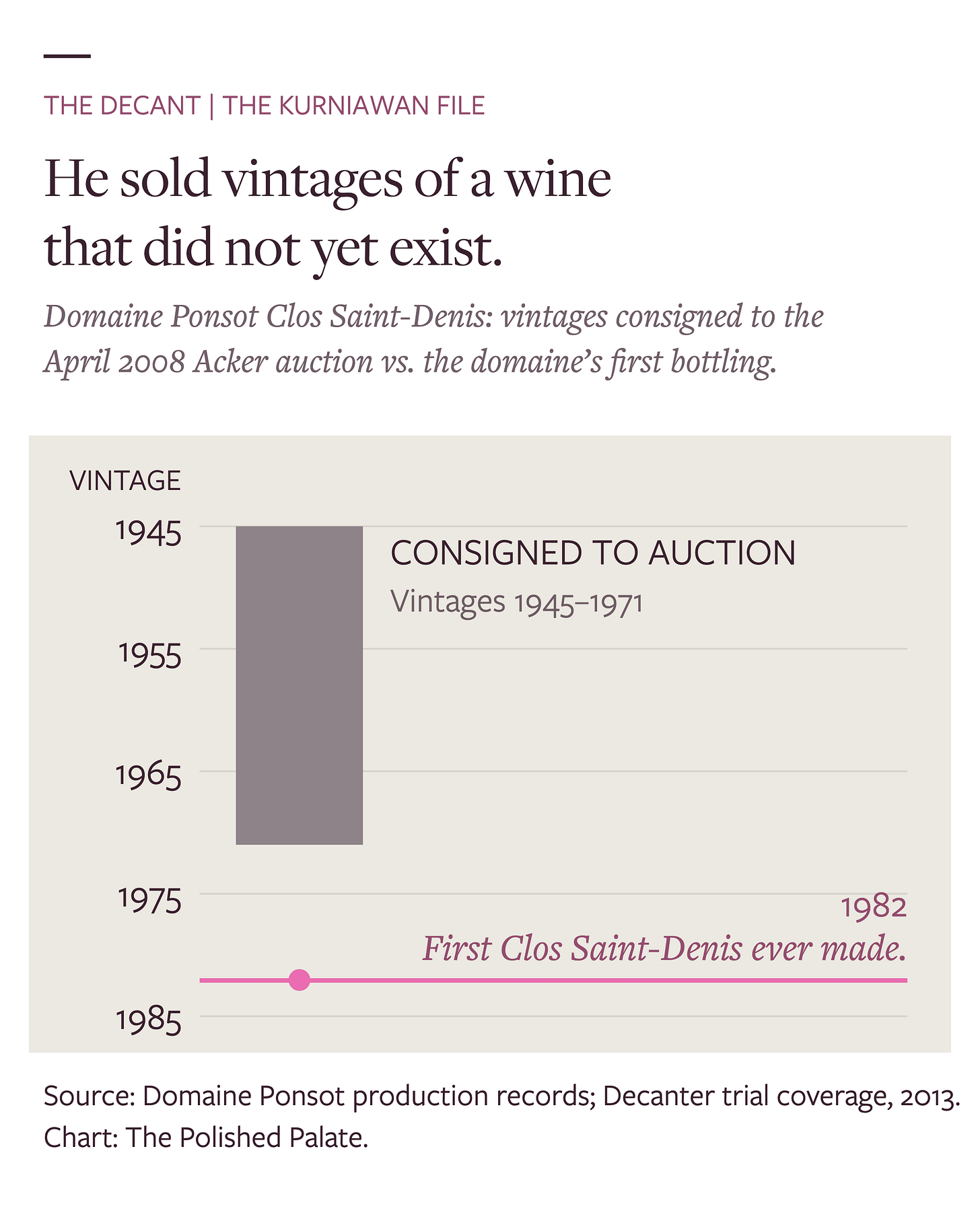
In April 2008, Acker Merrall & Condit listed a run of Domaine Ponsot Clos Saint-Denis from Kurniawan’s cellar in a New York auction, with vintages reaching from 1945 to 1971. The lots carried an estimated value between $600,000 and $1.3 million.
Laurent Ponsot, who ran the domaine, flew from Burgundy to New York and sat in the auction room. Moments before the lots came under the hammer, he had them pulled. His reason fit in one sentence: Domaine Ponsot made its first Clos Saint-Denis in 1982. A 1945 bottling could not exist. As he later put it in court, per Decanter’s trial coverage, “this wine cannot exist.”
Notice what caught the fraud. Nobody in that room stood up because a glass tasted wrong. Ponsot stood up because his family’s production records said the wine was impossible. The same pattern ran through the whole case. At the record 2006 sale, Kurniawan offered eight magnums of 1947 Château Lafleur; wine consultant David Molyneux-Berry later pointed out that the château produced only five.
Billionaire collector Bill Koch, who had bought Kurniawan bottles including a 1947 Pétrus and two 1934 Domaine de la Romanée-Conti, sued him in 2009 with a team of investigators behind him, and settled in July 2014 for $3 million. Ledgers, bottling dates, production counts. Every piece of evidence that caught Kurniawan was on paper. None of it came from a glass.
Confronted about the Ponsot lots, Kurniawan gave reporters a line that should hang framed in every tasting room: “We try our best to get it right, but it’s Burgundy, and sometimes shit happens.”
A kitchen sink in Arcadia
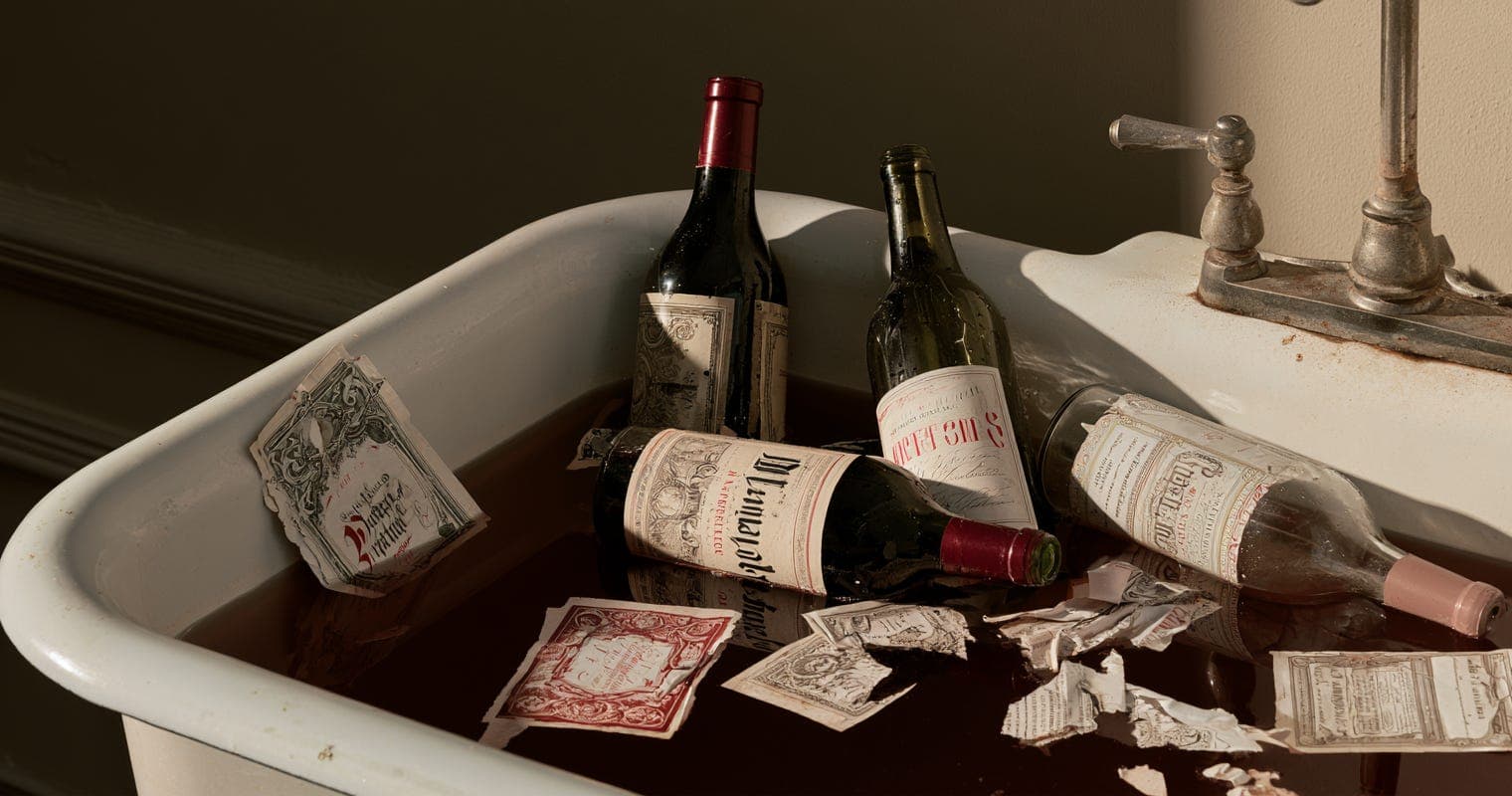
Early on the morning of March 8, 2012, FBI agents arrested Kurniawan at his home in Arcadia, California. In the kitchen sink, bottles sat soaking, their labels peeling off. Behind a locked door, agents found what prosecutors would call a counterfeit wine factory: printers, ink pads, glue, sealing wax, stamps for aging corks, thousands of forged labels for the rarest wines on earth, and crates of empty bottles waiting to be dressed.
They also found the recipes. Bottles in the house carried handwritten blending instructions, and agents catalogued stocks of inexpensive Napa wine with notes indicating it would be passed off as older Bordeaux. His base stock for fake old Burgundy ran to off-vintage bottles from the 1950s and 1960s, cheap because the years were poor, correct because the age was real.
Here is the detail that turns the story from caper to argument: the instrument that made those recipes work was his palate. Prosecutors argued that Kurniawan used an exceptional palate to blend young California wine into old, tired French wine until the glass matched the memory of the real thing. He had built his reputation on that palate. The gift was real. He aimed it backward, at deception, and it worked on the exact people whose palates were supposed to be the market’s immune system.
The trial ran in December 2013 in Manhattan federal court, Laurent Ponsot testifying for the prosecution. The jury convicted Kurniawan of fraud, the first person convicted in a US federal court for selling counterfeit wine. In August 2014 he was sentenced to 10 years, ordered to pay $28.4 million in restitution and to forfeit $20 million more. He was released in November 2020 and deported to Indonesia in April 2021.
By some estimates, as many as 10,000 of his bottles are still out there, resting in serious cellars, waiting to be opened at someone’s fiftieth birthday.
What the applause proves
The tempting conclusion is that expert taste is theater and the whole apparatus of scores and tastings deserves the bonfire. Sit with the record, though, and it supports something narrower and more useful.
Start with what the fraud never faced: a blind tasting. Every Kurniawan counterfeit was served sighted, under a famous label, at a price that had already argued its case, poured by a generous host into a room primed to be amazed. Sighted tasting and blind tasting share a verb and almost nothing else. His fakes were never once caught sighted, and never once served blind.
The science here is blunt. In 2001, researcher Frédéric Brochet served the same mid-range Bordeaux to experienced tasters in two bottles, one dressed as a grand cru, one as a table wine. The grand cru drew descriptors like complex, balanced, and rounded. The identical wine in the humble bottle was called weak, short, and flat. Forty tasters judged the grand cru version worth drinking; twelve said the same of the table wine. Expectation reached the glass before the wine did, in a controlled setting, with trained palates, years before Kurniawan printed his first label.
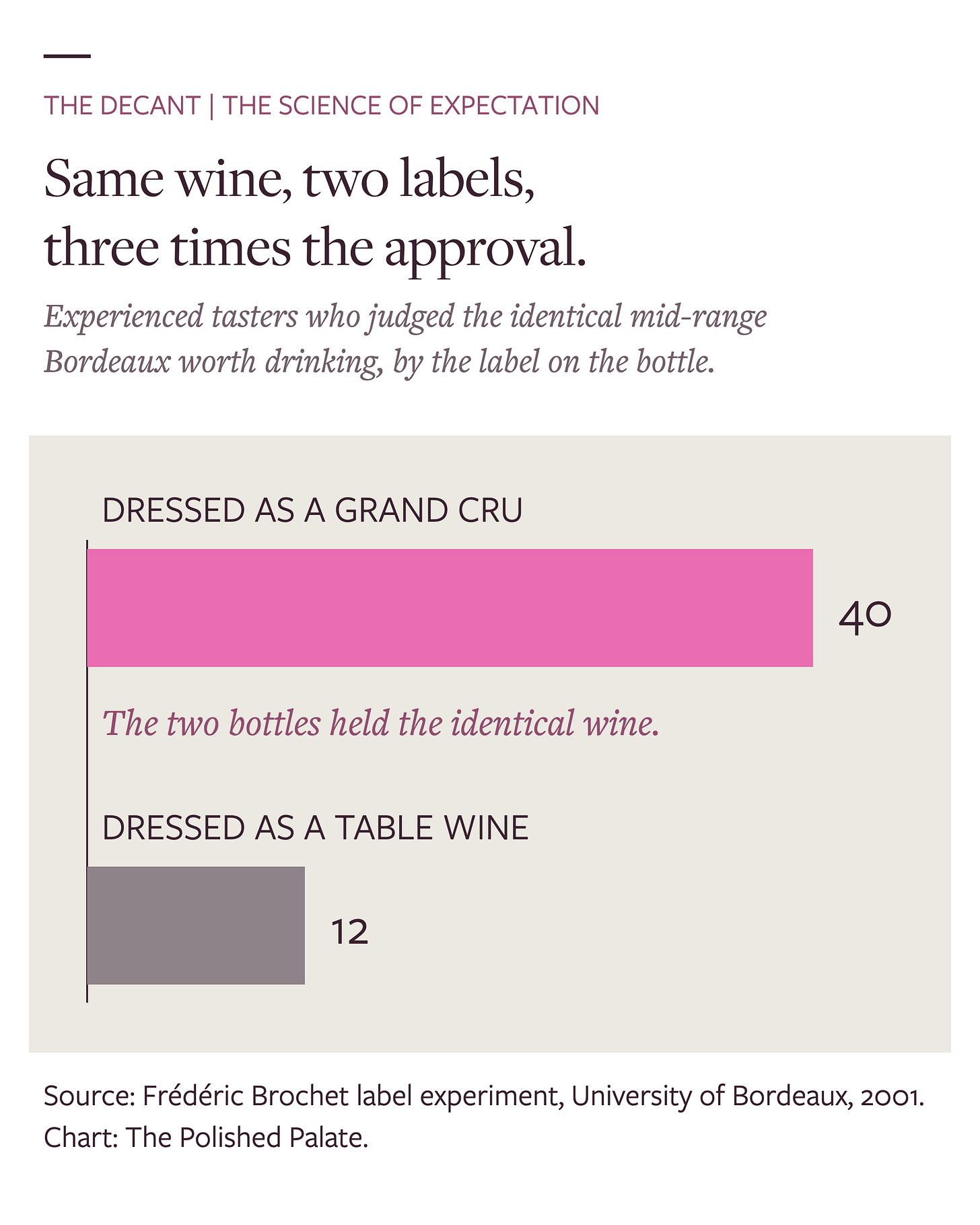
So the Kurniawan record proves that expectation and provenance shape what experts taste, at the highest level, for years at a stretch. It does not prove that palates are worthless. Training still builds real sensitivity and real vocabulary. What training never installs is immunity to context. The most credentialed taster in the room is as open to label influence as you are, and usually more certain of the verdict.
And blind tasting comes out of this story strengthened, at least when the stakes are honest. We covered the Judgment of Paris earlier in this series: when Napa’s unknowns beat Bordeaux’s aristocracy in 1976, the bags stayed on the bottles, and that single condition gave the result its force. This is also the second con this series has covered. Austria’s 1985 antifreeze scandal ran on chemistry. Kurniawan’s ran on psychology, and psychology is the harder adulterant to screen for, because every taster brings it to the glass.
Pocket Palate: the Kurniawan file
- The scale: about $35 million in 2006 auction sales alone; estimates run as high as 10,000 counterfeit bottles still in circulation.
- The method: off-vintage Burgundy and younger Napa Cabernet, blended by palate in a home kitchen, rebottled under forged labels of the world’s rarest wines.
- The catch: production records. Domaine Ponsot made its first Clos Saint-Denis in 1982; Kurniawan consigned vintages back to 1945.
- The sentence: convicted December 2013, the first US federal conviction for selling counterfeit wine; 10 years, $28.4 million restitution, $20 million forfeited, deported in 2021.
- The lesson: his fakes were always served under famous labels to tasters who knew the price. Poured sighted, expectation does part of the tasting at every level of training.
The Finish
Kurniawan’s victims deferred to impeccable authorities. The auction house had certified the bottles. The catalogs carried glowing notes. The man pouring was famous for his palate. Every one of those authorities checked out, and every one was wrong, because none of them had verified the wine itself, and the wine came from a kitchen in California.
The verification nobody at those tables performed is one you can practice this week: attention to what is in the glass, separated from what the label promises. Have someone pour you a wine without showing you the bottle. Before the reveal, write down three things you notice: the fruit, the acidity, how long the taste holds after you swallow. You will be wrong about some of it. Good. Every miss recalibrates the instrument, and the next blind glass gets sharper. That is how a palate stops being borrowed and becomes yours.
Go Deeper
If this week’s idea stuck with you, these take it further.
- The Man Who Duped Millionaires Into Paying Big Bucks for Fake Wine (NPR, 2013): A brisk, readable account of the scheme and conviction, written the week the jury came back.
- Kurniawan trial: ‘This wine cannot exist’, winemaker Ponsot tells court (Decanter, 2013): Trade coverage of the courtroom moment where production records, delivered in person, ended the fraud’s last defense.
- After Rudy: What can the fine-wine world learn from the Kurniawan case? (World of Fine Wine): The deepest post-mortem on how the market’s own institutions lent the con its legitimacy, with Maureen Downey’s analysis.
- The Legendary Study That Embarrassed Wine Experts Across the Globe (RealClearScience, 2014): A clear summary of Frédéric Brochet’s label experiments, the controlled version of what Kurniawan ran in the wild.
- Prominent Wine Dealer Rudy Kurniawan Sentenced to 10 Years in Prison (FBI, 2014): The primary document: the government’s own account of the scheme, the raid, and the sentence.