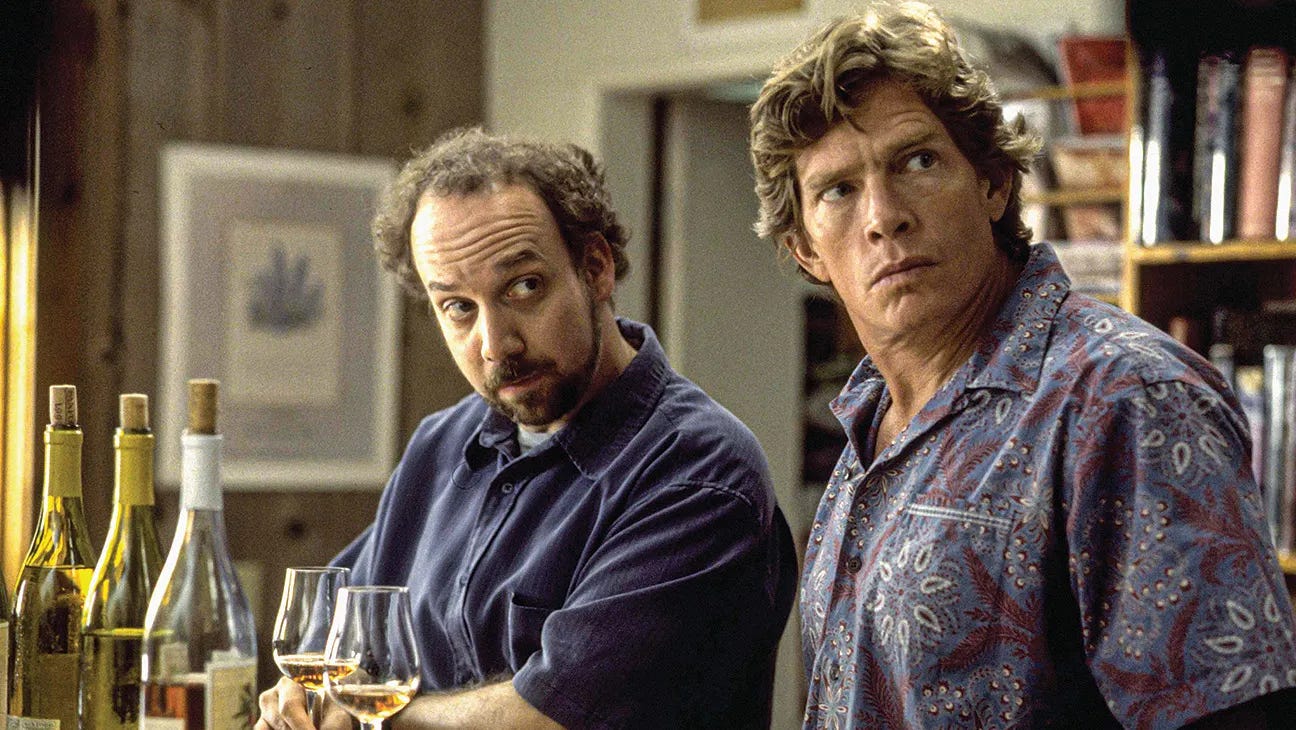
In October 2004, Fox Searchlight released a low-budget character study about two friends driving through Santa Barbara wine country. Sideways grossed $109 million on a $16 million budget. The protagonist, Miles, drank Pinot Noir and refused Merlot.
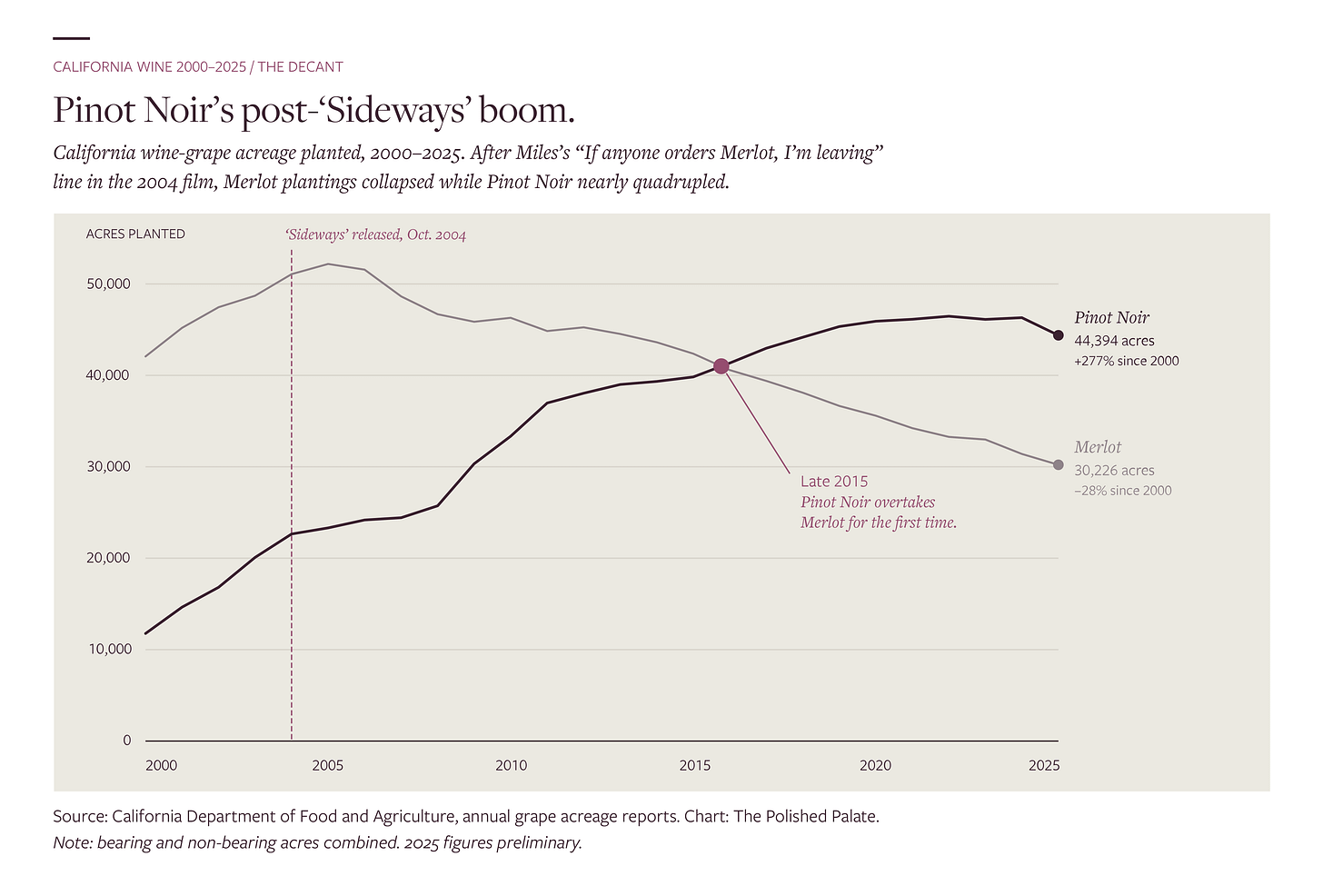
Twenty years later, California Pinot Noir production has risen roughly 170 percent, Merlot acreage has declined by about 35 percent, and the most-cited example of a film moving a commodity market is still a small comedy nobody at the studio expected.
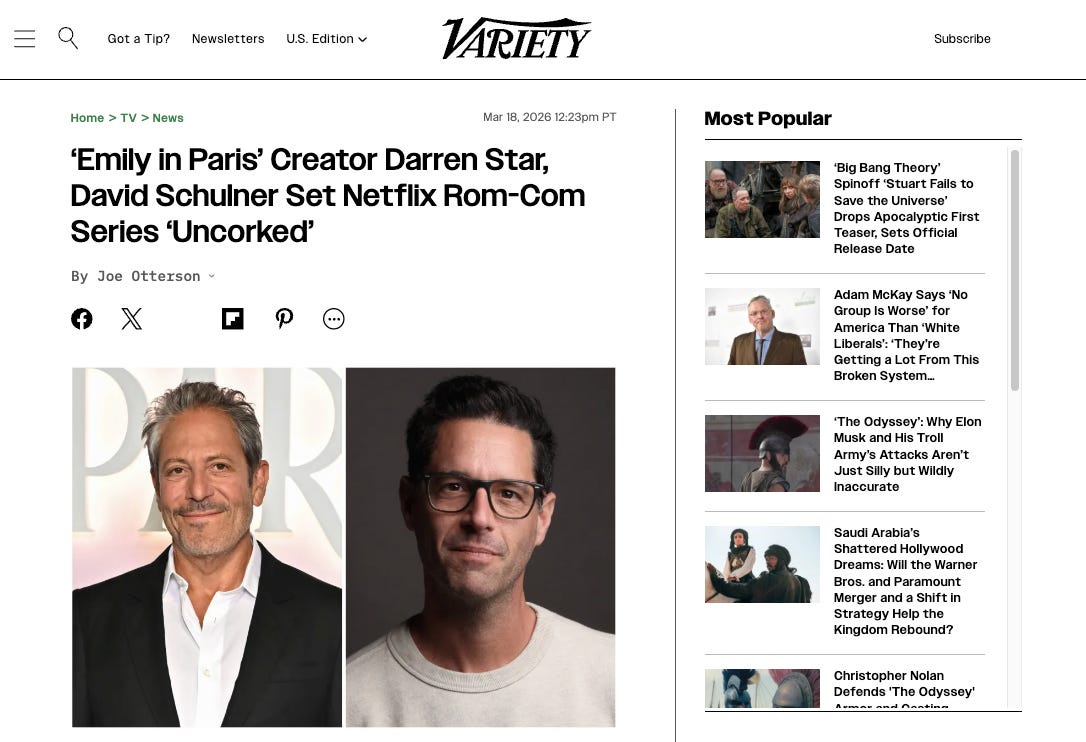
In March 2026, Netflix announced Uncorked, a half-hour dramedy from Darren Star (Sex and the City, Emily in Paris) and David Schulner (New Amsterdam), set in Napa. A self-destructive winemaker returns home chasing a 100-point wine, a second shot at love, and a legacy. The official logline says her passion for drinking is, in the show’s own words, “a failing that usually begins before lunch on Tuesday.” Napa Valley Vintners is the public authenticity partner.
The temptation is to read this as Sideways II and predict the next Pinot. That reading does not survive interrogation. Cabernet Sauvignon, the logical Uncorked-adjacent varietal, does not need Hollywood to sell. It is the dominant U.S. premium varietal by every available measure, with about 90,000 acres of California bearing land and the highest average bottle price of any American wine category. There is no commercial slack for a 170-percent lift to fall into.
What Uncorked is coming for is Napa itself. The setting, the social geometry, the 100-point chase as a consumer cultural reference, the cult-tier producer dynamics, the sober-curious thread implied in the logline, the winery-visit economy, and the AVA structure most viewers will encounter without context. By the time you watch the first episode, those seven things will determine how much of the show makes sense to you.
The Polished Palate exists so you can stop deferring to critics, scores, and television. The work of the next eighteen months is to give you the vocabulary and the historical context to form your own view, before a streaming show does it for you.
What Sideways actually did to American wine
Sideways did three things at once, and the timing of each matters:
- The first effect was immediate. Cuellar, Karnowsky, and Acosta studied IRI scanner data from 1999 to 2008 and published their findings in the Journal of Wine Economics. Pinot Noir sales rose roughly 16 percent in the post-release window. Merlot sales fell about 2 percent, with damage concentrated in the under-$10 segment. The largest Pinot lift came in the $20-to-$40 tier, the price band where aspirational consumer behavior actually lives. The study’s framing was deliberately modest: a small negative on Merlot, a clearer positive on Pinot, no industry-collapsing devastation.
- The second effect was structural and slow. USDA bearing-acreage data shows California Pinot Noir plantings nearly doubling between 2004 and 2023. Merlot acreage in the same window declined by about 35 percent. The trade summary, the one the headline of this issue cites, lives in this longer arc. California Pinot Noir production has risen by approximately 170 percent off the 2004 baseline. The supply side responded for two decades to demand that started with a single character monologue.
- The third effect is the one neither dataset measures. Sideways rewired what Pinot Noir and Merlot meant. Pinot became code for taste, discernment, and aspiration. Merlot became code for the suburban grocery aisle. Neither bottle changed. The story around the bottle changed, and the bottles followed.
The cultural mechanism is the part that ports cleanly to Uncorked. The varietal move is the part that does not.
What we know about Uncorked, and why it isn’t going to land quietly
Three things about Uncorked are on the public record so far:
- Creative team. Darren Star wrote Sex and the City, created Emily in Paris, ran Younger, and continues to executive-produce Uncoupled. David Schulner created New Amsterdam. Star’s active Netflix slate has cleared 435 million views between H1 2023 and H2 2025, with Emily in Paris alone past 250 million. This is the platform’s most reliable network for high-aesthetic adult dramedy.
- Premise. From the official logline, the protagonist is a “talented but self-destructive winemaker” returning to Napa chasing a 100-point wine, a second shot at love, and a legacy. The same logline notes “her passion for making wine is matched by her passion for drinking it, a failing that usually begins before lunch on Tuesday.” Four storylines are visible from those two sentences: the 100-point chase, the family-business dynamic, the alcohol-use thread, and the women rewriting Napa winemaking. Each maps to a real archetype in the contemporary trade, and each will get its own issue in the next eight weeks.
- Industry partner. Napa Valley Vintners is publicly working with the production on authenticity research. NVV’s involvement has included Auction Napa Valley, Premiere Napa Valley, and the February 2026 NVV annual meeting. This is not an outsider’s Napa story. The trade is shaping the texture of the show.
What is not yet on the record: a release date, casting, a trailer, or an episode count. The window between now and then is the one that matters for any viewer who would rather understand the wine world the show is about to dramatize than have it described to them.
By the time the first episode airs, the difference between Oakville and Stags Leap, the math behind a 100-point score, and the real winemakers the protagonist is built from should already be in your vocabulary. The next eleven Wednesdays put each of them there.
Why Uncorked won’t move Cabernet (and what it could move instead)
The most predictable take on Uncorked is that it will repeat the Sideways effect on a new varietal. That take is wrong, and the reason matters.
Cabernet Sauvignon does not need Hollywood. It’s the dominant U.S. premium varietal by acreage, dollar share, restaurant list weighting, and retail shelf presence. Napa Cabernet specifically commands the highest average bottle price of any American wine category and has done so for thirty years.
The Sideways effect worked partly because Pinot Noir was the underdog in 2004 with structural room to grow on the supply side. Cabernet has neither space nor narrative slack to absorb a 170-percent lift.
What Uncorked can actually move sits in five other places:
- Cult-tier producer dynamics. Screaming Eagle, Harlan Estate, Bryant Family, Colgin, Bond. Allocation waitlists, secondary-market pricing, mailing-list pressure. The 100-point chase storyline points directly at this tier. A fictional protagonist chasing a fictional 100-point score will send wine-curious viewers searching for the real-world equivalents the morning after each episode airs. Knowing what’s actually in a $4,000 bottle, and what isn’t, is the kind of vocabulary the show isn’t going to give you.
- AVA recognition. Oakville, Stags Leap District, Howell Mountain, Spring Mountain. Whichever AVA the production sets the protagonist’s winery in becomes a search-volume event for the entire region. Viewers will start asking “is my Napa Cab from there?” and that question, asked at scale, moves shelf placement. The label literacy that takes wine drinkers years to develop is about to be the difference between feeling like an insider while watching the show and missing every reference it makes.
- The 100-point conversation itself. Robert Parker’s scoring system has been a consumer-level cultural reference inside the trade for forty years and almost never outside it. Uncorked turns Parker’s invention into a plot mechanism. Knowing what the points actually measure, and what chasing them costs, is about to become the entry-level vocabulary for talking about American wine.
- The sober-curious thread. Uncorked‘s logline puts the protagonist’s alcohol use on the page in the official marketing copy. The sober-curious segment is the fastest-growing category in U.S. beverage. If the protagonist’s drinking lands as cautionary on screen, the conversation about how the wine trade treats its own alcohol use moves from trade-press margins to general consumer awareness for the first time.
- A possible backlash toward restraint-style Cabernet. If the protagonist reads as cautionary, the cultural response may swing away from the 100-point ripeness aesthetic and toward producers like Cathy Corison, Heidi Barrett at her restraint-leaning end, and Helen Keplinger. All three already make Napa Cabernet that runs against the 100-point grain, and their work is currently known mostly inside the trade. The show would move them from connoisseur fringe to mainstream curiosity in a single season.
Five distinct possible moves, none of them “Cabernet sales go up 170 percent.” Whichever one moves first will tell you what the show is actually doing, and the second will probably reach you in your local wine shop within six months. The next eleven Wednesdays are an attempt to make sure neither one catches you by surprise.
Where The Decant is going for the next 18 months
Right now, none of the show exists yet. The next twelve Wednesdays use that runway to lay down the wine education a viewer needs before any of it lands: Napa’s actual history, the 100-point system that drives the protagonist’s plot, the Mondavi family infighting that built and broke the most valuable name in American wine, the 1976 blind tasting that put Napa on the world map, the cult Cabernets that cost more than most people’s monthly rent, the women rewriting what Napa Cabernet is supposed to taste like, and the sober-curious thread the trade keeps quiet.
When the trailer drops, the work shifts to frame-by-frame breakdowns: what bottle is on the table, what AVA the vineyard could plausibly be, whether the cellar is working or built for the shot. The Wednesday before episode one airs, a “what to know before you watch” issue pulls the threads together.
While the show is airing, every Wednesday is an episode or theme companion: what was real, what was Hollywood, what to drink while watching, which real winemaker each character is built on.
After the finale, the work moves to impact: how the show actually moves the wine world, which varietals tick up, which winemakers find themselves with longer waitlists, which conversations the trade has to start having now that millions of viewers have heard them.
After all of that closes out, The Decant continues. The show will end. Napa will keep making wine, and culture will keep producing the next moment worth translating. The reason to subscribe is to see those moments coming early enough to think about them before everyone else does.
A pour for the read
A Russian River Pinot Noir if you want to sit inside the last wave (Williams Selyem, Kosta Browne, or Failla Hirsch Vineyard). An Oakville Cabernet from Corison or Smith-Madrone if you want to taste what the restraint-Cab counter-narrative might look like in your glass.
The Finish
The Sideways effect did not happen because Sideways told viewers what to drink. It happened because a fictional character gave shape to a feeling the audience already had, and the U.S. wine market organized itself around that feeling for two decades.
Uncorked will be doing the same work for a different audience, with a different protagonist, around a different set of bottles and a different cultural conversation.
Reflective prompt. Which wine do you reach for when you want to feel like the version of yourself you are trying to become? The honest answer is data. It tells you whose story is already shaping your palate.
One concrete action. Reply to this email with the show, book, conversation, or trip that most changed what you drink. The replies will become the through-line for an issue later in this arc, and the act of answering is itself the work. Notice whose voice is already in your glass.
Go Deeper
If this issue stuck with you, these resources take the conversation further.
- The Sideways Effect: A Test for Changes in the Demand for Merlot and Pinot Noir Wines, Cuellar, Karnowsky, and Acosta (American Association of Wine Economists working paper, 2008) *The peer-reviewed source of the short-window Pinot Noir and Merlot demand figures. The methodology section is the model for any future Hollywood-moves-wine claim.
- The Sideways Effect: How A Wine-Obsessed Film Reshaped The Industry, NPR / The Salt, (2017) *Accessible long-form treatment of both the demand-side data and the cultural mechanism. The clearest free overview of the effect for a non-trade reader.
- The Sideways effect is still being felt in the wine industry after 20 years, NorCal Public Media, (2024) *The twenty-year retrospective with current USDA acreage figures and trade reactions. Where the 170-percent production figure cited in this issue comes from.
- Sideways changed the US wine industry, fueling pinot noir sales, NPR / The Indicator from Planet Money, (2022) *A shorter economist-led breakdown of how the supply-side caught up with demand over two decades. Complements the long-form Salt piece with the production-side story.
Subscribe to The Polished Palate for the Wednesday Uncorked arc and the Saturday flagship. The wine world Netflix is about to land in deserves a translator who has been in it for eleven years.*