Plenty of California labels carry a founding date before 1920, and the date raises a question most of us never ask: how does a winery survive 13 years in which selling wine is a federal crime? The answer is a clause most drinkers have never read, and who survived under it says something about what a rule on a wine label can check.
Prohibition produced a paradox. Wine sales collapsed, and California planted more vines than it had ever planted. More than 700 wineries were operating in 1919; 177 were left at the start of 1933. In the same stretch the state’s vineyard acreage nearly doubled, grape prices rose tenfold, and the wine most Americans drank got worse. The law banned the sale of wine, and Americans kept drinking it.
The explanation sits in the statute. The National Prohibition Act, the Volstead Act, became law on October 28, 1919, and national Prohibition took effect on January 17, 1920. It defined an intoxicating liquor as anything with one-half of 1 percent alcohol or more, which put every wine ever made on the wrong side of the line.
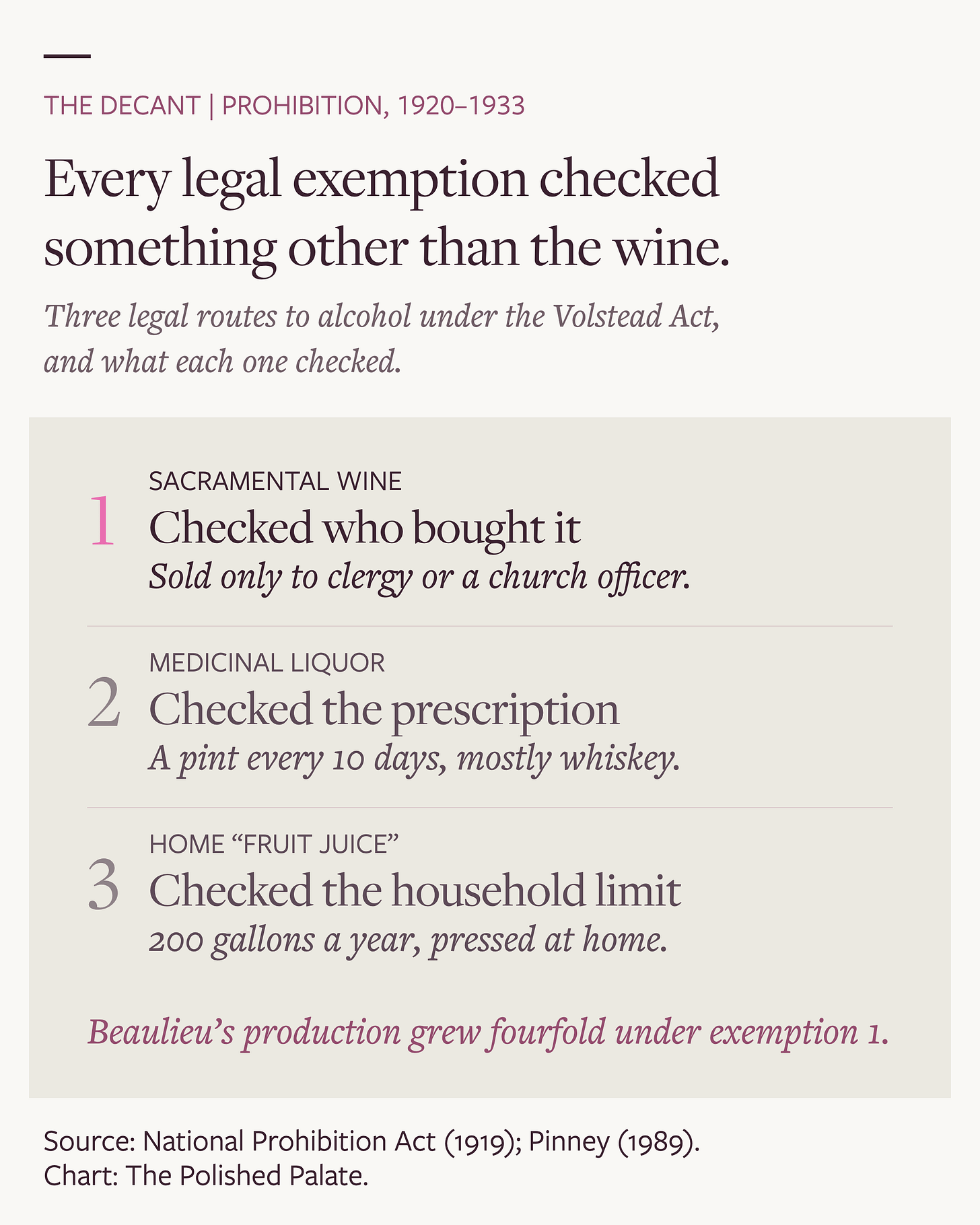
It also carved out three exemptions, and growers and drinkers used every one.
- Section 3 said wine for sacramental purposes could be made, sold, and transported “but only as herein provided,” under permits from the commissioner.
- Section 29 said the penalties for making liquor without a permit “shall not apply to a person for manufacturing nonintoxicating cider and fruit juices exclusively for use in his home.” The regulations that followed set the household ceiling at 200 gallons a year, and nobody in Washington ever defined the moment at which a family’s grape juice stopped being juice.
- A third exemption, Section 6’s liquor “for medicinal purposes when prescribed by a physician,” mattered mostly to whiskey: Section 7 capped it at a pint of spirits every 10 days.
Each exemption came with its own test. The sacramental exemption required a buyer the law named: clergy, or an officer a church had authorized. The home-winemaking exemption required only grapes that could be shipped east and fermented in a basement, up to 200 gallons a year. Both tests measured paperwork and freight. Wineries with a church customer kept their vineyards, cellars, and crews through 1933, and growers shipping east planted whatever grape survived the trip. In American wine, Prohibition is the clearest case of a law shaping which wines survived to be tasted.
Only a handful of producers held sacramental permits: a French immigrant in Rutherford with friends at the archdiocese, an Irish family in Livermore that had made altar wine since 1883, and religious orders that made wine for their own sacraments. When repeal came on December 5, 1933, they had vines in the ground, wine in the cellar, and a crew that had made a vintage every year. Beaulieu’s Georges de Latour Private Reserve, Concannon’s Petite Sirah, and the Christian Brothers brandy are the shelf names that came out of the ban.
Pairing while you read: Concannon Petite Sirah, Livermore Valley, about $12 to $15. The same family label that made wine legally through every year of Prohibition.
The permit and the archbishop
Georges de Latour was born in Bordeaux in 1856 and reached California in 1883. His first wine business was scraping tartrate crystals out of used casks in San Jose. In 1900 he and his wife Fernande bought 4 acres in Rutherford. The story goes that when Fernande first saw the land she said Quel beau lieu, “what a beautiful place,” and the property became Beaulieu Vineyard.
The decision that saved the winery came in 1907, when de Latour obtained a warrant to produce sacramental wine and set Beaulieu up as a nationwide supplier to the Catholic Church. He was a practicing Catholic, and the Napa Valley Register records that he carried letters of recommendation from 2 archbishops of San Francisco, Patrick W. Riordan, who held the seat from 1884 to 1914, and Edward J. Hanna, who held it from 1915 to 1935. By the winery’s own account the altar-wine contract ran from the 1908 vintage to 1978.
Read the statute again and you see why a friend at the archdiocese was worth so much. Section 6 said a permit holder could sell sacramental wine only to “a rabbi, minister of the gospel, priest, or an officer duly authorized for the purpose by any church or congregation,” and that the head of a diocese could name a priest to supervise the manufacture.
The numbers followed. Beaulieu’s production increased fourfold during Prohibition. In 1923, with the altar-wine business booming, de Latour bought the neighboring stone winery that State Senator Seneca Ewer had built in 1885 and planted new vineyards to feed it. By repeal, Beaulieu was producing over 1 million gallons a year.
In 1938 de Latour hired Andre Tchelistcheff out of France, and on arrival Tchelistcheff tasted the family’s private wine from the 1936 vintage and insisted it be bottled as the winery’s flagship. The first release of Georges de Latour Private Reserve Cabernet Sauvignon came in 1940, the year de Latour died, from a winery that had never stopped working. The Private Reserve owes as much to Tchelistcheff as to the permit. What the permit bought was a vineyard, a cellar, and a crew still standing when he arrived. The 2021 vintage sells for $180 at the winery and about $165 at Total Wine in September 2026.
Livermore, and the family that never missed a harvest
James Concannon was born in 1847 on the Aran Islands off Galway and emigrated at 18. By the family’s account, Archbishop Joseph Alemany of San Francisco advised him to get some land and make sacramental wine for the Church. Concannon planted in Livermore in 1883 and imported cuttings from Chateau Margaux in 1893. He died in 1911, and his son Joseph, known as Captain Joe, ran the winery through all 13 years of Prohibition on the altar-wine bond.
Jim Concannon, the third generation, put it this way: “We had been making altar wine for 35 years, and it was perfectly legal for us to continue to do so. We never missed a harvest.” The winery supplied Catholic parishes and also Lutheran and Episcopalian congregations, and 3 of its Prohibition-era bottles now sit in the Smithsonian.
The 1893 Margaux vines were still healthy in the 1960s, and UC Davis registered cuttings from them as Concannon Cabernet clones 7, 8, and 11, which the winery estimates now account for around 80 percent of California’s Cabernet Sauvignon. In 1961 Jim Concannon made the first varietal Petite Sirah in America, and that wine is still the label’s flagship at roughly $12 to $15 a bottle.
The religious orders had the cleanest permits of all, because they were their own customers. The Christian Brothers had made wine at Martinez since 1882. In 1930, in the middle of Prohibition, they bought the Mont La Salle property above Napa, built a $500,000 campus, and moved in during December 1931 with 60,000 gallons of sacramental wine shifted under federal approval. Their first brandy followed in 1940; the order sold the business to Heublein in 1989, and the brandy is now bottled in Kentucky for Heaven Hill at $16.99.
The permit racket
The sacramental exemption was also the most abused piece of the law.
A 1925 report by the Federal Council of the Churches of Christ counted 2,139,000 gallons of sacramental wine withdrawn from bonded warehouses in fiscal 1922, then 2,503,500 in 1923, then 2,944,700 in 1924. The report’s verdict: “it is clear that the legitimate demand does not increase 800,000 gallons in two years.”
The weak point was structural, and Hannah Sprecher’s study in the American Jewish Archives Journal explains it. Catholic and Protestant use of wine happened in public, at a Mass or a service, by clergy in supervised orders. Jewish ritual use happened at home with no clergyman present, and Treasury regulations made rabbis the intermediaries. A permitted family could withdraw 10 gallons a year. Fictitious congregations were assembled from telephone books, Indian Reservation records, and headstones. Fake rabbis needed only 10 signatures for a license and sold permits to restaurants for $200 to $500 each. In 1921 the New York Times reported the seizure of $250,000 worth of wine from the Menorah Wine Company on the Lower East Side, which had been honoring permits signed by teenage boys.
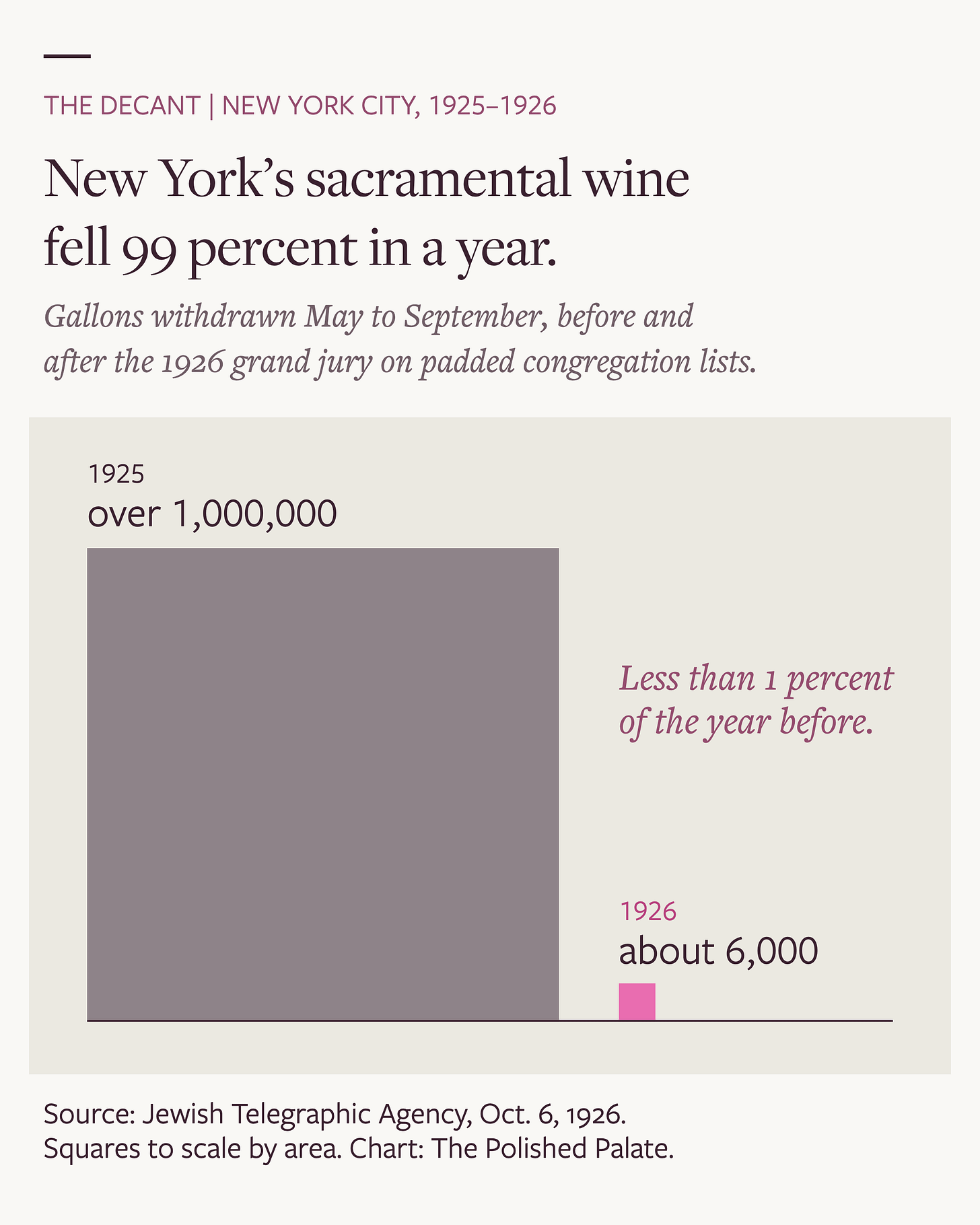
The crackdown came in 1926. Federal authorities put 600 New York City rabbis before a grand jury for padding their congregation lists; indicted defendants had claimed 1,900 members where 300 existed. The Jewish Telegraphic Agency reported on October 6, 1926, that sacramental withdrawals in the city fell from over 1,000,000 gallons in May through September 1925 to slightly more than 6,000 gallons in the same months of 1926. Once investigators checked the congregation lists, the New York permit trade collapsed.
Compare that to Beaulieu and Concannon. Their permits survived the crackdown because their customer was a bishop who could be asked, in writing, whether the wine had arrived and been used. The check verified the customer and left the quality of the wine unexamined.
The 200-gallon allowance, and the grape that made the wine worse
The home-winemaking allowance was the biggest, and it explains why California came out of Prohibition with more vineyard than it went in with.
Thomas Pinney, the historian of American wine, summarized it: the home provision “led to an immediate demand for fresh grapes all over the country.” Produce agents competed for every carload heading east, and “the price of grapes shot up from $10 to $100 a ton and even higher.”
The state had roughly 300,000 acres of vines in 1919; by 1926 that had almost doubled, and grape shipments had grown by 125 percent. American wine consumption, by the most widely cited estimates, went from about 55 million gallons a year before the ban to about 156 million during it.
The grape that won was Alicante Bouschet. Its plantings went from 18,000 acres in 1919 to 39,000 by 1932, because a home winemaker 3,000 miles from the vineyard needed skins thick enough to survive a freight car and enough color to be pressed 2 or 3 times and still look like red wine. Pinney’s verdict: it “at best makes only a mediocre wine.”
So a rule that regulated only what could be shipped and fermented at home favored the qualities a freight clerk could see over everything a drinker can taste. A grape Pinney rated mediocre got 39,000 acres, and by 1926 supply passed demand. Pinney records that “the years of Prohibition ended as they had begun, with the spectacle of discouraged growers pulling out their vines.”
What the survivors had on December 5, 1933
By repeal, the results of the two exceptions were clear. The houses with a customer who could be asked came out with vines in the ground, cellars full, and crews that had made a vintage every autumn. California as a whole came out with 39,000 acres of a grape chosen for a freight car, and growers pulling vines they could no longer sell. Neither outcome was a judgment about flavor, and both shaped what Californians drank for decades. The home-winemaking exception ended up favoring a thick-skinned grape that survived the freight car.
Beaulieu shows how the two fit together. The permit kept the winery operating through 1933, so there was a cellar for Tchelistcheff to walk into. The Private Reserve itself came from Tchelistcheff tasting the 1936 wine and insisting it be bottled as the flagship.
The same split runs through the rules printed on a label today. An appellation tells you where the grapes grew, and an alcohol figure tells you how strong the wine is. Both are verified by someone other than you, and they shape which wines reach the shelf and what they cost. Whether the wine is good is something you find out by tasting it.
The Finish
The founding date on the label is a credential, and now you know how little it certifies. A California house that says 1883 or 1900 came through the dry years by one of several routes: an altar-wine permit with a bishop at the other end, grapes and juice shipped east to home winemakers, concentrate and grape bricks sold with a warning not to let them ferment, or a closed cellar and a name revived after repeal.
The date tells you the name survived. The route tells you what survived with it: a permit house came through with its vineyard, cellar, and crew, and a revived name may have come through with nothing but the label.
Beaulieu’s date is backed by a permit that could be checked, and that is worth knowing about a house. What the Private Reserve tastes like is a separate question, and you answer it by tasting the wine. I tasted the Georges de Latour in February 2021, in a webinar from The Tasting Panel and The SOMM Journal called Somm Sessions: It’s All About the Dust. The dust in that title is Rutherford dust, the phrase Tchelistcheff later coined for what he tasted in Rutherford Cabernet, starting with the 1936 de Latour wine he insisted on bottling. The 1907 permit is the reason there was still a cellar for him to taste it in.
So the next time a pre-1920 date lands in front of you, find out which route the house took; many wineries tell that story on their own site. Then taste the wine as though the date were not on the label.
Pocket Palate: the Prohibition loophole
One card to keep:
- The three exemptions: sacramental wine under permit (Sections 3 and 6), medicinal liquor by prescription at a pint per 10 days, mostly spirits (Sections 6 and 7), and home “nonintoxicating” cider and fruit juices (Section 29), capped by regulation at 200 gallons a year.
- Who survived on sacramental permits: Beaulieu (altar-wine warrant from 1907, production up fourfold by 1933), Concannon (altar wine since 1883, “never missed a harvest”), and the Christian Brothers (60,000 gallons moved under federal approval in 1931).
- How the permit was abused: sacramental withdrawals rose from 2,139,000 gallons in 1922 to 2,944,700 in 1924; in 1926 a New York crackdown on 600 rabbis cut the city’s withdrawals from over 1,000,000 gallons to about 6,000 in the same 5 months.
- The acreage paradox: California’s vines went from about 300,000 acres in 1919 to nearly double by 1926, grape prices from about $10 a ton to $100, and the winning grape was Alicante Bouschet, thick-skinned, dark, and mediocre in the glass.
- What the names cost now: Beaulieu Georges de Latour Private Reserve 2021, $180 at the winery (September 2026); Concannon Petite Sirah, about $12 to $15; Christian Brothers brandy, about $17.
Go Deeper
If this week’s idea stuck with you, these take it further.
- Kelsey Burnham, Prohibition in Wine Country (Napa Valley Register, 2010): A short local history from the Napa County Historical Society: de Latour’s deal with the diocese, Beringer’s raisin cakes, and why the priests and rabbis were probably supplying their congregations.
- Julian Hitner, California and Prohibition: Collateral Damage (Decanter, 2019): The trade view, with the winery counts (700 in 1919, 177 at the start of 1933), the 1923 Beaulieu expansion, and the slow recovery after repeal.
- Hannah Sprecher, “Let Them Drink and Forget Our Poverty”: Orthodox Rabbis React to Prohibition (American Jewish Archives Journal, 1991): The scholarly account of the sacramental permit’s weak point, the Menorah Wine Company scandal, and the rabbis who fought the abuse from inside.
- Thomas Pinney, A History of Wine in America: From the Beginnings to Prohibition (University of California Press, 1989): The standard history, free to read online; the final chapter covers the grape boom, Alicante Bouschet, and the bust.
- National Prohibition Act, 41 Stat. 305 (United States Statutes at Large, 1919): The primary document. Sections 3, 6, 7, and 29 of Title II are the exemptions, in the statute’s own words.