1 Big Idea: Read the Line the Law Checks
You are in the aisle with two Chardonnays at $15. One says Reserve in gold script across the front. The other gives you a grape, a year, and a place. You reach for the Reserve, because the word sounds like the winery kept something back for you.
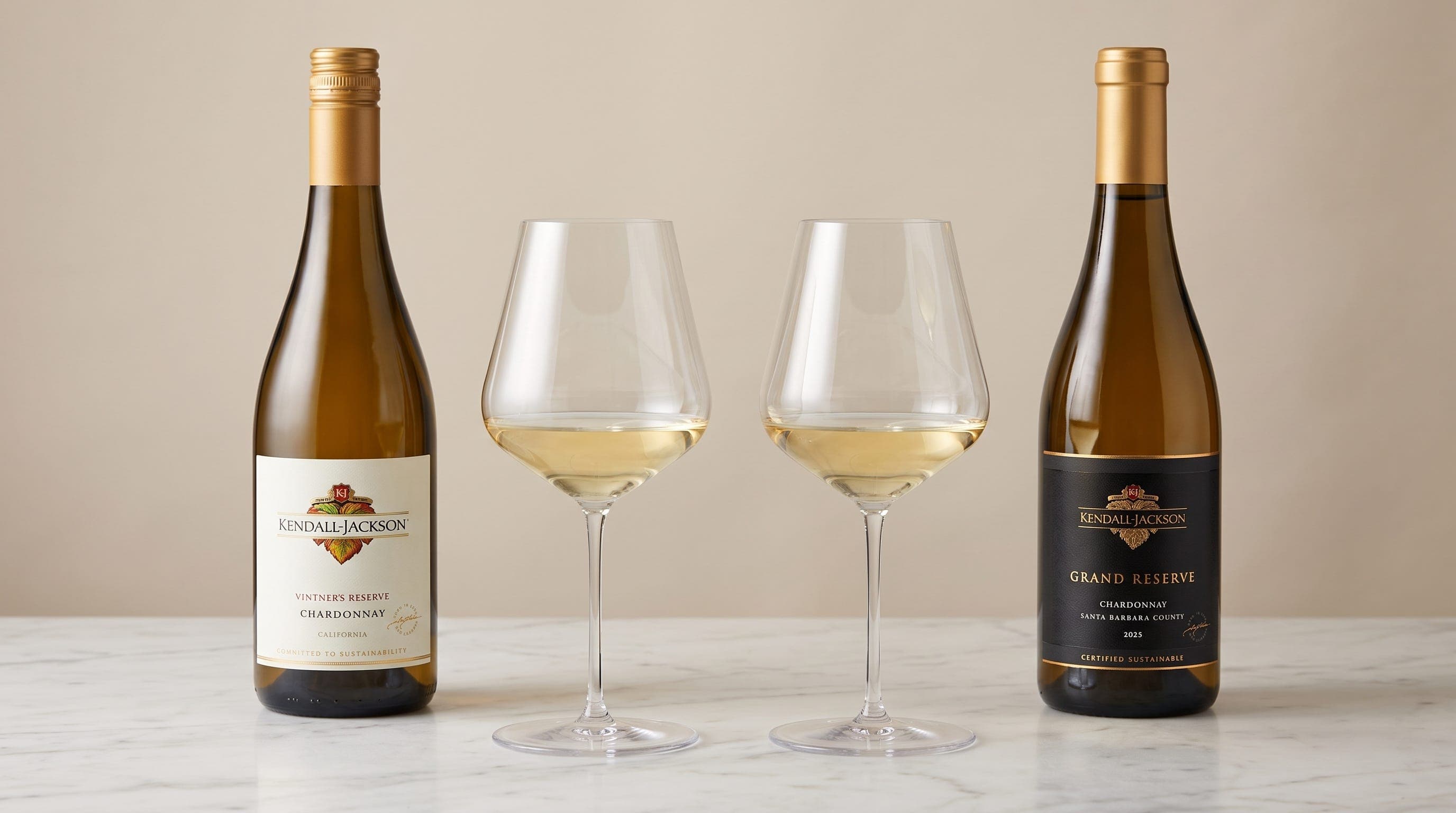
Kendall-Jackson prints the word on 2 tiers. Vintner’s Reserve is the Chardonnay Jess Jackson first made in 1982 from grapes he bought up and down the coast, as far south as Santa Barbara, and according to Wine Spectator it became the best-selling California Chardonnay in the country. The winery’s step up is called Grand Reserve. By the winery’s own account, what separates them is where the grapes come from: Grand Reserve is estate fruit from a single appellation, and Vintner’s Reserve can blend owned and purchased vineyards.
The gold word is the same on both bottles. The small line under it changes. Vintner’s Reserve says California, the widest place name a California winery can print. The Grand Reserve Chardonnay says Santa Barbara County.
The trade chose to keep the word undefined. In November 2010 the federal regulator, the Alcohol and Tobacco Tax and Trade Bureau, asked for public comment on whether Reserve, Old Vine, Estate, Barrel Select, Proprietor’s Blend and a list of similar words should be defined, with ideas on the table like case limits for Reserve and age minimums for Old Vine. The trade groups Wine Institute and WineAmerica asked the bureau to withdraw the notice. 16 years later, Reserve and Old Vine still have no legal meaning on an American label, and any winery can print them on any bottle. In Spain and Italy the word carries rules: a red Rioja Reserva has to age at least 3 years, one of them in oak, before release.
The words with a rule behind them tend to sit in the smallest type:
- The place. A wine labeled California has to be made from California grapes only, under state law. A county name means at least 75% of the grapes came from that county. An American Viticultural Area, like Russian River Valley, means at least 85%.
- The year. A vintage means at least 95% of the wine came from that harvest if the label names an AVA, and 85% if it names a state or county.
- The grape. A grape name on the front means at least 75% of the wine is that variety.
- Estate Bottled. The winery grew every grape on land it owns or controls, inside the named AVA, and made and bottled the wine on its own premises.
I have a working rule for the aisle: the bigger and more decorative the word, the less likely anyone is checking it. I read a label as a ladder. The place line tells you how much is guaranteed, and the guarantee rises as the place shrinks: California, then a county, then an AVA, then a named vineyard. The regulator can audit a winery’s grape records against that line. When the guarantee is thin, as it is with California, the only thing that earns belief is what the producer chooses to tell you on the back label: the vineyard, the lots, the number of cases.
Some Reserves come with a stated meaning. You can tell them apart with one test: the producer says what the word means on that bottle. It names the vineyard or the AVA, says how the lots were chosen, or tells you how few cases were made. A Reserve with a single AVA beneath it and a vineyard on the back label gives you something you can check. A Reserve over the word California, with nothing on the back label about which lots or how many, is a brand name.
3 Taste Experiments
#1: Same word, different place line
- Objective: Taste what the small line changes while the big word stays the same.
- What to try: Kendall-Jackson Vintner’s Reserve Chardonnay (California, $13-17) next to Kendall-Jackson Grand Reserve Chardonnay (Santa Barbara County, $15-25), which the winery makes from its estate vineyards in the Santa Maria and Los Alamos valleys. Same producer, same grape, the word Reserve on both. Chill them and pour side by side.
- What to notice: How bright the acidity feels on the sides of your tongue, and whether the fruit reads riper (pineapple, peach) or crisper (lemon, green apple). How much of each glass is oak and vanilla. Which one you would pick to drink again.
- Lesson: The word Reserve was printed on both bottles. What changed between them is the line under it: grapes from anywhere in California in one, and at least 75% from one cool coastal county in the other. Santa Maria Valley opens west to the Pacific, and its fog and wind keep the days cool. The place line is the part of that difference the law holds the winery to.
#2: A 3-county blend vs a single place
- Objective: Taste what happens when the place name on a Pinot Noir gets smaller.
- What to try: Meiomi Pinot Noir (California, $18-25), which the winery builds from Monterey, Santa Barbara and Sonoma counties, next to a Pinot Noir from one AVA: La Crema Sonoma Coast Pinot Noir ($18-25) or Hahn SLH Pinot Noir (Santa Lucia Highlands, estate grown, $30-35).
- What to notice: Read both labels first. Meiomi’s says California, which legally allows grapes from anywhere in the state, so the 3 counties are something the winery tells you, and the label does not. The other names one stretch of coast. Then taste: sweetness of fruit (cherry jam or fresh cherry), how bright the acidity feels, and how much of the impression comes from oak and vanilla.
- Lesson: A blend across counties is built by the winery for a consistent style every year, and blending regions is a legitimate way to build one. A single AVA means at least 85% of the grapes came from one area, so the wine reflects that one area’s weather more directly from year to year. Neither is the better wine by rule. The place line tells you which kind of wine you are holding before you open it.
#3: 2 Zinfandels that both say Old Vine
- Objective: Check the Old Vine claim yourself, since the law does not. This one is a label test first and a tasting second.
- What to try: Bogle Old Vine Zinfandel (California, $11-13) or Cline Ancient Vines Zinfandel (Contra Costa County, $14-22), next to Bedrock Old Vine Zinfandel (California, $24-30). Both front labels give you only a state or a county. Bedrock names its vineyards: in the 2023 bottling the largest share came from the Bedrock Vineyard in Sonoma Valley, whose vines date to an 1888 replanting.
- What to notice: Read both back labels and both winery websites first, and write down what each one tells you about where the vines are and when they were planted. Then taste: how dense and dark the fruit feels (blackberry, raspberry jam, black pepper), how warm the alcohol is in your throat, and how long the taste lasts after you swallow.
- Lesson: “Old Vine” has no legal age in America, so a 10-year-old vineyard could carry it. The one standard in California is voluntary: the Historic Vineyard Society registers vineyards at least 50 years old where at least a third of the vines in production trace to the original planting. A producer who means the words tells you the vineyard and the year, so you can look the vineyard up in the Historic Vineyard Society registry.
Pocket Palate: Read the label line the law checks
- “Reserve,” “Old Vine”: No legal definition in the United States. Any winery can print them on any bottle.
- The place: California = 100% California grapes under state law, from anywhere in the state. A county = at least 75% from that county. An AVA (Russian River Valley, Columbia Valley) = at least 85% from that area.
- The year: At least 95% from that harvest with an AVA on the label, 85% with a state or county.
- The grape: At least 75% of the variety named.
- Estate Bottled: Grown on land the winery owns or controls in the named AVA, and made and bottled there.
- An honest Reserve: The producer says what the word means on that bottle: a vineyard, an AVA, how the lots were chosen, or how many cases.
- Abroad: In Spain and Italy the word carries rules. A red Rioja Reserva ages at least 3 years, one of them in oak, before release.
The Finish
Jess Jackson put a word on his first Chardonnay that sounds like the winery held something back, and it became the best-selling California Chardonnay in the country. The law let him print that word without defining it, and it required the place line beneath it to be accurate.
The front of the label is the winery’s to design. Knowing which of its words a regulator checked lets you decide how much of the rest to believe.
One action for this week: the next time 2 bottles sit at the same price, skip the biggest word on each and read the place line first. The narrower one carries the bigger guarantee. If both say California, turn them around, and the one whose producer tells you where the grapes grew is giving you more to go on.
Go Deeper
If this week’s idea stuck with you, these take it further.
- Meggan Robinson, What Does ‘Reserve’ Mean on a Wine Label? (Tasting Table, 2023): A short explainer on why Reserve is unregulated in the United States and what the word means in countries that do define it.
- Ben O’Donnell, Feds Debate Stricter Wine-Label Rules (Wine Spectator, 2010): The federal regulator’s 2010 request for comment on defining Reserve, Old Vine, Estate and a dozen other words, and the trade’s push to drop it.
- About the Historic Vineyard Society (Historic Vineyard Society): The criteria behind California’s registry of heritage vineyards, the closest thing the state has to a definition of old vines.
- 27 CFR 4.25, Appellations of Origin (Cornell Legal Information Institute): The federal rule itself, with the 75% and 85% thresholds and the multi-county labeling requirement.