1 Big Idea: Cheese Turns Red Wine Down
The board is on the table: a block of sharp cheddar, a round of Brie, a wedge of blue. Someone opens a Cabernet, because red wine goes with cheese, and nobody stops to ask why.
Wine merchants have an old saying for this, in print in English since at least 1972: buy on apples, sell on cheese. The logic is commercial: a buyer tastes with an apple or plain bread so faults show up, and a seller serves cheese because it makes the wine easier to like.
The myth is that red wine is cheese’s default partner. Each of 3 studies measured a different piece of it.
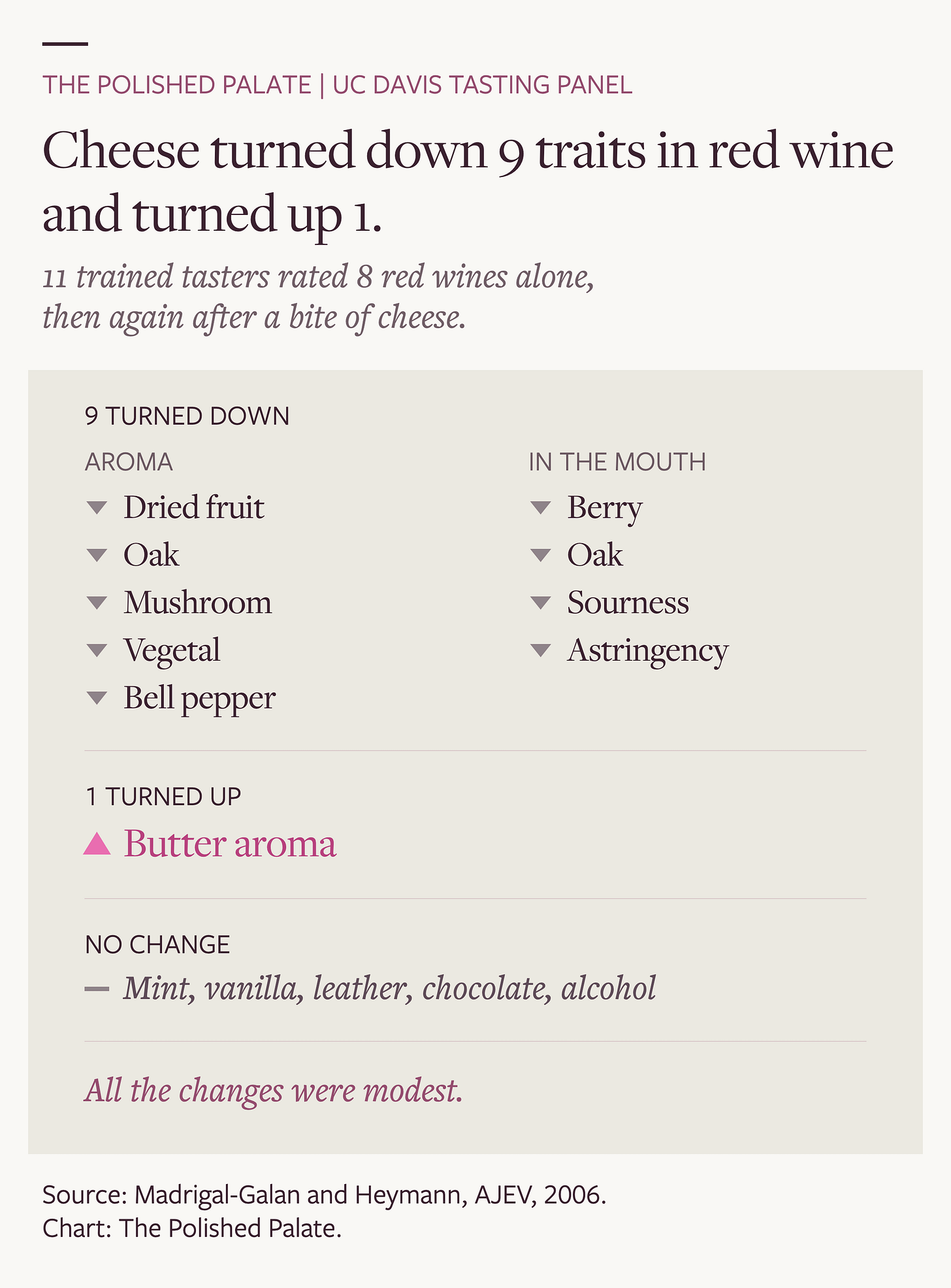
Intensity. At UC Davis in 2006, a trained panel rated how strong each flavor was in 8 red wines, first alone and then after a bite of cheese. Cheese turned down most of what they rated: fruit and oak aromas, berry and oak flavor, sourness, and astringency, the drying grip of tannin. Only a buttery aroma went up. The changes were modest, and each cheese had the same effect on every wine.
Liking. In a 2016 study in Dijon, France, 31 wine and cheese drinkers tasted 2 whites and 2 reds with and without cheese. Overall they liked the wines more with cheese. The biggest gain came in Madiran, the most tannic red, where cheese cut how long the grip and sourness dominated.
Balance. A Canadian study of 9 cheeses and 18 wines measured whether the wine or the cheese took over. A dry Riesling came closest to balance, the whites as a group came closer than the reds, and aged cheddar matched lighter reds and whites better than full-bodied reds.
Liking is the measure that makes red look like cheese’s natural partner, and it is the weakest test of a pairing. Cheese made the Dijon wines easier to like overall, so liking cannot single out red. It also rises when cheese removes something: the Madiran gained most as its grip faded. When you have paid for a bottle, the test that matters is whether you can still taste it next to the cheese. On that test, the Davis panel measured reds losing some fruit, oak and grip. Nobody measured that for whites; the Canadian balance scores put them closer to an even match.
The causes, as the researchers name them:
- Fat and protein against tannin. The Davis authors named cheese fat coating the mouth, and cheese protein binding, as likely reasons astringency dropped.
- Salt against acid. They named cheese salt as a likely reason sourness dropped.
- Sugar against salt. In lab tests on sugar and salt solutions, sugar cut saltiness sharply and salt barely lowered sweetness.
My reasoning, for you to test: a wine that starts with high acidity should have more of it left after the salt takes some away. Bubbles may add to that, since a 2009 study in mice traced the taste of carbonation to the cells that sense sour. The Canadian panel found a sparkling wine balanced well with a firm, sharp cheese, but no study here measured how much of a sparkling wine you still taste after cheese. Experiment #2 is where you find out.
Cheese makes a red easier to like by turning it down. No study here measured how much of a white you taste after the bite, and Experiment #1 lets you check it yourself.
You need only 2 glasses and a supermarket cheese case to check these claims and judge the next cheese board yourself.
3 Taste Experiments
#1: Aged cheddar with Cabernet vs dry Riesling
- Objective: Taste what fat and salt do to tannin, and what they leave behind in a high-acid white.
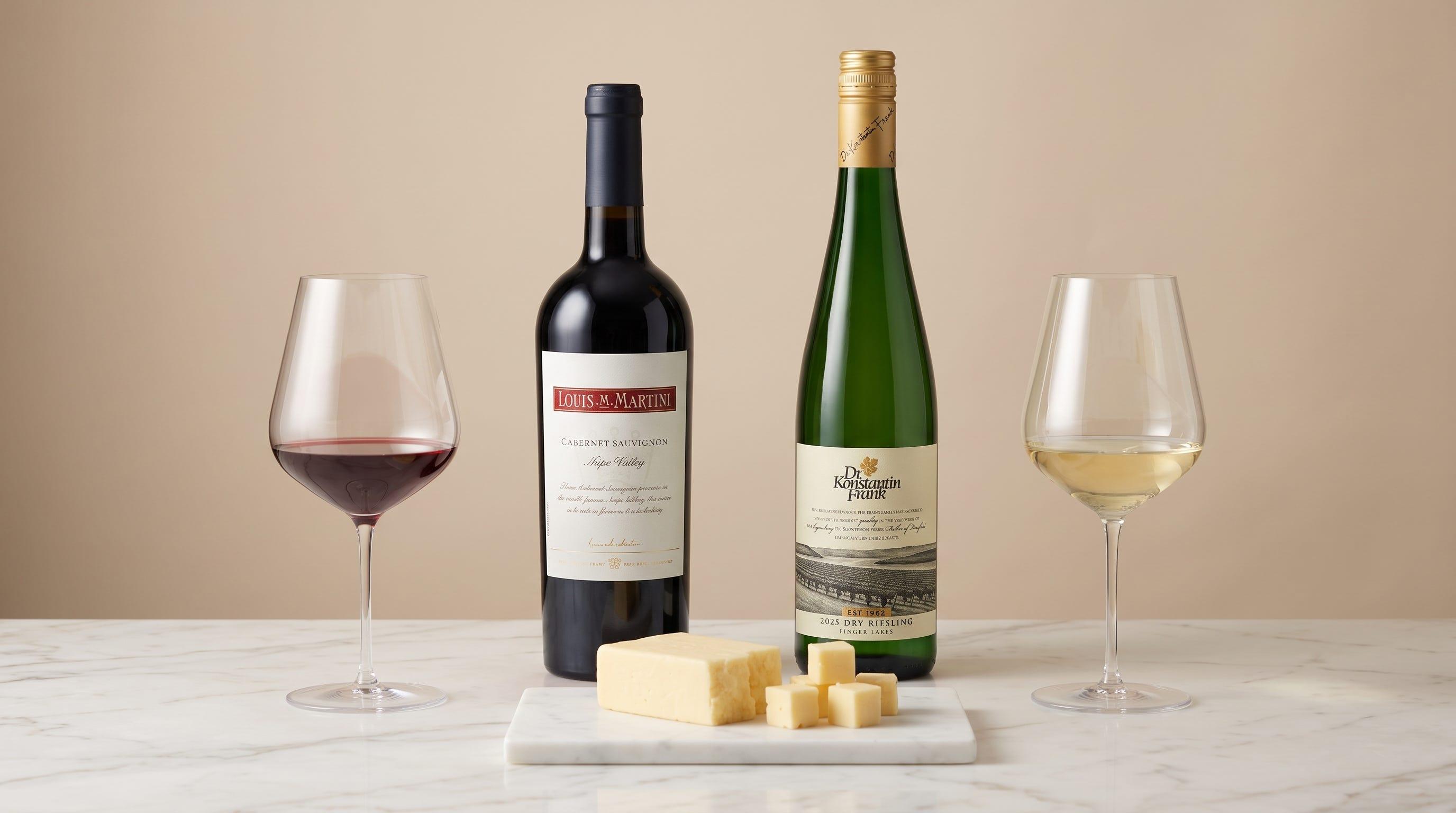
- What to try: Tillamook Extra Sharp White Cheddar or Cabot Extra Sharp Cheddar, both aged a year or more ($4-6 for 8 oz). Open a Cabernet Sauvignon, Josh Cellars (California, $12-15) or Louis M. Martini (Sonoma County, $18-22), next to a dry Riesling, Pacific Rim Dry Riesling (Columbia Valley, Washington, $10-12) or Dr. Konstantin Frank Dry Riesling (Finger Lakes, New York, $15-20).
- What to notice: Sip each wine on its own, then again after chewing a cube of cheese. In the Cabernet, how much of the drying grip on your gums is left, whether the berry flavor and the oak are as strong as they were, and whether the wine tastes less sour. In the Riesling, whether the acidity still makes your mouth water, and whether the cheese tastes sharper or rounder after the sip.
- Lesson: The cheddar does smooth the Cabernet’s tannin. It also takes fruit and oak with it, and the Canadian panel found aged cheddar matched lighter reds and whites better than full-bodied reds. If the smoother, quieter Cabernet is the version you like, that is a real preference, and you know what it lost.
#2: Brie with a light red vs Crémant or Champagne
- Objective: Taste how acidity and bubbles hold up against a soft, rich cheese, and how a light red fares with little tannin to trade.
- What to try: Président Brie ($5-8 for an 8 oz wheel), served at room temperature. A light red, Louis Jadot Beaujolais-Villages or Georges Duboeuf Beaujolais-Villages (Gamay, Beaujolais, France, $11-14), next to a sparkling wine made by the same method as Champagne: Lucien Albrecht Crémant d’Alsace Brut (Alsace, France, $17-20), Gruet Brut (New Mexico, $15-20) or, as a stretch, Nicolas Feuillatte Réserve Exclusive Brut (Champagne, $35-45).
- What to notice: After a bite of Brie, how much of the coating is still on your tongue when you swallow each wine. Whether the Beaujolais tastes thinner or flatter after the cheese than before. Whether the sparkling wine leaves your mouth clean enough that you want the next bite.
- Lesson: A light red has little tannin for the cheese’s fat to soften, so by the Davis findings the cheese takes fruit and sourness and has little grip to ease in return. The sparkling wine is the prediction from the reasoning above: it starts with high acidity and carbon dioxide, so more of it may be left after the bite. Taste the 2 glasses side by side to find out whether that holds. The Canadian panel found the Camembert in their lineup, a close cousin of Brie, paired better with white wines than with reds.
#3: Blue cheese with a dry red vs a sweet wine
- Objective: Taste what salt does to a dry red, and what sugar does to salt.
- What to try: Roquefort Société, a sheep’s milk blue from France ($7-10 for 3.5 oz), or Point Reyes Original Blue, a raw cow’s milk blue from California (about $25-30 a pound at the cheese counter). A dry red, Alamos Malbec ($9-13) or Catena Malbec ($15-20), both Mendoza, Argentina, next to a sweet wine: Castelnau de Suduiraut Sauternes (Bordeaux, France, $18-25 for a 375 ml half bottle), Graham’s Six Grapes Reserve Port ($18-23) or Fonseca Bin 27 Port ($18-23).
- What to notice: How salty the blue tastes on its own, then right after a sip of each wine. Whether the Malbec’s fruit survives the bite or tastes hollow and harsh. Whether the sweet wine tastes less sugary next to the cheese than it did alone, and whether either one overwhelms the cheese.
- Lesson: In lab tests sugar turns salt down and salt barely touches sugar, one reason Sauternes with Roquefort has lasted as a classic. The Canadian study adds a limit: its late-harvest, ice and Port-style wines dominated the cheeses, and their most suitable matches were the strongest-flavored ones, the blue among them. Save the sweet wine for the blue, and pour something else for the rest of the board.
Pocket Palate: What cheese does to wine
- Fat and protein vs tannin: Cheese softens a red’s grip. In the UC Davis tests it lowered the red’s fruit and oak too.
- Why liking misleads: In a Dijon study, cheese made the wines easier to like overall, and the most tannic red gained most as its grip faded.
- Salt vs acid: Cheese lowers how sour a wine tastes, and the Davis authors named salt as a likely reason. My reasoning: a high-acid white or a sparkling wine has more acidity to spare.
- Sugar vs salt: In lab solutions, sugar cut saltiness and salt barely touched sweetness. Pour the sweet wine with the blue.
- The test: Taste the wine alone, then after a bite of cheese. Keep the pair where you still like both.
The Finish
Cheese makes a red easier to like, and in the Davis tests it did that by turning the red’s fruit, oak and grip down. When you open a bottle you paid for, the test is whether you can still taste it with cheese in your mouth. By that test the case for red as cheese’s default partner is weak: the reds lost flavor, and the Canadian balance scores put whites, led by a dry Riesling, closer to an even match. Mara Galmarini, who led the Dijon study, told NPR: “If you have many cheeses, better to serve a white wine.”
Ask yourself which change you noticed first: the grip easing, the fruit fading, or the salt dropping. Then ask whether you missed what went away. Your answers to those 2 questions are the pairing rule to use at your own table.
One action for this week: put out 1 cheese and 2 open bottles, a red and anything else. Taste each wine before the cheese and after it, and pour more of whichever one you could still taste after the bite.
Go Deeper
If this week’s idea stuck with you, these take it further.
- Jeremy Cherfas, Pairing Wine and Cheese? Science Says White May Be a Better Choice Than Red (NPR, 2016): A short account of the Dijon study, in which cheese shortened the drying grip of red wines and the lead scientist called white wine the lower-risk choice for a mixed board.
- Jacob Gaffney, Serving Port with Camembert? That Does Not Compute (Wine Spectator, 2006): Covers the Canadian and UC Davis studies side by side, including the dry Riesling result and the sweet and Port-style wines that dominated the cheeses.
- Berenice Madrigal-Galan and Hildegarde Heymann, Sensory Effects of Consuming Cheese Prior to Evaluating Red Wine Flavor (American Journal of Enology and Viticulture, 2006): The UC Davis paper itself, with the 8 wines, the 8 cheeses and the full list of wine attributes cheese turned down.
- Barry G. Green et al., Taste Mixture Interactions: Suppression, Additivity, and the Predominance of Sweetness (Physiology & Behavior, 2010): The free lab study behind the sugar-and-salt effect, with sweetness turning down saltiness, sourness and bitterness in mixtures.