1 Big Idea: Where a Bottle’s Price Goes
You are in the aisle with a $10 Cabernet in your hand. One shelf up sits a $16 bottle from Paso Robles, and at eye level a $45 bottle from Napa. Three prices, and no way to tell how much of each price goes to the wine.
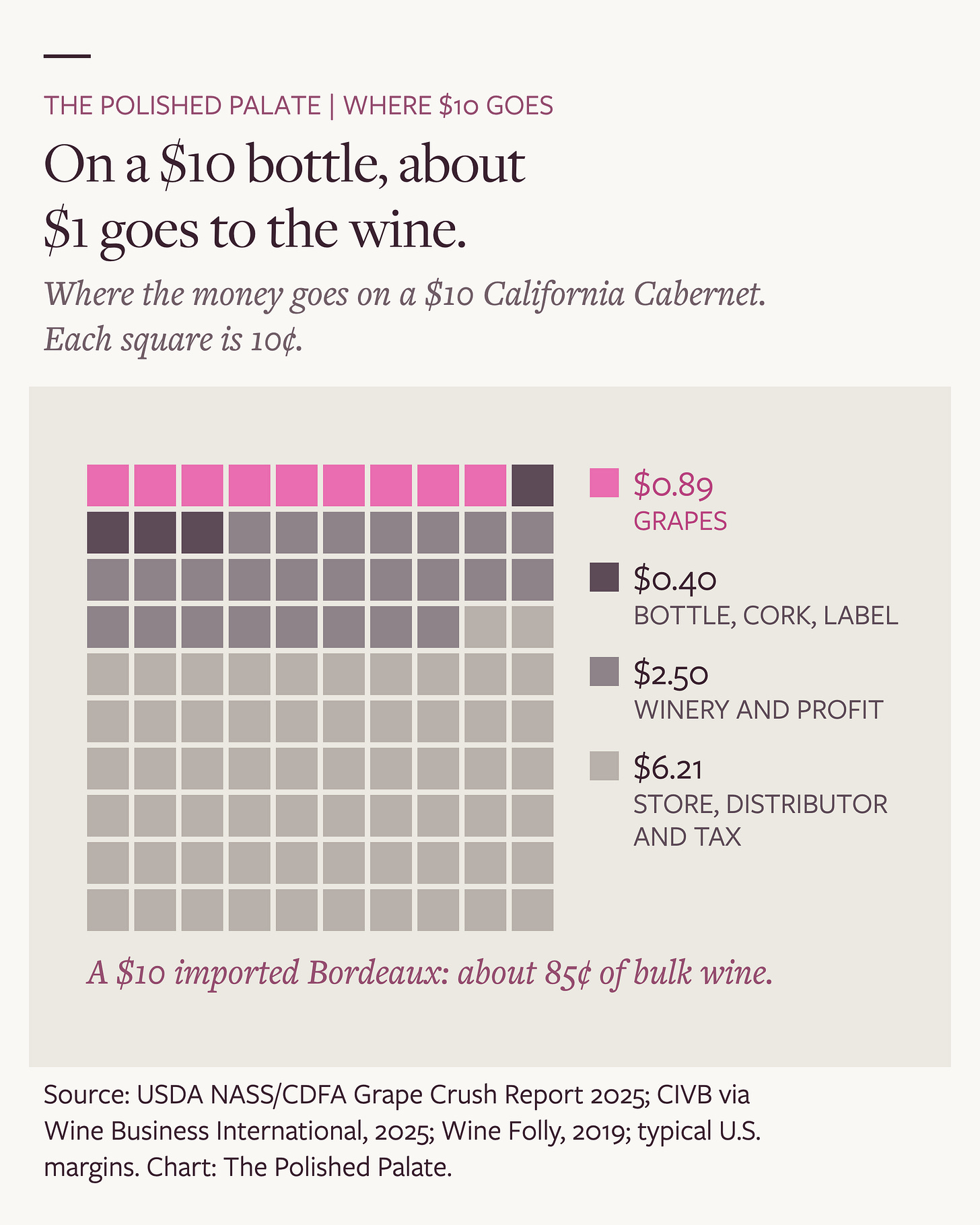
At any price, the store and the distributor keep about 60% of what you pay for a bottle in the U.S., so the winery sees about 40 cents of every shelf dollar. Under about $15, glass, tax and the cost of running a winery take most of that 40 cents. Above it, more of each extra dollar can reach the grapes and barrels, and how much depends on what the extra buys: costlier grapes, more time in the cellar, or a famous name.
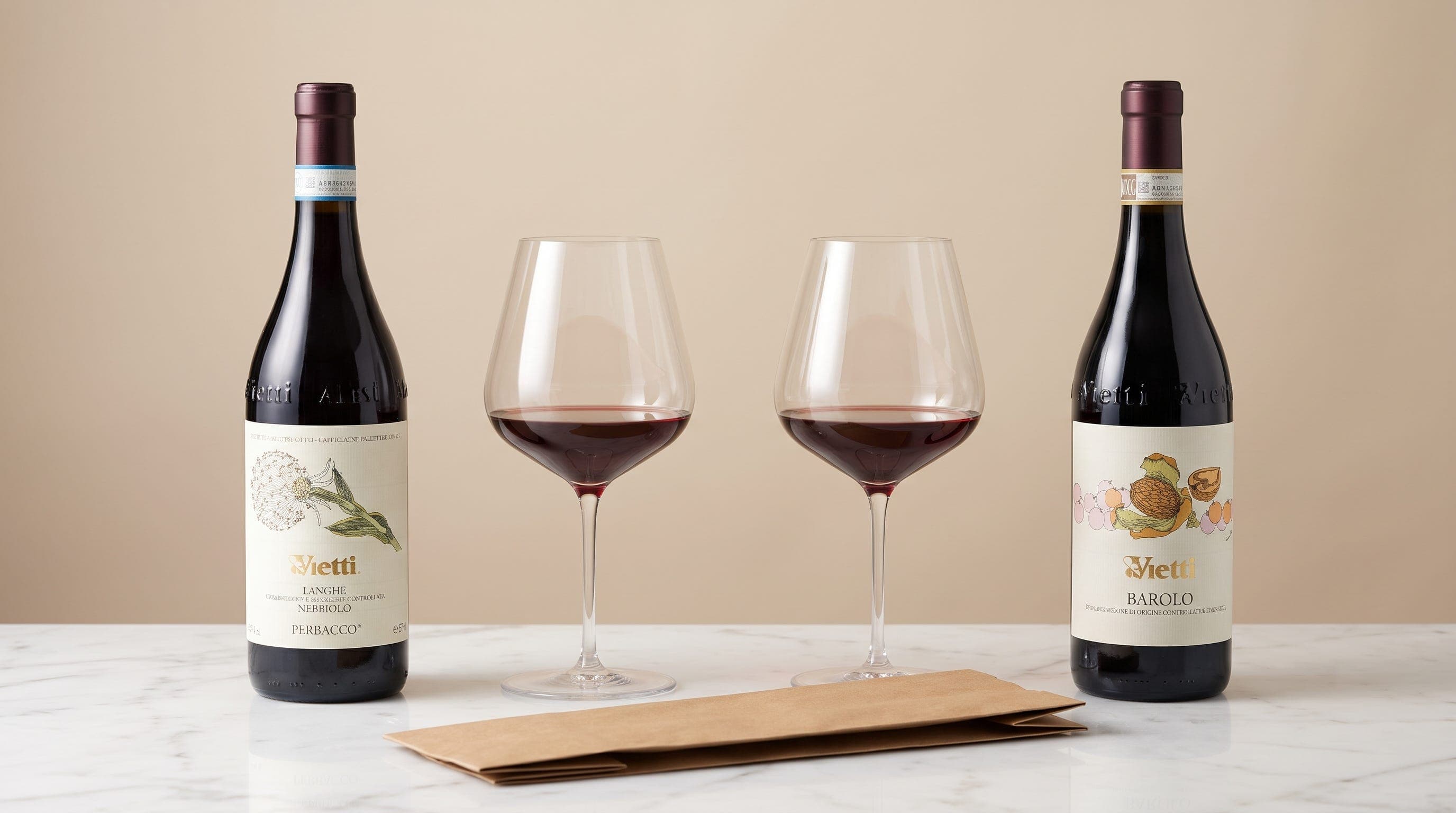
In California, the dollars between a $16 and a $45 Cabernet put about 37 of those 40 cents into the bottle. Between a $30 Langhe Nebbiolo and a $60 Barolo from the same cellar, the grape price barely moves, and the extra pays for the lots the producer picks, more time in the cellar and the name.
I buy wine from distributors as a sommelier, so the first number I see on any bottle is its price before a store marks it up. This issue works back from that number to the grapes.
Start with the $10 Cabernet. In the U.S., wine moves from the winery to a distributor to a store. The store keeps about a third of the shelf price and the distributor about a quarter, which leaves the winery around $4. Glass, cork, label and federal tax take about 60 cents of that. Lodi Cabernet sold for $640 a ton in 2025, and a ton makes about 720 bottles, so fruit from there costs under $1 a bottle. The remaining $2.50 or so pays for making the wine, running the winery, selling it and profit, a split no winery publishes.
An imported bottle adds an importer, ocean freight and a U.S. tariff that has sat between 10% and 15% on European wine at different points over the past year. Red Bordeaux traded in bulk in 2025 at about €900 per tonneau, a 900-liter unit that fills 1,200 bottles. That puts about 85 cents of finished wine, grapes and winemaking included, in a $10 Bordeaux.
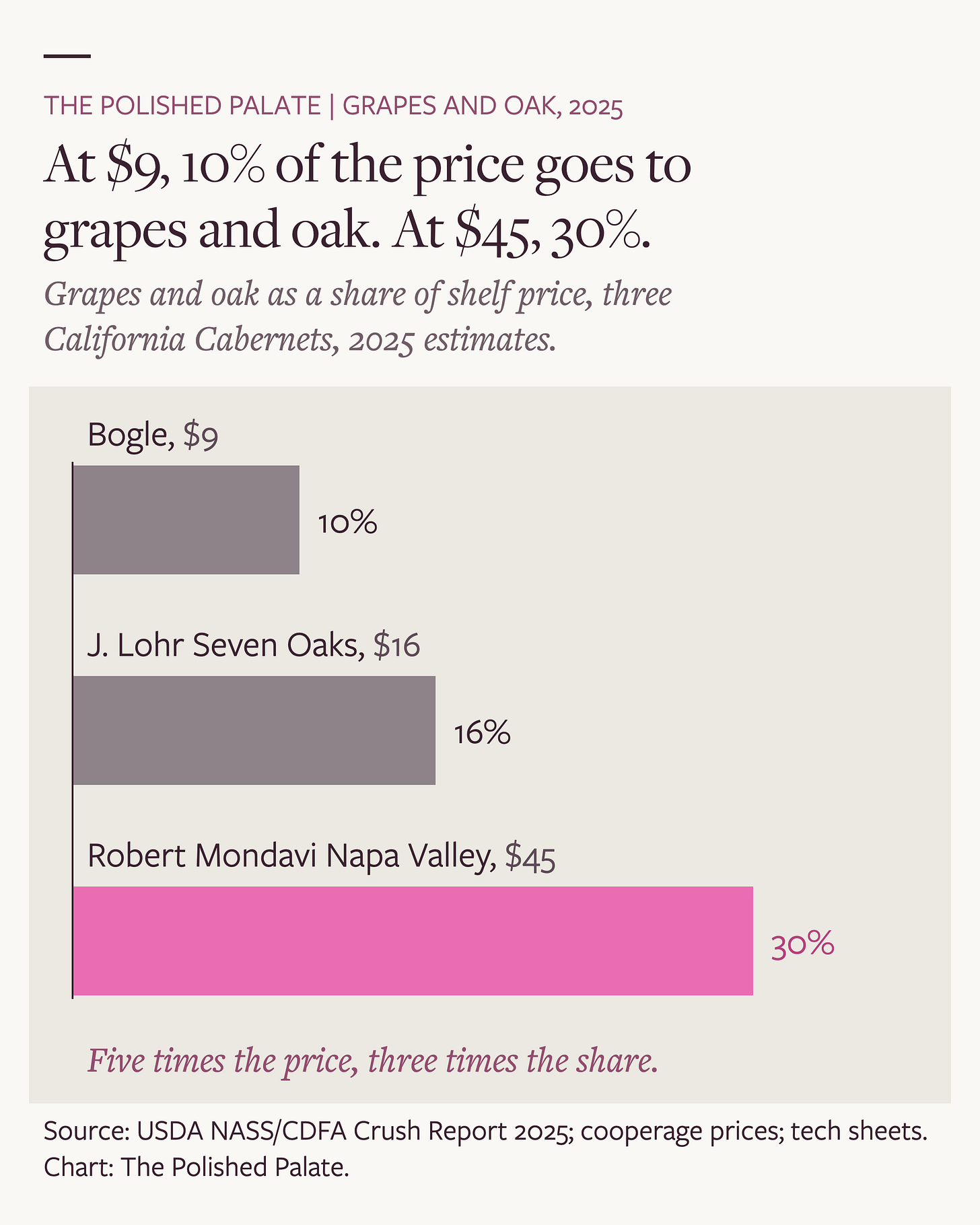
Now climb the shelf. Because the winery keeps only about 40 cents of each extra shelf dollar, 40 cents is the most an extra dollar can put into the bottle. Glass and tax cost about the same on a $45 bottle as on a $10 one, so past the bottom shelf most of the winery’s extra share is free to go into the bottle. Here is how much of it reaches the grapes and barrels at each step:
- $9 Bogle to $16 J. Lohr Seven Oaks: about 24 cents of each extra dollar.
- $16 Seven Oaks to $45 Robert Mondavi Napa Valley: about 37 cents, close to the whole 40. Napa Cabernet averaged $8,645 a ton in 2025, 13 times the Lodi price, and part of that price pays for the Napa name itself. The Mondavi also gets new French barrels. Mondavi does not publish what it pays for fruit, so this step uses the Napa average.
- $45 Mondavi to a $4,000 Screaming Eagle: about 5 cents. Decant #7 followed the climb to the top, where that bottle holds about $200 of wine.
Piedmont works differently. The 2025 grape price list from the Cuneo chamber of commerce puts the fruit in a bottle of Barolo at about $3, more where a producer keeps yields below the legal maximum. Vietti’s Perbacco Langhe Nebbiolo comes from vineyards mostly inside the Barolo and Barbaresco zones, so its fruit costs $2 to $3 by that list. Langhe Nebbiolo from outside those 2 zones costs closer to $1.
The list prices grapes by where they grow. It has no way to price the choice Vietti makes after fermentation: the winery ages each parcel separately, then picks which lots go on to become Barolo, and the rest become Perbacco. Vietti does not publish how it chooses. Site and vine age are the usual reasons a producer holds a lot back for Barolo. The Barolo then ages longer. Perbacco is bottled after about 18 to 20 months in wood, and Barolo by law ages at least 38 months, 18 of them in wood, before release.
So the extra $30 pays for 3 things at once: the lots Vietti judged best, the extra time and the word Barolo on the label. Time in the cellar costs a producer storage space and money tied up in unsold wine, and no producer I could find publishes what that comes to per bottle. Piedmont grape prices fell about 17% from 2024, so this year’s numbers sit low.
These figures are estimates. A state’s markups, a winery that owns its vineyards, or a store running a sale will all move them. Each pair below tests one step on the price ladder. Put each bottle in a paper bag, have someone else pour, and write down which glass you would buy again before the bags come off.
3 Taste Experiments
#1: A $9 and a $16 Cabernet, the first step up
- Objective: This pair tests the first step out of the markup zone. By the estimates above, about $1 of the $9 price goes to grapes and barrels and about $2.60 of the $16 price, so for $7 more on the shelf, more than twice as much money goes into what is in the bottle.
- What to try: Bogle Cabernet Sauvignon (California, $9-11), aged 12 months in one-year-old American oak, or Columbia Crest Grand Estates Cabernet (Columbia Valley, $9-14). Then J. Lohr Seven Oaks Cabernet Sauvignon (Paso Robles, $15-18) or Liberty School Cabernet Sauvignon (Paso Robles, $13-17).
- What to notice: How deep and dark the fruit tastes, and whether it reads as fresh or as jam. Vanilla, toast or sweet spice from oak. How firm the tannin feels on your gums. How long the taste lasts after you swallow: count the seconds for each glass. When the bottles are empty, weigh them on a kitchen scale. Heavier glass costs the winery more and adds nothing to the wine.
- Lesson: The Paso Robles district averaged $1,582 a ton for Cabernet in 2025, about $2.20 of grapes per bottle, against under $1 for the cheapest California fruit. If you pick the Seven Oaks blind, that extra $7 bought something you can taste. If you cannot tell them apart, the $9 bottle is the one to buy for now.
#2: A $16 Paso Robles Cabernet and a $45 Napa Cabernet
- Objective: This pair tests costlier grapes and more new oak, the step where about a third of a California bottle’s price starts paying for grapes and oak.
- What to try: The Seven Oaks or Liberty School from #1. Then Robert Mondavi Napa Valley Cabernet Sauvignon ($40-50), aged 18 months in French oak, 29% of it new, or Louis M. Martini Napa Valley Cabernet Sauvignon ($42-55).
- What to notice: Whether the fruit tastes riper or more concentrated. Toast, cedar or coffee from new French oak. How fine or coarse the tannin feels, like suede or like sandpaper. Which glass you go back to first.
- Lesson: At the 2025 Napa average of $8,645 a ton, the Mondavi holds about $12 of grapes, plus about $1.35 a bottle in new French barrels. That is roughly $13 of a $45 price spent on grapes and barrels, against about $2.60 of $16 for the Seven Oaks. If you prefer the Napa bottle blind, you are paying for something that is in the glass. If you prefer the Seven Oaks, your preference saves you about $30 a bottle.
#3: Langhe Nebbiolo and Barolo from the same cellar
- Objective: This pair tests what a producer’s own sorting is worth. Vietti ferments and ages each vineyard parcel separately, then picks which lots go on to become Barolo. The rest become its Langhe Nebbiolo.
- What to try: Vietti Perbacco Langhe Nebbiolo ($28-32), aged about 18 to 20 months in wood, next to Vietti Barolo ($54-65), which many shops still list as Barolo Castiglione, aged about 24 to 30 months in large casks and some barriques. For a second producer, G.D. Vajra Langhe Nebbiolo next to G.D. Vajra Albe Barolo ($36-45). Open both an hour before tasting, since young Nebbiolo tightens up straight from the bottle.
- What to notice: Color at the rim of the glass, where Nebbiolo turns orange as it ages. Rose, tar, cherry or dried herbs on the nose. How much the tannin grips, and whether it dries your mouth out or feels smooth. How long the taste lasts after you swallow.
- Lesson: By the Cuneo prices, the Perbacco holds $2 to $3 of grapes and the Barolo about $3. The list has no line for what sets the Barolo apart: the lots Vietti judged best, more time in wood and bottle, and the name. A blind tasting tests the lots and the time together, with no way to pull them apart, and it cannot test the name. If you prefer the Barolo blind, you tasted the selection and the time. If you cannot tell them apart, neither showed up for you in a young bottle tonight. Many Barolos need years more in a cellar before that difference shows, so this test covers drinking them now and nothing later.
Pocket Palate: Where a bottle’s price goes
- The markups: In the U.S. the store keeps about a third of the shelf price and the distributor about a quarter. An import adds an importer, freight and a tariff, and its shelf price runs about 3.5 to 4 times the producer’s price on cheaper bottles.
- The fixed costs: Glass, cork and label run about 40 cents on a value bottle. Federal excise tax is about 21 cents. Both cost about the same whatever the price, so they take a bigger share of a cheap bottle.
- The grapes: In 2025, under $1 a bottle for Lodi Cabernet, $2.20 for Paso Robles and $12 for Napa. About $1 for Langhe Nebbiolo grown outside Barolo and Barbaresco, and $2 to $3 for Nebbiolo grown inside them, which is where Vietti’s Perbacco comes from.
- The barrels: New French oak costs about $4.70 a bottle when every barrel is new, and American oak about half that.
- Where an extra dollar reaches the bottle: The winery sees about 40 cents of each extra shelf dollar. From a $16 to a $45 California Cabernet, about 37 of those cents went to grapes and oak. From a $30 Langhe Nebbiolo to a $60 Barolo from the same cellar, the grape price barely moves, and the extra pays for the producer’s best lots, more aging and the name.
The Finish
On a $10 bottle, about $1 pays for the wine: under $1 of grapes in a California Cabernet, about 85 cents of finished bulk wine in a Bordeaux. Between a $16 and a $45 California Cabernet, at the Napa grape average, nearly everything the winery receives goes into grapes and barrels, so more of your money pays for what is in the bottle.
Whether that makes a better wine is a separate question: part of a Napa grape price pays for the Napa name, and new oak is a style some drinkers would rather skip. The dollars from a Langhe Nebbiolo to a Barolo buy a producer’s best lots, more cellar time and a name. From a $45 Napa Cabernet to a cult one, they buy mostly scarcity and a name. A blind tasting is how you find out whether any of that money buys something you can taste.
When the bags came off, which step on the ladder did you notice, and which one did you pass on?
One action for this week: pick the price you usually spend on a bottle, then buy one bottle a step above it from the same producer or region. Taste them blind. If you pick the pricier one, you know what your next $10 is buying. If you do not, keep the money.
Go Deeper
If this week’s idea stuck with you, these take it further.
- Madeline Puckette, Why Is Wine So Expensive? (Wine Folly, 2019): Illustrated breakdowns of what grapes, oak barrels and packaging add to a bottle, including the cost of making two California reds, one for about $5 a bottle and one for about $16.
- Jessica Fields, Understanding the Three-Tier System of Alcohol Distribution (VinePair, 2022): How U.S. law puts a distributor between every winery and every store, and why that step adds to the shelf price.
- Prezzi delle uve, anno 2025 (Camera di commercio di Cuneo): The official 2025 grape price list for Cuneo province, which covers the Langhe and Roero, where the Barolo and Langhe Nebbiolo prices in this issue come from. In Italian, and the tables read easily.
- Grape Crush Report, Final 2025 Crop (California Department of Food and Agriculture and USDA NASS, 2026): The state’s yearly record of what wineries paid for every grape in every district. Table 6 holds the per-ton Cabernet prices behind this issue.