1 Big Idea: When the Map Changed Scale
I poured myself a pale, high-toned white last week and at first sip I thought it could’ve been Burgundy. Cool, mineral, a little austere. It was a Santa Barbara Chardonnay, grown twenty miles from the Pacific and picked early on purpose.
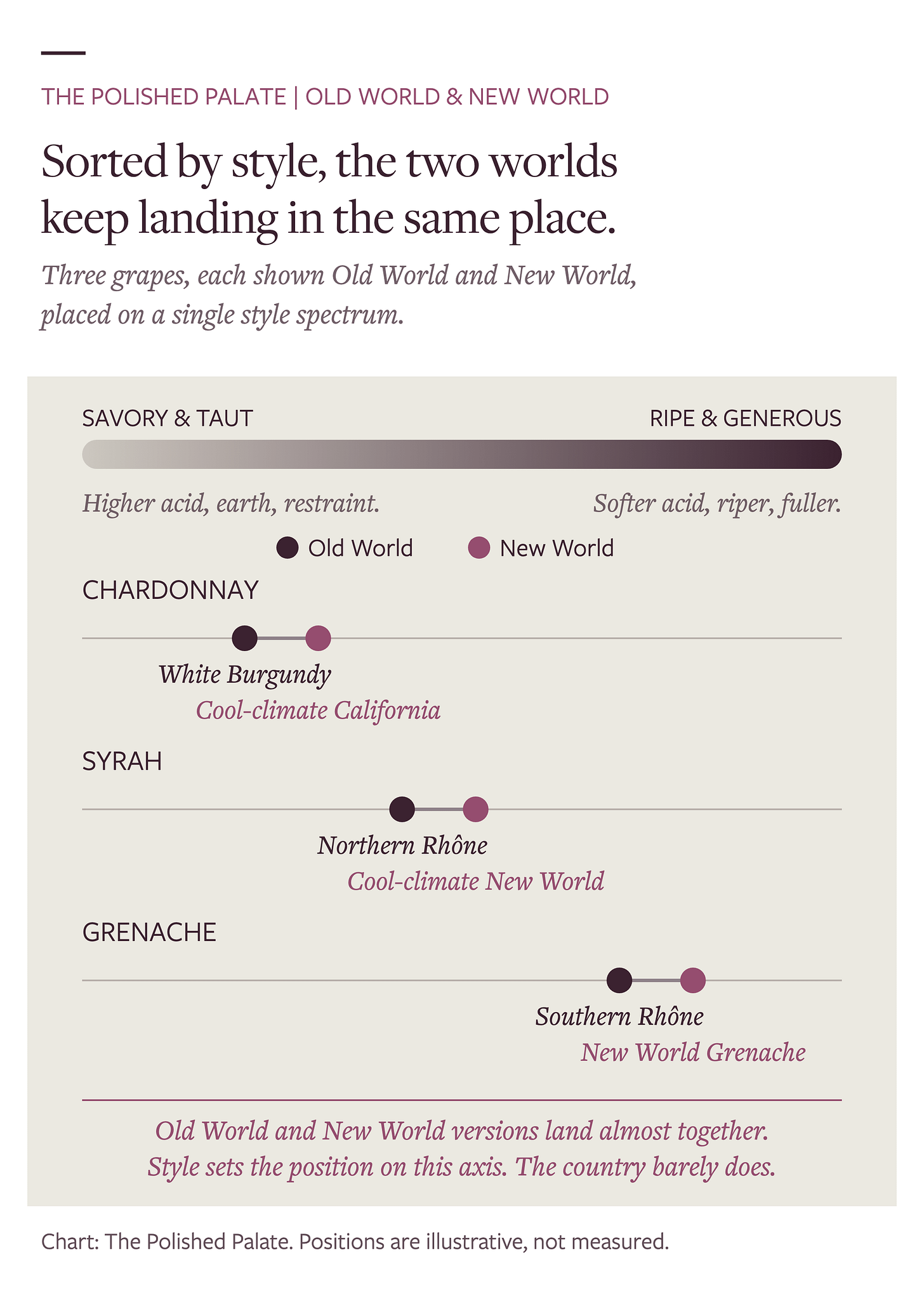
For most of the last century, Old World and New World worked as a reliable shortcut. Old World meant Europe, and usually restraint: savory notes, earth and stone, bright acidity, a wine built to taste like the place it grew. New World meant everywhere else, and usually ripeness, roundness, and fruit at full volume. You could parse a list by country and be right often enough to trust it.
That shortcut has been failing for fifteen years. The Old World warmed, and its wines grew riper. One study that measured the actual alcohol in more than 100,000 wines found it rising in every country it tested between 1992 and 2009, the Old World included.
A generation of New World growers went hunting for cooler sites and a lighter touch, and their wines grew leaner and more savory. The two traditions have been drifting toward each other the whole time you were learning to tell them apart.
What predicts the glass now is climate and intent: how warm the vineyard was, and what the winemaker set out to chase. The map still matters here, more than ever. It just works at a finer grain than a hemisphere.
Country isn’t a reliable indicator of style anymore. The region predicts a great deal, because a New World grower chasing savory tension goes hunting for a cold site and prints its name on the label. Learn which corners run cool, the Sonoma Coast and the Sta. Rita Hills, Tasmania and the Mornington Peninsula, and you can read a fair amount of the style before you pull the cork.
3 Taste Experiments
Three grapes this week, each in a pairing built to test the old rule. Buy both bottles in each pair, taste them side by side, and try to call which is Old World and which is New before you check the label. Pay attention to how confident you actually are. Spread them across an evening with water and plain bread to reset.
#1: Restrained California Chardonnay vs White Burgundy
Objective: Start where the convergence is most complete, in a white where a cool site and a light hand erase the border.
What to try: A lean, cool-climate New World Chardonnay such as Au Bon Climat Santa Barbara, Sandhi Santa Barbara, or Chehalem “INOX” unoaked (Oregon), roughly $22 to $30. Then a white Burgundy such as Louis Jadot Mâcon-Villages, Joseph Drouhin Saint-Véran, or Domaine de la Croix Senaillet Mâcon-Villages, roughly $16 to $24.
What to notice: Both should show green apple, citrus, and wet stone, with a saline, mouthwatering cut and oak kept to a whisper. Taste them with the labels hidden and try to name which is which. Most people cannot do it reliably, and that difficulty is the whole lesson.
Lesson: Same grape, same restraint, two hemispheres, one wine. When a New World grower picks a cool site and an early harvest, the savory, place-driven signature once reserved for Europe is available to anyone.
#2: Southern Rhône Grenache vs New World Grenache
Objective: Flip the direction and hear the Old World turned all the way up, where warmth and a modern cellar give a European wine full New World generosity.
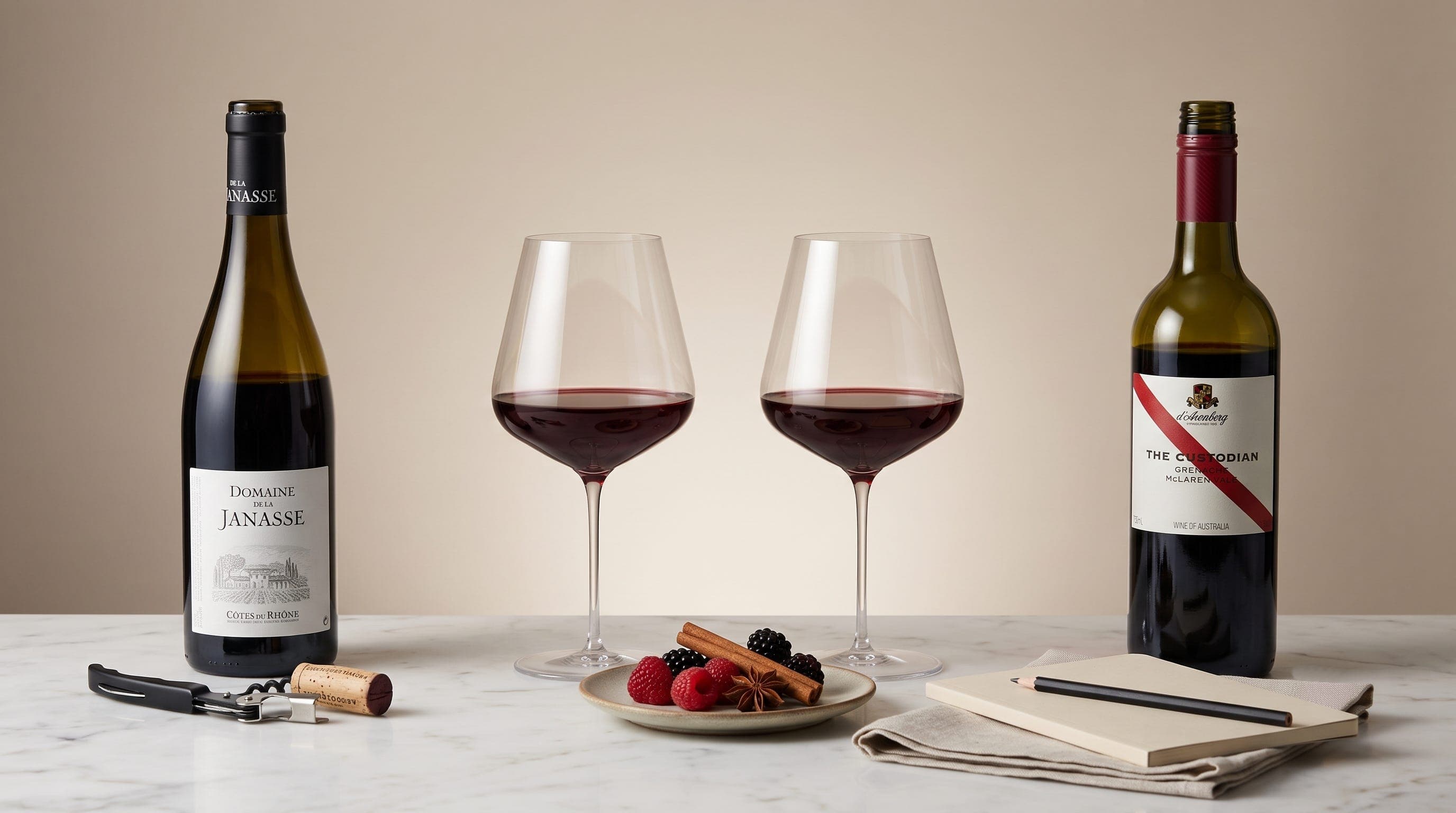
What to try: A ripe, Grenache-led Southern Rhône such as Domaine de la Janasse Côtes du Rhône, Famille Perrin “Les Cornuds” Vacqueyras, or Domaine du Cayron Gigondas, roughly $18 to $32. Then a New World Grenache such as Yangarra Estate Old Vine (McLaren Vale), d’Arenberg “The Custodian,” or Bonny Doon “Clos de Gilroy,” roughly $20 to $30.
What to notice: Both arrive plush and sun-soaked, with sweet raspberry and blackberry, warm baking spice, high alcohol, and soft, low acidity. The French bottle is every bit as ripe and generous as the Australian one. The idea that Europe automatically means restraint does not survive this pair.
Lesson: A warm European vineyard, picked ripe and worked in a modern cellar, hands you fruit at full volume. The restraint people credit to the Old World was really a cooler climate doing the work, and that climate is warming.
#3: Northern Rhône Syrah vs Cool-Climate New World Syrah
Objective: Finish at the pairing the old rule treats as its safest bet, a big dark red, and watch even that gap close once you match the climate on both sides.
What to try: A Northern Rhône Syrah such as JL Chave Sélection “Silène” Crozes-Hermitage, Delas “Saint-Esprit,” or Paul Jaboulet Aîné “Les Jalets,” roughly $26 to $32. Then a cool-climate New World Syrah such as Qupé Central Coast (California), Yering Station Yarra Valley Shiraz, or Mount Langi Ghiran “Cliff Edge” Grampians Shiraz, roughly $20 to $32.
What to notice: Both should show black pepper, cured meat, olive, and violets, with a cool savory streak running under the dark fruit and firm acidity holding it together. Called blind, the cool-climate New World bottle can out-pepper the Rhône. The label marked Australia or California is doing the savory, place-driven thing the old rule handed to France.
Lesson: Even the widest supposed gap in wine closes when both bottles come from a cool vineyard and a grower chasing savory tension. Match the climate and the intent, and the hemisphere disappears.
Pocket Palate: What to Read Now
The old question was “Old World or New World.” The better frame is two questions.
- How warm was the vineyard? Cooler sites give higher acidity, lower alcohol, and a savory, taut shape. Warmer sites give riper fruit, higher alcohol, and a round, generous one. This holds on both sides of the ocean now.
- What did the winemaker chase? Restraint (early pick, neutral oak, whole cluster, site expression) or generosity (later pick, new oak, fruit at full volume). It is a choice, and it is available anywhere.
- The tells on the label: alcohol under 13% leans cool and restrained; over 14.5% leans warm and ripe. A narrow place-name (Saint-Véran, Sonoma Coast) signals site ambition; a broad one (California, Vin de France) usually signals a house style.
- Learn the cool corners: a handful of New World sub-regions run genuinely cold, the Sonoma Coast, the Sta. Rita Hills, the Yarra Valley, the Adelaide Hills. A wine from one of those leans Old World in shape before the winemaker does a thing.
- Chardonnay: cool New World $22 to $30, beside white Burgundy $16 to $24.
- Grenache: Southern Rhône $18 to $32, beside New World Grenache $20 to $30.
- Syrah: Northern Rhône $20 to $26, beside cool-climate New World Syrah $20 to $32.
- The point: the region tells you what the country no longer can.
The Finish
By now you have tried three times to call a wine’s origin from the glass, and at least once you probably could not. That difficulty is good news. It means your palate is reading the real signals, warmth and winemaking intent, and quietly ignoring the country, which is what a confident taster does.
Somewhere in those six glasses you also noticed a lean. Maybe you kept returning to the cool, savory, taut wines, the ones with tension and stone. Maybe the ripe, round, generous ones were the glasses that emptied first. Your preference finally has a portable name. It is a style you can chase in any country, often at a friendlier price than the famous version.
This is the fourth stage of The Resonance Method, putting words to your own taste. The vocabulary that lasts is about temperature and intention, and it travels anywhere wine is grown.
So here is this week’s move. The next time you are handed a list, start with what you are actually in the mood for, the cool and savory or the warm and generous. Then read the region or ask your somm to find it, because that is where the climate lives now, wherever in the world it happens to be grown.
Go Deeper
If this week’s idea stuck with you, these take it further.
- What Do “Old World” and “New World” Mean in Wine? (Wine Enthusiast): A short, free reference on the terms and, more usefully here, on why the line between the two worlds keeps blurring as growers borrow from each other.
- Chris Losh, “Wine and the Climate Crisis: Where Are We Now and What Happens Next?” (World of Fine Wine, 2023): How warming vineyards are pushing wines toward higher ripeness and alcohol everywhere, the force quietly pulling both worlds toward the middle.
- Jon Bonné, The New California Wine (Ten Speed Press, 2013): The definitive account of the restraint movement that taught a generation of New World growers to make wines with the tension and savor once thought European, the single best book for understanding how the convergence happened.
- Julian M. Alston et al., “Splendide Mendax: False Label Claims About High and Rising Alcohol Content of Wine” (Journal of Wine Economics, 2015): The study behind the alcohol figure in this issue. It measured the real alcohol in over 100,000 wines and found it climbing across the wine world, the Old World included, a rise the labels themselves tend to understate.