Netflix’s Uncorked arrives later this year, and it will introduce millions of viewers to Napa Valley for the first time. The version they will see is the postcard: sunlit benches, mansion-style tasting rooms, an aspirational hum about heritage and craft. That version is real. It is also incomplete.
I have spent the last couple of weeks doing the research I would want any wine-curious viewer to have before the show airs. It’s also for my own pre-show edification. Eleven years in the trade gives me a working frame for the questions, and a sommelier’s training in how to read the trade record.
Most of these specific bottles, especially the cult Cabs and the older vintages, are allocation-only or secondary-market wines that have been mostly out of reach for years. What I am bringing here is research and perspective. Where I make a claim about a date, a price, a score, or a winemaker’s decision, the source is named. Where the trade record is partial, I say so.
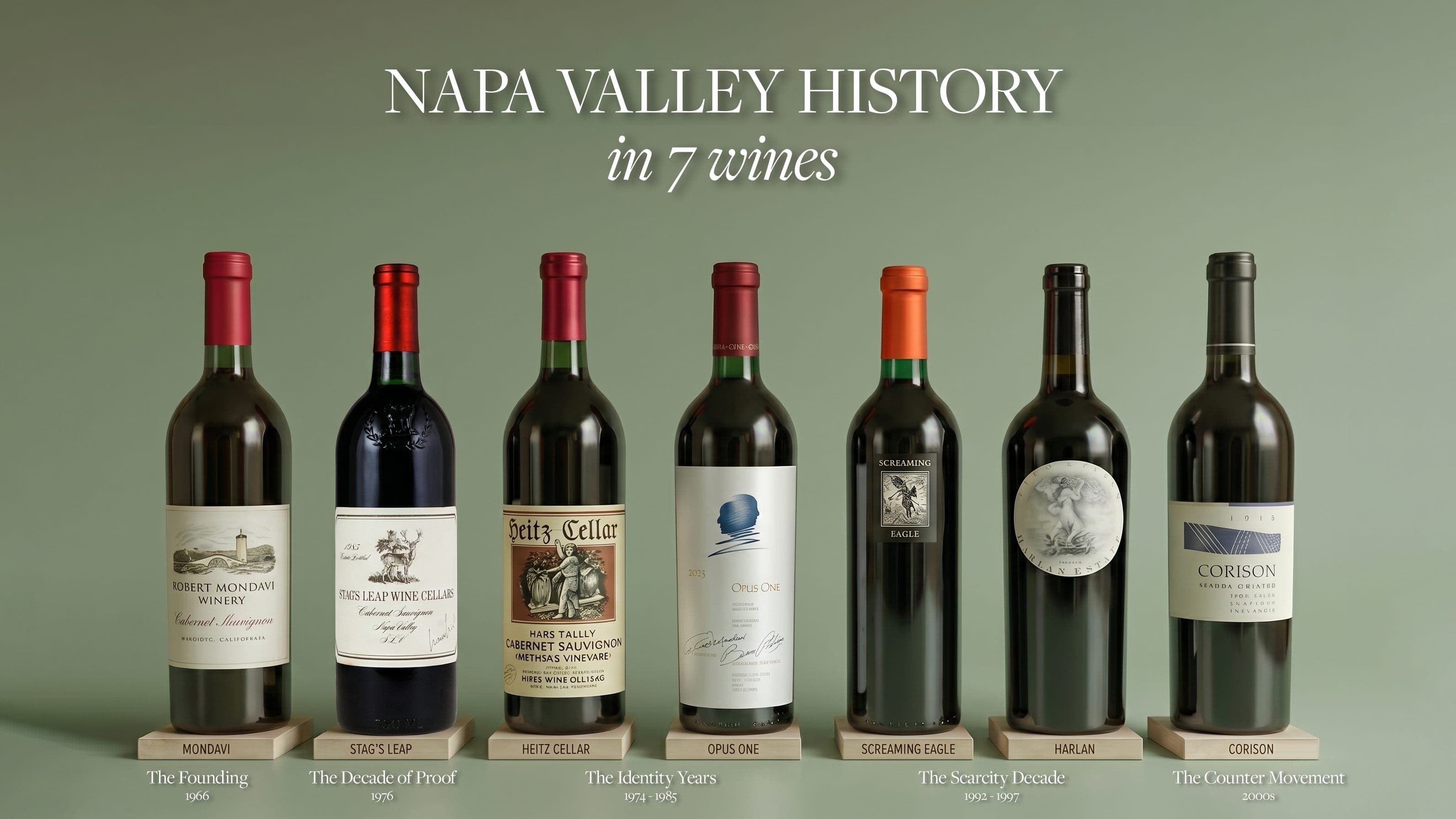
The thesis is straightforward. Modern Napa is a 60-year story built around 7 bottles, with one chapter still being written. Each bottle answered the question its decade was asking.
- The 1966 Robert Mondavi Cabernet Sauvignon Reserve answered: was Napa worth the bet?
- The 1973 Stag’s Leap Wine Cellars S.L.V. Cabernet answered: can California compete?
- The 1974 Heitz Cellars Martha’s Vineyard Cabernet answered: does Napa have its own identity?
- The 1979 Opus One answered: can Napa play at First Growth prices?
- The 1992 Screaming Eagle answered: can scarcity itself become the brand?
- The 1997 Harlan Estate answered: can a critic’s palate rewrite a region’s style?
- The 2007 Corison Kronos Vineyard Cabernet answered: can restraint survive a market that rewards the opposite?
And then there is the 2020 vintage, the one many of Napa’s best producers refused to release. It is not the eighth bottle. It is the chapter still being written, and it stands outside the count because the answer is not in yet.
What follows is each chapter, told through the bottle that defined it. The reason to do the homework now is practical. When Uncorked shapes the next public chapter of Napa’s story, you will already have the context to understand it. Whatever wine, producer, or scene the show puts in front of you, you will know which question its decade was asking, and which turn it represents.
That is what discernment looks like at the scale of a region.
1. The Founding (1966)
1966 Robert Mondavi Cabernet Sauvignon Reserve
Before any of what follows could happen, modern Napa had to exist. In 1966 it barely did. Prohibition had been repealed thirty-three years earlier, but the California wine industry it had gutted was slow to rebuild. What remained in the valley was a thin patchwork of pre-Prohibition holdovers like Beaulieu, Inglenook, and Charles Krug. Most American wine still moved in jug bottles, sold by sweetness and color rather than by grape or place. The fine-wine conversation lived in France.
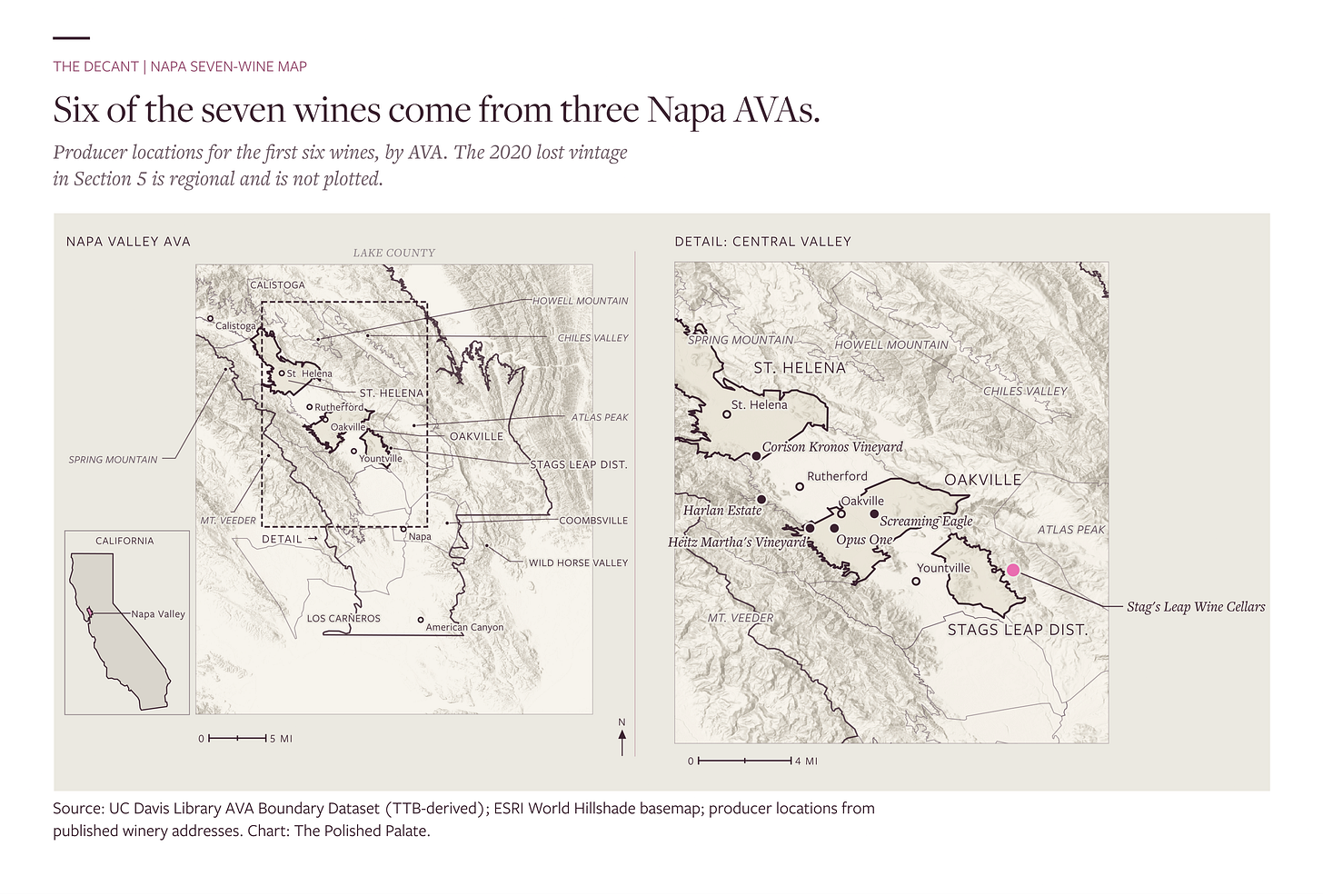
Robert Mondavi was fifty-two years old when he broke with his brother Peter at Charles Krug and opened his own winery in Oakville. It was the first major new Napa winery built since the repeal of Prohibition in 1933.1 Mondavi designed it as a public statement. A mission-style building by Cliff May, visible from Highway 29. A tasting room built to welcome visitors at a time when almost no California winery did. A wine program built around the premise that a serious American Cabernet was possible.
He hired a young winemaker named Warren Winiarski, who had left a teaching post at the University of Chicago to learn the craft. Winiarski made Mondavi’s inaugural Cabernet Sauvignon Reserve from the 1966 vintage, fermenting in stainless steel and aging in new French oak barriques, a setup almost no California producer was using at the time.2 He would buy his own property in the Stag’s Leap District in 1970. The 1966 Mondavi Reserve is, by the same hand, the prologue to the next chapter.
Mondavi also did the rest of the work the region needed someone to do. He labeled wines by varietal rather than by generic European appellation. He launched the “Fumé Blanc” rebrand of Sauvignon Blanc in 1968 to break the grape free of its jug-wine baggage. He opened the winery to public tours and built one of the first serious tasting-room programs in the country.3
Robert Mondavi proved that Napa was worth the bet. A modern Napa winery could be built, staffed, and bottled at a level that meant something. Everything that followed was a response to the question the 1966 Reserve had answered first.
2. The Decade of Proof (1976)
1973 Stag’s Leap Wine Cellars S.L.V. Cabernet Sauvignon
Before 1976, Napa was a regional industry. Most of the world’s wine attention sat in France, and the American fine-wine market took its cues from Bordeaux and Burgundy. California Cabernet was rarely on the same shelf, let alone the same conversation.
Warren Winiarski had left a teaching post at the University of Chicago in the early 1960s to learn winemaking. He worked at Souverain and then at the Robert Mondavi Winery (he made the 1966 reserve cab), and bought his own property in the Stag’s Leap District of Napa in 1970. He planted Cabernet Sauvignon. The S.L.V. vineyard, named for Stag’s Leap Vineyards, produced its first commercial wine in 1972.4
On May 24, 1976, Steven Spurrier, an English wine merchant living in Paris, organized a blind tasting at the InterContinental Paris. Nine French judges sat down with ten Cabernets and ten Chardonnays. The American wines were unknown to them. George M. Taber, covering the tasting for TIME magazine, was the only journalist in the room. That tasting became known as The Judgment of Paris.
The results, when the bags came off, broke the French panel’s expectations. The 1973 Stag’s Leap Wine Cellars S.L.V. Cabernet finished first among the reds, ahead of Château Mouton Rothschild 1970, Château Haut-Brion 1970, Château Montrose 1970, and Château Léoville-Las-Cases 1971. The 1973 Chateau Montelena Chardonnay, made by Mike Grgich, finished first among the whites.
Taber’s TIME dispatch ran on June 7, 1976. The story moved from there into wider American press and stayed there. A bottle of the 1973 Stag’s Leap S.L.V. now sits in the collection of the Smithsonian National Museum of American History (NMAH) in Washington, where it is cataloged as one of the objects that marked a turn in American cultural history.
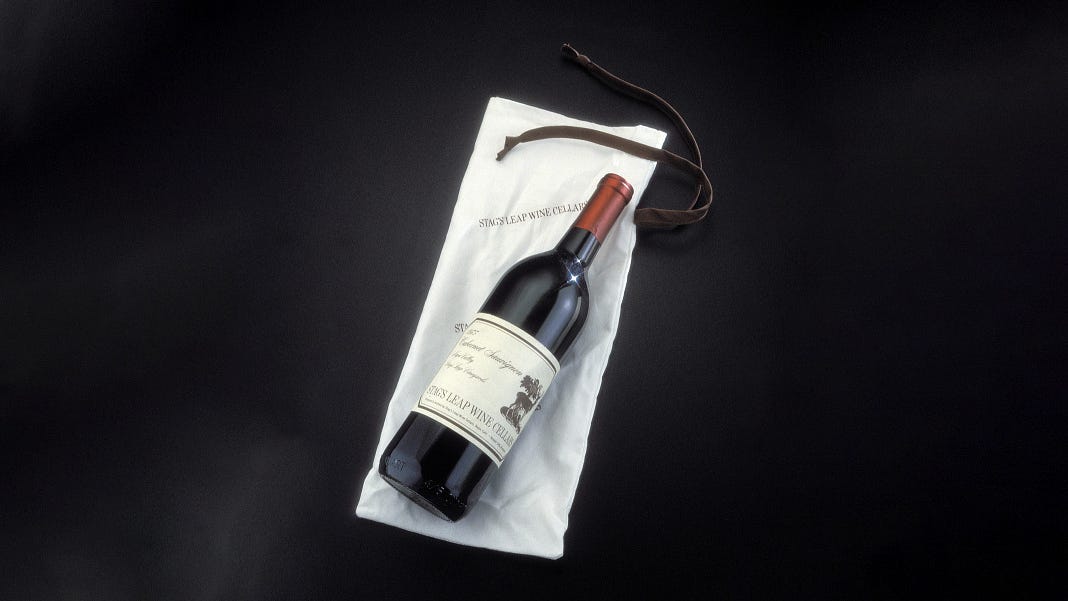
This wine proved that California could compete on the same blind table as the First Growths, judged by the same French palates that had defined “great wine” for a century. The presumption that French wine was simply better, in some structural way the New World could not catch, broke that afternoon. It did not re-form.
3. The Identity Years (1974–1985)
1974 Heitz Cellars Martha’s Vineyard + 1979 Opus One
Two wines made in the same window asked two related questions. Heitz asked what kind of place Napa was on its own terms. Opus One asked what Napa wanted to look like to the rest of the world.
Joe Heitz started bottling Tom and Martha May’s vineyard in Oakville separately in 1966. It was one of the earliest modern Napa single-vineyard designations, a contemporary equivalent of the way Burgundy had been thinking about land for centuries. The wine carried a distinctive eucalyptus note from the gum trees that lined the site, and Heitz let the vineyard taste like the vineyard rather than smoothing it over. The 1974 vintage became one of the defining American Cabernets of the decade, reviewed and celebrated extensively in trade press through the late 1970s and into the 1980s.5
Heitz’s question, answered through the Martha’s Vineyard line: Napa was going to think in vineyards on its own terms, in places with names, in single sites that meant something.
Robert Mondavi and Baron Philippe de Rothschild first met in 1970, by Mondavi’s account in Harvests of Joy, at a wine conference in Hawaii. They announced a joint venture in 1979. The first vintage of the resulting wine, Opus One, was 1979. The wine was released in 1984 as a blend of the 1979 and 1980 vintages, at $50 per bottle, the highest opening price for an American wine to that point.6
Opus One’s question, answered through that opening price: Napa was going to play the global luxury game. It would borrow Bordeaux’s pricing model, its winemaking partnerships, and its First Growth packaging psychology. The era of Napa Cab as luxury good had begun.
Heitz proved Napa had an interior identity. Opus One proved Napa had a global one.
4. The Scarcity Decade (1992–1997)
1992 Screaming Eagle + 1997 Harlan Estate
The 1990s changed the math of how a Napa Cabernet could become famous. Two producers from very different backgrounds answered the same underlying question. How small could production be, how high could the price climb, and how completely could a critic’s score determine both?
Jean Phillips, a former Realtor, bought an Oakville property in 1986. She planted Cabernet and made small batches with consulting help. Her first commercial vintage was 1992, with production of roughly 200 cases. Robert Parker, the most powerful wine critic of the era, scored the 1992 vintage 99 points and later scored the 1997 vintage 100, according to The Wine Advocate archives.7 The mailing list, by the late 1990s, was effectively closed. Bottles traded on the secondary market at multiples of the release price. Stan Kroenke, the American sports-franchise owner, acquired the property in 2006.8
What Screaming Eagle answered: scarcity, by itself, could be the entire brand. A 200-case production with no retail distribution, no advertising, and no consumer-facing infrastructure could become the most-discussed Cabernet in the world.
Bill Harlan, a real-estate developer, bought 240 acres in the Mayacamas hills above Oakville in 1984. He planted 40 acres and waited. His first commercial release was the 1990 vintage, sold in 1996. The 1997 vintage received a 100-point score from Parker on release.9
What Harlan answered: a 100-point score did not just sell a wine. It rewrote what kind of wine the region had reason to make.
Producers who chased the Parker palate picked later, made wines bigger, riper, more extracted, and more oak-marked. The “Napa house style” of the late 1990s and 2000s was the market answering a critic, and answering at scale.
By 2000, Napa had a scarcity economy and a points economy at the same time. Two forces, related but distinct, one decade.
5. The Counter-Movement (mid-2000s)
2007 Cathy Corison Kronos Vineyard Cabernet Sauvignon
Cathy Corison spent a decade making wine for other Napa estates before founding Corison Winery in 1987. She bought Kronos Vineyard, an old-vine site on the St. Helena bench, in 1995. The first single-vineyard Kronos bottling was the 1996 vintage.10
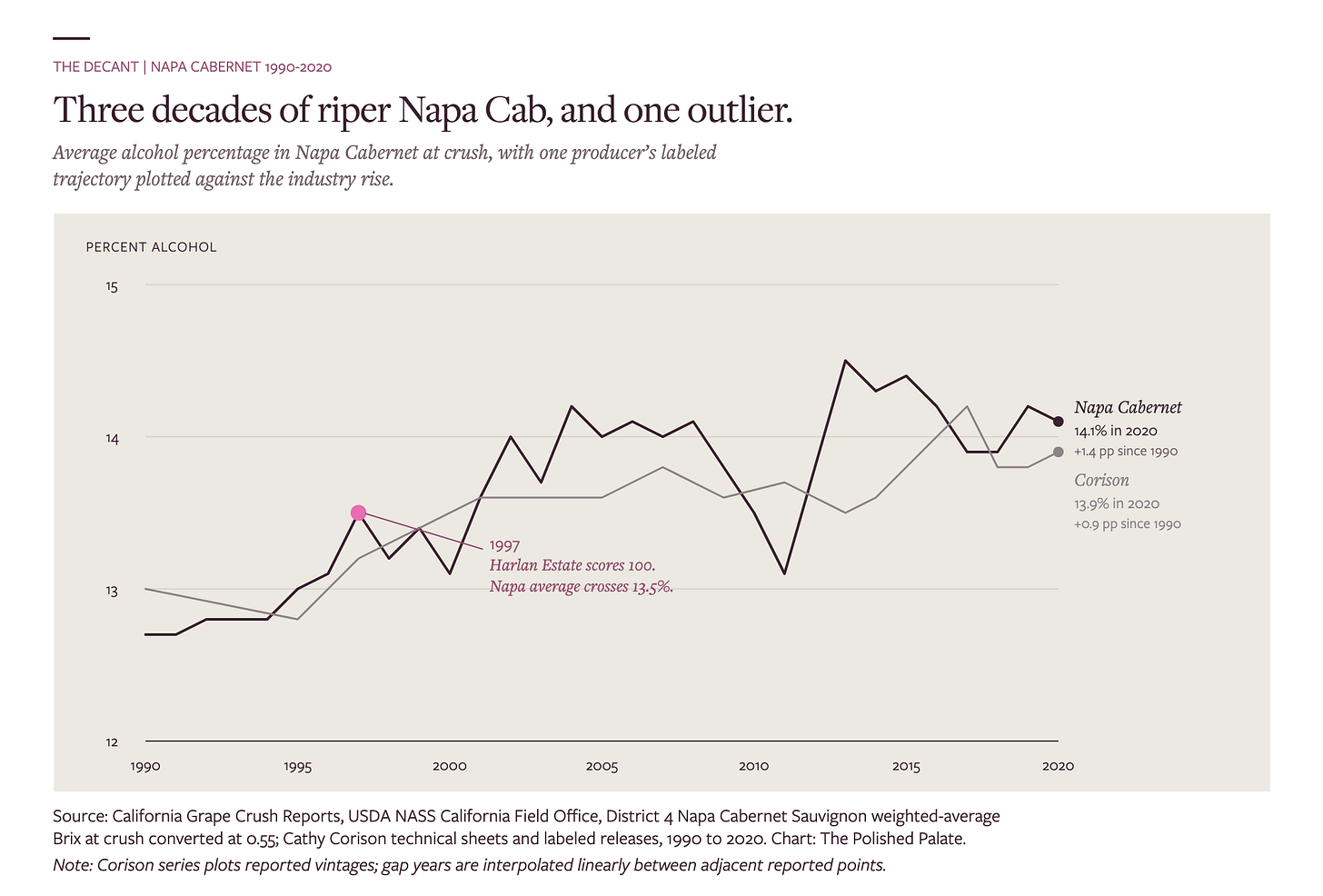
What set Corison apart was a house style that ran against the prevailing market. Her Cabernets sat around 13.5% alcohol while neighbors pushed past 15%. She picked early, fermented cool, and used modest amounts of new oak. Her bottlings were built to age twenty years before they showed their best. That made them long-cycle wines, designed for cellars and patience.
While most of Napa’s most-discussed wines in that decade were optimized for the Parker template, Corison was building wines that prioritized longevity, freshness, and low-alcohol balance. She was not alone in the instinct, though she was earlier than most. Steve Matthiasson founded Matthiasson Wines in 2003 on similar principles.11 Dan Petroski’s Massican project and a growing group of younger winemakers came in behind with the same instinct.
The 2007 Kronos proved restraint could survive a market that did not yet reward it. Someone was still making Napa Cab on Napa Cab’s own terms while the scores chased a different style. The region had a counter-tradition. By the mid-2010s it had compiled a fifteen-year track record built on cellar-aged results, the kind of evidence that does not need marketing.
When the market eventually began rotating away from heavy, high-alcohol Napa Cab in the mid-2010s, Corison was already there. So were the producers who had followed her in. The mid-2000s chapter is the one where the region’s center of gravity began to wobble, even if the wobble took another decade to register publicly.
Epilogue: The Climate Chapter (2020)
The vintage many refused to release
The 2017 fires were the warning. The Atlas Fire, the Tubbs Fire, and the Nuns Fire all started in October of that year. They marked the first major modern wildfire vintage in Napa, with smoke-impact in finished wines that the trade was not yet equipped to detect reliably.12
2020 was the rupture. The LNU Lightning Complex Fire started on August 17, 2020. The Glass Fire started on September 27, 2020, mid-harvest, with most of the Cabernet still hanging on the vine. Smoke-affected fruit covered much of the valley.13
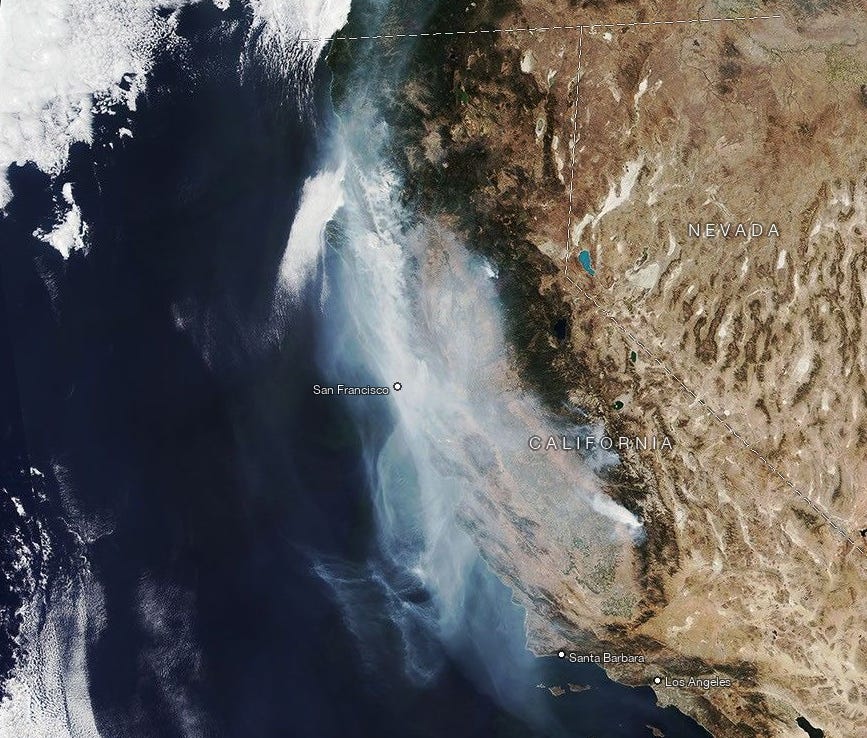
Three of Napa’s most respected producers declined to release a 2020 Cabernet. Cathy Corison declined to bottle the 2020 Kronos. Continuum Estate, the Mondavi family’s Pritchard Hill project, declined the 2020 vintage. Dunn Vineyards, the Howell Mountain producer that has made some of Napa’s most age-worthy Cabernets since 1979, declined as well.14 Other producers proceeded with releases, with varying disclosures about smoke impact.
By 2020, the central question of a Napa vintage had become existential. Producers were no longer asking what kind of Cabernet to make. They were asking whether there would be a Cabernet to make at all.
Wildfire smoke is now a recurring climate-driven risk for North Coast California vintages. The trade and UC Davis are still in the early innings on smoke-taint detection, mitigation, and disclosure protocols.15 Producers are experimenting with picking earlier, with different exposure thresholds, with rebuilding insurance models that did not exist a decade ago.
The next generation of Napa’s identity will be shaped by climate. Winemaker intent matters, but only within whatever envelope the climate allows.
The Finish
Each of the seven wines answered the question its decade was asking. The story of Netflix’s Uncorked will, almost certainly, lean on the surface arc: the well-lit caves, the founder myths, the postcards. The story actually contained in these seven bottles is the reality. Founding, competition, identity, money, scarcity, scores, restraint, and a chapter about climate that no one in the region has finished writing.
Of the seven questions, which one are you sitting with longest? For me it’s the one outside the count, the chapter still being written.
One concrete action: pick a producer named in any of these chapters. The exact bottles above are mostly out of reach now, sitting on auction blocks or in private cellars. Current releases from the same houses are widely available. Find one at retail, open it this Sunday, and taste it knowing which decade it belongs to and what its decade was answering. Pay attention to whether the wine in your glass feels like it is still answering that question, or whether it has moved on.
Go Deeper
- George M. Taber, Judgment of Paris: California vs. France and the Historic 1976 Paris Tasting That Revolutionized Wine (Scribner, 2005): The eyewitness account by the only journalist in the room.
- James Conaway, Napa: The Story of an American Eden (Houghton Mifflin, 1990) and The Far Side of Eden (Houghton Mifflin, 2002): The two-volume social history of Napa from the post-Prohibition rebuild through the cult Cab era.
- Elin McCoy, The Emperor of Wine: The Rise of Robert M. Parker, Jr. and the Reign of American Taste (Ecco, 2005): How a single critic’s palate reshaped Napa’s house style for two decades.
- Esther Mobley, San Francisco Chronicle wine reporting on the 2020 Napa harvest: The primary contemporaneous account of which producers declined to release the 2020 vintage and why.
- Bancroft Library Oral History Center, California Wine Industry interview series (UC Berkeley): First-person oral histories with figures across the modern Napa arc, including Mondavi and other key voices from the 1960s through 1990s expansion.
1Robert Mondavi, Harvests of Joy, HarperCollins, 1998; James Conaway, Napa: The Story of an American Eden, Houghton Mifflin, 1990.
2Robert Mondavi Winery published history; World of Fine Wine retrospective coverage of the 1966–2005 Reserve verticals.
3Conaway, Napa; Elin McCoy, The Emperor of Wine, Ecco, 2005.
4Stag’s Leap Wine Cellars published history; James Conaway, Napa: The Story of an American Eden, Houghton Mifflin, 1990.
5Conaway, Napa; Wine Spectator retrospective coverage of the Martha’s Vineyard bottlings.
6Robert Mondavi, Harvests of Joy, HarperCollins, 1998; Elin McCoy, The Emperor of Wine, Ecco, 2005; Conaway, Napa.
7McCoy, The Emperor of Wine; Wine Spectator cult Cab coverage; published Parker score archives via The Wine Advocate.
8Trade press reporting on the sale, including Wine Spectator and Decanter.
9Harlan Estate published history; Wine Spectator multi-issue coverage of the 1997 release window.
10Corison Winery published history; San Francisco Chronicle profile coverage by Esther Mobley, 2014–2019; World of Fine Wine feature interviews.
11Matthiasson Wines published history; San Francisco Chronicle coverage of the new-generation Napa cohort by Esther Mobley across 2014–2019.
12Cal Fire incident records; San Francisco Chronicle and Decanter harvest coverage, October–December 2017.
13Cal Fire incident records; Esther Mobley’s reporting in the San Francisco Chronicle across September and October 2020.
14San Francisco Chronicle reporting by Esther Mobley, October–November 2020 and follow-up coverage in 2021–2022; Continuum, Corison, and Dunn published statements regarding the 2020 vintage.
15UC Davis Department of Viticulture and Enology, ongoing smoke-impact research program.