1 Big Idea: The Air Above the Wine
Most of what you taste in wine, you smell. The tongue reports sweet, sour, salty, bitter, and savory, and that is the whole list. The cherry, the pepper, the wet stone, the smoke all reach you through the nose, from the inch of air sitting above the wine in the glass.
You put real thought into the shelf: producer, region, the extra $8 for the better bottle. Then the wine reaches that inch of air through three levers you have probably never touched, and at home the correction I make most often costs nothing: 30 minutes in the fridge on a red that came off a warm counter. The wine changes with it.
Temperature controls how much of the wine leaves the liquid. Warmth speeds evaporation, so a red off a 72-degree counter puts alcohol in the air ahead of the fruit, and the taste-cell signal for sweetness strengthens as temperature rises, so the same wine tastes softer and sweeter than it does at 60. Deep cold does the reverse: almost nothing evaporates, and a 38-degree white gives you acid and grip with hardly any smell.
Glass shape controls where that vapor goes. A 2015 imaging study of cool wine found that a bowl narrower at the rim than at its widest point holds a ring of alcohol vapor at the edge and a low-alcohol pocket in the center, where fruit can be smelled with less burn. A straight-sided tumbler shows no ring at all.
Pour size controls how much room the vapor has. A 5-ounce serving in a bowl that holds 15 leaves 10 ounces of air for aroma to collect in. A glass filled to the brim leaves none, and your nose ends up an inch from the liquid, getting mostly alcohol.
Here is the part that costs you money. Of those three levers, the wine trade has sold you exactly one. Riedel built a business on a different stem for every grape, $35 and up per glass, on the claim that bowl shape steers wine to sweet or acid zones of your tongue.
That tongue map came from a misreading of a 1901 study; every basic taste is sensed across the whole tongue. The mechanism that is real, vapor held in a tapered bowl, works the same for every grape, and one glass delivers it.
The two levers nobody sells are free. “Room temperature” translated the French chambré when dining rooms sat at 60 to 65 degrees; central heating has moved them to the low 70s, and the rule was never updated, partly because warm serving makes the soft, sweet-edged profile of the largest red brands taste softer still. And nobody pours less to give the aroma room, because a full glass looks generous. This week you test all three yourself, with one bottle under $20.
3 Taste Experiments
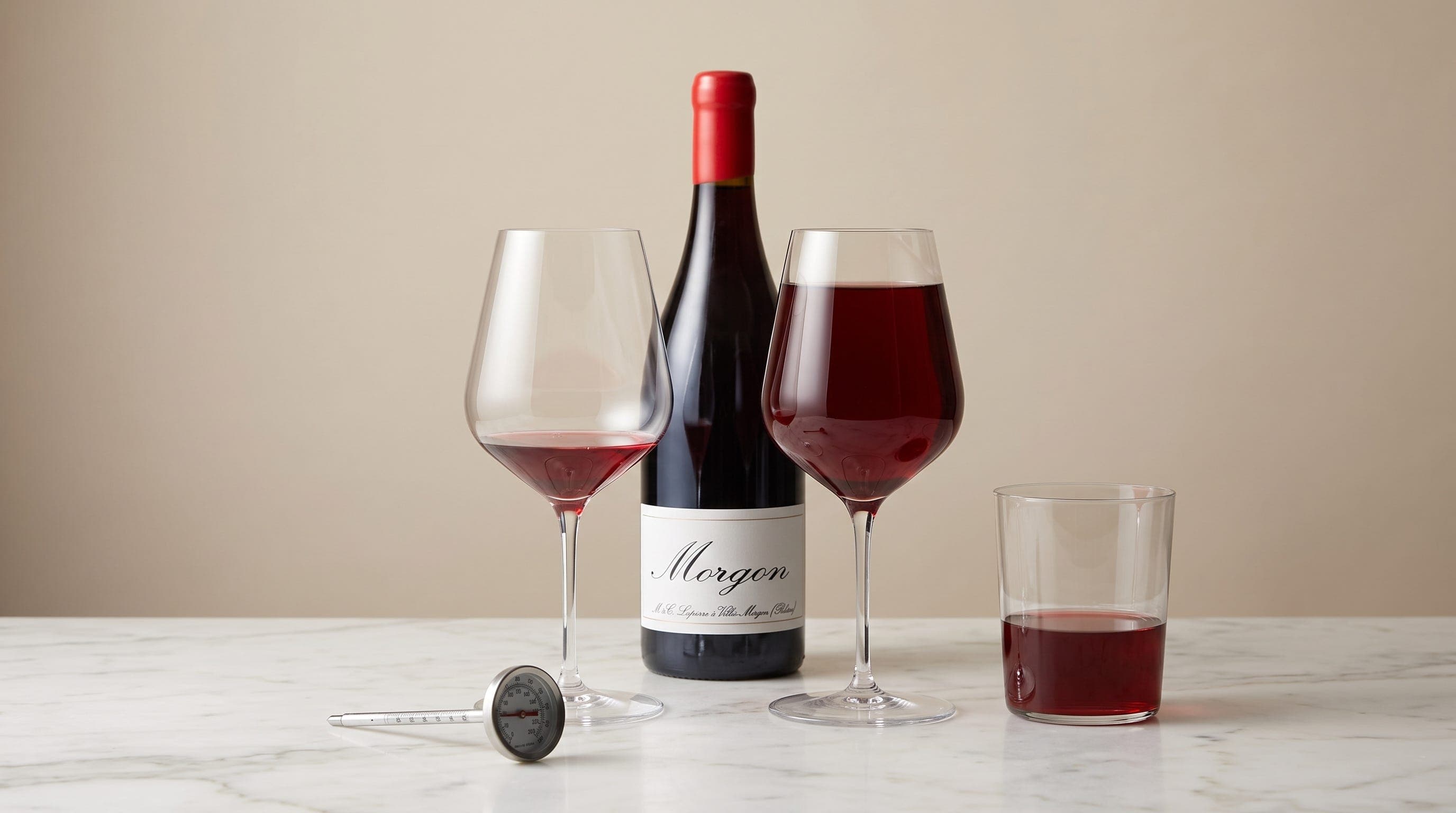
All 3 experiments run on a single inexpensive, aromatic red. Buy one of these: Louis Jadot Beaujolais-Villages (Gamay, $14-16), Famille Perrin Réserve Côtes du Rhône (Grenache-Syrah, $11-13), or Erath Pinot Noir (Oregon, $15-19). One bottle covers the full set in an evening, or recork and spread it across the week. For a stretch version, rerun the set with Marcel Lapierre Morgon (Gamay, about $40) and every difference is bigger.
#1: 1 Bottle, 3 Temperatures
- Objective: Feel temperature move sweetness, alcohol, and aroma in the same wine.
- What to try: Pour 3 glasses. Refrigerate one for 25 minutes, one for 10, and leave one on the counter. Taste in order, coldest first.
- What to notice: The coldest glass gives off little aroma and tastes firmer, all edges and grip. The 10-minute glass, near 60 degrees, shows the most detail: fruit, flowers, spice, each separated. The counter glass leads with alcohol on the nose, and the fruit turns softer, sweeter, and blurrier.
- Lesson: The 10-minute glass shows what you bought. Serve reds at 60 to 65 and they gain definition; serve whites at 45 to 55, about 20 minutes out of the fridge, and their aroma comes back. If you love an ice-cold Sauvignon Blanc on a hot porch, keep it; comfort is a legitimate reason to serve it that way. Just know what the deep chill is muting, and make it your call.
#2: 1 Wine, 3 Vessels
- Objective: Separate what a glass does from what glass marketing says it does.
- What to try: Give one serving 10 minutes in the fridge, the best glass from Experiment 1, then split it across three vessels: a wine glass whose bowl is wider than its rim, a straight-sided water tumbler, and a coffee mug. Smell each for 5 seconds before sipping, then sip.
- What to notice: Over the tapered bowl the aroma sits collected and dense. Over the tumbler, much of it is gone and the wine reads simpler and sharper. Over the mug you also lose the color, and your read gets noticeably less certain.
- Lesson: What you smelled over the tapered bowl is the ring the 2015 imaging study photographed: alcohol vapor held at the rim, a low-alcohol pocket in the center, fruit with less burn. The tumbler showed no ring, and the mug took the color away as well, which is why your read got less certain. None of that depends on the grape. Riedel’s pitch, a different shape for Oaked Chardonnay than for Riesling, rests on the tongue map from the Big Idea, and one tapered glass delivers the real mechanism for every wine you will ever pour. A 12-stem set adds cost without adding anything you can smell.
#3: 2 Ounces vs a Full Glass
- Objective: Taste headspace, the empty part of the glass where aroma collects.
- What to try: Two matching wine glasses: 2 ounces in one, the other filled to within an inch of the rim. Try to swirl both. Smell each, then sip. Come back to both after 10 minutes.
- What to notice: The 2-ounce glass gives off more aroma, and swirling lifts more. The full glass puts your nose against liquid and gives you mostly alcohol. Ten minutes later the small glass has opened further while the full one sits unchanged.
- Lesson: Aroma collects in the empty part of the glass, which is why a standard serving is 5 ounces in a bowl that could hold 15. A bar that fills the glass to the brim looks generous and removes the headspace where the aroma collects. At home the fix costs nothing: pour less, top up more often, and the bottle lasts the same number of glasses while every glass carries more aroma.
Pocket Palate: Serving defaults
The card to save. Facts from this issue, in pouring order.
- Reds: 30 minutes in the fridge before opening. Target 60 to 65 degrees.
- Whites: Out of the fridge 20 minutes before pouring. Target 45 to 55; the more complex the white, the warmer the end you aim for.
- Glass: One bowl wider than its rim beats a varietal set. The mechanism, aroma collecting above the wine, is the same for every grape.
- Pour: 5 ounces in a standard glass. Aroma collects in the empty part.
- Order: Fix temperature first, glass second, pour third. Temperature and pour cost nothing; one tapered glass is the only purchase.
The Finish
Three levers, one bottle, and by the end you will have tasted how much one wine changes with the serving. That range is the point: much of what gets blamed on the bottle, the grape, or your own palate traces back to the serving.
Think of a wine you wrote off this year. Which version did you actually taste: the 72-degree version, the tumbler version, the filled-to-the-brim version? You judged honestly, and the serving skewed what reached you.
One action for tonight: take whatever red is open in your kitchen, pour two glasses, give one 10 minutes in the fridge, and taste them side by side. From there the defaults are yours to set: the temperature, the glass, and how much goes in it. The wine you judge is the one you served.
One more thing before you go: this October, The Polished Palate goes live for the first time. A guided tasting with a designed flight and real-time discussion, so you can check what reaches your palate against what reaches everyone else’s. The date and seat count land in your inbox soon. Seats will be limited, and subscribers hear first. I want a seat at the first one
Go Deeper
If this week’s idea stuck with you, these take it further.
- Madeline Puckette, Ideal Serving Temperature for Wine (Wine Folly): The practical chart worth saving: serving ranges by style, plus quick fixes when a bottle is too warm or too cold.
- Steven D. Munger, The Taste Map of the Tongue You Learned in School Is All Wrong (Smithsonian, 2017): A chemosensory scientist traces how a 1901 German study got misread into the tongue map, the same map the varietal-glass pitch leaned on.
- Arakawa et al., A Sniffer-Camera for Imaging of Ethanol Vaporization from Wine: The Effect of Wine Glass Shape (Analyst, 2015): The imaging study behind Experiment 2: a tapered bowl holds a low-alcohol zone in the center of the glass where fruit aroma can be smelled with less burn.
- Talavera et al., Heat Activation of TRPM5 Underlies Thermal Sensitivity of Sweet Taste (Nature, 2005): The physiology paper showing sweet-taste signaling strengthens as temperature rises, the mechanism that makes a warm red read sweeter and softer.