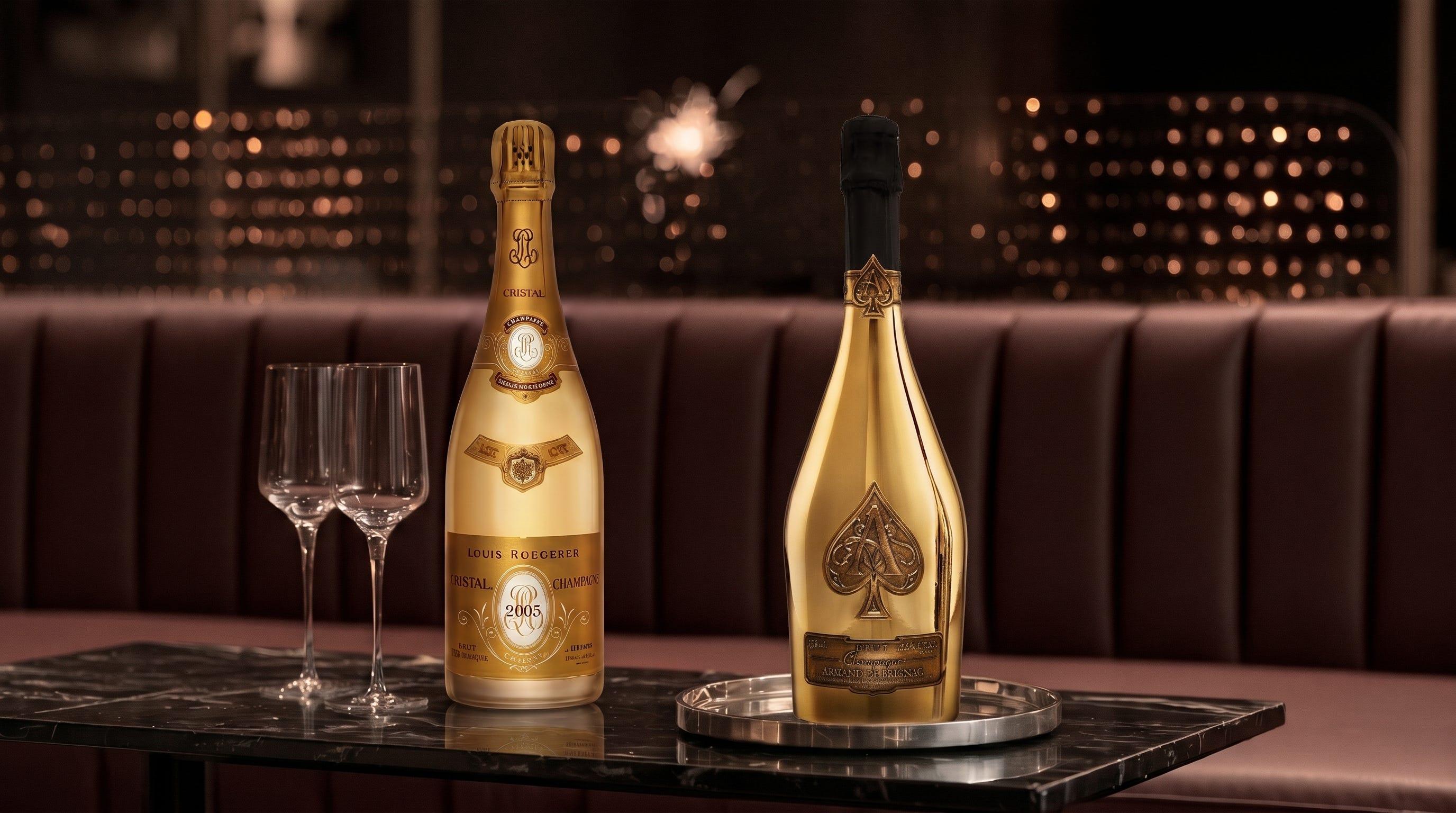
If you have watched a bottle of Champagne carried through a club with a sparkler stuck in it, odds are it was one of two. One is Cristal, a clear bottle wrapped in gold cellophane. The other is Armand de Brignac, an opaque, metal-coated gold bottle with a pewter ace of spades on the front, which everyone calls Ace of Spades. Both come wrapped in gold, and both sell for about $300 at a US shop and far more at a club table.
Both trace back to one interview in 2006. The man who had just taken over the house behind Cristal was asked about rappers drinking it, and his answer ended Jay-Z’s loyalty to the brand. By the end of that year Jay-Z had a new Champagne on screen.
The swap shows what a buyer is paying for in a $300 Champagne. The gold bottle was famous before a single one reached an American shop, and the family that makes it sells its own Champagne for about a fifth of the price.
How Cristal became hip-hop’s Champagne
Cristal started as one customer’s wine. Louis Roederer, the Reims house that makes it, says it created Cristal in 1876 for Tsar Alexander II and put it in a clear, flat-bottomed lead-crystal bottle “to distinguish this cuvée.” The wine went on public sale only in 1945, and it stayed scarce: Roederer makes it only in years it judges good enough, and its sales chief put average output at about 400,000 bottles in 2010.
In the mid-1990s New York rappers started naming it. Akin Ojumu, reporting for The Observer in 2002, traced the switch: the Notorious B.I.G. had name-checked Moët on his 1994 debut and moved up to Cristal in 1996, guesting on Jay-Z’s first album. Within a few years, Ojumu wrote, every aspiring hip-hop artist seemed to mention it.
The house said it did not court the attention. Its UK spokeswoman told Ojumu the family was “delighted that people like Cristal but they don’t go out of their way to court publicity.” Its American importer did some courting anyway. Maisons Marques let rappers show Cristal on screen if it appeared in a high-class setting, and supplied Jay-Z with a fridge full of it for his “I Just Wanna Love U” video, because the scene was a state-of-the-art kitchen. By then the bottle people saw in videos and on club tables was Cristal.
“We can’t forbid people from buying it”
In 2006 Frédéric Rouzaud took over as head of Roederer and gave an interview to The Economist’s Intelligent Life magazine. Asked about hip-hop’s attachment to Cristal, he said he viewed it with “curiosity and serenity.” Asked whether the association could hurt the brand, he answered, as The Guardian reported it: “That’s a good question, but what can we do? We can’t forbid people from buying it. I’m sure Dom Pérignon or Krug would be delighted to have their business.” The words “unwelcome attention” came from the magazine’s own subheading.
In mid-June Jay-Z issued a statement: “I view his comments as racist and will no longer support any of his products through any of my various brands including the 40/40 Club nor in my personal life.” He said his clubs would stock Dom Pérignon and Krug. A few weeks later he told The New York Times what Rouzaud should have said: “Surely he meant to say, ‘Thank you,’ right?” and then, “Anything but a ‘Thank you’ is racist.”
Roederer answered that it had “the utmost regard for, and interest in, all forms of art and culture.” Nine years later Rouzaud gave the wealth magazine Spear’s his own verdict: “I was branded a racist, which was ridiculous.”
The gold bottle arrives
Four months after his statement, in late October 2006, Jay-Z released “Show Me What You Got.” In the video, set in Monaco, a waiter offers him Cristal. He sends it back, and the waiter returns with a gold bottle in a silver briefcase. Jamie Goode, the British wine writer, notes that the video was shot before any bottles of the new brand had reached the United States. American viewers saw the bottle before they could buy it.
The gold bottle came from the Cattier family, growers and Champagne makers in the village of Chigny-les-Roses, just south of Reims, with 33 hectares of vines. Its American partner was Sovereign Brands, a New York importer. The brand’s side said at the time that it and Jay-Z “have not entered into any agreement, sponsorship or otherwise.”
Later reporting gives a different account, in two steps. In November 2014 Jay-Z bought Sovereign’s interest in the brand, and the business journalist Zack O’Malley Greenburg wrote that week that Jay-Z had held a financial interest in Armand de Brignac “since its inception.” In February 2021, when Moët Hennessy, part of LVMH, bought half the brand, CNBC reported that his involvement “started in 2006 with a 50% stake in the brand.”
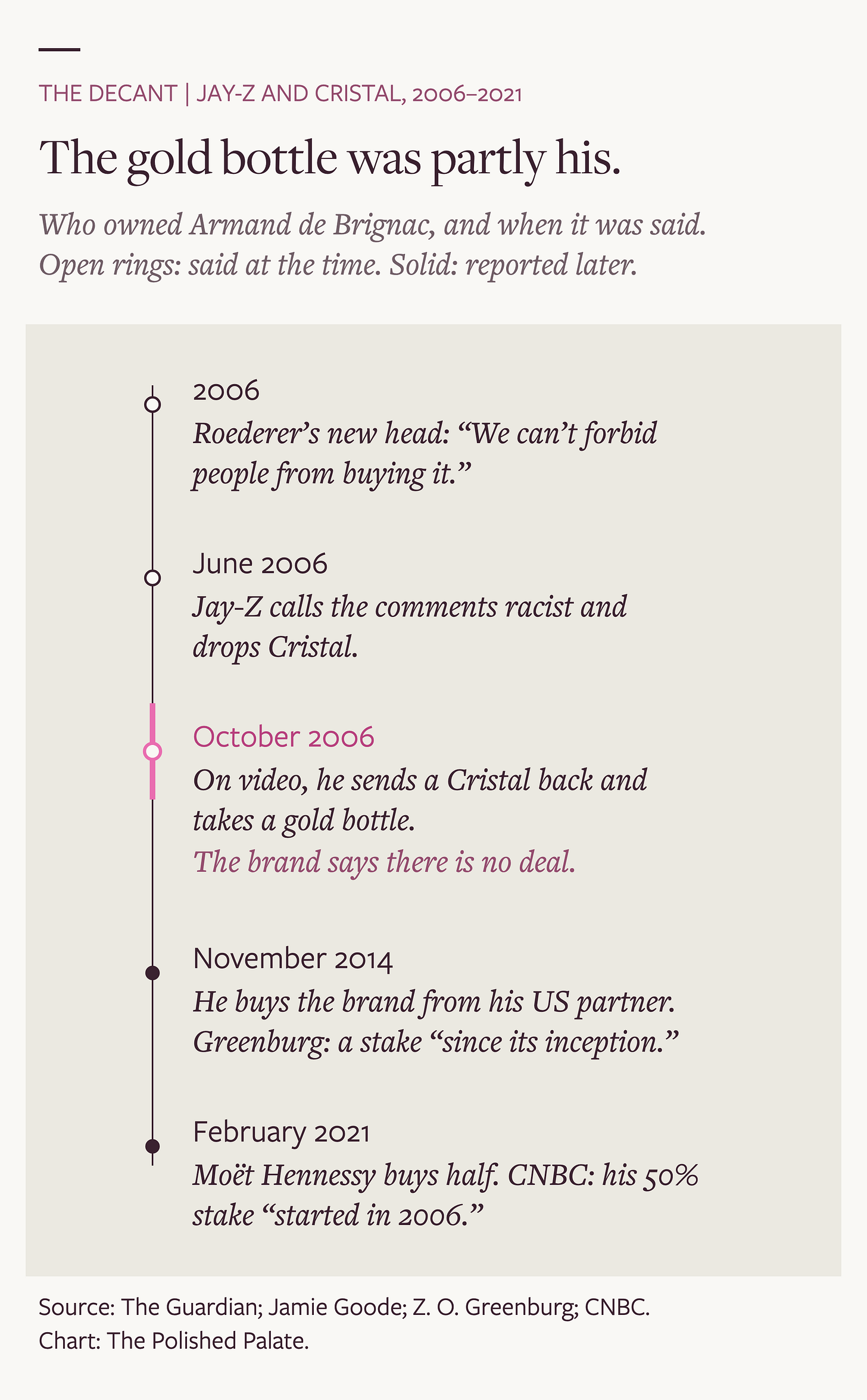
Rouzaud reads the same events as marketing. “Jay-Z used the row as a publicity stunt to launch Ace of Spades,” he told Spear’s in 2015. Jay-Z called the comments racist, and nothing reported since changes what Rouzaud said in 2006. The later reporting also shows that the Champagne Jay-Z moved to was one he part-owned from its launch. The two men still give opposite accounts of why he walked. The record does settle one thing: within four months, the Champagne Jay-Z put on screen went from one he bought to one he partly owned.
Both brands came through. Roederer’s sales chief told The Globe and Mail in 2010 that Cristal’s sales “never suffered” from the boycott, a company claim I found no independent figure to test, and Cristal’s price has barely moved since: $200 to $300 a bottle in the 2006 press, $300 to $350 at US shops in 2026. Armand de Brignac grew into a business that, when LVMH bought half in 2021 without disclosing terms, Forbes valued at about $630 million.
Where the $300 goes in each bottle
The two bottles sell for about the same price, and the wine in each is made differently. Here is what each house publishes.
Cristal comes from a single harvest, and Roederer skips the years it judges too weak. It is about 60 percent Pinot Noir and 40 percent Chardonnay, all of it from Roederer’s own vineyards, aged six years in the house’s cellars and eight more months after disgorgement, the step that removes the spent yeast and adds a final dose of sugar. The 2016 and 2018, the vintages on the US importer’s pages, carry 7 grams of sugar per liter.
Armand de Brignac Brut Gold is non-vintage, the way most Champagne is: the brand’s own page says half of each blend comes from one harvest and half from reserve wines of two older ones. Blending in older wine keeps a house style steady from year to year, and Krug’s Grande Cuvée, among the most expensive Champagnes made, is also a blend across many years. Brut Gold is 50 percent Pinot Noir, 40 percent Chardonnay and 10 percent Pinot Meunier, from the Cattiers’ vineyards and from grapes they buy in the Côte des Blancs and the Vallée de la Marne, according to Goode; most big Champagne houses buy much of their fruit. It carries 9 grams of sugar per liter. Critics have split on it: FINE Champagne Magazine, a Helsinki title, placed it first in a 2009 blind tasting of more than 1,000 Champagnes, at 96 points, and Goode scored it 89 in 2015, noting “quite noticeable dosage.”
Then there is the family’s own label. Cattier sells its Premier Cru Brut, made in the same cellars, for about $63 at Total Wine. Brut Gold is made to its own recipe, so the two are different wines. Most of what a buyer pays above Cattier’s $63 is for the gold bottle, the name and the video it appeared in.
The Finish
Cristal and Brut Gold cost the same, and the price of each goes to different things. Cristal’s $300 goes to a single harvest from Roederer’s own vines, six years in the cellar, a house that skips weak years, and a name hip-hop made famous. Most of Brut Gold’s $300 goes to the gold bottle and the story Jay-Z gave it; critics have split on the wine itself, and the family that makes it sells its own Champagne for about $63.
If you are buying for the wine, that difference is the reason to pick Cristal. If you are buying the moment the gold bottle arrives at the table, that moment is what most of Brut Gold’s price goes to. You get to decide which of those you are paying for.
Pocket Palate: Cristal vs. Ace of Spades
One card to keep:
- Cristal: Louis Roederer, Reims. Single harvest, made only in good years. About 60% Pinot Noir, 40% Chardonnay, all from the house’s own vines; about six years in the cellar; 7 g/L of sugar for the 2016 and 2018. Clear bottle since 1876, sold in gold cellophane. About $300 to $350 at US retail in 2026.
- Armand de Brignac Brut Gold: the Cattier family, Chigny-les-Roses. Non-vintage: half one harvest, half two older reserve harvests. 50% Pinot Noir, 40% Chardonnay, 10% Pinot Meunier, from estate and bought grapes; 9 g/L of sugar. Metal-coated gold bottle. About $300 at US retail; Cattier’s own Premier Cru Brut is about $63.
- The break: 2006. Rouzaud to The Economist’s Intelligent Life: “We can’t forbid people from buying it.” Jay-Z called the comments racist in mid-June and dropped Cristal.
- The swap: “Show Me What You Got,” late October 2006. Cristal sent back, gold bottle brought out. The brand denied any deal; CNBC reported in 2021 that Jay-Z had held half from the 2006 launch.
- Since: Jay-Z bought out his US partner in 2014 and sold half to LVMH’s Moët Hennessy in 2021, at a value Forbes estimated near $630 million. Roederer says Cristal’s sales never suffered.
Go Deeper
If this week’s idea stuck with you, these take it further.
- Akin Ojumu, Hip Pop (The Observer, 2002): The fullest contemporary account of how Cristal became hip-hop’s Champagne, including the importer’s rules for putting it on screen.
- Jay-Z Puts a Cap on Cristal (The New York Times, 2006): The boycott as it happened, with Jay-Z’s own words and the market numbers that suggested it would not hurt much.
- Jamie Goode, Champagne Armand de Brignac: A Marketing Success Story (Wine Anorak, 2015): A visit to the Cattiers, with the grape sources, the Antique Gold precedent, and tasting notes on the whole range.
- Amelia Lucas, LVMH Buys 50% Stake in Jay-Z’s Champagne Brand Armand de Brignac (CNBC, 2021): The 2021 deal, with the ownership history from the 2006 stake to the 2014 buyout.