Abe Zarate pours wine for a living in New York, and he has not had a drink since the summer of 2020.
He still works the floor. He still tastes everything that crosses his station, and he still walks a guest through a list with the fluency of someone studying for the advanced sommelier exam. He just spits.
A few years ago, “sober sommelier” would have read as a contradiction in terms. Zarate started an Instagram account, @sober_somm, partly to keep himself accountable and partly because he went looking for other sober people in the beverage business and could barely find any.
I’m a Certified Sommelier. I have spent more than a decade around wine, and I can tell you the trade runs on a seemingly obvious fact it almost never says out loud: that the people who love wine most are the people who drink the most of it.
Tastings reward immersion. Trade events run on open bottles from noon onward. The somm who finishes the glass reads as committed, and the one who slides it away reads as an anomaly. For an industry whose entire product is a drug, we are remarkably quiet about what that drug does to the people who sell it.
Something is shifting underneath that silence. A generation of drinkers is consuming less alcohol than any in living memory, and a small but growing number of wine professionals are deciding they can love the work without drinking through it.
The culture calls this sober-curious, and the word makes it sound like a wellness fad. From inside the trade it looks like something older and more familiar. It looks like discernment, the same muscle this newsletter spends every week trying to build.
Taste sovereignty has always been about refusing to let the critic, the score, or the room decide what belongs in your glass. There is a version of that question most of us are never asked: how much, and whether to pour at all.
Choosing to drink less, and to make the wine you do drink count, is the most honest thing a developed palate can do. The person who can taste everything and still decide most of it is not worth swallowing has arrived somewhere. That is who you become when the decision is yours and not the room’s.
The numbers are not a fad
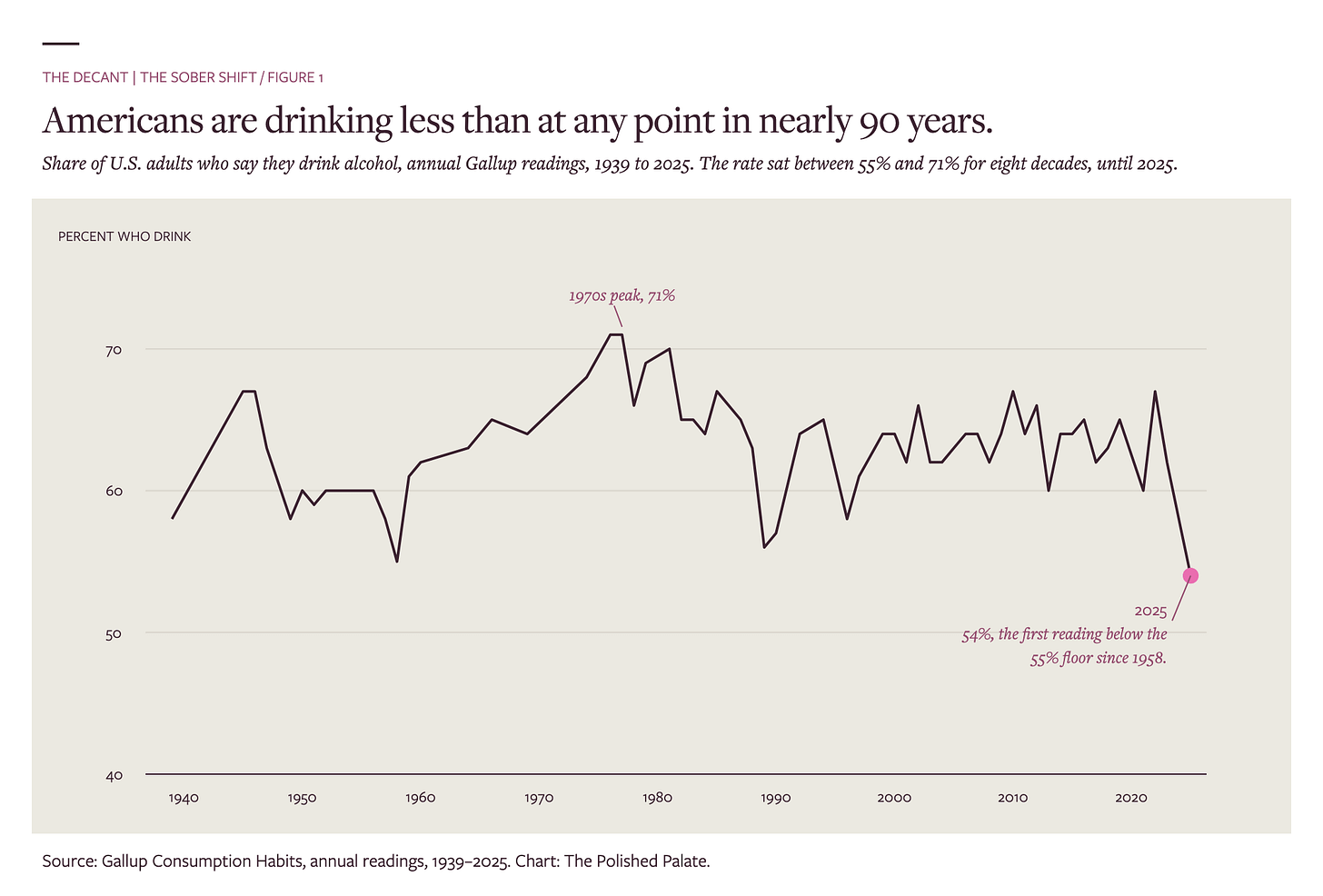
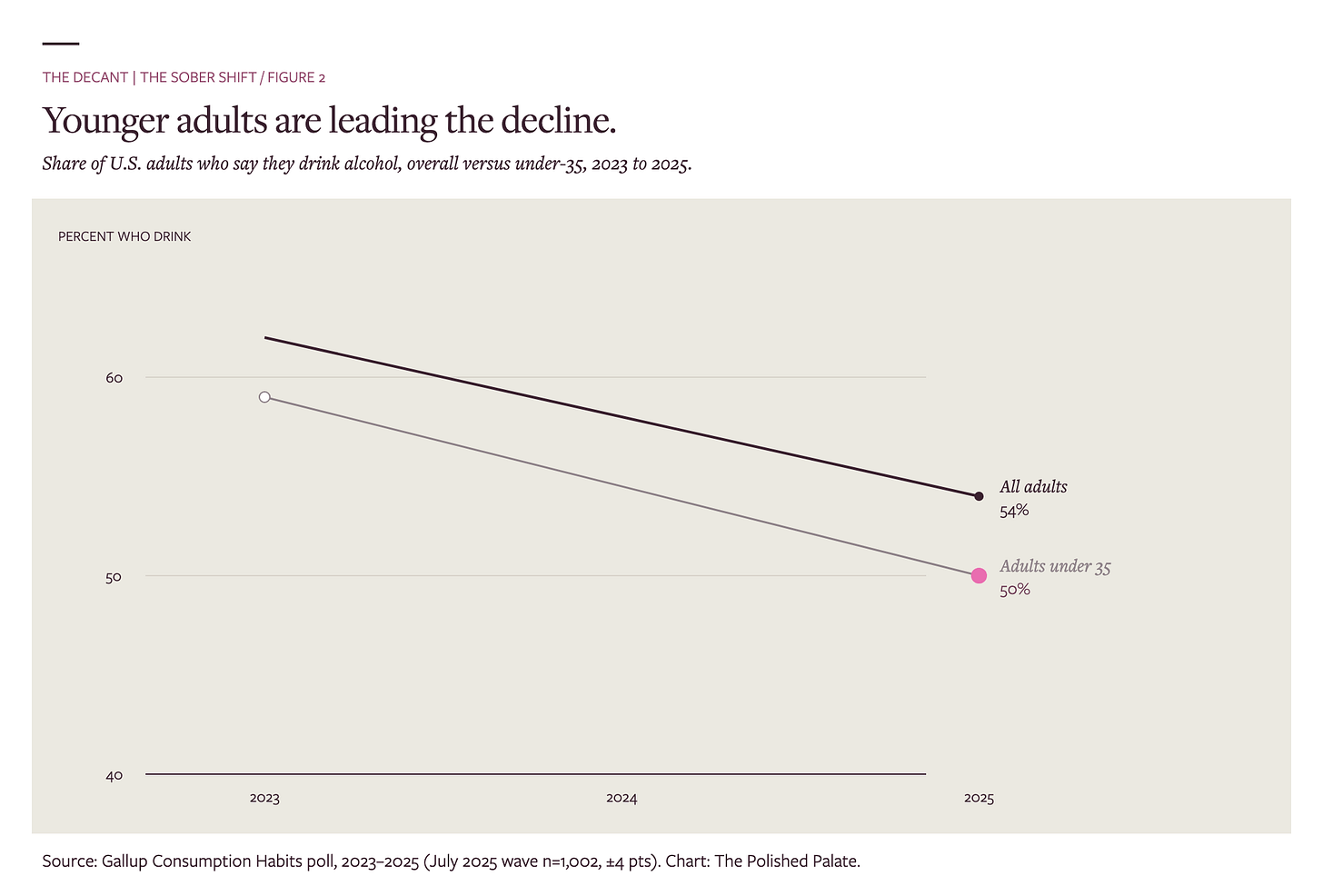
In 2025, Gallup recorded the lowest share of American adults who drink alcohol in nearly ninety years of asking the question. Fifty-four percent said they drink, down from 62 percent in 2023. Among adults aged 18 to 34 the drop is steeper, from 59 percent in 2023 to 50 percent in 2025.
Younger drinkers are not just drinking less. They increasingly believe that even moderate drinking carries a health cost, and they are acting on it.
The money has noticed. IWSR, the drinks-industry data firm, reported that no-alcohol and low-alcohol volumes across the world’s ten largest markets grew 4 percent in 2024 while value rose 6 percent, and it forecasts no-alcohol volumes climbing another 9 percent in 2025.
The no-alcohol category pulled in roughly 61 million new buyers between 2022 and 2024. The U.S. no-alcohol market is on track to be worth close to five billion dollars by the end of the decade.
A movement this large does not come from people who never cared about wine. It comes, in large part, from people who care a great deal and are renegotiating the terms.
The immersion economy
Victoria James was the beverage director at Cote, a Korean steakhouse in New York with a serious wine program, when she decided to spend October of 2017 sober. She kept working the whole month. She tasted cocktails by spitting them, and she swirled glasses at the table without sipping so guests would not notice.
What she remembers most is how the people around her reacted. Colleagues asked if she was pregnant. One told her, in so many words, not to be soft about it. Her eventual advice to other somms considering a break was bleak in its honesty: if you do it, maybe don’t tell anyone.
That reaction is the part we don’t talk about. The trade has built a social economy where drinking is the dues you pay to belong. Distributor lunches, supplier dinners, late shifts that end with the staff opening something good.
The bottles are genuinely part of the education, and they are also a current that carries people somewhere they did not necessarily choose to go. James was healthy, employed, and excellent at her job, and stepping out of that current for thirty days was treated as a small betrayal.
When the cost of moderation is social suspicion, you learn why the silence holds. It is easier to finish the glass.
Moderation as discernment
Here is the reframe I keep coming back to. The skill this whole project is built on is the ability to notice what resonates and let go of what doesn’t. We practice it on wines, learning to tell the bottle that moves you from the one that merely impresses. The same skill, turned on your own consumption, looks like editing.
Zarate describes his relationship to wine now as reframed around people’s stories and the places the wine comes from, the parts that survive when the buzz is no longer the point. Caroline Conner, a wine educator in Lyon, keeps no open bottle at home unless she is hosting and does Dry January every year, while staying clear that she is not swearing off wine forever. Both are simply exercising a preference, on their own terms, the way you would over anything else you have learned to taste carefully.
That is the quiet promise of a trained palate. The more precisely you can tell what is worth it, the less you need. A glass you actually chose, poured because this specific wine earned the hour, will always do more for you than three you drank because the bottle was open.
Discernment is the skill of knowing the difference and being free to act on it. A cellar full of bottles you drank without noticing teaches you nothing.
Less, but better
The practical objection used to be real: if you wanted to drink less and still drink well, your options were sad. That has changed faster than most wine lists have caught up to.
Dealcoholized wine has gone from novelty to a small, serious category. Leitz, an established Rheingau Riesling house, makes a dealcoholized line that real wine drinkers take seriously. French Bloom, an organic alcohol-free sparkling, has been named the world’s best in its category multiple years running. Noughty makes a dependable non-alcoholic Chardonnay and sparkling. None of them are pretending to be Grand Cru, and the best of them are genuinely worth tasting with the same attention you would give anything else.
The lower-intervention, lower-alcohol end of real wine is having its own moment, too. It shows up in lighter reds served with a chill, high-acid whites that come in under 12 percent, and traditional styles built for the dinner table.
You can drink actual wine and drink less of it without surrendering anything that made you fall for it. The aim is to put the decision back where it belongs, with you, so that each glass is one you actually chose.
The Finish
The wine trade taught me to taste, and it took longer to teach me that tasting and drinking are not the same act. You can give a wine your full attention and give most of the bottle a pass.
The sober-curious shift is a question the industry has long avoided asking itself, surfacing now because a generation stopped waiting for permission. It passes no verdict on anyone’s drinking, yours included.
So here is the question worth sitting with this week: when you last opened a bottle, did you choose it, or did you drink it because it was there? One is sovereignty. The other is just the current.
This week, pour one glass on purpose. Pick the wine deliberately, drink it slowly enough to actually notice it, and let that be the whole experience. Or take one of the serious alcohol-free bottles and taste it as critically as you would any other wine. Either way, make the decision yours.
A pairing for reading this one: a single glass of something you will finish slowly, or a good alcohol-free bottle tasted with full attention.
Go Deeper
If this week’s idea stuck with you, these take the conversation further.
- Gallup, “U.S. Drinking Rate at New Low as Alcohol Concerns Surge” (2025): The primary data behind the generational shift, straight from the source.
- IWSR, “Key statistics: the no-alcohol and low-alcohol market”: The drinks industry’s own numbers on how fast no and low is growing, and who is actually buying it.
- Salon, “What happens when a wine expert doesn’t want to drink?” (2024): The Abe Zarate and Caroline Conner profiles, on what the work looks like once the drinking stops.
- SevenFifty Daily, “What Happens When a Somm Takes a Break From Drinking?”: Victoria James on the social cost of moderation inside a restaurant beverage program.