1 Big Idea: Learn to Spot Winemaking Decisions
A wine label is dense with information. Producer, region, grape, vintage, sometimes a few words about winemaking technique. All of it is real. The catch is that the label speaks in technical terms, and your tongue has nothing to pair those terms with yet. “Stainless fermentation, no malolactic, aged on the lees” becomes useful once you have tasted what the words point to.
Building that match is the work of years. The senses live in the body, and they only learn from controlled side-by-side comparison, where one variable changes and everything else holds still.
Three production decisions stand out for how cleanly they isolate at the kitchen table. Vessel: where the wine spent its formative months. Method: how it became wine in the first place. Blend: whose grapes ended up in the bottle together.
These are not the only things that shape a wine. Grape, climate, vintage, and a dozen other winemaking calls all pile in. The reason these three earn their own week is that you can change one and hold the rest still, which is rarer than it sounds. That is the work this week. Three weekend experiments, one variable each:
- Vessel: a stainless Chablis beside an oaked Pouilly-Fuissé.
- Method: a tank-fermented Prosecco beside a bottle-fermented Champagne.
- Blend: a Paso Robles Cabernet beside a Paso Robles Bordeaux blend.
Six bottles, three Saturdays. By the end, words like “oak-aged,” “méthode champenoise,” or “Bordeaux blend” on a label will trigger a specific sensory expectation before you ever pull the cork. That is more than most drinkers will ever build, and it puts something solid under your feet the next time someone hands you a glass and asks what you think.
3 Taste Experiments
#1: Vessel - Stainless vs. Oak
Objective. Feel what oak actually adds (texture, vanilla, weight) by isolating it as the only variable.
What to try.
- Wine A (stainless, no oak): Chablis. Producers: Domaine Christian Moreau Père & Fils Chablis, Louis Michel & Fils Chablis, or William Fèvre Chablis Champs Royaux. Price range $22 to $32.
- Wine B (oak-aged): Pouilly-Fuissé. Producers: Louis Jadot, Joseph Drouhin, or Louis Latour. Price range $30 to $45.
What to notice.
- Color: pale lemon vs. deeper gold.
- Aroma: citrus and wet stone vs. vanilla, butter, and baking spice.
- Texture: taut and saline vs. creamy and rounded.
- Finish: short and bright vs. lingering and sweet-toned.
- Heat: alcohol perception, since oak amplifies it.
Lesson. Both wines are Burgundy Chardonnay. What changes from one glass to the other is mostly one production choice: whether the wine saw oak. Once you can feel that choice, you have a sensory anchor for one of the most common winemaking decisions in the world.
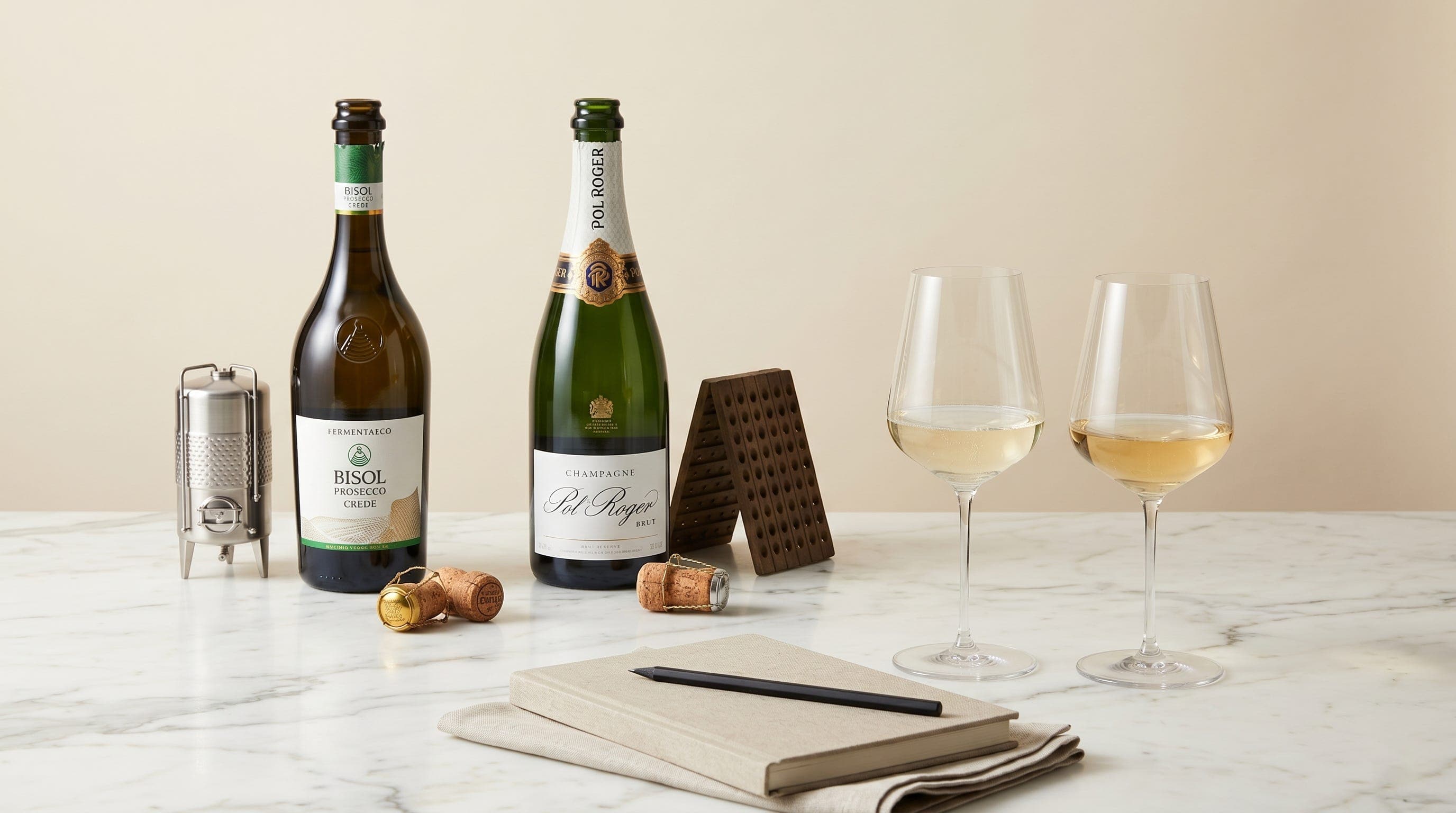
#2: Method - Méthode Champenoise vs. Tank
Objective. Feel what fermentation method does to texture, complexity, and finish in sparkling wine.
What to try.
- Wine A (Charmat / tank method): Prosecco. Producers: Bisol Crede Prosecco DOCG, Nino Franco Rustico, or Mionetto Prestige Brut DOC. Price range $15 to $22.
- Wine B (méthode champenoise): NV Brut Champagne. Producers: Kirkland Signature Brut Champagne, Nicolas Feuillatte Brut Réserve, or Pol Roger Brut Réserve. Price range $25 to $70.
- Even at the budget end, méthode champenoise vs Charmat is unmistakable.
What to notice.
- Bubbles: large and frothy vs. fine and persistent.
- Aroma: fresh fruit and floral vs. brioche, toast, and yeast autolysis.
- Texture: light and easy vs. creamy and structured.
- Finish: short and fruity vs. long and savory.
- Acid: both have it, though Champagne’s reads sharper after the bubbles dissipate.
Lesson. Same job, carbonate the wine. Two different methods: a sealed pressurized tank, or a second fermentation that takes place inside the bottle. Two completely different end states. Method shapes the entire personality of the wine.
#3: Blending - Varietal vs. Multi-grape
Objective. Feel how blending changes a wine you already think you know.
What to try.
- Wine A (varietal Cabernet Sauvignon): Paso Robles Cabernet Sauvignon. Producers: J. Lohr Seven Oaks Cabernet Sauvignon, Justin Cabernet Sauvignon, or DAOU Cabernet Sauvignon. Price range $18 to $32.
- Wine B (Bordeaux blend): Paso Robles Bordeaux blend. Producers: J. Lohr Cuvée POM, Justin Isosceles, or Robert Hall Cavern Select. Price range $50 to $85.
- Pairing both bottles from the same producer (e.g., both J. Lohr or both Justin) isolates the blending decision most cleanly.
What to notice.
- Structure: Cabernet’s straight-line tannic backbone vs. the blend’s rounded mid-palate.
- Aroma: black currant and cedar vs. plum, violet, and tobacco.
- Texture: angular vs. silken.
- Finish: focused vs. layered.
- The “missing weight”: what Merlot and Cabernet Franc add to round out a Cab-led wine.
Lesson. Blending is composition. Merlot, Cabernet Franc, and Petit Verdot fill the spaces a single varietal leaves empty. Once you can taste that fill, you understand why Bordeaux made blending the rule and why Paso Robles producers will sell you both versions of the same idea.
The Finish
Three Saturdays, three pairs, six bottles. What you build over those weekends is a set of sensory anchors for three specific winemaking decisions.
The next time a label mentions oak vs stainless, méthode champenoise vs Charmat, or a varietal vs Bordeaux blend, your tongue has something to pair those terms with. That is the start of a working palate.
Pick the pair that intrigues you most. Schedule it for next Saturday afternoon. Set up two glasses, label nothing, taste blind for the first five minutes, then read the labels and see how close your senses got. Twenty minutes of focused attention beats twenty hours of reading.
Of the three pairs, which one surprised you most? Which one matched what you expected? The gap between those two answers tells you where your palate is still working things out, and where it is most likely to grow next.
This is what discernment looks like in daily life.
Go Deeper
- Émile Peynaud, The Taste of Wine: The Art and Science of Wine Appreciation (Wiley, 2nd ed. 1996): The foundational text on tasting from the Bordeaux professor who shaped modern enology. Chapters on the role of method, vessel, and aging on perception are unmatched anywhere in the literature.
- Decanter, “Champagne vs Prosecco: What’s the difference?”: Decanter’s direct comparison of traditional method vs Charmat, with a clear explanation of why second fermentation in the bottle generates the brioche, biscuit, and yeast-autolysis notes that define traditional-method sparkling.
- Berry Bros. & Rudd, “Bordeaux: the art of the blend”: Mark Pardoe MW (Berry Bros.’ wine director) walks through why Bordeaux producers rely on multiple grapes to manage structure, climate variability, and vintage swing.