1 Big Idea: Climate Sets the Dials Before Anyone Else Touches Them
Years ago I poured two Syrahs side by side for a table of confident drinkers, no labels showing. One was a Northern Rhône Crozes-Hermitage, the other a Barossa Shiraz. One taster, a few glasses into his evening, was sure the Rhône was not even the same grape as his beloved Australian bottle. He was tasting two wines made from identical genetic material, and to him they came from different planets.
He was not wrong to be confused. He was tasting climate.
Long before any cellar decision about oak or yeast or time, the place where the grapes grew has already set the wine’s basic chemistry. Warmth is the engine.
The more heat and sun a vineyard gets through the season, the riper the grapes get: sugar climbs, and that sugar becomes alcohol during fermentation. At the same time, the grape’s natural acidity falls, and its flavors travel from the tart and the green toward the ripe, the soft, and the sweet-fruited. A cool site does the reverse. It ripens grapes slowly and incompletely, holding on to acidity, keeping alcohol modest, and leaving flavors in the citrus, orchard-fruit, and herbal range.
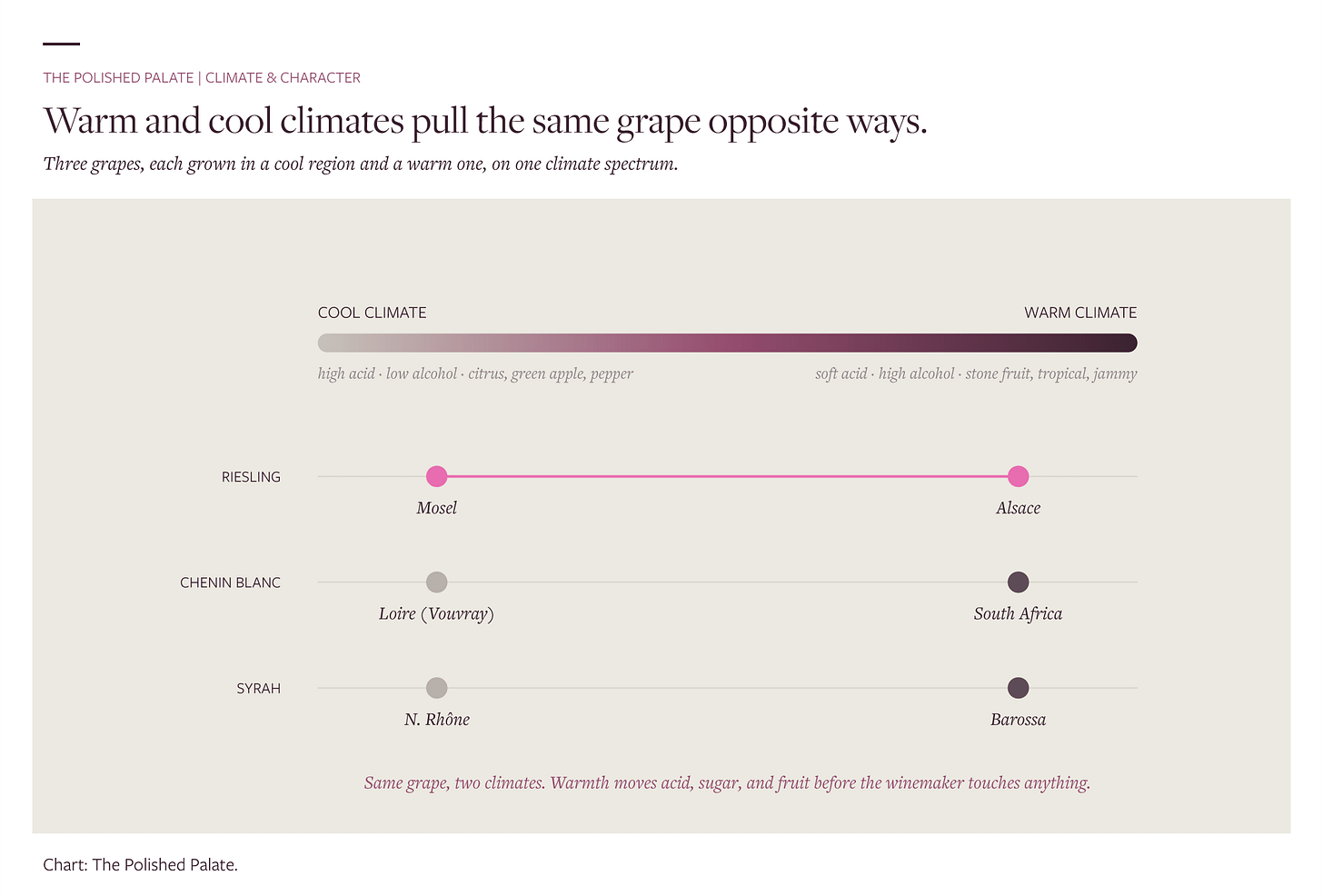
This is why a Riesling from a cold German river valley can come in under nine percent alcohol and taste like a squeeze of lime, while the same grape grown somewhere sunnier, like Alsace, arrives fuller, rounder, and noticeably stronger. Same grape, different thermostat, two wines that barely recognize each other.
Learn to read where a wine sits on that warmth spectrum and you have a master key. It tells you why one bottle feels electric and another feels plush, before you know a single thing about who made it.
3 Taste Experiments
# 1: Riesling, cool Mosel vs. warmer Alsace
Objective: Hear what climate does to a single, transparent grape. Riesling hides nothing, which makes it the clearest teacher of the ripeness factor.
What to try: From Germany’s Mosel, a cool valley of steep slate slopes, look for Dr. Loosen, Selbach-Oster, or Joh. Jos. Prüm (roughly $15 to $35). From Alsace in France, a warmer, sunnier, drier region in the rain shadow of the Vosges mountains, look for Trimbach, Hugel, or Léon Beyer (roughly $20 to $30). Choose a dry Mosel Kabinett and a dry Alsace bottling so you are comparing climate, not sweetness.
What to notice:
- Alcohol on the label first. The Mosel often sits between 8 and 11 percent; the Alsace usually reads 12.5 to 13.5.
- Acidity on the palate. The Mosel should make your mouth water and feel weightless; the Alsace feels broader and softer.
- Flavor. Lime, green apple, and wet slate in the cool wine; riper peach, apricot, and a waxy, honeyed note in the warm one.
The lesson: Nobody added sugar or stripped acid out. The Mosel grapes simply never got hot enough to ripen as far, so they kept their acid and stayed light. The Alsace fruit ripened further, traded some of that acid for body and alcohol, and pushed its flavors toward stone fruit. That single difference, how far the grapes ripened, accounts for most of what separates these two glasses.
# 2: Chenin Blanc, cool Loire vs. warm South Africa
Objective: Confirm the pattern holds in a completely different grape and a wider temperature gap, this time stretching from northern France to the southern tip of Africa.
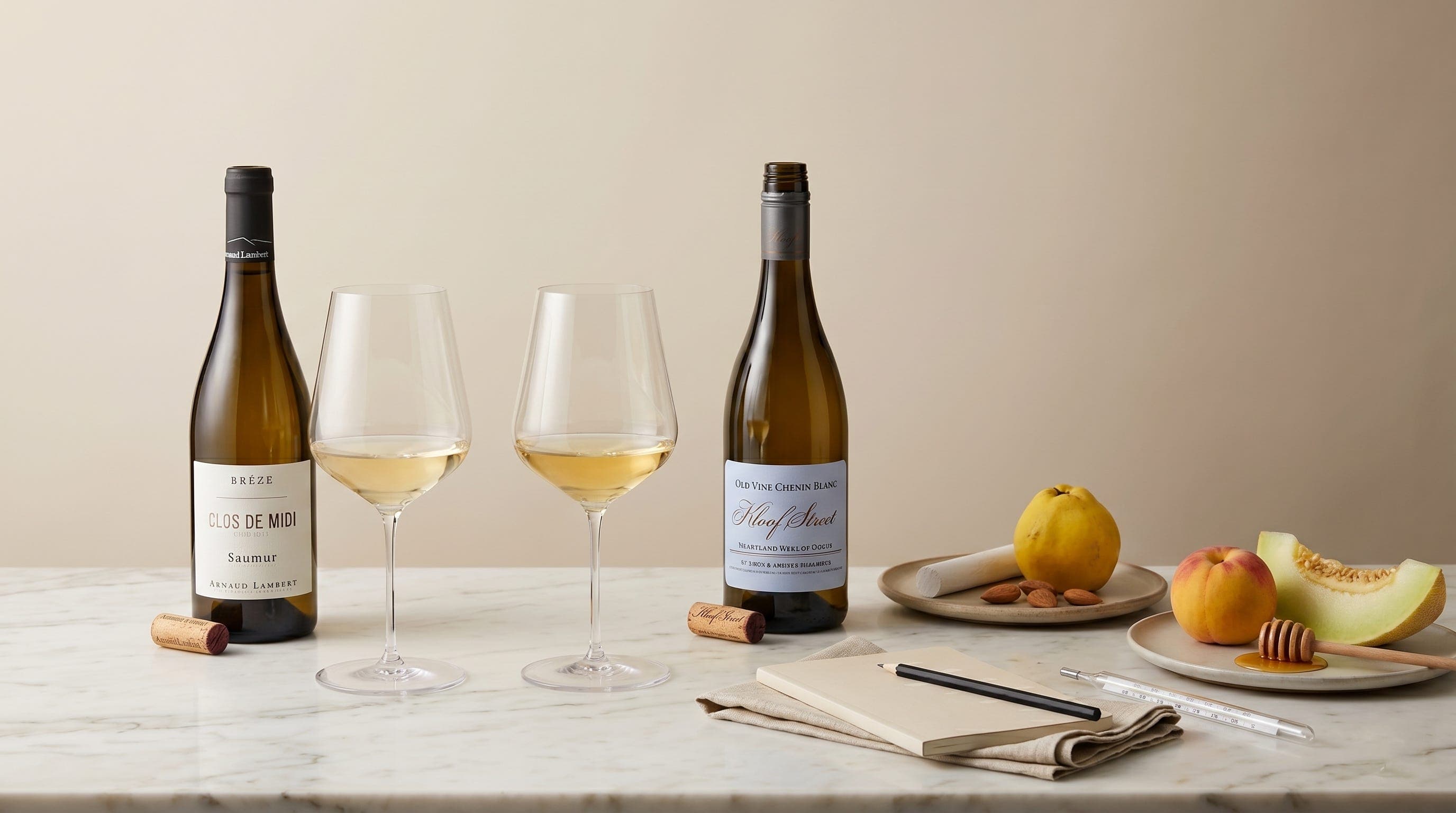
What to try: From France’s Loire Valley, a cool, marginal climate for ripening, look for a dry Vouvray (Domaine Huet or François Chidaine) or a Saumur (Arnaud Lambert), roughly $25 to $35. Insist on a dry, or sec, bottling, since Loire Chenin is often made with some sweetness and that would cloud the read. From South Africa, where old Chenin vines bake in the warm Swartland and Stellenbosch sun, look for Ken Forrester Old Vine Reserve, Raats Family, or Mullineux Kloof Street (roughly $15 to $25).
What to notice:
- Weight and texture. The Loire wine feels taut, lean, and almost stony. The South African feels rounder and fuller across the tongue.
- Flavor. Quince, raw almond, and a wet-wool savoriness in the cool version; ripe yellow peach, melon, and a touch of honey in the warm one.
- The finish. The Loire leaves a mouthwatering, mineral snap. The South African leaves a softer, fruit-sweet impression even when fully dry.
The lesson: The South African Chenin is not sweeter in any technical sense. It tastes riper because the fruit got riper, the same move you just watched Riesling make. When you can feel that a wine is dry but tastes ripe, you are tasting the climate, and you are learning to separate actual sugar from the impression of ripeness. That distinction is one of the most useful things a developing palate can own.
# 3: Syrah, cool Rhône vs. warm Barossa
Objective: Watch climate transform a red so completely that, as my dinner guest proved, people stop believing it is one grape. This is the pair that made the idea click for me, so it earns the splurge slot.
What to try: From France’s Northern Rhône, a cool, continental stretch of the river, look for a Crozes-Hermitage or Cornas from Guigal, Jean-Luc Colombo, or Domaine du Tunnel (roughly $25 to $45). From Australia’s Barossa Valley, hot and sun-soaked, look for Torbreck Woodcutter’s, d’Arenberg The Footbolt, or Penfolds Bin 28 (roughly $20 to $35).
What to notice:
- Fruit character. The Rhône leans red and savory: red plum, black olive, cracked black pepper, smoked meat. The Barossa leans black and sweet: blueberry, blackberry jam, chocolate, vanilla.
- Body and alcohol. The Rhône feels lithe and tense, often around 13 percent. The Barossa feels broad and warming, frequently 14.5 or higher.
- The overall impression. One wine feels like it is holding something back. The other gives everything up front.
The lesson: Cool-climate Syrah keeps its acid and its savory, peppery edge because the grapes never fully ripened into pure sweetness. Warm-climate Shiraz ripens all the way, so its fruit turns dark and jammy, its alcohol rises, and its acid relaxes. Same grape, opposite personalities, and the only thing that changed is how much heat the vineyard collected before harvest.
The Finish
Three grapes, three temperature gaps, one pattern underneath all of them. Heat ripens fruit, and ripeness moves the same dials every time: alcohol up, acid down, flavors from tart and red toward ripe and black (for reds). Or from tart and citrusy toward ripe and tropical (for whites). Once you have felt it in Riesling, Chenin, and Syrah, you will start catching it everywhere, in wines you have drunk for years without a name for what you were noticing.
One honest caveat: climate is the loudest factor here, but it shares the controls. A grower’s choice of when to pick moves sugar, acid, and alcohol the same way warmth does, which is why these pairs lean on typical, dry bottlings from each region, so climate stays the signal in the glass.
Here is the part that matters for your own taste. Neither end of the spectrum is better. Some palates are pulled toward the tension and lift of cool-climate wines, others toward the generosity and warmth of riper ones, and most of us lean one way without ever having said it out loud. Knowing your lean is the start of choosing wine deliberately, with a reason behind the pick.
So this week, after you taste these pairs, go back to a wine you already love and place it on the spectrum. Cool or warm? Then ask whether your favorites have been quietly clustering at one end the whole time. That answer is worth more than any score.
Go Deeper
If this week’s idea stuck with you, these resources take it further.
- Warm Climate vs. Cool Climate Wines, Wine Folly. The quickest way in, a side-by-side of how warm and cool sites push sugar, acid, and alcohol in opposite directions. Read it in a couple of minutes before the papers below.
- Climate, Grapes, and Wine: Structure and Suitability in a Variable and Changing Climate, Gregory V. Jones (Springer, 2012; open access via IVES). The foundational framework, from the climatologist who mapped which grapes ripen well in which climates and why.
- Impact of climate change on grape berry ripening, Suzy Y. Rogiers et al. (Frontiers in Plant Science, 2022). A peer-reviewed look at the actual mechanics of how heat drives sugar up and acid down inside the berry.
For the chemistry underneath these comparisons, the balance between acid, alcohol, sugar, and tannin is the companion piece to this one.