You can buy a bottle with the Robert Mondavi name on it tonight, at almost any grocery store, for less than a decent lunch. The man whose signature became American wine’s most recognizable has been gone since 2008. The company that prints his name answers to Constellation Brands, a corporation in Victor, New York that also sells Corona and Svedka. None of this is a secret. It is just rarely told as one story.
It is the most American wine story there is. An immigrant’s son builds a name out of nothing, makes it the most valuable in the country, and watches his own family hand it to a conglomerate for $1.36 billion. The engine that drove the rise and the fall was the same one: a Mondavi brother who could not work with another Mondavi.
Netflix’s Uncorked arrives later this year to retell Napa’s story for a new audience. Before it does, this is the dynasty that wrote the first chapter, told straight, with the dates and figures named.
Robert Mondavi did more than build a winery. He built the idea that a California wine could stand beside the great bottles of France and charge accordingly.
That idea is now worth billions. The family that authored it owns almost none of it. What they kept is harder to put a price on, and it turns out to be the part that mattered.
The fracture that built a winery
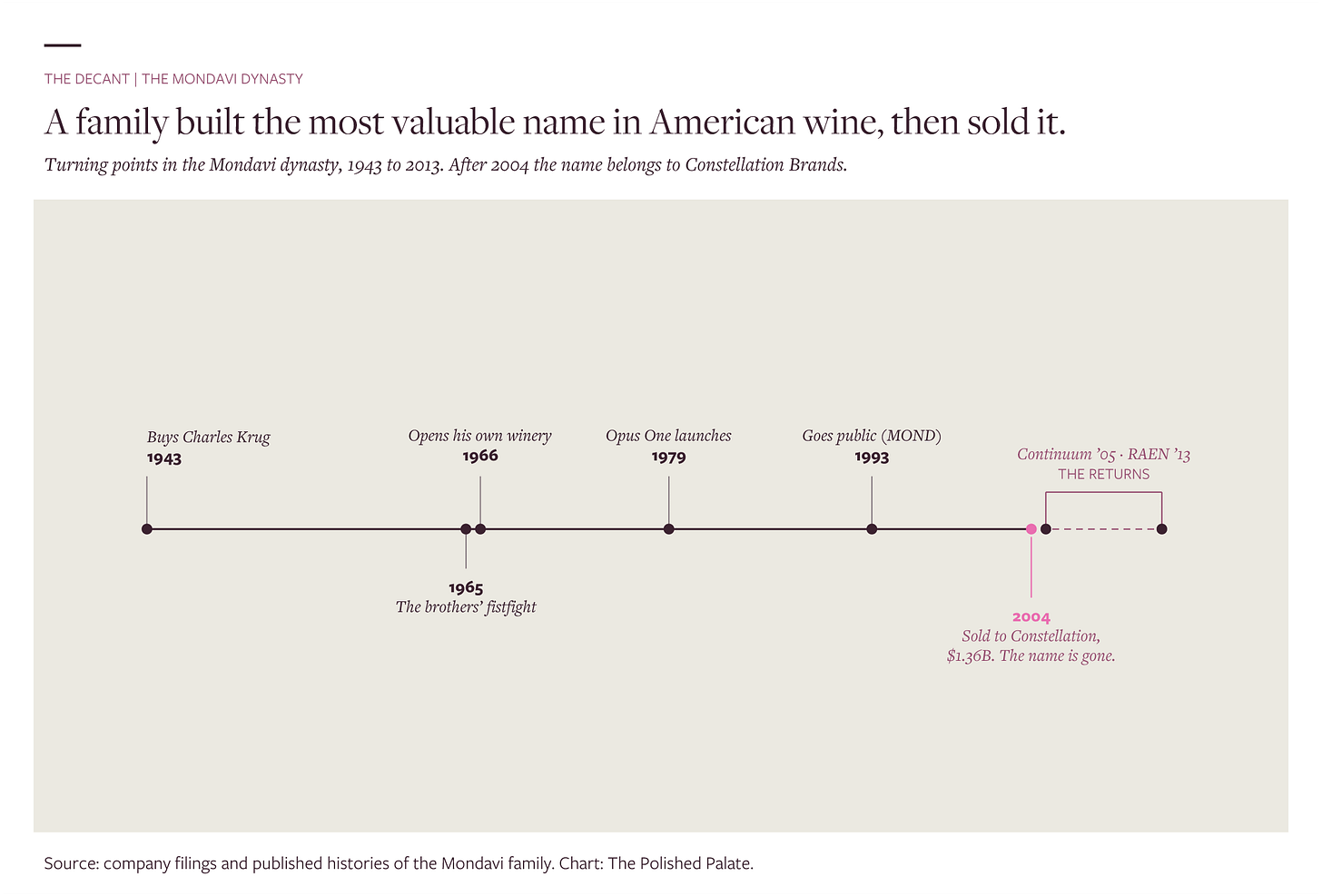
The Mondavis started in fruit, not wine. Cesare Mondavi emigrated from Sassoferrato in central Italy, settled his family in Minnesota, then moved them to Lodi in California’s Central Valley, where he ran a fruit-packing business. In 1943 the family bought the Charles Krug winery in St. Helena, one of Napa’s oldest. Cesare’s two sons ran it after him. Robert, born in 1913, was the salesman and the visionary. Peter, fourteen months younger, was the cellar hand and the conservative.
They did not agree on much, and by the mid-1960s they did not agree on anything that mattered. Robert wanted to spend and expand and chase greatness. Peter wanted to hold the line.
In November 1965, by Robert’s own account in his memoir Harvests of Joy, the argument became physical. The brothers came to blows at Krug. “When it was all over, there were no apologies and no handshake,” he wrote. His family suspended him.
So at fifty-two, an age when most men are protecting what they have, Robert Mondavi started over. In 1966 he opened the Robert Mondavi Winery in Oakville, the first major new winery built in Napa since the end of Prohibition. He hired the architect Cliff May to design it as a statement: a long mission-style arch and tower, set back from Highway 29, built to pull travelers in off the road at a time when almost no California winery bothered to welcome visitors. His winery sat beside To Kalon, a vineyard first planted by H.W. Crabb in 1868 and now regarded as one of the great Cabernet sites in the country.
He had a gift for the public side of wine that the trade had never really seen. In 1968 he took Sauvignon Blanc, a grape Californians were not buying, aged it in oak, and renamed it Fumé Blanc. The grape did not change. The name did, and it sold. That instinct, that a story well told moves a wine as surely as what is in the glass, is the through line of everything that followed.
The decade Napa went global
A winery on Highway 29 was a local achievement. Robert wanted Napa measured against Bordeaux, and in 1979 he found a way to force the comparison.
That year he launched a joint venture with Baron Philippe de Rothschild, the owner of Château Mouton Rothschild and one of the most celebrated names in France. Two continents, two of the proudest egos in wine, one bottle. They called it Opus One. The 1979 was the first vintage. When the wine reached the market it carried a price no California bottle had dared before, placing Napa on the same shelf, and at the same number, as a Bordeaux First Growth.
The wine was only half the achievement. The other half was permission. A Frenchman of Rothschild’s standing had agreed, in public and in partnership, that Napa belonged in the conversation. Robert spent the years that followed as the valley’s traveling ambassador, evangelizing California wine in markets that had dismissed it a decade earlier.
By the late 1980s the Robert Mondavi Winery was the reference point for the entire region, and his name had become shorthand for the proposition that American wine could be serious wine.
Going public, going big
In 1993 Robert Mondavi took the company public. On June 10 it began trading on the NASDAQ under the ticker MOND, with an initial offering of 3.7 million shares at $13.50 each. The family kept control through a second class of supervoting shares, a structure that let them raise outside money while still steering the company. On paper, it was the best of both worlds.
The money funded growth, and growth pulled the name in two directions at once. At the top sat the Oakville winery and Opus One. Below them, the company built volume brands like Woodbridge and the lower-priced Coastal range, wines that put the Mondavi name on millions of cases and into supermarket carts across the country.
There were ventures in Chile, in Italy, in the south of France. The reach was enormous. So was the strain on what the name meant. By the early 2000s a company executive admitted to the press that the brand had drifted too far from fine wine and needed its image back.
A name can mean prestige or it can mean volume. Holding both at once is one of the hardest tricks in any luxury business, and the Mondavi company was now trying to do it across four countries and a dozen price points, with a public market watching every quarter.
The second fracture
Robert had two sons, and he gave them the company. Michael, the elder, ran the business. Timothy made the wine. They had inherited their father’s ambition and, it turned out, his family’s oldest flaw: two Mondavis who could not share a steering wheel.
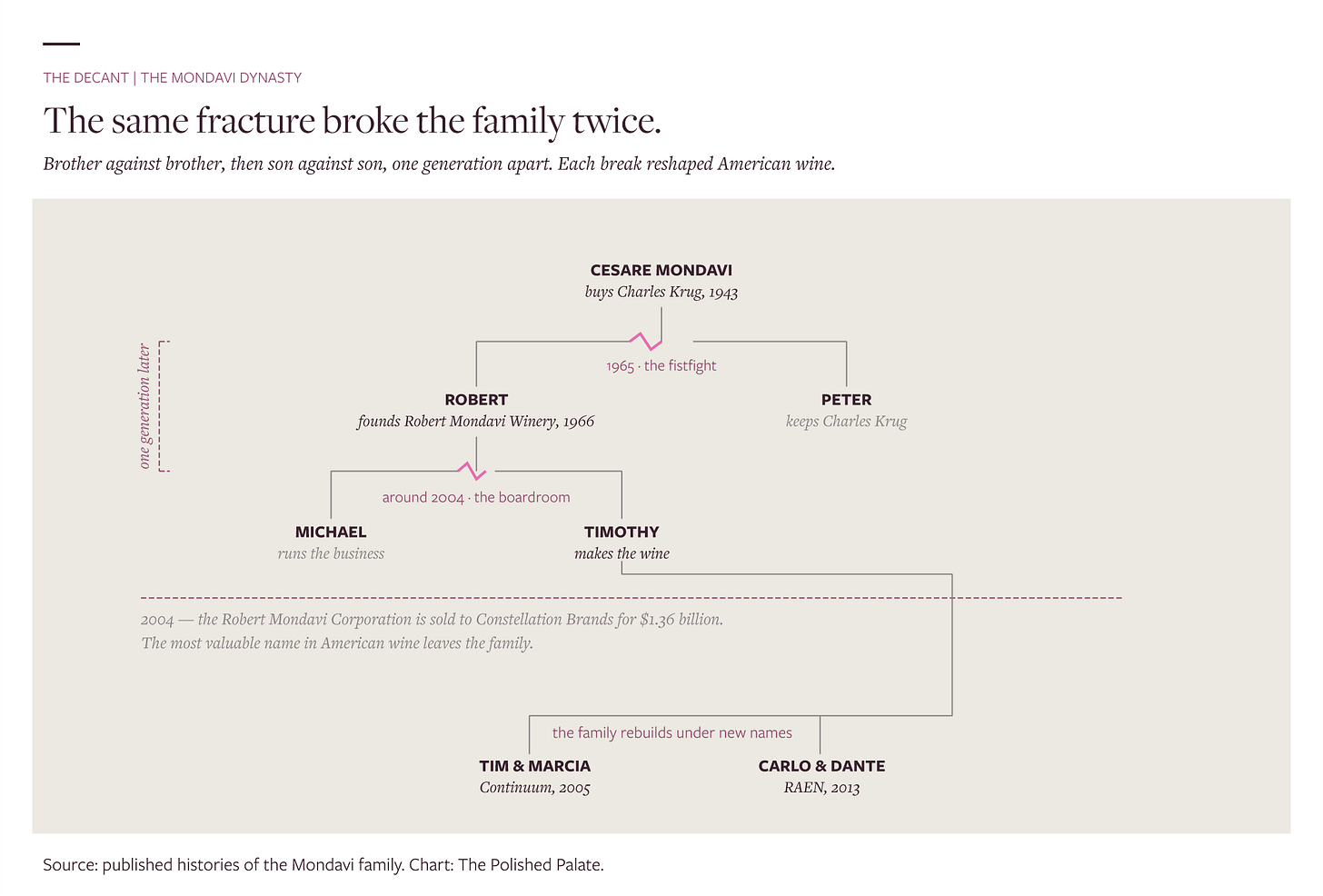
Michael pushed for scale, acquisitions, and shareholder returns. Tim pushed for quality and patience and the high end. Each thought the other was steering the company off a cliff, and for years the board absorbed the friction. Julia Flynn Siler, the Wall Street Journal reporter who chronicled the family in her book The House of Mondavi, framed it plainly: Robert’s sons repeated, almost beat for beat, the brother-against-brother fight that had driven their father out of Charles Krug forty years earlier.
By 2004 the stock had slumped, the strategy was contested, and the supervoting structure that once protected the family had become the mechanism of its undoing. The board moved to sell. In December, Constellation Brands acquired the Robert Mondavi Corporation for approximately $1.36 billion, paying $56.50 a share for the public Class A stock, with the deal closing on December 22. The family that had spent thirty-eight years building the name no longer owned it.
Robert was ninety-one when the company bearing his name was sold out from under the family. By most accounts he was devastated.
What a name is worth
Here is the turn the headlines missed. The Mondavis lost the company. They did not lose the thing the company was built to express.
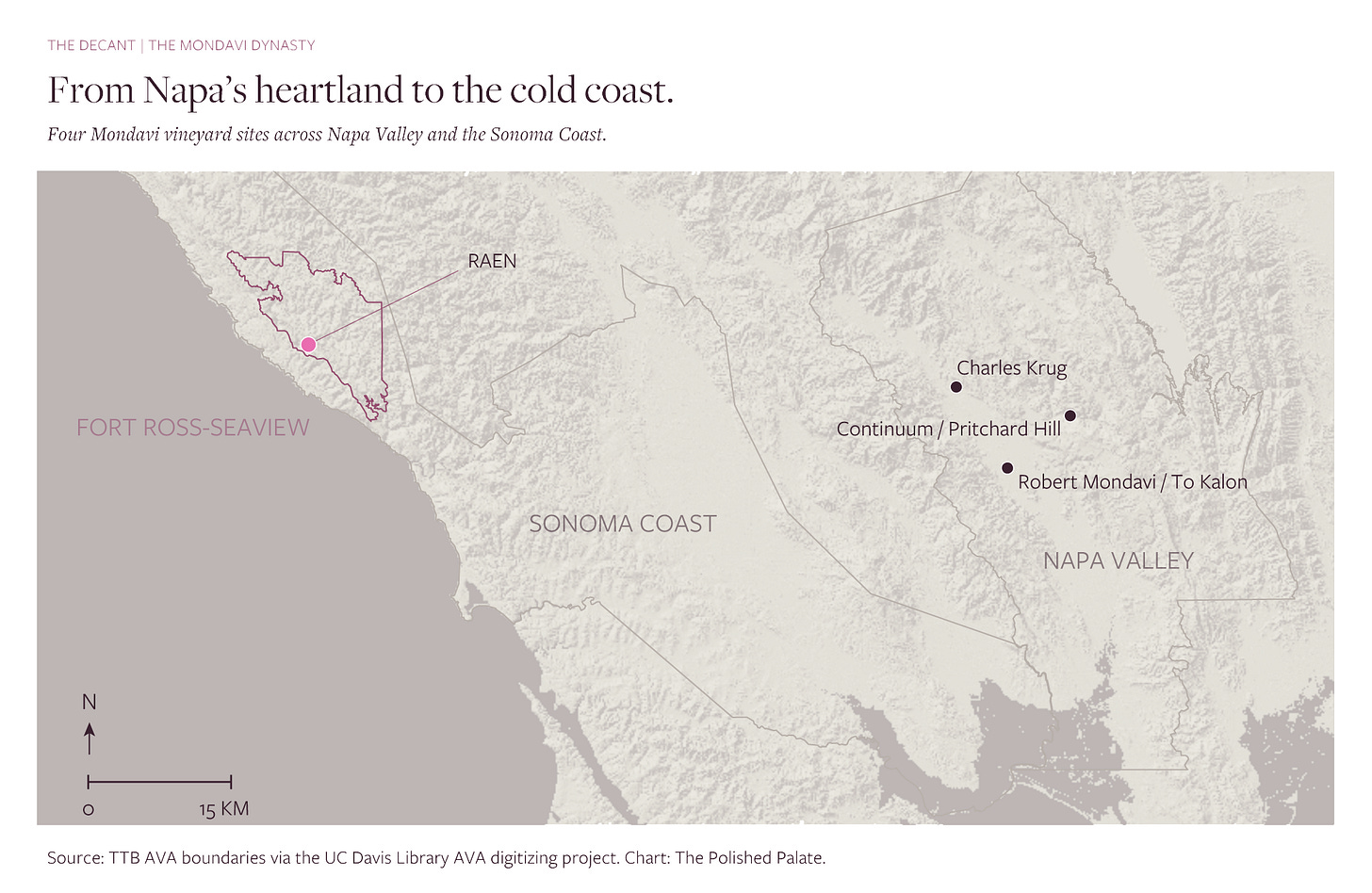
Within a year of the sale, Robert, his son Tim, and his daughter Marcia founded a new winery called Continuum. The first three vintages, 2005 through 2007, were made largely from To Kalon fruit, the same Oakville ground the family had farmed for decades, before they acquired their own land high on Pritchard Hill and moved the estate there. The name was deliberate.
Robert’s most repeated line, the one the family carved into the new venture, was “This is just the beginning.” At ninety-one, having lost the company, he started another one.
Robert Mondavi died on May 16, 2008, at his home in Yountville. He was ninety-four. In his last years he gave much of his fortune away. He helped found COPIA, a center for wine and food and the arts in Napa, and he and his wife Margrit endowed the Robert Mondavi Institute for Wine and Food Science at UC Davis, which opened the same year he died. He had spent his life arguing that wine belonged in the company of art and music and serious thought, and he wrote that argument into institutions that outlived the company.
Then it went a generation deeper. In 2013 his grandsons Carlo and Dante, Tim’s sons, founded their own winery on the cold western hills of the Sonoma Coast. They called it RAEN, for Research in Agriculture and Enology Naturally, and they made cool-climate Pinot Noir, about as far from a blockbuster Napa Cabernet as the family could get. Their flagship bottling is named Royal St. Robert, after their grandfather. They could have fought to put the Mondavi name on a label. They built a new one and kept the man inside it.
That is the lesson hiding inside the billion-dollar headline. A name is an asset. It can be bought, leveraged, diluted across a dozen price points, and sold to a corporation that will keep printing it long after you are gone. A reputation is something else. It is the part of your work that walks out the door with you, that your children carry under a new sign because they choose to, that no acquisition closes on.
The Mondavis sold the most valuable name in American wine. They kept the only thing that was ever really theirs.
When Uncorked puts Napa’s glossy version in front of you this year, hold that distinction in mind. Most of what a wine label sells you is a name. The harder, better question is whose reputation is actually in the bottle, and whether they still answer for it.
The Finish
We tend to treat a famous name on a label as proof of something. The Mondavi story is a long argument that a name and a reputation are different objects that happen to share a spelling. One is owned. The other is earned, and it leaves when the people who earned it leave.
Most of us are not selling a winery. The principle still lands. The credentials you inherit, the brands you borrow, the labels you let speak for you: those are names. What you actually pay attention to, taste for yourself, and stand behind is closer to a reputation, and it is the only part that stays yours.
So this week, pick one bottle with a famous name on it and ask what you actually know about who makes it now. Not the story on the front label. The answer underneath. That small habit, separating the name from the reputation, is most of what discernment is.
A pairing for reading this one: a glass of Napa Cabernet, or fittingly a current Charles Krug or Robert Mondavi bottle, something with a storied name worth examining as you go.
Go Deeper
If this week’s story stuck with you, these take it further.
- Julia Flynn Siler, “The House of Mondavi: The Rise and Fall of an American Wine Dynasty” (Internet Archive): The definitive account, by the Wall Street Journal reporter who covered the family through the sale.
- Wine Spectator, “The Rise and Fall of the Mondavi Empire”: A tight trade-side summary of how the company came apart.
- Constellation Brands and Mondavi merger filing (SEC): The primary document on the $56.50-per-share terms, straight from the record.
- UC Davis, “Legendary Winemaker and Benefactor Robert Mondavi Dies”: The philanthropy that carried the reputation past the company.
- Decanter, “Mondavi brothers unite”: Robert and Peter, decades after the fistfight, making wine together again.
For the wider Napa arc this fits into, see “Napa Valley’s History in 7 Wines”, where the 1966 founding is one of seven turning points.