You know one expensive wine by name, even if you have never seen a bottle: Domaine de la Romanée-Conti (DRC). It’s the name someone says at the table when the conversation turns to the most expensive wine in the world, and the number that follows, $558,000 for a single bottle of the 1945 at Sotheby’s in New York in October 2018, is the kind of fact people repeat without knowing anything else about Burgundy.
Since 2021 a different wine has topped Wine-Searcher’s annual list of the world’s most expensive wines: a red from the same slope a few miles north, Musigny, made by Domaine Leroy in a few hundred bottles a year. On the 2026 list, published on September 30, its average price across every vintage on offer was $61,596 a bottle. Romanée-Conti’s was $24,005. Domaine Leroy is run by Lalou Bize-Leroy, who is 94, and who in January 1992 was removed as co-director of DRC by the shareholders of her own family.
Set side by side, those two facts look like a verdict on the 1992 vote. The record supports something narrower and more useful. The size of her plot and the yields she insists on explain why so few bottles of her Musigny exist. Why a bottle of it now lists at 2.5x the price of DRC is a separate question. Part of the answer is what buyers will pay, and part is how Wine-Searcher calculates the number.
The half of DRC that was hers
Maison Leroy was founded in 1868 in Auxey-Duresses as a négociant house: a firm that bought finished wine from growers, aged it, and sold it under its own label. In 1942 Henri Leroy bought half of Domaine de la Romanée-Conti, and the Leroy and de Villaine families have shared the domaine ever since.
Henri’s daughter Lalou was born in 1932, and he trained her palate himself. In 1955, at 23, she took charge of Maison Leroy, where the whole job is choosing which barrels to buy. She told the French critic Thierry Desseauve in 2021 that by then she already had in mind what a good Pommard or a good Volnay should be. She never stopped tasting: she still blind-tastes everything that goes into bottle under the Maison Leroy label, and in 2025, at 93, she chose the wines for that year’s release herself.
In 1974 she replaced her father as co-director of Domaine de la Romanée-Conti, alongside Aubert de Villaine. She ran the commercial side, and Maison Leroy distributed the domaine’s wines through most of the world.
The 1988 bet
In 1988 Domaine Charles Noëllat came up for sale in Vosne-Romanée, the same village as DRC, with old vines in Richebourg and Romanée-Saint-Vivant, two of the grands crus the domaine she co-directed was famous for. She bought the vines, stock, winery, and cellars for 65 million francs, roughly $11 million at 1988 exchange rates. To pay for it, she and her sister Pauline sold a third of the family firm to Takashimaya, the Japanese department store that had long been its importer. That purchase is the origin of Domaine Leroy. Today the domaine and Maison Leroy belong to one company, owned in thirds by Lalou, the family of her late sister, and Takashimaya, and she runs the domaine.
Then she changed how the vines were farmed. She stopped chemical treatments on the vineyards she bought, and from September 1988 every vine was worked biodynamically, using the farming system built on Rudolf Steiner’s lectures, years before the method was common in Burgundy.
Her own account of the decision is plain: “I knew we had to stop using chemicals in the vineyards, but I didn’t know what to replace them with. Biodynamics was exactly what I was looking for.”
January 1992
The public record on what happened next is thin, and neither side has said publicly why the vote went as it did. One disagreement is documented: how she handled the sale of the domaine’s wines became a quarrel with the other shareholders. One more fact is in plain view. From the 1988 vintage on, the co-director of DRC also ran a competing estate that made Richebourg and Romanée-Saint-Vivant in the same village and sold into the same market. That was a conflict of interest whatever the shareholders’ reasons were, and the record does not say whether it was one of them.
In January 1992 the Leroy family shareholders removed her as co-director, and her nephew Henry-Frédéric Roch held the Leroy seat for nearly all of the next 26 years, until his death in 2018. She kept her shares in the domaine. She lost the job, and Maison Leroy lost the right to distribute the domaine’s wines.
Nobody in that room has said publicly what the vote felt like, and I am not going to guess. What she did next is on the record in yield figures.
What she refused to do
The appellation rules for a red grand cru like Musigny allow a base yield of 35 hectolitres of wine per hectare of vines. She has called that limit unreasonable and says a vine should give 20 to 25. In practice hers give around 15, and in 2012 they gave 9.
Her explanation, to Wine Spectator in 2015, is mechanical: “A wine from a vine that’s yielded 40 hectoliters per hectare will not have the natural concentration of a wine that comes from a vine that gave 9, 10, 12 or 15 hectoliters. Voilà!” Tasting the 2025 Maison Leroy selection, she said it shorter: “La qualité, c’est les rendements.” Quality is yield.
The method is a list of things she will not do. She skips the summer “green harvest” many estates use to concentrate the remaining clusters; she lets the vine set what it sets and removes the unripe material by hand at picking. She keeps the canopy full because she wants as many leaves as possible, and once told an interviewer there are never enough. In the summer of 1993, when mildew tore through Burgundy, she refused the fungicides that would have saved the crop. From her hectare of Romanée-Saint-Vivant she made 700 litres of wine, roughly a fifth of what the law would have allowed. André Porcheret, whom she had hired in 1988 to run both the cellar and the vineyards, wanted to spray, and he left after that harvest. She kept the policy.
Wine Spectator reported in 2015 that Domaine Leroy’s whole output had ranged from 1,700 to 3,750 cases a year since 1988, about 2,700 on average. She has been candid about the price side: she told the magazine she sells just enough to keep the domaine going, and that she thinks her wines are not expensive enough.
Why there are so few bottles
Put the two famous wines side by side on the same measures. Romanée-Conti is a single vineyard of about 1.8 hectares. In the mid-2000s it averaged about 42 hectolitres of wine a year, roughly 23 hectolitres a hectare, or about 5,600 bottles. DRC has farmed organically since the mid-1980s and went fully biodynamic in 2007, 19 years after she did. Her Musigny comes from about 0.27 hectares, a seventh of that area, at her usual 15 hectolitres a hectare.
Do the arithmetic in two steps. Farm her quarter-hectare at Romanée-Conti’s yield and it would make about 800 bottles a year, so the land alone takes you from 5,600 bottles down to about 800. Her yields, about a third lower, take it the rest of the way, to roughly 550. Most of the scarcity is the size of the plot. Her refusals take off a further third, and they are the part of the story she chose.
What the price records
Start with what the number is. Wine-Searcher’s average is built from the retail prices merchants list on its site, across every vintage on offer, and compiled monthly. It moves with which bottles happen to be for sale. In April 2019 the site counted almost 500 offers of Romanée-Conti across 68 vintages, and about 90 offers of Leroy Musigny across 34. In July 2025, 12 of the 19 Leroy Musigny vintages made since 1994 averaged more than $50,000 a bottle, while a 1985 was listed at about $7,100. Which of those vintages are on offer in a given month can move the average a long way.
With that in mind, the record. Leroy Musigny first passed Romanée-Conti in April 2019, at $22,049 against $20,267. On the August 2020 list Romanée-Conti was ahead again, $19,378 to $17,224. Wine-Searcher’s 2026 table puts the two at $28,071 and $22,366 in 2021, at $46,991 and $23,786 a year before the latest list, and at $61,596 and $24,005 now.
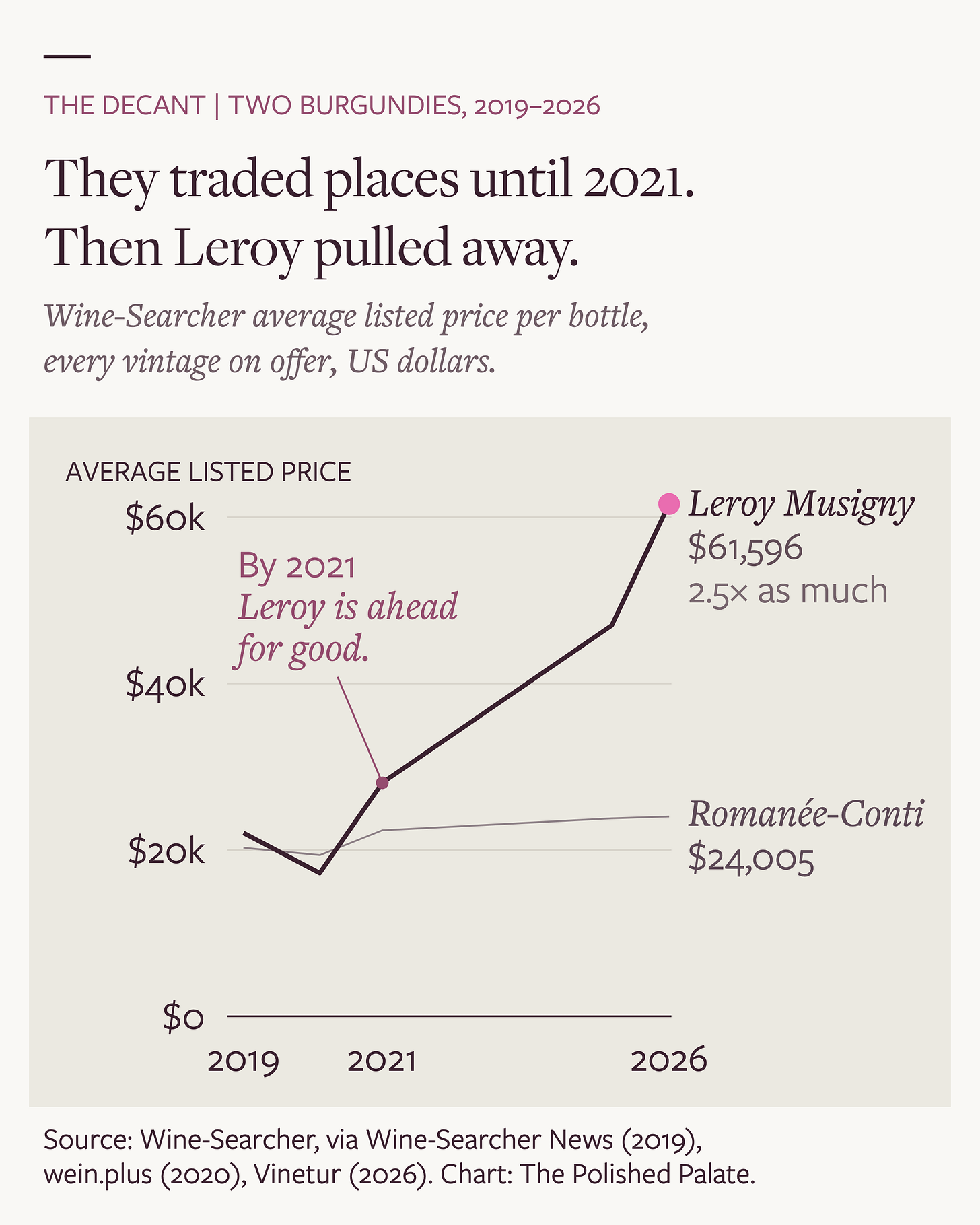
The land and the yields have been constant since 2019, while the gap went from roughly level to two and a half times, so they account for the scarcity and leave the widening to two other things. One is the listing mix: with about 90 offers, each young vintage that comes onto the market above $50,000 pulls the Leroy average up in a way 500 offers of Romanée-Conti barely register.
The other is buyers, and auction results show them, because an auction price is a completed sale. The French auction house iDealwine reports that Leroy Musigny has been the highest-priced wine at its sales for some years, displacing Romanée-Conti: a 2006 sold for €34,100 in 2022 and €25,415 in May 2025, the same month a 2020 Romanée-Conti made €16,902. In June 2021 a three-bottle case of the 2013 sold for $142,000, more than double the average auction price at the time. The record shows both forces at work and does not say how much of the 2.5 times belongs to each.
The price also cannot tell you which wine is better; almost nobody alive has tasted both often enough to say.
The Finish
A quarter of a hectare and yields far under the legal limit leave Lalou Bize-Leroy with a few hundred bottles of Musigny a year. At auction, buyers now pay more for one of them than for a bottle of DRC, and a thin market of listings widens that gap on Wine-Searcher’s list to 2.5 times. The story has a coda. When Henry-Frédéric Roch died in 2018, the Leroy family’s seat at DRC passed to Perrine Fenal, Lalou’s daughter. De Villaine stepped down at the end of 2021 and handed his side to his nephew. The chair she was removed from is held by her child, and at 94 she is still tasting.
One action for this week. The next time a Burgundy price stops you, on a list or a shelf, ask three things before you decide anything: what did the maker refuse to do, how much land is there, and how many bottles are actually for sale? Then decide which of those you are willing to pay for.
Pocket Palate: Lalou Bize-Leroy
One card to keep:
- The ouster: January 1992, removed as co-director of Domaine de la Romanée-Conti by the Leroy family’s shareholders after 18 years alongside Aubert de Villaine. From 1988 she also ran a competing estate in the same village; the shareholders’ reasons are not on record. She kept her shares and lost the job.
- The bet: 1988, Domaine Charles Noëllat in Vosne-Romanée for 65 million francs (roughly $11 million at 1988 exchange rates), paid for by selling a third of the family firm to Takashimaya. Biodynamics from September 1988, on every vine.
- The refusal: yields around 15 hectolitres a hectare, 9 in 2012, where the appellation allows 35 and Romanée-Conti averaged about 23 in the mid-2000s.
- The land: about 0.27 hectares of Musigny against 1.8 hectares of Romanée-Conti. The land takes the bottle count from about 5,600 to 800; her yields take it to roughly 550.
- The price: $61,596 against $24,005 on Wine-Searcher, September 30, 2026. That is an average of merchants’ listed prices across every vintage on offer; at auction, where prices are completed sales, iDealwine reports Leroy Musigny has topped Romanée-Conti at its sales for some years.
Go Deeper
If this week’s idea stuck with you, these take it further.
- Leroy Musigny Grand Cru Tops Wine-Searcher’s 2026 Ranking at $61,596 (Vinetur, 2026): The September 2026 Wine-Searcher table behind this issue’s numbers, with one-year and five-year comparisons for all ten wines.
- May Auction Report: And the Highest-Priced Wine of the First Half of the Year Is… (iDealwine, 2025): Completed auction sales, the other half of the price story, with Leroy Musigny against Romanée-Conti hammer prices.
- William Kelley, Lalou Bize-Leroy: Force of Nature (The World of Fine Wine, 2020): The fullest English-language profile, with her own words on the 1988 conversion, the 1993 mildew summer, and the doubt she says never leaves the job.
- Don Kavanagh, DRC Toppled as Leroy Takes Price Crown (Wine-Searcher, 2019): The trade report from April 2019, when Leroy Musigny first passed Romanée-Conti, with the offer counts that show how thin the Leroy market is.
- Clive Coates, The Wines of Burgundy (University of California Press, 2008): The standard named-author reference on the region’s domaines, including Leroy, DRC, and the yield rules the argument rests on.