Somewhere in every category of drink there is a name that does the choosing for you. Macallan in Scotch, Screaming Eagle in Napa Cabernet, Veuve Clicquot in Champagne. Buying by name is pretty common, and most of the time it is a perfectly rational shortcut.
How does a name get that job in the first place? The honest answer is almost never quality alone. In the clearest case on record, it was a head start of a few weeks.
That case played out in the spring and summer of 1814, between two houses from the same small region, selling the same product to the same customers. One of them put a name into an empty market weeks before the other. The difference echoed for a century, and it still shapes what happens at your table when someone hands you a wine list.
The March that decided nothing
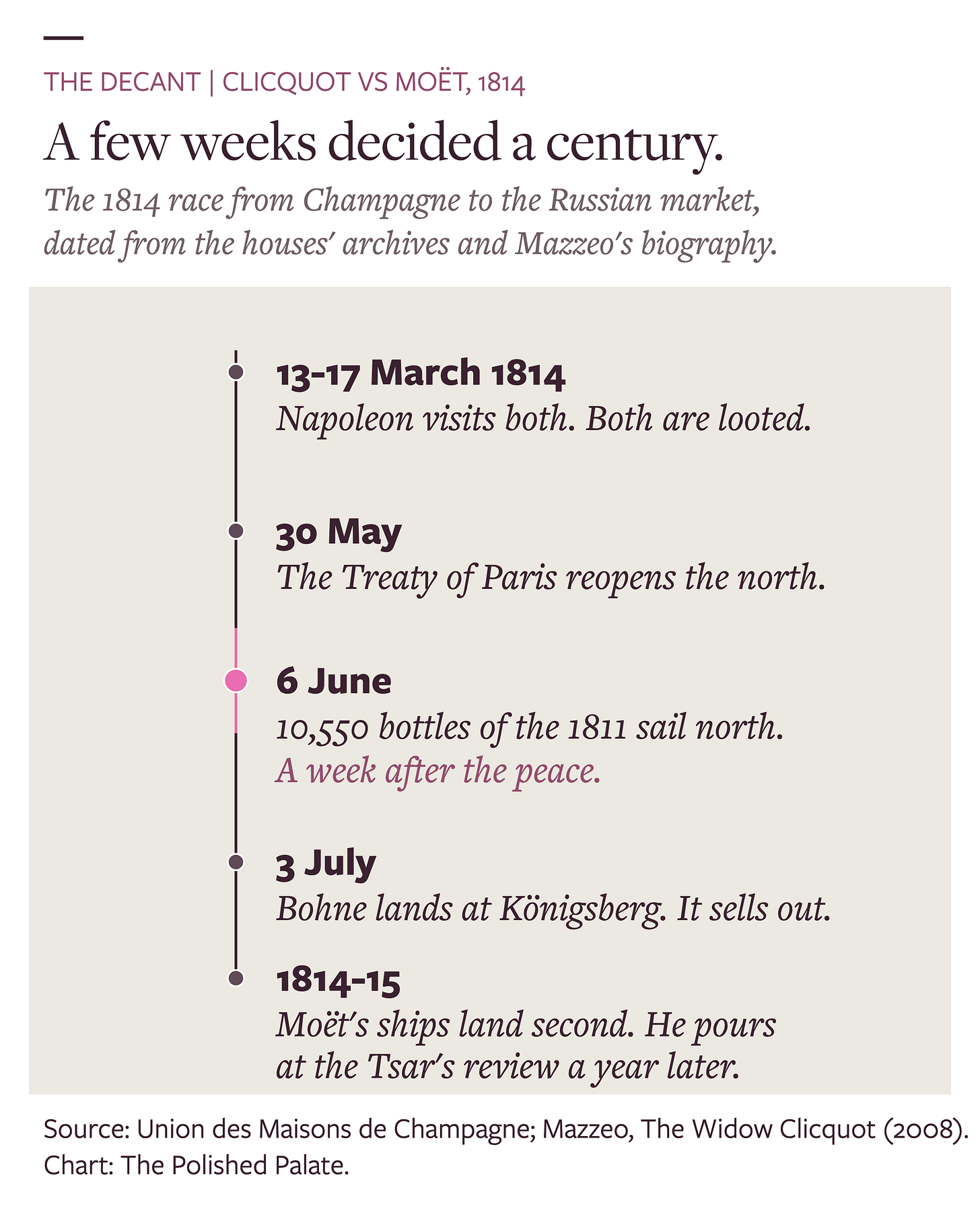
Start with a fact that would be too neat to use if it were not documented. On 13 March 1814, Napoleon reached Reims and pushed the Allies out of the city. He stayed three days, as the guest of Jean-Baptiste Ponsardin, who was Barbe-Nicole Clicquot’s brother. On 17 March he moved on to Épernay and stayed with Jean-Rémy Moët. Three weeks later, on 6 April, he abdicated.
Both accounts come from the Union des Maisons de Champagne’s own history of the period, which is drawn from the houses’ archives and from contemporary letters and memoirs. The same source records what the armies did on either side of that visit. The Prussians laid waste to Épernay on 7 February, lost it, retook it on the twelfth, and lost it again. Russian troops occupied the town on 17 March, the day Napoleon passed through, and pillaged for two days. In Reims, the Cossacks emptied the storerooms and got into any cellar that had not been bricked up in time.
So in March 1814 the two houses were, on paper, in the same position. Both had hosted the losing side. Both had been robbed. What separated them was scale and connection, and it wasn’t even close to a fair fight.
Jean-Rémy Moët had taken over his father’s house in Épernay in 1792 and was mayor of the town from 1802 to 1815. He exported 43,000 bottles in 1802 and got 55,000 into England in 1810, in the middle of a naval blockade, by way of Flanders ports and Guernsey. The Union’s biography credits his skill and stubbornness with keeping Épernay from being destroyed outright that spring. He was the establishment, and he had spent twenty years becoming it.
Barbe-Nicole Clicquot was 36, had been widowed at 27 when her husband François died in 1805, and had spent the intervening years failing to make the business work while her father-in-law covered her losses.
The letters had been pointing at Russia for six years
The part of this story that gets flattened into “she took a risk” is actually a paper trail, and it’s worth reading in order.
- In 1808, her travelling salesman Louis Bohne wrote to her that they had a perfectly organized business associated with the most respectable houses of their kind in the North, and that with such materials they could expect to construct a splendid edifice as peace returned to Europe. That is a man describing a plan he intends to execute later.
- In 1809, from Hamburg, the same man wrote that the port closed with chains was a pitiable spectacle, that the wealthiest businesses were wringing their hands, and that when he tried to sell champagne over the moaning, they laughed in his face.
- He wrote from the north with news that the Empress was pregnant and that rivers of Champagne’s wine would be drunk in that immense country if she gave birth to a prince. The trade body’s history dates that letter to 1810; Tilar Mazzeo’s biography places the same news four years earlier, and the imperial birth records side with the earlier date. Either way, the instruction that followed tells you how closely the houses were watching each other: do not speak of this at home, or all our competitors will flock to the North.
He also wrote to her, at some point in the Russian years, asking her never to mention politics in a letter, because the punishment for indiscretion was deportation to the mines in Siberia.
Six years of a salesman telling his employer exactly where the money would be and exactly who would take it from them if word got out. When the moment came, she was not improvising.
The week in June that decided everything
The First Treaty of Paris was signed on 30 May 1814. It ended the war between France and the coalition that included Russia and Prussia, and it reopened trade that had been shut for years.
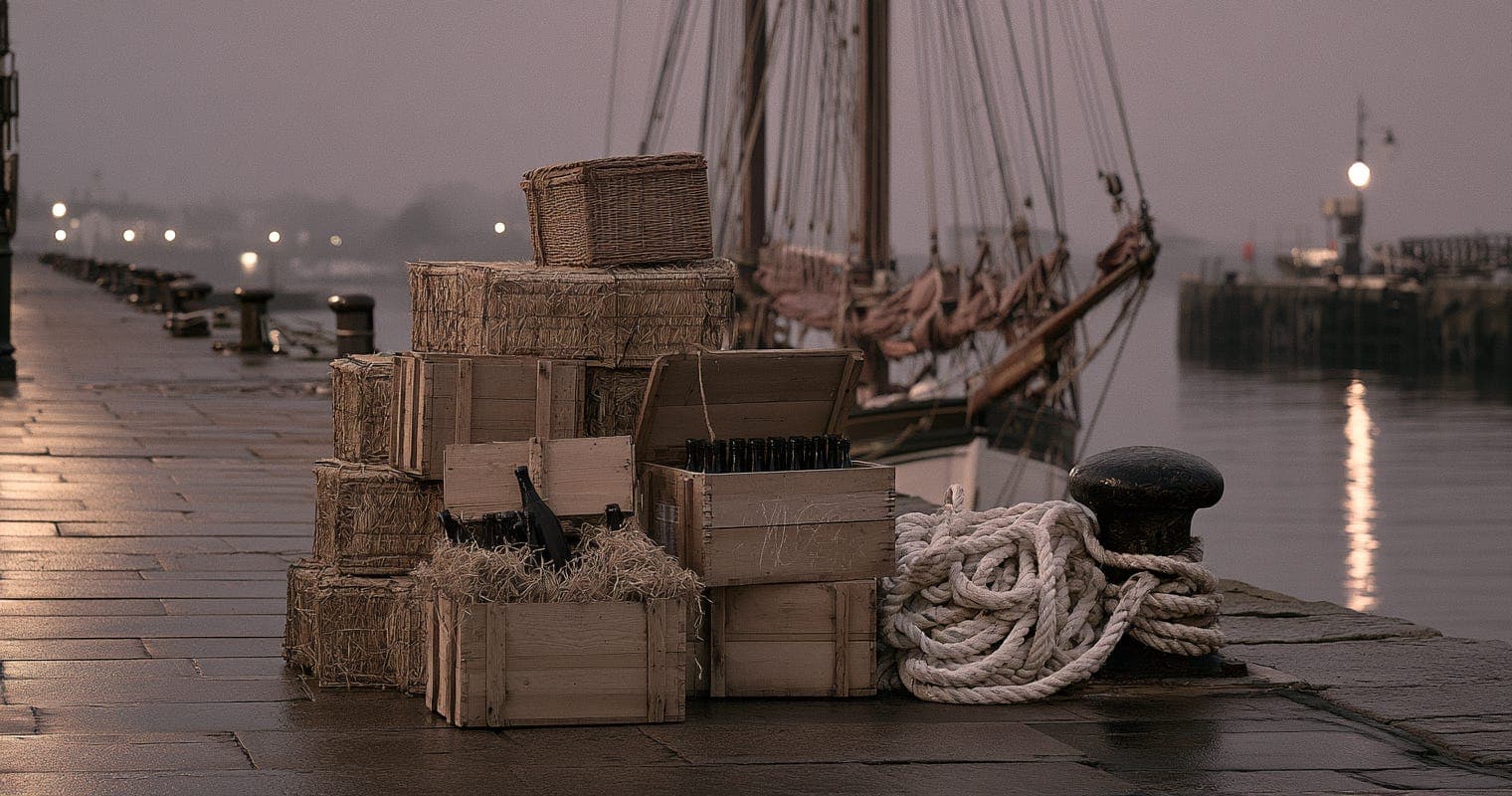
The Union’s history describes what happened next in a single sentence that is easy to skim past: even before the wars of the Empire had finished, Madame Clicquot secretly prepared to send a cargo of champagne to Saint Petersburg on a small seventy-five ton sailing ship. Mazzeo spells out what secretly meant. When the cases left Reims, bottled French wine was still banned in Russia, and a cargo caught traveling without a license could be confiscated and destroyed. The ban lifted while the ship was at sea. Peace had barely been signed when Bohne, after a long and rough crossing, landed at Königsberg on the Baltic coast on 3 July, and the first bottles went on from there.
The widely repeated version adds detail the archive summary leaves out: a chartered Dutch vessel, the Zes Gebroeders, sailing on 6 June 1814 with 10,550 bottles of her 1811 aboard, followed weeks later by a second ship, La Bonne Intention, carrying 12,780 bottles for Saint Petersburg. Even the departure port is contested: retellings say Le Havre, while Mazzeo has the first cases going by wagon through Paris to a ship waiting at Rouen.
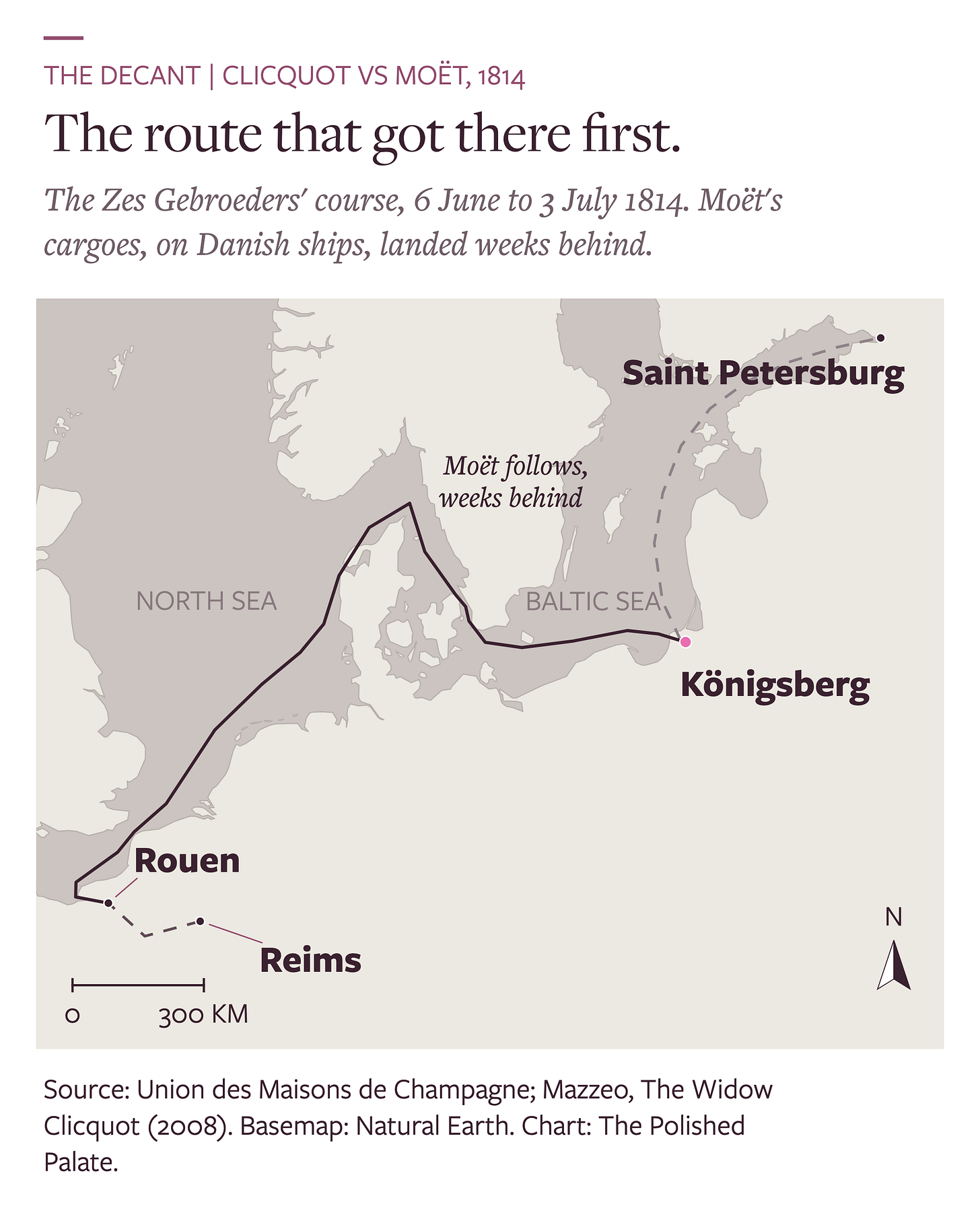
Decanter’s own house profile gives the figure as 10,500 bottles and puts the destination directly at Saint Petersburg. I cannot reconcile those accounts from public sources, so treat the exact figures as unsettled and keep the shape: somewhere over ten thousand bottles, on a small ship, a week after the treaty, with a second load behind it.
The cargo was the 1811, the comet vintage. The Great Comet of 1811 stayed visible to the naked eye for about 260 days, including through that harvest, and the wine that followed it was good enough that growers across Europe named the year after the sky. Winemakers in the Champagne branded the corks of that harvest with a star, the mark of the Vin de la Comète, and she was among them. She was not sending her ordinary stock into the best opportunity of her life.
What happened on the docks is the part the archive’s single sentence cannot hold. Mazzeo describes buyers besieging Bohne at his hotel before the cases were fully unloaded, wine merchants nearly coming to blows as the Königsberg allocation dwindled, and bottles selling at 5.5 francs apiece, roughly what she paid a vineyard laborer for a week of work. Bohne sold the entire cargo and wrote back to her with a line that has survived in the house archives: I already have orders for a further assault on your cellars.
Moët was racing too
The tidy version of this story has Moët standing still. He was not.
The Union’s biography of Jean-Rémy Moët records that in 1814 and 1815 he competed with Madame Clicquot for the Russian market, using Danish vessels. Mazzeo adds the paper trail: while her ship was loading, Moët was already writing to Count Tolstoy, grand marshal of the imperial palace, for permission to send the Tsar 30,000 bottles, and within weeks he had several thousand more on the water, on the chance they would clear customs. He got there. He simply got there second, into a market where the first arrival had already been drunk, talked about, and reordered.
There is a detail from the following year that shows how completely the positions had reversed. In September 1815, Tsar Alexander I staged an enormous military review on the chalk plain below Mont Aimé, in Champagne itself, with 200,000 men and the sovereigns of Europe watching. Moët supplied the wine for the Tsar’s table: 1,900 bottles at three francs and 300 of superior quality at four. Excellent business. Also a supplier’s role at somebody else’s event, one year after his competitor had put her name into that same Tsar’s country ahead of him.
What the head start bought her is measurable. By 1821 Madame Clicquot was selling 280,000 bottles a year, most of it into the Russian court, in a region whose entire annual production was around three million bottles at the end of that decade. By her death in 1866 the house was shipping roughly 750,000 bottles a year worldwide.
The sales figures are not even the strongest evidence. In chapter four of Eugene Onegin, written in the 1820s, Pushkin sets a table for a young poet: “Of widow Clicquot or Moët / A blessed bottle, placed in ice.” A Russian reader in 1828 needed no explanation of either name. Two houses from the same small French region, six years after the war that had ruined both of them, functioning in Russian verse as a single shorthand for the good stuff.
The parts that are legend
This story attracts invention, so here is where I stop trusting it.
- The famous line about the looting is quoted for both of them. The Union’s history has Madame Clicquot exclaiming, “So let them drink! If they drink, they will pay.” For Moët, the same source points to a journalist named Lallemand writing in L’Illustration on 23 August 1862, who quotes him saying that being robbed brought a smile to his face, because everyone who drank his wine would become a travelling salesman for the house. That is a quotation reaching print 48 years after the event it describes, in a magazine feature, about a man who was by then dead 21 years. Lallemand is also the source for the claim that allied officers emptied Moët’s cellars of several hundred thousand bottles. Treat that figure as a journalist’s, not an inventory.
- The Tsar declaring he would drink nothing but Clicquot is repeated everywhere, sometimes attached to Alexander I and sometimes to his brother Grand Duke Michael Pavlovich. I could not find it in any source closer to the event than modern retellings. It reads as house mythology, the kind of story a house keeps because it sells wine.
- Even the invention she is most celebrated for is shakier than the marketing suggests. The Union des Maisons de Champagne introduces the riddling table with the words “legend has it,” describes Madame Clicquot as prompted by an employee called Antoine Müller to have a kitchen table drilled with angled holes, credits a worker named Thomassin at another house with putting the idea into practice, and notes that the pupitre as we know it was patented by a M. Michelot in 1864. Her wine really did reach Russia clearer than most of what was arriving alongside it. And the later edge was real however it began: Mazzeo notes the riddling method stayed a house secret for the better part of a decade, and Moët did not adopt it until 1832. The kitchen table is legend, not record. The head start in clear wine was measurable in years.
None of that weakens the actual achievement, and I think it clarifies it. Nothing about the 1814 dash required a myth. A woman with six years of intelligence from the field, a stock of the best vintage in living memory, and the nerve to load a small ship before her competitors believed the route was open. That is enough.
Pocket Palate: what the record supports about 1814
Five things to keep from this one, sorted by how well they are attested.
- Documented, from the houses’ own archives: peace signed 30 May 1814, Bohne landing at Königsberg on a 75-ton ship after a rough crossing, and selling the whole cargo.
- Documented, and rarely mentioned: Moët chased the same market in 1814 and 1815 using Danish ships, and lost the race by weeks.
- Sourced but variable: the bottle counts. Accounts give 10,550 to Königsberg plus 12,780 to Saint Petersburg, or 10,500 straight to Saint Petersburg.
- Attributed late: the “let them drink, they will pay” line, in Moët’s version printed by a journalist in 1862, 48 years after the looting.
- Unsupported: the Tsar’s vow to drink nothing else, and the kitchen table drilled with holes. Both are brand story.
The Finish
Consider what actually changed hands in the summer of 1814. Bohne arrived in a market with nothing to compare his cargo to. No second bottle on the table, no critic, no shelf of alternatives. Under those conditions the first credible name to land becomes the standard, and everything that shows up later gets measured against it.
Russian buyers knew the name Clicquot before they had any other idea of what champagne was, so her wine became the definition of the category. Moët, who was larger, better connected, and only a few weeks behind, spent the rest of the century as the other name in Pushkin’s line.
Mazzeo adds a detail that closes the loop. 1814 is also the year Barbe-Nicole first shipped bottles with labels, among the first in the region to use them, a reassurance for customers suddenly suspicious about what was really inside their expensive bottles. The name had already done the selling. The label existed to protect the name.
I am not immune to this and I have stopped pretending otherwise. A sommelier certification has never stopped me from reaching for a familiar house on a wine list when I am tired and there are people waiting, which is exactly the moment the label is doing the choosing. It is the same reflex the 100-point score trains, which I wrote about in why 90 points functions as a price cliff. You know the name before you taste the wine, so your expectations are set before you have perceived anything yourself.
So this week, put the label out of reach. Get two bottles of traditional-method sparkling wine at similar prices, one from a name you trust and one from a grower or a region you cannot place, have someone cover them or pour them in another room, and taste them side by side without knowing which is which. Give each one a slow minute. Notice which glass you keep going back to.
Then look. If the answer surprises you, that surprise tells you how much of your preference was coming from the label. Barbe-Nicole Clicquot built a fortune on a fact that still holds at your table: the first name to arrive does most of the work of deciding what people think they are drinking. You can watch that happen to you and go along with it, or you can taste first and decide afterward.
Go Deeper
If this week’s idea stuck with you, these take it further.
- Mark Cartwright, Veuve Clicquot: The Champagne Queen (World History Encyclopedia, 2025): A clean narrative overview of her life and the 1814 shipments, useful for orientation before you go into the archival material.
- Tilar J. Mazzeo, The Widow Clicquot (Harper, 2008): The full biography. Source for the Rouen departure and the earlier dating of the pregnancy letter, and rich on what the archive compresses: the loading before the ban lifted, the 3 July landing at Königsberg, and the bottles selling at 5.5 francs each.
- Success and an Expanding Market (Union des Maisons de Champagne): The trade body’s own history of the Napoleonic years, with the March 1814 movements, the looting of the cellars, and both versions of the “let them drink” line with its 1862 provenance.
- Commerce (Union des Maisons de Champagne): Where the Bohne letters live, including the Königsberg landing on the 75-ton ship and his line about a further assault on her cellars.
- Jean-Rémy Moët (Union des Maisons de Champagne): The rival’s side, with his export figures by year and the note that he chased the Russian market with Danish ships in 1814 and 1815.
- Alexander Pushkin, Eugene Onegin, translated by Henry Spalding (Macmillan, 1881): Chapter four, stanza XXXV, where the two houses appear in the same line as a Russian shorthand for the best thing on the table.