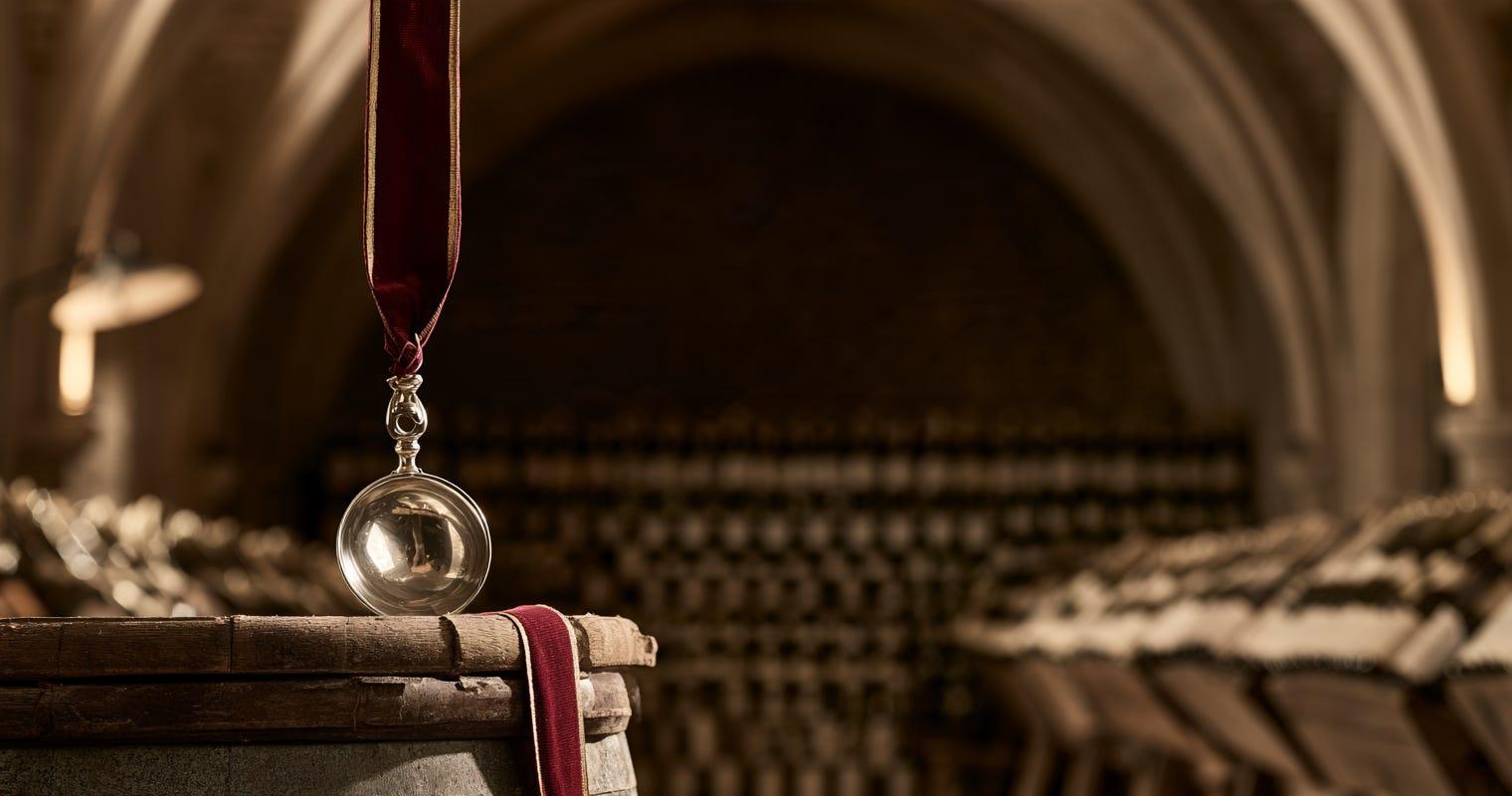
You have seen gold medal stickers on wine bottles. Burgundy has a version of its own: a small round seal with a coat of arms, awarded by the Confrérie des Chevaliers du Tastevin, and you may never have noticed one. The Confrérie is better known for its photographs: men in crimson and gold robes in the beamed cellar of a monastery, shallow silver tasting cups hanging from ribbons at their necks.
Both come from the brotherhood two wine men invented in a Nuits-Saint-Georges cellar in November 1934 to move stock they could not sell. If you do come across the seal on a shelf, it is worth knowing what it certifies, who asks to be judged for it, and which famous names were missing from the latest list.
This Saturday, November 14, the Confrérie holds its Chapitre des Trois Glorieuses at the Château du Clos de Vougeot, a black-tie dinner for about 500 guests in the monks’ old cellar, with new knights inducted between courses. It looks medieval, and the building is. The Confrérie’s own history page gives the reason the ceremony exists: the revival was required for economic reasons, after Burgundy’s sales collapsed in the world crisis. The founders’ plan, in the Confrérie’s paraphrase of that night, comes down to one sentence: if our cellars are full, we have to empty them, and invite our friends to help.
The Confrérie is a sales plan built to look like an old tradition, by people who wrote down the motive. In 1950 the same Confrérie added the seal, a blind tasting with a narrower job, and the two are tied together by money. Under the seal’s own rules, producers who pass it can offer wine for the Confrérie’s dinners, which the Confrérie selects and buys.
Pairing while you read: Joseph Faiveley Bourgogne Pinot Noir, around $35, from the Nuits-Saint-Georges house one of the founders belonged to.
A full cellar in Nuits-Saint-Georges
Burgundy had good wine and too few buyers in the early 1930s. The Confrérie lists 1929, 1933 and 1934 as great vintages, and says in the same paragraph that the wine did not leave the cellars and the money did not come in. The Gazette Drouot’s history of the château gives the cause: after the 1929 crash and American Prohibition, which ran from 1920 to December 1933, burgundy stopped selling.
Georges Faiveley belonged to the family house in Nuits-Saint-Georges, founded in 1825; he had married in 1913 and served at Verdun. Camille Rodier was a grower and merchant who had written Le Vin de Bourgogne, a 1920 survey of the Côte d’Or.
The Faiveley family tells the origin this way. In 1934 Georges was browsing the bouquinistes along the Seine in Paris, found a text on old wine brotherhoods, bought it out of curiosity, and took the idea home to Rodier. The line the family and the World of Fine Wine attribute to him states the plan: “If no-one wants to buy our wines then let’s invite our friends to share them with us!”
The founding act was signed on November 16, 1934, in the Caveau Nuiton, a cellar in Nuits-Saint-Georges. The Confrérie’s account of the meeting names two models: Rabelais, for his gusto and good humour, and Molière, for his smiling common sense. The ritual that came out of it is comic on purpose. New knights are dubbed in the name of Noah, father of the vine, Bacchus, god of wine, and Saint Vincent, patron of winegrowers, and the motto is a pun, Jamais en vain, toujours en vin: never in vain, always in wine.
An old building for a new ceremony
The Confrérie’s home is old: a cellar and vat house the Cistercian monks of Cîteaux built for the walled Clos de Vougeot, which they assembled between 1109 and 1115, with a Renaissance house added in 1551. The Revolution seized the estate in 1790, and the Clos de Vougeot became a legal appellation in 1937.
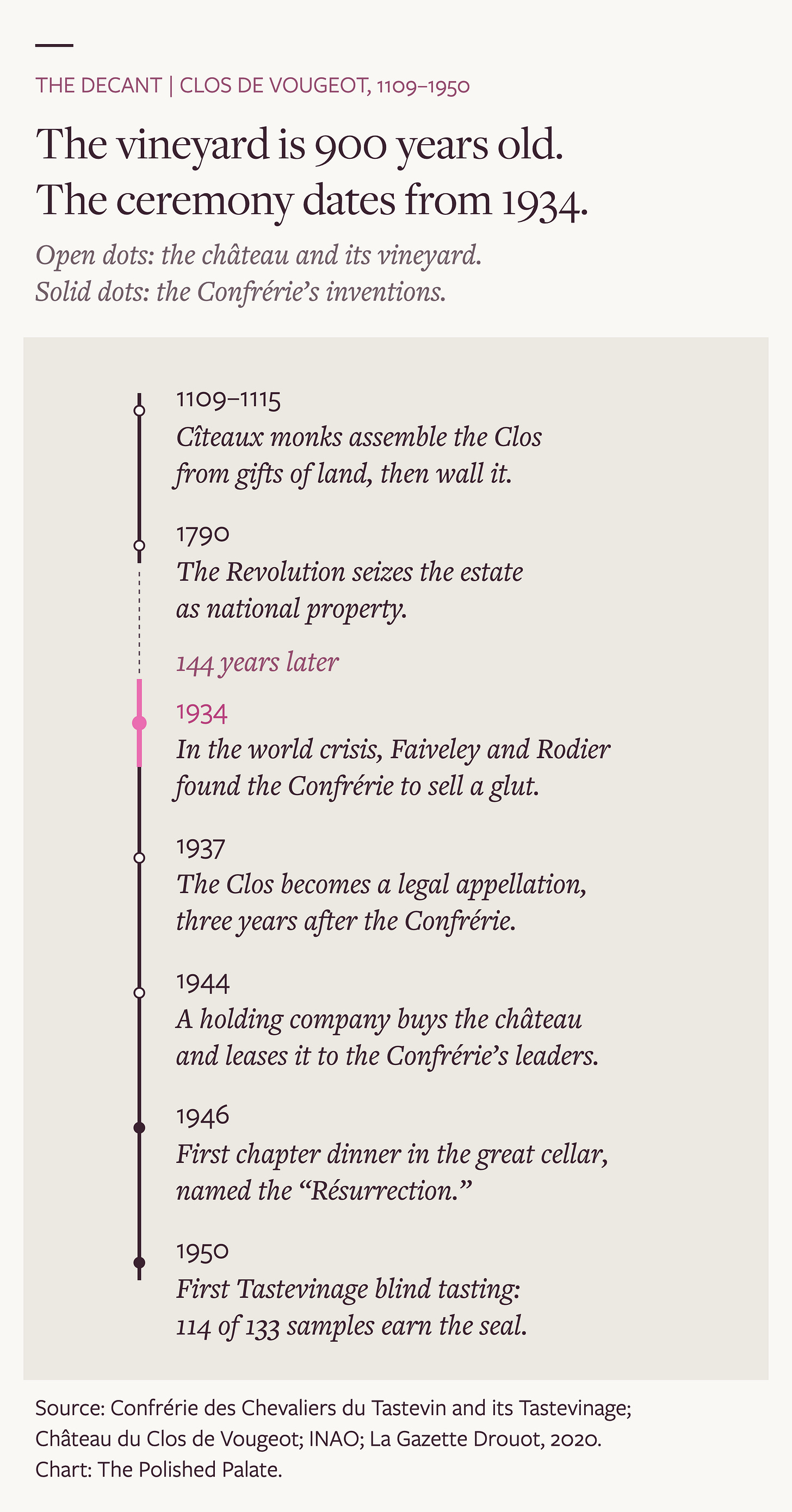
The Confrérie’s leaders secured it after the Liberation, while the war in Europe still had more than five months to run. On November 29, 1944, its owner since 1920, Étienne Camuzet, sold it without a single vine to a holding company that leased it to the Confrérie’s leaders for 99 years. Neither the Confrérie’s history nor the Gazette Drouot’s account gives the price or names who put up the money.
One effect of the terms is easy to miss. The vineyard is divided among about 80 owners, the Confrérie owns none of it, and no wine is sold at the château, so the Confrérie sells nothing of its own against the growers it promotes. The first chapter in the great cellar was held on November 16, 1946, and the Confrérie named it the Chapitre de la Résurrection.
Today it counts about 12,000 knights worldwide and holds 16 chapters a year. Its press kit lists Charles de Gaulle among those who have received its crimson and gold ribbon, and on November 3, 2021, Emmanuel Macron and Angela Merkel were given the insignia of Grand Officer there. Chapters are open to members and their guests, and the Confrérie does not publish what a seat costs. The robes show how a region chose to present itself, and they are no evidence about the wine in any particular bottle.
The seal on the bottle
The Tastevinage is a blind tasting held at the château twice a year, in spring and autumn. Wines that pass carry the Confrérie’s seal, either a full label or a round sticker printed with the tasting date, the lot and a bottle number, with invisible ultraviolet ink against counterfeits.
The jury of growers, merchants, brokers, sommeliers, oenologists and journalists tastes under cloth sleeves that hide everything except the appellation and the vintage. The Confrérie keeps a lab profile of every winning lot and pulls sealed bottles from shop shelves to check that what is for sale matches what was tasted.
The question the jurors are asked is printed on the Tastevinage’s own site: Is this wine worthy of its appellation and vintage? Is it representative, and is its future promising? In a word, is this a wine I would be happy to own in my cellar and proud to offer my friends? That last question repeats the founders’ 1934 plan: wine to share with friends.
The pass rate has fallen. At the first session, on June 28, 1950, 30 tasters passed 114 of 133 samples, about six in seven. At the 118th, on September 11, 2026, 151 tasters passed 122 of 397, about 31 percent. That is just under a ceiling: French rules let any registered wine competition reward at most a third of the wines presented, and the Tastevinage statutes repeat the limit for each year. So a seal awarded today means the lot ranked in roughly the top third of the wines its producers chose to submit that year, judged blind by trade tasters.
Who chooses to be judged
The seal is reliable for what it records, and what it records depends on who enters. Nobody is tasted without asking to be. A producer, cooperative or merchant house submits a bottled lot with its lab analyses and four bottles, and if the lot passes, the producer pays for the seals; the Tastevinage does not publish the price.
The money runs both ways, and the statutes spell it out. Article 9 lets winners set their own price and sell to the members and friends the Confrérie sends them. Article 10 gives winners the right to answer the Confrérie’s calls for samples, from which it selects and then buys the wines served at its chapters at Vougeot and at its branches’ dinners abroad. The seal is a way onto the Confrérie’s own wine list, and a chapter opens more than 1,000 bottles in an evening, by the press kit’s count. The same statutes keep the organisers out of the verdict: members of the Confrérie’s Grand Conseil sit at the tasting with an advisory voice and no vote.
At the September 2026 session the list of winners included Joseph Drouhin, Albert Bichot, La Chablisienne, and Domaine Faiveley, the founder’s own house, with a 2017 Corton Clos des Cortons Faiveley and a 2023 Nuits-Saint-Georges Les Montroziers. Domaine de la Romanée-Conti and Domaine Leroy are not on it. That is an absence from one session’s list, nothing more.
A competition medal works the same way: a panel scored the wine well on one day, among wines whose producers chose, and usually paid, to enter, under the same one-third ceiling. The Tastevinage adds a published question and checks on the shelf, and its finding is specific: Burgundy trade tasters judged this lot typical of its appellation and vintage and good enough to give to friends.
It cannot tell you about the wines that were not in the room. A bottle without the seal has not failed anything; it may never have been entered, and a domaine that sells out every bottle has little reason to enter. Typical is a judgment about fitting the appellation’s norm, and you may love the bottles that do not fit it. The seal says nothing about price either, because the producer sets that freely.
The founders’ 1934 plan, sharing bottles with friends, is one a shopper can use at home: open the bottles with people you trust and decide what you think.
The Finish
The seal is a real filter and a sales channel at once. It turned away 275 of 397 wines in September, judged blind, and it is also how a producer gets onto the Confrérie’s own dinner list and in front of the members it sends to buy. For a shopper, that makes the seal one informed opinion: a lot ranked in the top third of a self-selected pool, from a producer who has joined a system that also buys and promotes its wine. Give it that much weight, and decide the rest by tasting.
When you next reach for a bottle because of a seal or a medal, ask what it measured and who chose to be measured. Then buy one bottle with the seal and one without, from the same appellation at a similar price, and taste them with a friend without looking at the labels.
Sunday’s 166th Hospices de Beaune sale will produce the most quoted Burgundy price of the year. I will take that number apart on Monday on LinkedIn.
Pocket Palate: the Chevaliers du Tastevin
One card to keep:
- Founded: November 16, 1934, in the Caveau Nuiton, Nuits-Saint-Georges, by Georges Faiveley and Camille Rodier, during a sales slump the Confrérie names as the reason.
- The château: Cistercian cellar and vat house, Renaissance house of 1551. Sold on November 29, 1944, without vines, to a holding company that leased it to the Confrérie’s leaders for 99 years. First chapter there November 16, 1946.
- The ritual: crimson and gold robes, knights dubbed in the name of Noah, Bacchus and Saint Vincent. The founders named Rabelais and Molière as their models.
- The seal: Tastevinage, since 1950. Blind, twice a year, at most a third of entries pass (the French legal ceiling for wine competitions). 1950: 114 of 133. September 2026: 122 of 397.
- What the seal measures: one panel’s verdict that this lot is typical of its appellation and vintage. The producer chose to enter and pays for the seals; winners can then sell wine to the Confrérie for its dinners. A bottle without a seal may never have been entered.
Go Deeper
If this week’s idea stuck with you, these take it further.
- The Story (Confrérie des Chevaliers du Tastevin): The Confrérie’s own history, unusually candid about the economic motive, with the founders’ Rabelais and Molière manifesto and the château purchase.
- Raymond Blake, Grace Period: Domaine Faiveley at 200 (The World of Fine Wine, 2026): Two centuries of the Faiveley family, including Georges at Verdun, the 1930s cellars and the founding of the Confrérie.
- Anne Doridou-Heim, Le Clos de Vougeot, un château dans les vignes (La Gazette Drouot, 2020): In French. The building from the Cistercian cellar to the 1944 sale and the 99-year lease, with the first chapter of 1946.
- Les statuts (Tastevinage): In French. The full rules of the seal: who may enter, minimum lot sizes, the one-third cap, the label invoices and the lab checks.
- Camille Rodier, Le Vin de Bourgogne (la Côte-d’Or) (L. Damidot, 1920): The co-founder’s own survey of the Côte d’Or, digitized by the Sonoma County Library, written 14 years before he helped invent the ceremony.