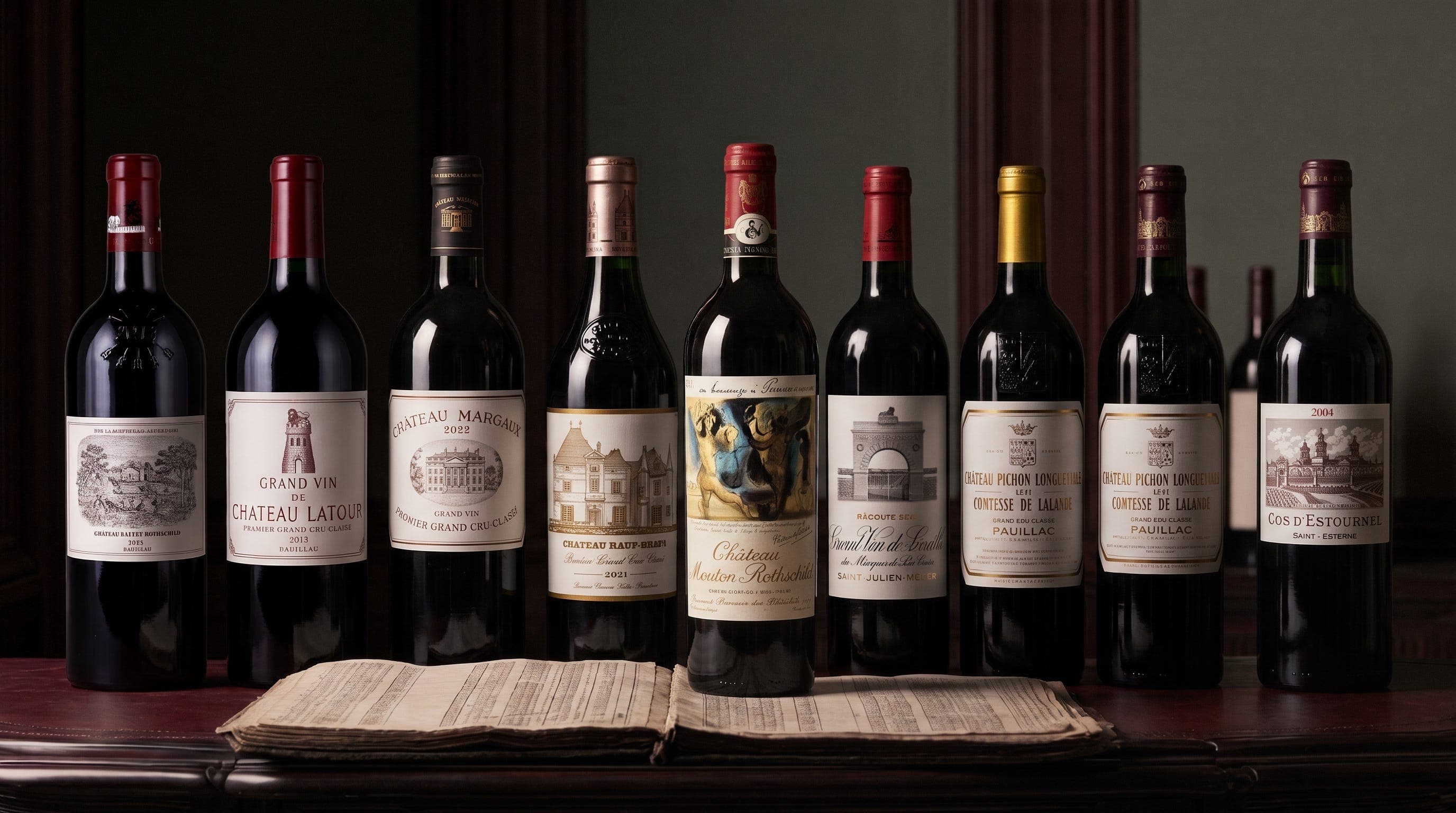
If you have ever paid extra for a Bordeaux because the label carried the words grand cru classé, part of that price was set by a committee that finished its work on April 18, 1855, and never met again. The assignment came from the top. Napoleon III wanted the Exposition Universelle, opening in Paris that May, to show the world the best of France, and Bordeaux’s wines would have their own display.
On April 5, Lodi-Martin Duffour-Dubergier, president of the Bordeaux Chamber of Commerce and a former mayor of the city, asked the region’s union of wine brokers for a ranked list of estates to accompany a map of the region. The brokers delivered 13 days later. Their cover letter, preserved in the Chamber of Commerce archives, shows they understood exactly what they were handing over: “You know as well as we do, Gentlemen, how delicate this classification is and how it arouses susceptibilities.”
The list sorted 58 estates into five tiers, with 4 first growths at the top: Lafite, Latour, Margaux, and Haut-Brion. All but Haut-Brion were Médoc estates; Haut-Brion, in Graves, had sold at Médoc first-growth prices since the 1600s.
The brokers held no tastings, requested no samples, and visited no chateau. They worked from the evidence they trusted most - decades of recorded sale prices in the merchants’ ledgers and their own trading books. An estate that had commanded top money for a generation ranked first. An estate that sold for less ranked lower.
I want to be fair to those brokers, because they did honest work. Price sustained over decades is a serious signal; it compresses thousands of independent judgments by merchants, négociants, and drinkers into one number. In April 1855, that number was still independent. Nobody had bid on a tier, because no tier existed. Every franc in those ledgers had been paid for the wine.
That is the last moment the signal was clean. The Exposition closed on November 15, 1855. The list stayed. Over the 171 years since, the ranking has been formally revised once, and in that time it did something the brokers never intended: it became a guarantee.
A first growth could charge first-growth prices because it was a first growth, and it could spend first-growth money on its vineyards, its cellar, and its selection because it charged first-growth prices. The list ranked the best-funded estates in Bordeaux, then kept them the best-funded, and the quality in the glass tracked the funding.
That is the argument of this issue. The 1855 classification is a self-fulfilling prophecy, a prediction that paid for its own confirmation. Which means the first growths are genuinely great, and the money is a large part of why.
Pairing while you read: Château Gloria, Saint-Julien, around $50. Fifty hectares assembled from parcels of nine classified growths, sold under a name the 1855 list does not include.
What the brokers actually measured
The request landed with the Syndicat des Courtiers, the brokers’ union, whose members lived between the chateaux and the merchant houses and saw every transaction pass between them. The work fell largely to Charles-Henri-Georges Merman, the only wine broker on the union’s six-member board, who consulted his own records, earlier unofficial rankings, and colleagues in the trade. He was compiling, and the material was already there: Thomas Jefferson, touring Bordeaux in 1787, had written down a ranking whose top names match the brokers’ four firsts.
The politics started before the ink dried. Monplaisir Goudal, the manager at Lafite, wanted the estate’s wine shown under its own label, and when the Chamber of Commerce refused he went over its head to Prince Napoléon, president of the Imperial Commission, and won. Eugène Larrieu of Haut-Brion kept his wine out of the joint display and showed it separately. Cantemerle, which had sold its whole crop to Dutch merchants for years and so barely appeared in the Bordeaux ledgers, was missing from the April list; it was added at the bottom months later, in a different hand.
Notice what the brokers were codifying: market standing, a thing every merchant in the city could check against his own books. That is why the letter called the work delicate. Money was the one measure nobody could argue with. The promise of assessed taste got attached later, by everyone else.
The rank guaranteed the money
The loop has three steps. A classified estate releases its wine at a price anchored to its tier, and the négociants and collectors accept that anchor because the tier is the shared language of the market.
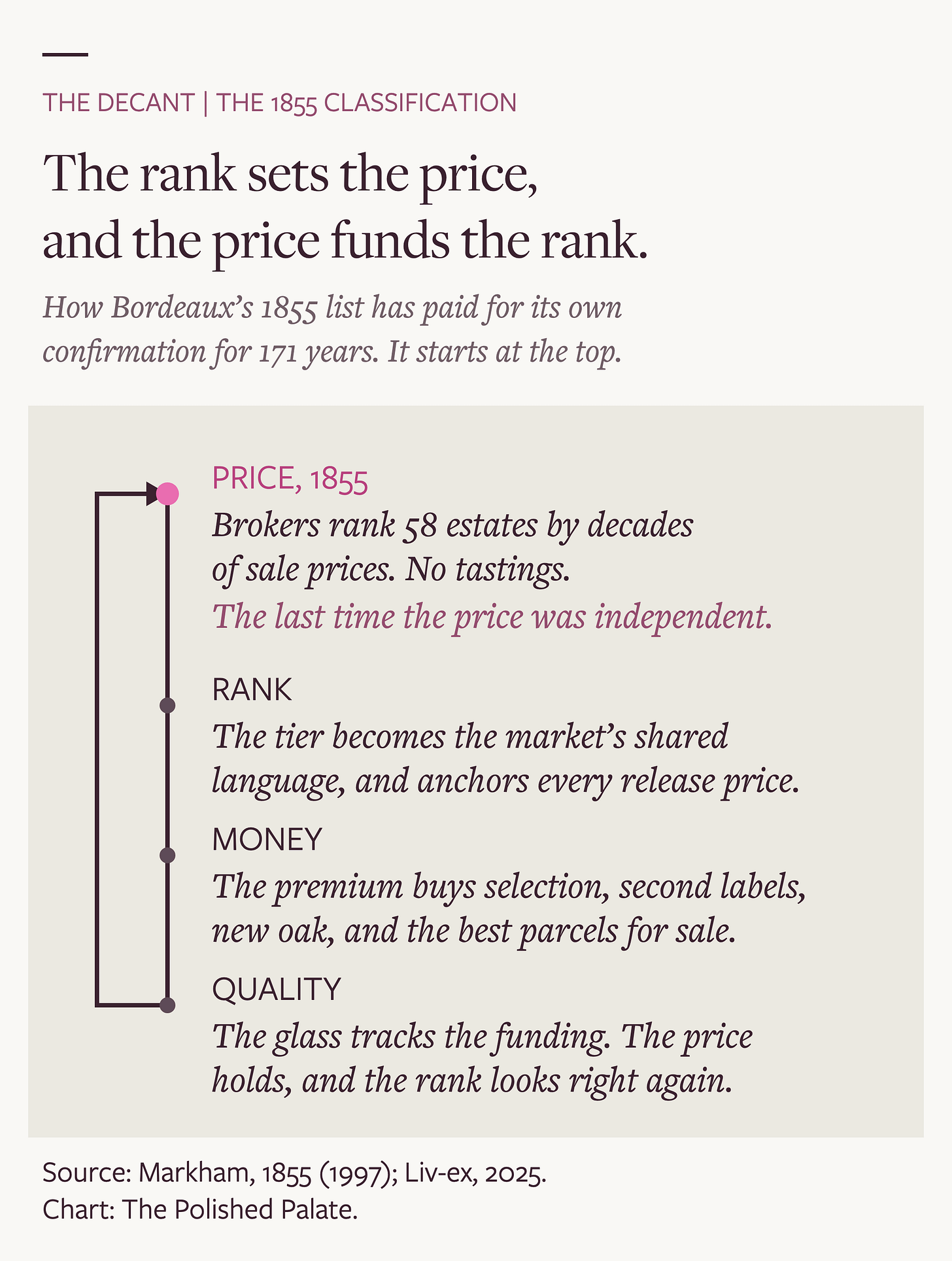
The estate then spends that money on the things that make wine better: a second label that keeps weak lots out of the grand vin (Latour has bottled Les Forts de Latour since 1966), harder selection in the vineyard and at the sorting table, new oak every year, and vineyard land as the best parcels in the commune come up for sale. Then the estate’s price is checked against its neighbors’, and it holds, which confirms the tier that set the price in the first place.
The land part matters more than it looks, because of a rule most drinkers never hear. The 1855 list classified estate names, and under the rules that govern the Médoc, any vineyard parcel inside a commune’s boundary is eligible to be farmed by any chateau there, whatever the quality of the parcel.
The harvest sells under the chateau’s rank. Estates have bought, sold, and swapped land for 171 years while their positions stood still. Château Dubignon, a third growth on the original list, disappeared entirely, its vines absorbed into Château Malescot St. Exupéry. Burgundy’s grand cru system draws its lines around specific hillsides; the 1855 list drew its lines around businesses, and a business with a guaranteed premium can keep buying hillsides.
So the rank follows the name, the money follows the rank, and the land changes hands underneath both. The list gave the names on it a 171-year head start in funding, and nothing in the system has closed the gap.
Mouton bought the line
The one promotion in the list’s history is the cleanest demonstration of how the loop works.
In 1922, Philippe de Rothschild took charge of Château Mouton Rothschild at age 20. The brokers had placed Mouton at the top of the second growths, one line below the firsts, and the family had resented the placement from the start. The grievance was on the label itself: “Premier ne puis, second ne daigne, Mouton suis.” First I cannot be, second I do not deign to be, I am Mouton.
Then he spent five decades running the estate as if it were already a first growth. In 1924 he made chateau bottling compulsory at Mouton, taking the wine’s finishing away from the merchants’ cellars, a move the firsts soon copied. From 1945 he commissioned a different artist for every vintage’s label. He priced Mouton alongside the firsts, the market paid it, and the money went back into the estate. For the last 20 of those years he campaigned formally, in public and in ministries, for the rank to match the price.
In 1973 it worked. Jacques Chirac, then France’s Minister of Agriculture, signed the decree elevating Mouton to first growth, the only promotion in the classification’s history. Philippe rewrote the motto: “Premier je suis, second je fus. Mouton ne change.” First I am, second I was. Mouton does not change. The 1973 label carried a Picasso, in the year of the painter’s death, over one of the weakest vintages of its decade in Bordeaux. The rank had nothing to do with what was in the barrels that year.
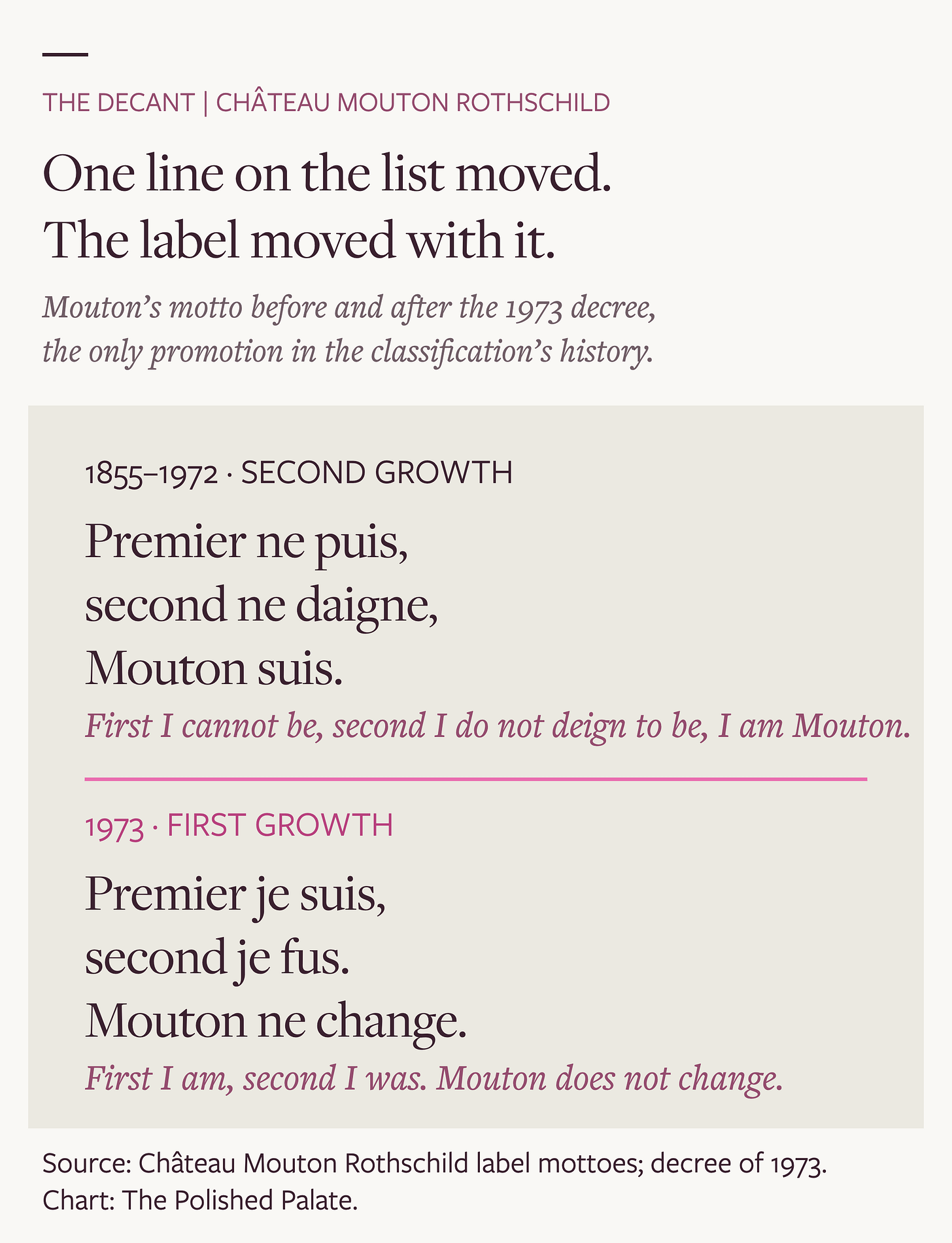
Mouton charged first-growth prices for decades before it held first-growth rank, spent that money like a first growth, and then presented the price record as the case for promotion. Rank followed price, then price followed rank.
The decree ratified an investment. That is the loop, run once in public, with a Rothschild fortune and 51 years of tenure behind it, and it is the only time the classification has been changed to match a price.
Two controls
If money is what the rank buys, two estates in neighboring communes test the claim: one classified estate that spent like a first growth without the rank, and one unclassified estate sitting on classified gravel without the premium.
Château Pontet-Canet is a fifth growth on the 1855 list, and its vines adjoin Mouton’s. When the Tesseron family, Cognac merchants, bought it in the 1970s, they spent on it as if the list had put it four tiers higher: replanting, horses back in the vineyard, and a conversion to biodynamic farming that made it the first classified growth in the Médoc to be certified, 2010. Robert Parker gave the 2009 a perfect 100, and Cult Wines, the fine wine investment platform, notes that Pontet-Canet’s average Parker score across recent vintages beats its first-growth neighbor Mouton. The rank stayed at fifth. The spending changed, and the wine changed with it.
Château Gloria runs the test the other way. Henri Martin, a cooper’s son born in Saint-Julien in 1903, bought his first hectare of vines at the end of the 1930s, and in 1942 added six hectares that had belonged to Château Beychevelle, a fourth growth. Over the following decades he assembled 50 hectares, parcel by parcel, from nine classified growths in Saint-Julien and Pauillac, buying the small outlying parcels their owners found expensive to farm. Same commune, same deep gravel, and in some places the very rows that once sold under a classified label. In 1981 he bought Château Saint-Pierre, a classified fourth growth, outright. Gloria itself carries no 1855 rank, and no mechanism exists to grant it one. Martin liked to raise a glass to “the most classified estate in Saint-Julien,” and the joke was accurate.
Gloria sells for around $50. Its classified neighbors on the same gravel sell for two to four times that. Some of that gap is real: Gloria cannot spend what Ducru-Beaucaillou spends. The rest is the premium that the rank guarantees to the names on the list, and that Gloria cannot charge.
The scoreboard
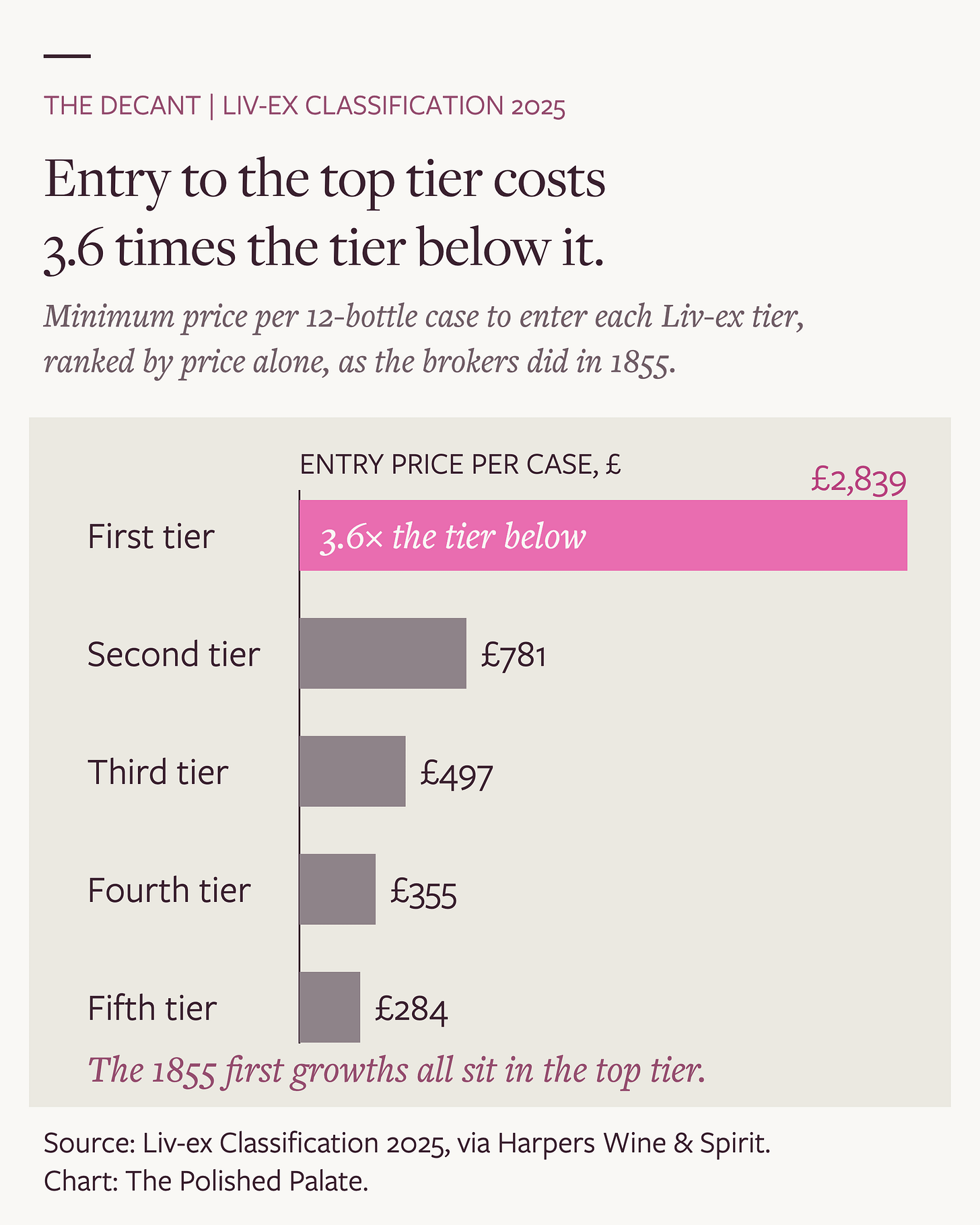
Liv-ex, the fine wine exchange, re-sorts the world’s traded wines into a five-tier table every two years using the brokers’ own method, ranking purely by price. In its 2025 edition, built from 332 wines, the second tier starts at 781 pounds a case and the first at 2,839. The largest jump in the ladder sits at the top: entry to the first tier costs 3.6 times entry to the tier below it.
The 1855 names sit at the summit, and that is the loop closing on itself. Liv-ex sorts the prices the rank produced. A method that would have caught a mismatch in 1855, when the prices were independent, cannot catch one now.
The only measurement that never enters the loop is a blind tasting, because a judge who cannot see the tier is the only person still judging the wine on its own. In 1976, the Judgment of Paris placed Stag’s Leap Wine Cellars ahead of Mouton and Haut-Brion in a blind flight judged by French professionals. In 1999, the Grand Jury Européen, tasting 132 top Bordeaux from the 1996 vintage in Merano, placed Sociando-Mallet, an unclassified Haut-Médoc estate, first. In 2001 the same jury tasted more than 100 red Bordeaux from 1982 in Las Vegas and placed Sociando-Mallet second, ahead of every first growth; the wine above it, Pichon Lalande, is a second growth.
Those results say something narrower and more useful than “the list is wrong.” The first growths finished near the top, behind estates that spend a fraction of what they spend. The funded advantage is real, it shows up in the glass as depth and polish, and I have no quarrel with anyone who loves it.
It is also much smaller than the price gap that pays for it. When you pay the first-growth premium, you are buying two things at once: a quality investment the premium has funded since 1855, and a rank that guarantees the premium whether or not the investment shows up in this particular vintage.
The Finish
The 1855 classification is a useful document once you know what it measures. It records which estates the market trusted in 1855, and it explains why those estates are still the best-resourced in Bordeaux. What it cannot tell you is how much of that resourcing reached the bottle in front of you, and the only thing that can report on that is your own palate.
If you are the kind of drinker who wants to know what a premium buys before you pay it, this list is the best place to practice, because nothing in wine has a more visible price and a less visible check.
So run the experiment. Next time you budget for a classified Bordeaux, make it two bottles: one classified growth and one unclassified neighbor from the same commune, Gloria or Sociando-Mallet both qualify. Cover the labels, pour them side by side, and decide which glass you refill. If the classified bottle wins, you have tasted what the money buys, and you can decide whether the gap is worth the premium. If the unclassified bottle wins, you have found where the premium stops paying for wine and starts paying for the rank.
Worth asking yourself: what else do you pay a premium for because it was ranked first once, and the premium has kept it well funded ever since?
Pocket Palate: the 1855 classification
One card to keep:
- What it is: 58 chateaux (61 today) sorted into five tiers by Bordeaux’s wine brokers in April 1855, for display at the Paris Exposition Universelle.
- How it ranked: decades of recorded sale prices from brokers’ and merchants’ ledgers. No tastings, no samples, no chateau visits.
- Changes since: Cantemerle added at the bottom of the list months after delivery; Mouton Rothschild promoted to first growth in 1973, the only promotion. No other estate has moved a tier.
- What the rank buys: a guaranteed price anchor, which funds selection, second labels, new oak, and vineyard purchases. The rank attaches to the chateau name, so an estate can buy land inside its commune without touching its rank.
- What blind tastings show: the funded advantage is real and much smaller than the price gap. Unclassified Sociando-Mallet finished ahead of every first growth in the 2001 Grand Jury Européen tasting of 1982s.
Go Deeper
If this week’s idea stuck with you, these take it further.
- Jane Anson, Brokers, Chateaux and Egos: The Story Behind the 1855 Classification (janeanson.com): The making of the list in documented detail: the April 5 request, Merman’s 13 days of compiling, and the lobbying that started before the Exposition opened.
- France Reigns in Liv-ex Classification 2025 (Harpers Wine & Spirit, 2025): What happens when the 1855 method, ranking strictly by price, is re-run on live market data every two years, with the tier thresholds cited in this issue.
- Sociando-Mallet: One of Bordeaux’s Sleeping Giants? (The Buyer): A close look at the unclassified estate that serves as the control group for everything the premium is supposed to buy.
- Dewey Markham Jr., 1855: A History of the Bordeaux Classification (Wiley, 1997): The definitive scholarly account, a James Beard award winner built from the Chamber of Commerce archives, with the primary documents reproduced in the appendices.