1 Big Idea: The Label Writes Your Tasting Note
You pour a glass and your eyes go to the label before the wine reaches your nose. Napa Cabernet. Ripe, dark, generous, probably a little sweet at the edges. You have the descriptors before you’ve even taken a sip, and the sip, when it comes, mostly confirms what you already wrote.
That is how perception works, and trained tasters get no exemption from it. Gil Morrot, Frédéric Brochet, and Denis Dubourdieu handed 54 tasters a white wine dyed red with an odorless dye, and the panel described its aromas using red-wine vocabulary. Seven years later, Hilke Plassmann and her co-authors put people in an fMRI scanner, poured them the same wine twice at two different stated prices, and found that the higher price raised both their reported enjoyment and activity in the part of the brain that encodes pleasantness. Nobody in either study was faking. The information arrived first, and perception followed it.
The wine trade understands this better than the average drinker does, and it has built the retail floor around it. Shelf talkers, scores in large type, back labels that describe the wine’s flavors to you in advance, servers who narrate what you are about to taste while they are still pouring. Every one of those puts the answer in your head before the glass gets there, and almost none of it exists to help you notice anything.
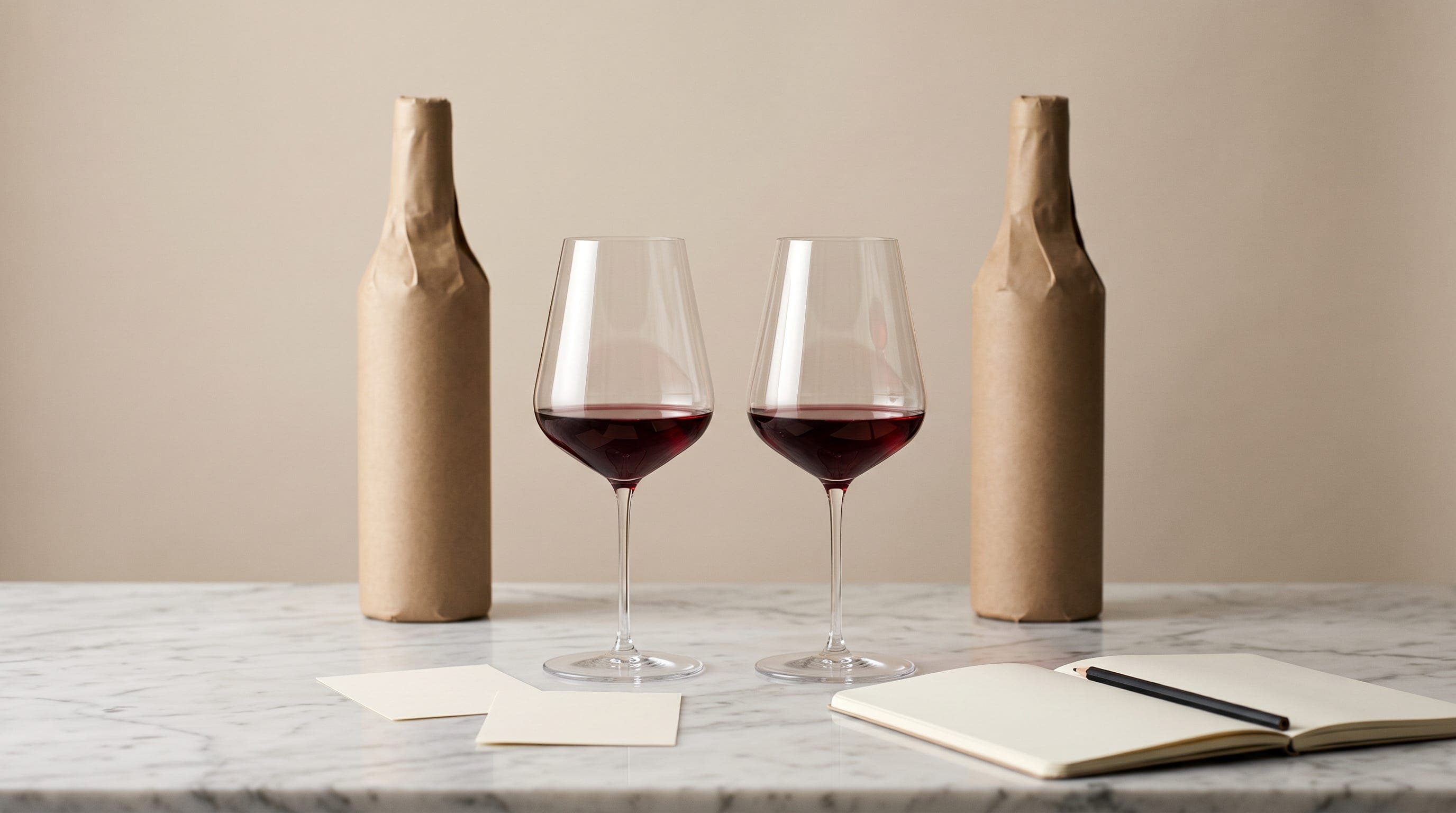
There is one reliable way out and it costs nothing. Cover the label. With no information in front of you but the glass, your own perception becomes the only source in the room. I taste blind often enough to say that the humbling part never wears off: with the bottle covered, wines I could describe confidently from memory turn back into open questions.
Here is what most blind tasting advice skips: blindness comes in layers, and you choose how many. Hide the price and keep everything else, and you learn what your preference says without a number leaning on it. Hide the place and you learn what geography actually tastes like. Hide everything and you find out how much of your tasting vocabulary survives contact with an unmarked glass. Full blindness is the top rung of a ladder, and the three tastings below climb it one rung at a time.
3 Taste Experiments
Three tastings, one ladder. Each hides more than the last, and the mechanic works alone every time. Pour in another room, slide each bottle into a paper bag or wrap it in foil, put a numbered slip face down under each glass, then shuffle the glasses with your eyes closed until you have genuinely lost track. Taste, write down what you think, and only then turn the slips over. Water and a plain cracker between glasses to reset.
#1: Two Pinot Noirs, Price Hidden
Objective: Start on the bottom rung. You know both wines are Pinot Noir. What you hide is which glass is which and what each one costs, so your preference has to speak before the price tag does.
What to try: A budget Pinot Noir such as Cono Sur Bicicleta (Chile), Underwood (Oregon), or Mark West (California), roughly $10 to $14. Then a step-up Pinot Noir such as La Crema Sonoma Coast, Erath (Oregon), or Elouan (Oregon), roughly $19 to $25.
What to notice: Which glass do you go back to? Write one sentence per glass about what pulls you in or puts you off: the fruit, the weight, the length of the finish. Rank the two, guess which one is the expensive bottle, then reveal.
Lesson: With the price hidden, your preference is the only data in the room, and the reveal tells you what the extra money buys. Sometimes it buys length, restraint, and texture you genuinely prefer, and now you know the step-up is worth it to you. Sometimes the cheap glass wins, and the reveal just handed you back ten dollars a bottle. Either result is information you could not have gotten with the tags showing.
#2: One Grape, Two Places, Labels Covered
Objective: Climb one rung. You know both wines are Sauvignon Blanc and you know the two regions in play. The bags keep you from knowing which glass is which, so the difference between the two places has to come from your own nose.
What to try: A Loire Sauvignon Blanc such as Henri Bourgeois “Petit Bourgeois,” Domaine de la Renaudie Touraine, or Pascal Jolivet Attitude, roughly $14 to $25. Then a Marlborough Sauvignon Blanc such as Whitehaven, Villa Maria Private Bin, or Kim Crawford, roughly $13 to $20.
What to notice: The grape is the constant, so every difference you find belongs to place and winemaking. One glass leans citrus, flint, and a quiet chalky finish. The other is loud: passionfruit, cut grass, a jalapeño edge. Call which is the Loire and which is Marlborough before you unbag, and note which one you would rebuy.
Lesson: This is the rung where blind tasting starts teaching geography. A book can tell you what a region is supposed to taste like. Here you caught the difference with your own nose and can describe it in your own words. Knowing the grape kept the puzzle solvable, which is the point of a partial blind: enough information to form a hypothesis, little enough that the glass settles it.
#3: Your Own Rack, Fully Blind
Objective: Take the top rung and measure how much of what you know about your favorite wines is coming from the glass. Fully blind, using three bottles you are sure you could describe from memory.
What to try: Three reds you already own and know well, from different grapes or regions so the differences are fair game. Buying fresh, pick three you have had at least twice: a Côtes du Rhône such as Guigal, Famille Perrin Réserve, or Domaine de la Janasse, roughly $12 to $22; a Rioja Crianza such as CVNE, Marqués de Cáceres, or Beronia, roughly $12 to $16; a Chianti Classico such as Rocca delle Macìe, Castello di Volpaia, or Antinori Pèppoli, roughly $15 to $30.
What to notice: Bag and shuffle all three, then write a full note on each before any reveal: does your mouth water, how heavy is it, how hard do the tannins grip, what fruit do you find. Finish each note with a call on which wine it is. Then turn the slips and score one point per correct call.
Lesson: Three out of three means your notes were coming from the glass all along. One out of three means the labels were doing more of the writing than you thought, which is among the most useful things a taster can learn, and it costs one evening. Nobody is grading this. Run the same three bottles again in a month and the score climbs, because now you know which cues you were skipping.
Pocket Palate: the blindness ladder
What each covered detail teaches, and the setup that works alone.
- The setup: Pour in another room, bag or foil the bottles, numbered slips face down under the glasses, shuffle with your eyes closed.
- Hide the price: Your preference becomes the only data. The reveal tells you what the extra money buys, or hands it back.
- Hide the place: With the grape held constant, every difference between the glasses belongs to geography and winemaking, and you caught it yourself.
- Hide everything: Your notes get tested against wines you thought you knew. The score tells you how much weight your first impression deserves.
- The order rule: Taste, write, then look. A label read after tasting is evidence you weigh. A label read before is an instruction you follow.
The Finish
Each rung works the same way. You removed one piece of information, and what came back was your own perception with nothing sitting on top of it. None of this requires you to abandon labels. Knowing a bottle is from the Médoc genuinely tells you something. The order is what matters. Taste, form a view, then look, and the label becomes evidence you weigh against your own reading. Look first and it becomes an instruction you follow.
So ask yourself which line on the label does the most writing in your notes: the price, the region, or the producer name. That is the detail to cover first. Then do one thing this week. Buy two Pinot Noirs at two prices, hide the tags, and write one sentence about each before you peek. Whatever the reveal says, you now own a measurement of your own palate that nobody handed to you, and the next rung is there whenever you want it.
Go Deeper
If this week’s idea stuck with you, these take it further.
- Stephen Bradley, 6 Somms Share Their Top Tips for Blind Tasting Wine (VinePair, 2026): Six working sommeliers describe how they actually approach an unmarked glass, including using color as a first filter and salivation as an acid gauge.
- Deductive Tasting Grid (Court of Master Sommeliers Europe): The structured worksheet professionals use to move from structure and flavor to a conclusion about grape, place, and age, free to download and useful on the top rung at home.
- Gil Morrot, Frédéric Brochet, Denis Dubourdieu, The Color of Odors (Brain and Language, 2001): The study behind the white wine dyed red, showing that 54 tasters described its aromas in red-wine terms once the color had told them what to expect.
- Hilke Plassmann, John O’Doherty, Baba Shiv, Antonio Rangel, Marketing actions can modulate neural representations of experienced pleasantness (PNAS, 2008): The price experiment, showing that a higher stated price raised both reported enjoyment and measured brain activity for an identical wine.