If you have ordered Grüner Veltliner in the last ten years, you have tasted the aftermath of a crime.
Not a metaphor. A real one, prosecuted in courtrooms in Eisenstadt and Krems, that emptied the shelves of an entire country’s wine and nearly ended its export trade for good.
The dry, peppery, high-acid white you know now, the one every sommelier in America started pouring by the glass sometime in the 2000s, exists in its current form because Austria hit bottom in 1985 and decided the only way out was to become the opposite of what it had been.
Here is the part that gets lost when the story is told for shock value. The scandal is usually shorthanded as “the time the Austrians put antifreeze in their wine.” That is close enough to sell a headline and wrong enough to matter.
What went into the wine was diethylene glycol, an industrial chemical that is a minor ingredient in some brands of antifreeze. It is not ethylene glycol, which is what most people mean by antifreeze, and which is considerably more toxic. Getting that distinction right is not pedantry. It is the difference between a poisoning and a fraud, and this was a fraud.
The chemist from Grafenwörth
Austrian investigators traced the practice back to Otto Nadrasky, a 58-year-old chemist and wine consultant from Grafenwörth in Lower Austria, who advised growers in the Wagram. Diethylene glycol (DEG) is faintly sweet and viscous. Add a few grams per liter to a thin, underripe white, and it takes on the body and honeyed weight of an expensive late-harvest wine.
It fooled the palate. For roughly a decade before anyone caught it, it fooled the buyers.
The demand was real and it came from Germany. Austrian exporters were shipping wine north by tank truck under standing contracts with German bottlers and supermarket chains, and what those contracts specified was sweet: Spätlese, Auslese, Beerenauslese, the rich dessert styles German consumers were buying by the case.
Then came vintages that would not deliver. The 1982 harvest in particular came in short on ripeness. A grower under contract had two options, and one of them cost about a schilling a liter.
Most of the doctored wine carried only a few grams of DEG per liter, far below a dangerous dose. You would have had to drink dozens of bottles at a sitting to reach the roughly 40 grams that would kill you.
One outlier proved the recklessness of the whole enterprise: a 1981 Welschriesling Beerenauslese from Burgenland tested at 48 grams per liter, enough that a single bottle could have been lethal. Nobody is known to have died. That was luck, not care.
The tractor
The fraud did not come apart because someone tasted the difference. It came apart because of paperwork.
The first documented crack was a sample. On December 21, 1984, an anonymous source walked wine into the Landwirtschaftlich-chemische Bundesversuchsanstalt in Vienna, the federal agricultural chemistry testing institute, and the lab found what should not have been there. By March 1985 the detection methods had improved enough for investigators to see the scale of it. On April 23, 1985, Günter Haiden, the Austrian agriculture minister, told the public.
Running alongside that lab work was the detail that has outlived every other part of the story. A winegrower had been buying antifreeze in industrial quantities and claiming it against his taxes as a farm expense. The volume did not match the farm. He owned one small tractor. A tax officer noticed the arithmetic and asked the question the grower least wanted asked.
That is the whole tragicomedy of the thing in one image. The wine passed the taste test. It failed the audit. A fraud built to satisfy the most demanding sweet-wine buyers in Europe was undone by a bureaucrat reading a return.
Then it went international. On June 27, 1985, a 1983 Ruster Auslese pulled from a supermarket in Stuttgart was analyzed and found to contain DEG, the first contaminated bottle caught on German soil. On July 9, the Federal Ministry of Health in Bonn, then under Heiner Geißler, issued a formal warning against drinking Austrian wine and published a list naming every contaminated wine found and the bottler responsible for each.
That list, not the chemistry, is what did the commercial killing. The German wholesaler and bottler Pieroth fought the blacklist through all three tiers of the German administrative courts and lost in 1990. Six of its senior employees were eventually fined a million Deutschmarks each by the Koblenz court in 1996.
The first Austrian arrest came on July 20. Japan banned the import and sale of all Austrian wine on July 29. The word “antifreeze,” accurate or not, became the shorthand for an entire country’s wine, and buyers did not forget it for years.
What it cost
The numbers are the part that still stops me.
By late August 1985 Austrian authorities had seized 227,500 hectoliters of wine. In total, 27 million liters were destroyed, roughly 36 million bottles, the equivalent of seven months of the country’s entire export trade poured away.
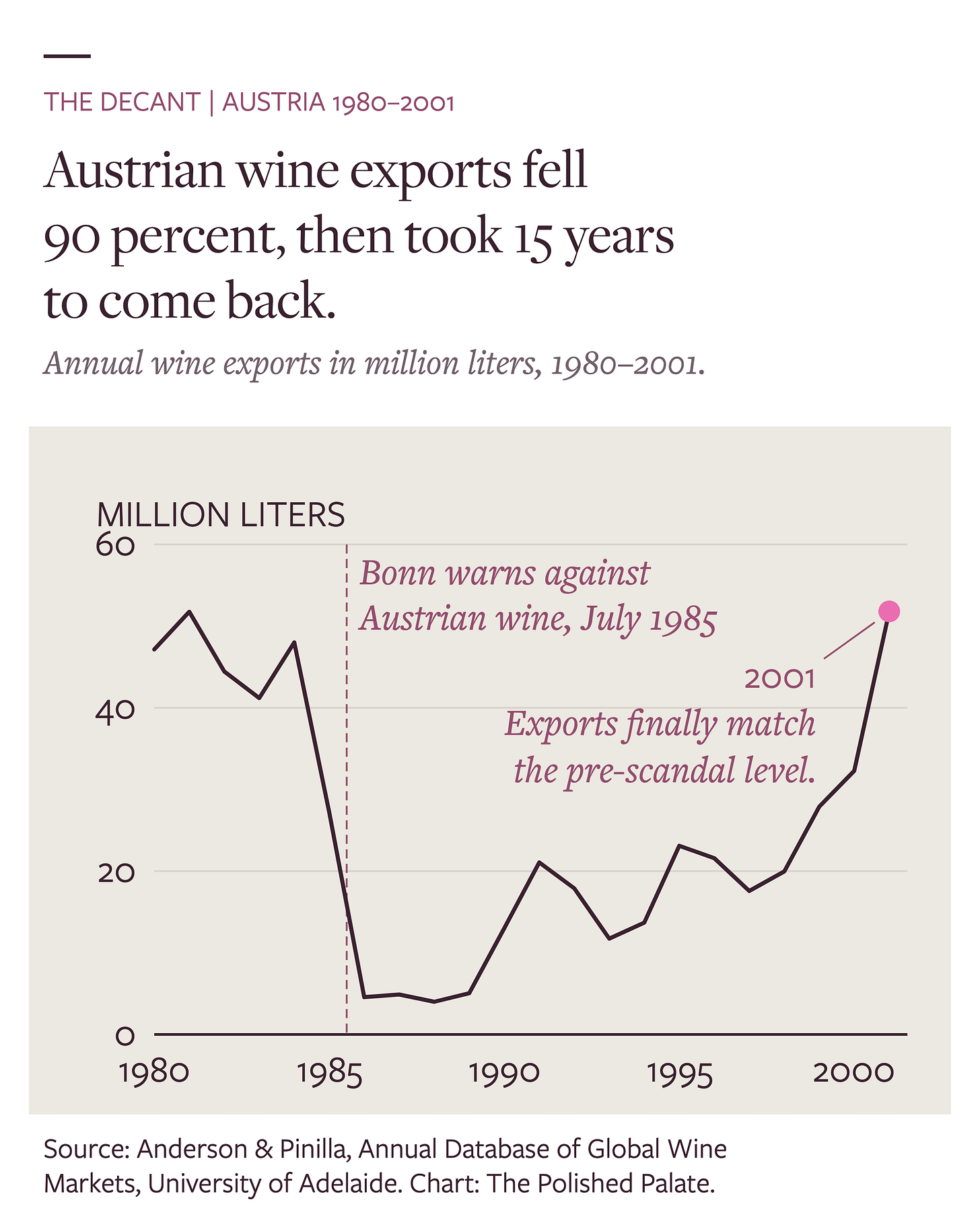
Exports went off a cliff. Austria shipped 478,500 hectoliters in 1984. In 1986 it shipped 42,118. That is not a dip. That is nine out of every ten bottles that used to leave the country simply not leaving, an entire trade built over decades gone in a single season. And it stayed gone. Austrian export volume did not match the pre-scandal level again until 2001. Fifteen years. A winemaker who was thirty when the health warning hit was in his mid-forties before the market came back to where it had been the summer before everything broke.
The legal reckoning was just as concentrated. By October 1985 the public prosecutor in Eisenstadt alone had proceedings open against 59 businesses, out of 325 filed reports and 52 criminal complaints, with 21 people charged with serious commercial fraud. The heaviest sentence handed down in Burgenland was five years. The first prison term, eighteen months, came in mid-October 1985.
One of those convictions ended a life. Karl Grill, proprietor of Firma Gebrüder Grill in the Wagram, took his own life after he was sentenced.
The rest of the cost fell on people who had done nothing. Wine was a real part of the rural economy in Lower Austria, Burgenland, and the Wachau, and the German contracts had been the steady base of it. When those buyers walked, the domestic reputation went with them. For a stretch, “Austrian wine” was a punchline across the German-speaking world, and honest growers who had never touched a drop of glycol paid the same price at the shelf as the ones who had.
Four thousand growers at the Ballhausplatz
The response was fast and it was not popular.
On August 29, 1985, the Austrian parliament held a special session and passed a new wine law. Outside, about 4,000 winegrowers filled the Ballhausplatz to protest it. They were not defending the fraud. They were objecting to being policed for it: to the paperwork, the inspections, the cost, the presumption.
Alois Puntigam of the ÖVP called the bill a “Husch-Pfusch-Verfahren,” a rushed and botched process, and in a narrow sense he had a point. The law had been drafted under enormous pressure and would be amended repeatedly over the next decade. It was formally enacted on October 24, 1985.
What it required was severe by any standard then in force. Every producer had to keep a cellar book. Harvests were subject to inspection at the point of picking. Maximum yields per hectare were set. And every bottle of quality wine had to carry a numbered official seal, the banderole, which the state issued only after the wine cleared two gates: a laboratory analysis for permitted methods and legal limits, and then a blind official tasting, which turned out to be the harder of the two. The state, in effect, put its own name on the neck of the bottle and staked its credibility on what was inside.
The rebuild
The generation that came up after 1985 took the law’s logic and ran past it.
They understood that a small country could never win a race to the bottom, particularly not one it had just been caught cheating in, so they aimed at the top. That meant single vineyards, lower yields, dry wines, and an attention to site that borrowed more from Burgundy than from the bulk trade.
It meant leaning into indigenous grapes the rest of the world barely knew: Grüner Veltliner above all, alongside Riesling on the terraces of the Wachau and Blaufränkisch in Burgenland. The Austrian Wine Marketing Board was founded in 1986 to carry that message abroad, into markets that had just banned the product.
Sweetness had been the vehicle of the fraud, so the reinvention pointed the other way, toward dry, precise, high-acid wine that tasted unmistakably of a place. The system caught up with the growers in 2001, when Austria wrote origin-based appellations into law as DAC, and the first one, Weinviertel DAC in 2003, was defined around exactly one thing: dry Grüner Veltliner.
Within two decades, dry Grüner from good producers was a benchmark, on serious wine lists across the world, priced like the fine wine it had become.
What the con and the recovery share
The most useful part of this story is that the crime and the cure ran on the same principle, just inverted.
The fraud worked because taste can be manipulated. A few grams of diethylene glycol convinced professional buyers in the largest wine market in Europe that they were drinking something richer and riper than the vintage had actually produced, and they went on believing it for years. That is a genuinely unsettling fact about tasting. Add the right compound and a thin wine reads as a great one, at least long enough to sign the contract. Tasting alone could not catch it, and for years it did not.
The recovery worked because origin cannot be manipulated the same way. You can fake sweetness. You cannot fake a specific hillside, a specific soil, a specific cool-climate acidity that only comes from where the vines actually grew, not once the whole system is built to verify it. Austria’s answer to a scandal about faked taste was to anchor its wine to the one thing that stayed true whether the palate could detect it or not.
That is why the wine in your glass tastes the way it does. The pepper and the citrus and the wet-stone edge of a good Grüner exist because a country caught cheating on flavor rebuilt its wine around verifiable origin instead.
Pocket Palate: what the Austrian scandal actually was
Five things worth keeping from 1985.
- The chemical: Diethylene glycol, not the ethylene glycol most people mean by antifreeze. A fraud, not a poisoning.
- The trick: A few grams per liter gave a thin, underripe white the body and honeyed weight of an expensive late-harvest wine.
- The catch: Not a palate. A tax officer noticed a grower deducting industrial antifreeze against one small tractor.
- The cost: Exports fell from 478,500 hectoliters in 1984 to 42,118 in 1986, and did not match the old level again until 2001.
- The lesson: Taste can be faked with an additive. Origin can be verified by inspection. Austria rebuilt on origin the state could check.
The Finish
The comfortable lesson here is “cheaters get caught,” and it is true, but it is not the interesting one. The interesting one is that a fraud fooled the experts for a decade, and the country’s recovery depended on admitting that experts can be fooled.
Austria did not rebuild by trusting palates harder. It rebuilt by refusing to rely on the palate alone, and putting a verifiable origin behind every bottle so that trust had something underneath it. That is worth sitting with the next time you defer to a score, a famous name, or your own confident first impression. The palate is powerful and it is also fallible, and the two facts live together.
So this week, if you can find one, drink a dry Grüner Veltliner or a Wachau Riesling and taste it as what it is: the product of the worst thing that ever happened to a wine country, and the best decision it ever made in response. Notice the acidity, the pepper, the sense of a real place in the glass. That clarity is not an accident. It was chosen, on purpose, by people who had learned the hard way what faking it costs.
A pairing for reading this one: a dry Grüner Veltliner or a Wachau Riesling, cold, the drier and more mineral the better.
Go Deeper
If this week’s story stuck with you, these take it further.
- 1985 Austrian diethylene glycol wine scandal (Wikipedia): The clearest timeline of the discovery, the chemistry, and the export collapse, with the ethylene-glycol distinction spelled out.
- ORF, “Verfahren gegen Dutzende Winzer”: The Austrian broadcaster’s case-by-case accounting of the prosecutions, the seizures, and the hectoliter figures behind the export collapse.
- Austrian Parliament library, “Pantscher, Fälscher und Kunstweinerzeuger”: Glykolwein-Skandal 1985: The primary-source account of the August 29 special session, the growers’ protest, and what the 1985 wine law actually required.
- Christian Seiler, “The Scandal That Changed Everything”: An Austrian writer’s account of how the country chose to rebuild from scratch instead of restoring the old trade.
- “Austrian wine: developments after the wine scandal of 1985” (ResearchGate): An academic look at the export data and the structural reforms, for the numbers underneath the story.
For a companion study in how a name and a reputation come apart, see How the Mondavi family built and lost a wine dynasty, where the fracture is internal rather than chemical.