You have paid more for a bottle because of what someone told you about it: “Old Vines” or “Reserve” on the label, words with no legal definition in the US; a shop clerk’s “only 200 cases made”; a server’s story about the family that farms it. Once the cork was out, you could judge the wine. The story you could not taste, and you paid for it on someone’s word.
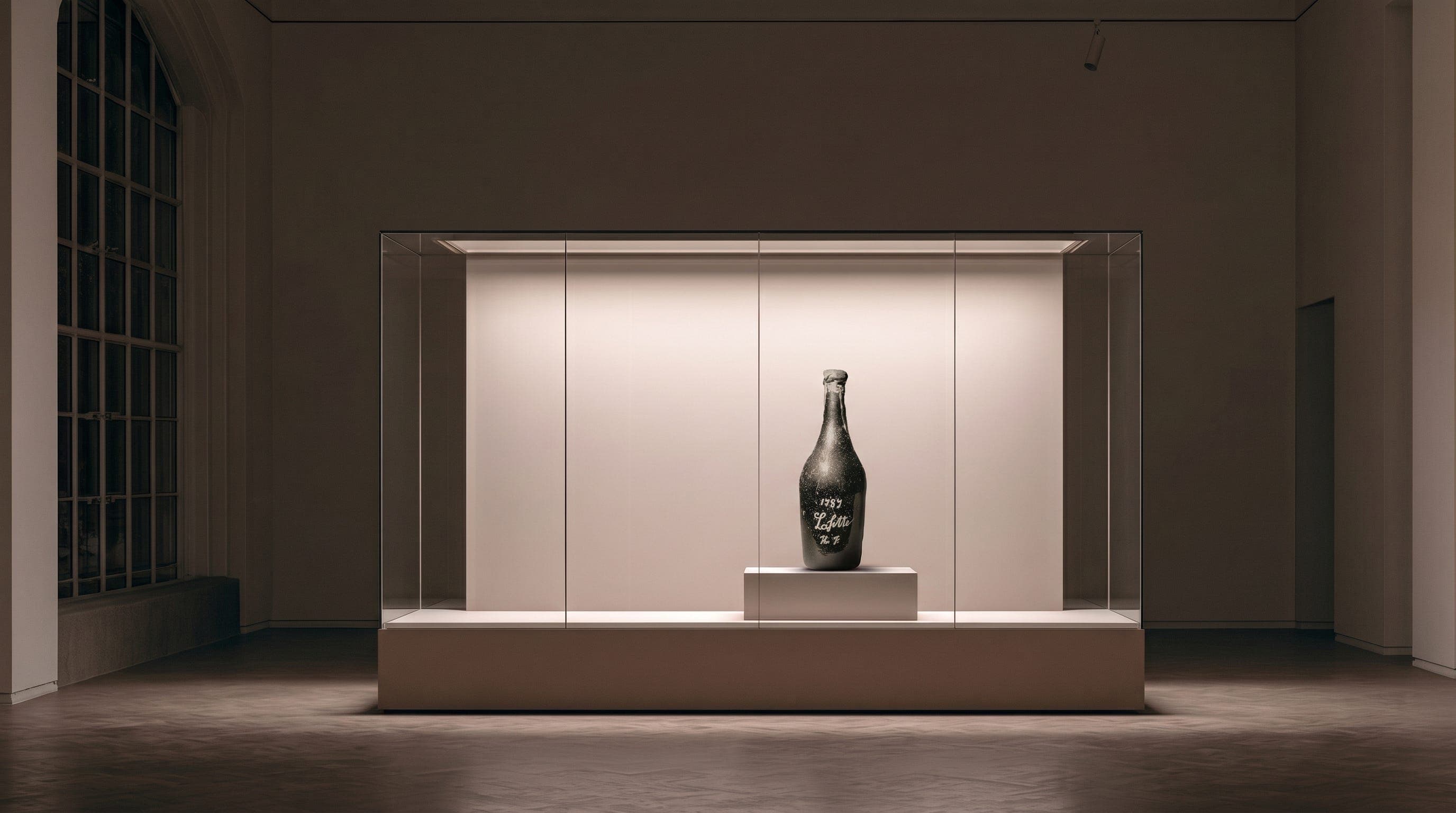
On December 5, 1985, the Forbes family paid that kind of premium at a scale that set the auction record for a single bottle. The bottle, sold at Christie’s in London, was engraved “1787 Lafitte Th.J.”, and the story attached to it was that the initials belonged to Thomas Jefferson, who had lived in Paris as America’s minister to France and stocked his cellar with Bordeaux. It went for £105,000, about $157,000. The auctioneer was Michael Broadbent, head of Christie’s wine department, whose 90,000-plus tasting notes made him the most trusted palate in the trade.
The Forbes bottle went on display in the family’s galleries in New York, standing upright under the lights. The heat dried the cork until it shrank and dropped into the wine. Nobody ever tasted it. Everything the Forbes family paid for was the story.
That story drew questions almost at once, and the people asking them never tasted the wine: a researcher with Jefferson’s papers, a lab in Munich, and eventually a glass engraver with a magnifying lens. What the trade did with their answers is the part of this case that applies every time you pay for a bottle’s history.
I work restaurant floors, which puts me among the people who pass a bottle’s history along to whoever pays for it. That is why this case matters to me.
The cellar nobody could visit
The bottles came from Hardy Rodenstock, born Meinhard Görke in 1941, a former manager of German pop acts who from around 1980 hosted multi-day tastings of 19th-century and pre-phylloxera bottles that nobody else could produce. When he served older wines, he banned spitting. “You don’t spit away history,” he told them. “You drink it.”
His account was that in 1985 he received a phone call about old bottles found in a walled-up cellar in Paris, engraved with late 18th-century vintages and the initials “Th.J.” He never said who called, never gave the address, and never said how many bottles there were.
The wines carried the names of four great Bordeaux estates, Lafite, Yquem, Margaux, and Branne-Mouton (now Mouton Rothschild). Every element of the provenance rested on his word alone.
The letter before the hammer
Jefferson was a compulsive record keeper. Monticello holds more than 60,000 of his documents, and his wine orders sit among them with prices and shippers. In the fall of 1985 Broadbent wrote to Monticello asking about references to wine in Jefferson’s letters.
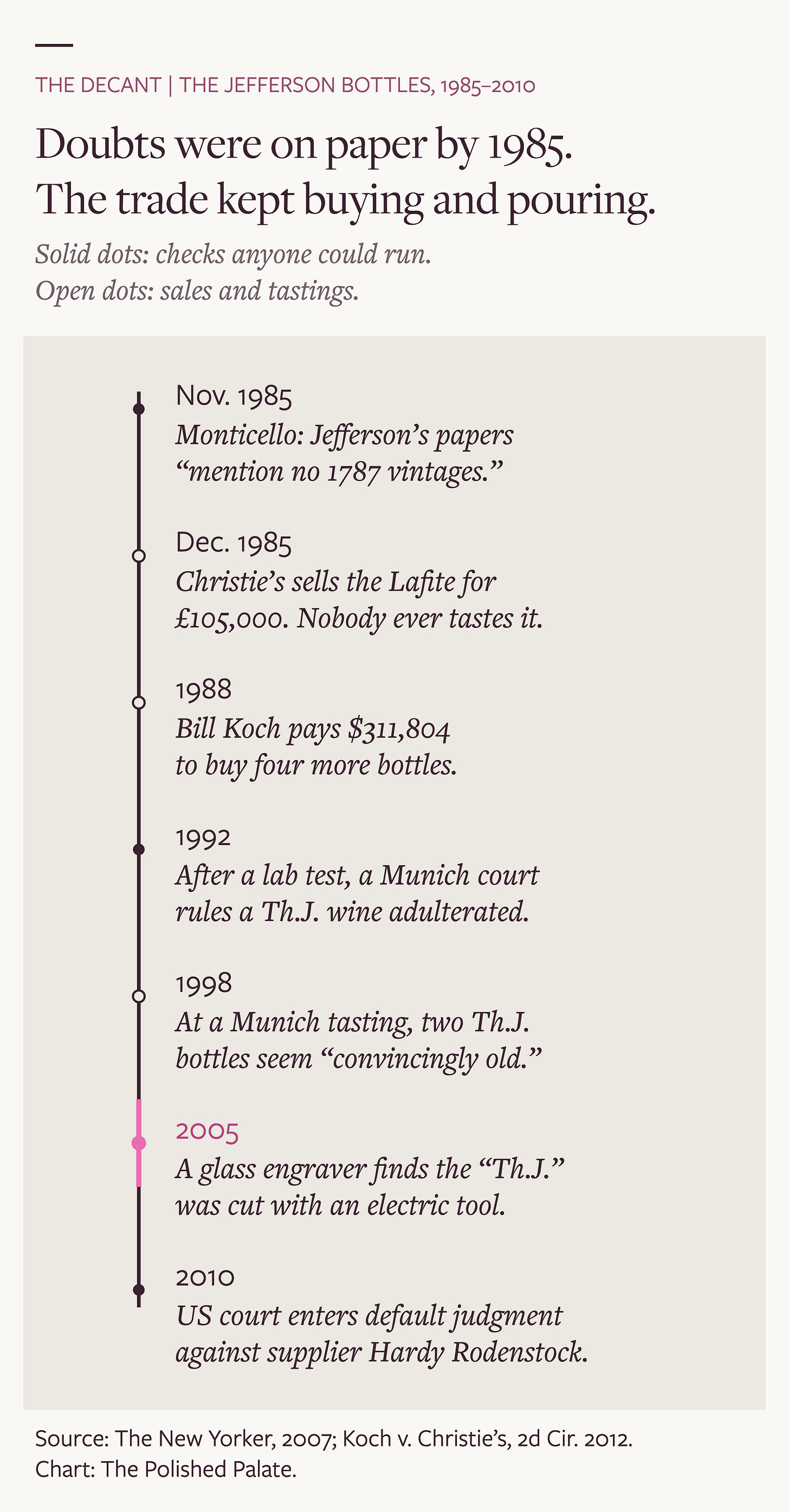
In November, weeks before the sale, a researcher there, Cinder Goodwin, wrote back that Jefferson’s account book, virtually all his letters, his banker’s statements, and French customs forms survived for the period, and they “mention no 1787 vintages.” She also told a New York Times reporter before the auction that Jefferson usually wrote his initials with a colon, Th:J, where the bottles had a period.
On the other side stood what the auction house could judge without the ledger. Christie’s glass experts found the bottle and engraving 18th-century French in style. Broadbent had tasted two other bottles from the cache and pronounced a 1784 Th.J. Yquem “perfect in every sense: colour, bouquet, taste.” He said at the time that he had “no proof” of Jefferson’s ownership but “masses” of circumstantial evidence.
The catalogue did not mention Goodwin’s doubts, and the hammer fell. Her formal report followed a week later. It allowed that the bottles could well be 18th century but found the Jefferson connection unsupported by the record, and it asked whether there had not been other Thomases, Theodores, or Theophiles with those initials.
The bottles kept selling. In March 1987 Christie’s sold a half-bottle of 1784 Margaux from the cache for $30,000. In 1988 the collector Bill Koch bought four Jefferson bottles through the Chicago Wine Company and Farr Vintners for $311,804.40, the figure in the court record. When his staff went looking for their provenance years later, they found that apart from Broadbent’s authentication of the Forbes bottle they had nothing on file.
The verdict and the tasting after it
In 1991 Hans-Peter Frericks, a German collector who had bought a “1787 Th.J. Lafitte” from Rodenstock, sent his bottle to a Munich lab. The carbon and tritium readings showed that nearly half the wine dated to 1962 or later. Frericks sued, and on December 14, 1992, a Munich court found that Rodenstock “adulterated the wine or knowingly offered adulterated wine.” Rodenstock appealed, and the case was settled out of court during the appeal, so no higher court ever ruled on it. The lab result and the first ruling were public all the same.
Six years later, in 1998, Rodenstock opened 125 vintages of Château d’Yquem over a week at the Hotel Königshof in Munich, two Th.J. bottles among them. Wine Spectator’s correspondent wrote that the 1784 “tasted as if it were decades younger.” Jancis Robinson, a Master of Wine who attended, found the two Th.J. bottles “convincingly old.” A court had already ruled on wine from the same cache. Around the table, the tasters’ judgment was the one that counted.
The drill
Koch had doubts of his own, and in 2000 he sent samples to the Woods Hole laboratory, whose report put a 4.6 percent probability on the wine dating from the 1740 to 1800 window the engravings claimed. In 2005 the Museum of Fine Arts in Boston, preparing an exhibition from his collection, asked for the provenance of the Jefferson bottles. Monticello told his staff it did not believe the bottles had ever belonged to Jefferson, and Koch hired a former FBI agent to build a case.
The investigator first took the bottles to a French physicist, who tested them for cesium-137, the isotope atmospheric nuclear testing put into wine bottled after 1945. He found none, which proved only that the wine was bottled before 1945. The engraving settled it. A master glass engraver examined the “Th.J.” under magnification. An 18th-century engraver held the bottle against a turning copper wheel, which cuts lines that vary in thickness like the strokes of a fountain pen. The lines on Koch’s bottles were uniform and slanted in a way a copper wheel would not cut, and the engraver concluded they had been made with a handheld electric tool, a dentist’s drill or a Dremel. Koch’s investigators later reported finding German craftsmen who said Rodenstock had hired them to engrave bottles; a Winterthur Museum account of the case says two of them confessed to engraving the names and dates.
Koch sued Rodenstock in federal court in Manhattan in 2006. Rodenstock called the engraving analysis the work of “amateur engravers,” then suggested in a letter to the court that whoever sold him the wines might have had some bottles re-engraved because the old engravings were no longer legible. He refused to take part in the case, and in May 2010 the court entered a default judgment against him.
What a palate was asked to do
In 2009 Broadbent won a libel settlement in London from Random House over Benjamin Wallace’s book The Billionaire’s Vinegar, which apologized for allegations that he had behaved improperly in auctioning the bottles. This issue takes his good faith as given. What it questions is the weight his palate was given.
Broadbent had tasted more old wine than anyone alive, and even he had no independent benchmark for a 1787. Much of his book Vintage Wine’s section on 18th-century wines, Patrick Radden Keefe reported in The New Yorker, consists of notes from Rodenstock tastings, so the trade’s reference for what a 200-year-old bottle tastes like came in large part from the supplier whose bottles were in question. A palate that good can say whether a wine is sound, old, and delicious. It cannot say which cellar a bottle sat in or whose initials were cut into it, and in this case it had nothing genuine to compare against.
Rodenstock made the same use of reputation himself. Of the Forbes bottle he wrote that if Christie’s “had the slightest doubt,” it would not have accepted the bottle. Defending a different wine, a 1921 Pétrus magnum that Robert Parker had scored 100 points at his 1995 Munich tasting, he asked The New Yorker whether there could be “any better proof that the wine was genuine” than world-renowned experts giving it the highest grade. Pétrus’s cellar master later said he did not believe any 1921 magnums had been bottled there. Decant #16 covered Rudy Kurniawan, whose fakes top tasters praised for years until Domaine Ponsot’s production records showed that a 1945 Clos Saint-Denis could not exist.
The Finish
Before you pay extra for a story about a bottle, ask what part of the story anyone could check: the importer on the back label, the estate’s own website, whether the word on the label means anything legally. If nothing can be checked, buy the bottle for what you expect the wine to be, or leave it. When you do open it, taste it before you reread the back label and write down what you found; that note is your evidence about the wine in the glass.
Worth sitting with past this issue: which words on the last label you paid extra for could anyone actually check?
Everything that exposed the Jefferson bottles could be checked by someone who never tasted them: a ledger, a lab reading, a tool mark under magnification. The palates that vouched for them could report only the glass, and for 20 years the trade gave their word more weight than the evidence anyone could check.
Pocket Palate: the Jefferson bottles
One card to keep:
- The sale: December 5, 1985, Christie’s London, a bottle engraved “1787 Lafitte Th.J.”, sold to the Forbes family for £105,000 (about $157,000), the auction record for a single bottle at the time. Never opened.
- The letter: in November 1985, before the sale, Monticello’s Cinder Goodwin wrote to Christie’s Michael Broadbent that Jefferson’s papers “mention no 1787 vintages.” The sale went ahead.
- The verdict: in 1992 a Munich court, after a lab found post-1962 wine in a Th.J. bottle, ruled against the supplier, Hardy Rodenstock. In 1998 tasters at his Yquem vertical found two more Th.J. bottles convincingly old.
- The tool: a master glass engraver found the “Th.J.” on Koch’s bottles was cut with an electric tool, which leaves uniform lines; an 18th-century copper wheel does not.
- The rule: a palate reports on the glass. Where a bottle has been is settled by evidence someone can check: papers, lab results, the object itself.
Go Deeper
If this week’s idea stuck with you, these take it further.
- The Kitchen Sisters, How Atomic Particles Became the Smoking Gun in Wine Fraud Mystery (NPR, 2014): The investigation told through Monticello’s Cinder Stanton and the investigators, including the cesium test that could not date the wine and the modern engraving tool that gave it away.
- Patrick Radden Keefe, The Jefferson Bottles (The New Yorker, 2007): The long-form account of Rodenstock, Broadbent, Koch, Monticello’s early doubts, and the investigators, written while the lawsuit was live.
- Benjamin Wallace, The Billionaire’s Vinegar (Crown, 2008): The book-length record of the sale and its unravelling. Withdrawn in the UK after Broadbent’s 2009 libel settlement, still in print everywhere else.
- Wine (Treasures on Trial: The Art and Science of Detecting Fakes, Winterthur Museum): A museum’s account of the engraving evidence: copper wheel versus electric drill, and why line thickness gave the bottles away.
- Koch v. Christie’s International PLC (U.S. Court of Appeals for the Second Circuit, 2012): The appeals court’s account of what Koch paid and when, the December 1985 Monticello report, and the Woods Hole probabilities. It held Koch’s claims against Christie’s time-barred and notes the 2010 default judgment against Rodenstock in passing.