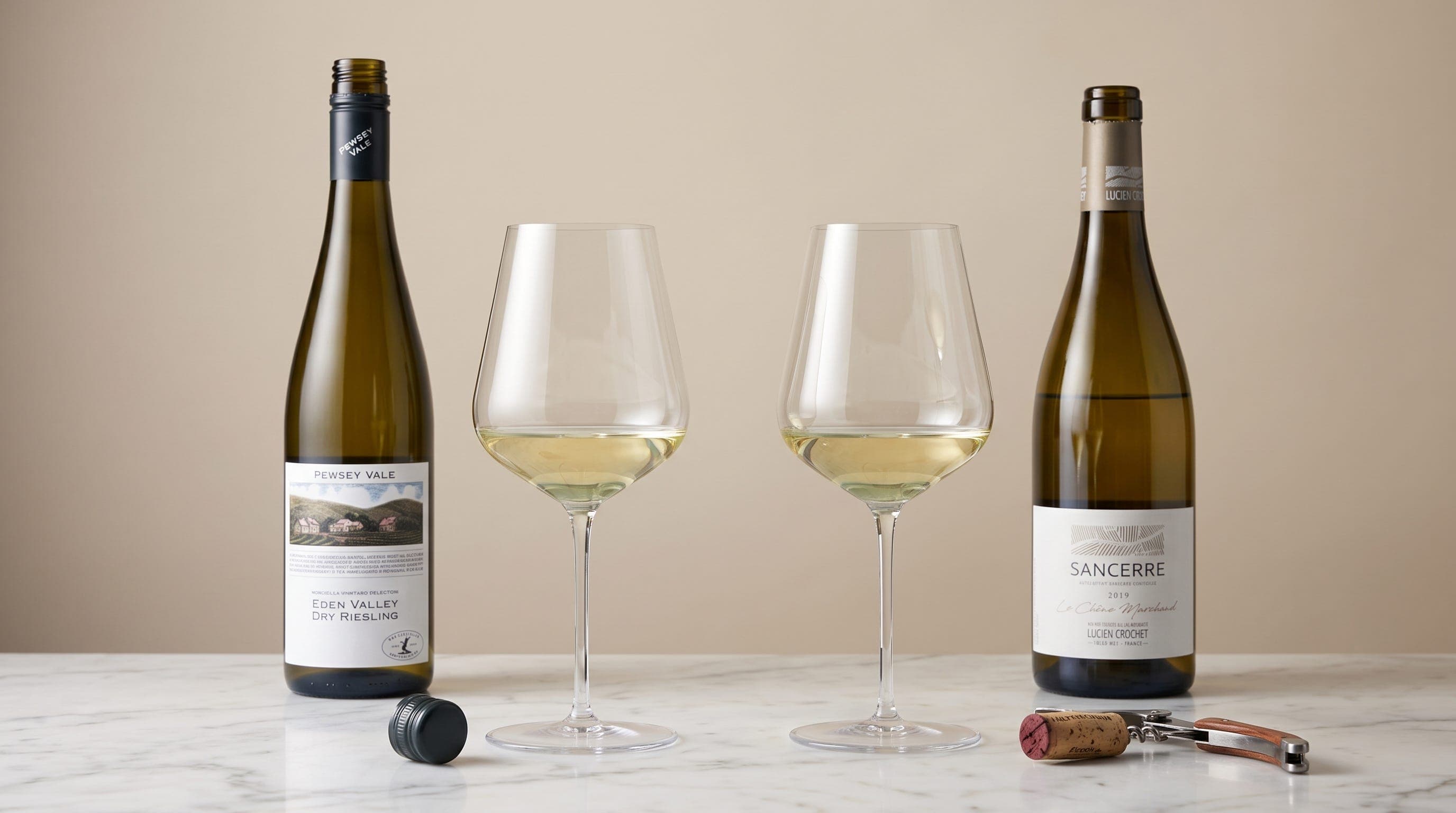
1 Big Idea: Every Bottle the Way It Was Made
You are standing in a wine aisle with two bottles of Riesling at about the same price. One has a cork and a foil capsule. The other twists open. Somewhere in the back of your head a small voice says the twist-off is the cheaper wine, and you reach for the cork.
For decades, twist-offs sat on the cheapest bottles in the aisle, so many drinkers learned to read them as a sign of low quality. The cork came with a ritual: the foil, the corkscrew, the pop.
In September 2000, PlumpJack in Napa released its 1997 Reserve Cabernet Sauvignon with half of the 300 cases sealed under screw cap. The specially made bottles cost the winery more, and it priced the screw-capped Cabernet at $135, $10 above the one under cork. Co-owner Gordon Getty was fed up with corked bottles, and the winery called the release an experiment to start a dialogue. At one of the best addresses in Napa, the twist-off was the deliberate choice, and the pricier bottle.
What PlumpJack was buying is a bottle that tastes the way it was made, every time. A cork cannot promise that, for 2 reasons:
The first is taint. A compound called TCA forms when chlorine compounds meet mold in cork bark, and a trace measured in parts per trillion makes a wine smell of wet cardboard and a damp basement, or simply flattens its fruit.
The flat version is the one that fools people. Two weeks ago on the floor, I opened a bottle of Lucien Crochet Sancerre that smelled muted, far less aromatic than I know that wine to be. On the palate it tasted like acid and a little bitterness, with the fruit and the balance gone missing. I opened a second bottle, and it smelled and tasted exactly the way that Sancerre should. Same wine, and the 2 bottles were completely different. The first one was corked.
Wine Spectator’s California editors kept an informal count of the cork-sealed bottles they judge corked. In 2007 it was about 1 bottle in 10. By 2012 it was about 1 in 27, as cork quality improved. The rate is falling, and it is still a risk only the cork carries. The producer never tastes that bottle. You do.
The second is air. Last week’s issue was about oxygen: a little of it, over years, is how a wine develops, and too much is how it dies. A natural cork lets in a small amount, and the amount varies widely from one cork to the next. A screw cap’s seal is set by its liner. The standard tin liner lets in almost no oxygen, and the alternative, called Saranex, lets in a little more. The winemaker picks the liner, which means the winemaker picks the air, and every bottle gets close to the same amount. The Australian Wine Research Institute’s ranges put the gap in one picture.
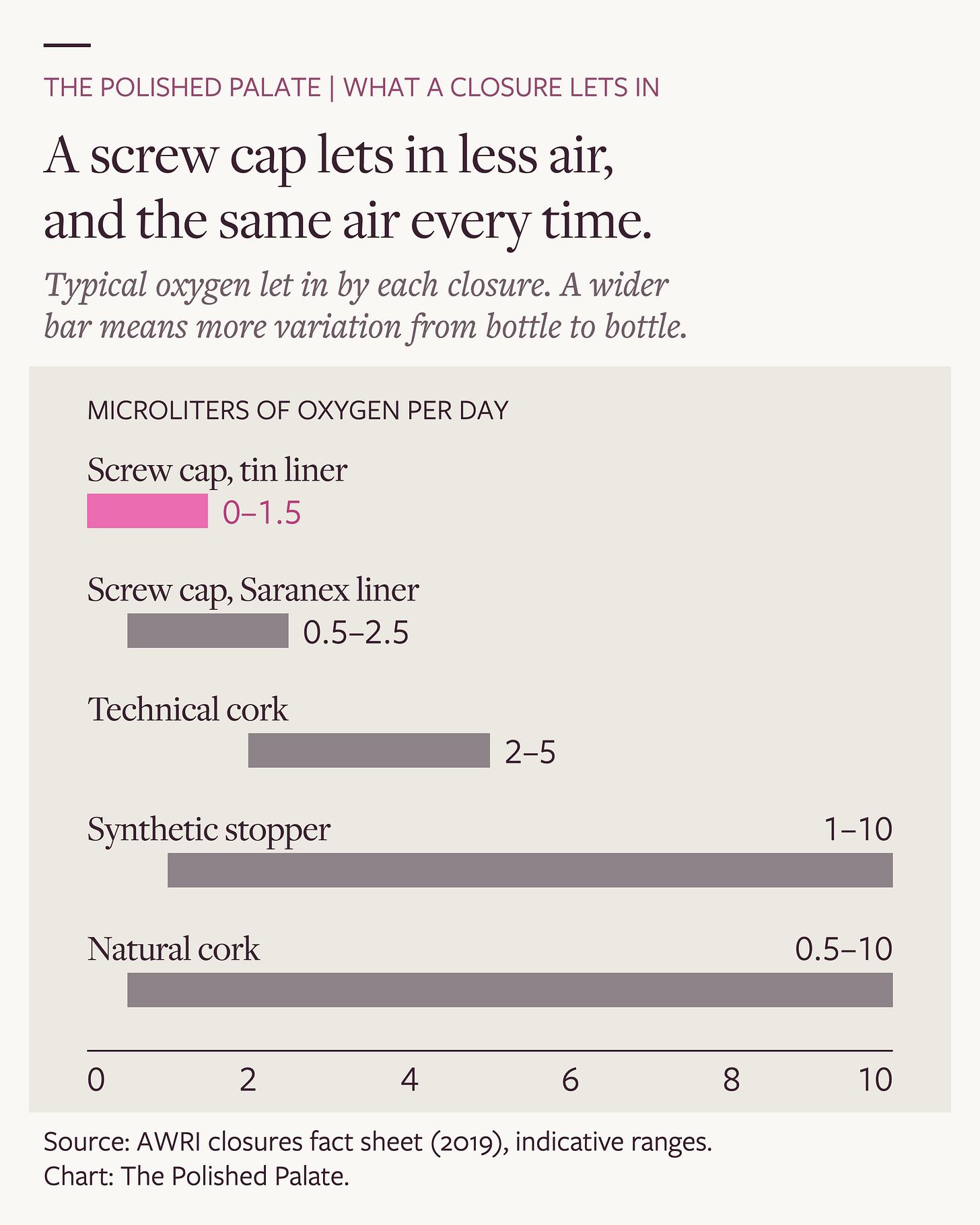
Australia and New Zealand made the switch on those 2 grounds. In July 2000, a group of Clare Valley Riesling makers led by Jeffrey Grosset bottled their 2000 Rieslings under screw cap together. New Zealand’s producers followed in 2001, and within a decade about 90 percent of their wine was sealed that way. The evidence was already in the bottle. A year earlier, in 1999, the AWRI had sealed one Clare Valley Semillon under 14 different closures, and it followed the wine for 10 years. The plastic stoppers oxidized fastest, and the screw cap was one of the 2 best performers.
So a twist-off on a good producer’s bottle is a promise: the wine you open is the wine they bottled, with no taint and no lottery on the air. Many fine winemakers still choose cork, for reds built to age for decades, for the small and gradual air it lets in, and because their buyers expect it. That is a defensible call. Either way, the closure was never telling you the price.
3 Taste Experiments
#1: One screw-capped white, at the twist and 20 minutes later
- Objective: Smell what a tight seal holds in, and watch it fade.
- What to try: One young screw-capped Riesling or Sauvignon Blanc: Pewsey Vale Dry Riesling (Eden Valley, $18-25), Jim Barry The Lodge Hill Riesling (Clare Valley, $19-23), or Kim Crawford Sauvignon Blanc (Marlborough, $13-16). Pour a small glass the moment you open it, then a second glass 20 minutes later.
- What to notice: In the first glass, look for struck match, flint, or a faint rubbery edge sitting on top of the fruit. Not every bottle shows it. In the second, check whether that edge has faded and the citrus, green apple, or passion fruit has come forward. Compare how fresh and sharp each glass feels on your tongue.
- Lesson: That struck-match note is reduction, the smell of a wine that has had very little air since bottling. Any wine can show it, and tightly sealed screw caps make it more likely. It usually fades within minutes of meeting air, which is why a wine that smells closed at first can open up over 20 minutes in the glass. What you smelled is the low-oxygen seal at work, and it is the same seal in every bottle of that wine.
#2: A young screw-capped Riesling vs one aged 5 years under screw cap
- Objective: Settle whether screw-capped wine can age.
- What to try: From one producer, so the closure and the region are constant: Pewsey Vale Dry Riesling (Eden Valley, $18-25) next to Pewsey Vale The Contours Riesling, released with about 5 years in bottle ($30-45). Peter Lehmann Wigan Riesling (Eden Valley, released at 5 years, $23-30) makes the same point against any young Australian Riesling. Chill both and pour side by side.
- What to notice: Color: pale green-straw in the young wine, deeper gold in the aged one. Smell the young one for lime and blossom; the aged one for toast, honey, lemon curd, and sometimes a petrol-like note. Then check the acidity in each. It should feel nearly as bright in the older wine.
- Lesson: The aged bottle spent its whole life under the closure people call cheap, and it developed the way a fine white is supposed to: slowly, and in one direction. Riesling has the acid to age, and the screw cap kept the air out, so the wine changed only through what was already in the bottle. A winery can hold a wine like that for 5 years or more and release it knowing every bottle has aged the same way. Under natural cork, with its variable air, you would expect more difference from one bottle to the next.
#3: The corked bottle (expectation only)
- Objective: Know cork taint on the first sniff, so you never pay for it twice.
- What to try: No purchase. Use the next cork-sealed bottle opened for you, at home or at a restaurant.
- What to notice: Wet cardboard, a damp basement, or a wet dog. In mild cases, like that Sancerre, nothing smells wrong: the aromas are muted, and the wine tastes of acid and a little bitterness where the fruit should be. A 2013 study in the journal PNAS found that TCA dulls the smell signal itself, which helps explain why a mildly corked wine just seems flat.
- Lesson: The taste a server pours before filling your glass is there to check for this. A corked bottle is a fault in the closure, and most restaurants will replace it. When you are not sure, a second bottle of the same wine settles it, the way it did for me. Say “I think this one is corked” and let them smell it.
Pocket Palate: Read the closure
- Natural cork: Lets in small, variable amounts of air. Carries a small risk of TCA taint. Still the choice of many winemakers for wines meant to age.
- Technical cork: Ground cork, treated to strip out TCA and pressed into a consistent stopper. Diam is the best-known brand, sold on being free of taint and consistent from stopper to stopper.
- Synthetic (plastic) stopper: Oxidized fastest in the AWRI trial. Fine for a wine you will open this year.
- Screw cap: The liner sets the air. The tin liner lets in almost none; Saranex lets in a little more. No TCA from the closure.
- The smell of trouble: Wet cardboard or damp basement means cork taint. Struck match on opening usually means reduction, and it fades with air.
- The rule: The closure tells you how the winemaker managed air and how much taint risk you are taking on. A screw cap from a good producer means every bottle should taste the same.
The Finish
PlumpJack’s experiment got its answer slowly. At the winery’s 10th-anniversary celebration in October 2007, both versions of the 1997 Reserve were poured blind, and there was no clear preference, according to the wine writer Richard Jennings. In 2011, at 14 years, he tasted the pair blind with a group: the screw-capped bottle scored 91 points and the corked one 89, and the group liked the cork-sealed bottle least of the 3 wines poured. The bottle sealed with the closure people call cheap held up as well as the cork, and in that tasting a little better.
3 glasses this week: a screw cap holding the air out, a screw-capped Riesling that aged on schedule, and a cork that went wrong. Every closure is a decision about how much air the wine gets and how much risk you inherit when you open it. A screw cap is the decision to make every bottle the same.
The preference is yours to make. If the pop of a cork is part of the evening for you, choose the bottle that gives it to you. The price of that pop is a small chance of a corked bottle and a little more variation from one bottle to the next.
One action for this week: back in the aisle, with 2 bottles at the same price, read the closure as information. For a wine you will open this week, the twist-off is the one that carries no taint risk. For a wine you want to keep, a producer who releases aged whites under screw cap, like the ones in #2, has already shown you it holds. And when a server pours you a taste from a cork, smell it for wet cardboard before you decide anything else.
Go Deeper
If this week’s idea stuck with you, these take it further.
- Jamie Goode, A Very Important Wine: 1999 AWRI Trial Semillon (Wine Anorak, 2010): A taster’s account of the Clare Valley Semillon sealed under 14 closures, a decade on, including the screw cap’s struck-flint note.
- Applying Screw Cap Closures (Australian Wine Research Institute): The research institute’s own guidance on screw cap liners, including the oxygen difference between tin and Saranex.
- Cork Taint in California Wines Hits New Low (Wine Spectator, 2013): The magazine’s own count of corked bottles in its blind tastings, and how the rate fell after 2007.
- Richard Jennings, Cork vs. Screw Cap at 14 Years: PlumpJack Reserve Cabernet (2011): Tasting notes from a blind side-by-side of the 2 PlumpJack 1997s, with the winery’s 2007 anniversary tasting for context.
- Hiroko Takeuchi, Hiroyuki Kato, and Takashi Kurahashi, 2,4,6-Trichloroanisole Is a Potent Suppressor of Olfactory Signal Transduction (PNAS, 2013): The study behind the muted-fruit effect of cork taint, with tasters’ detection thresholds in spiked red and white wine.