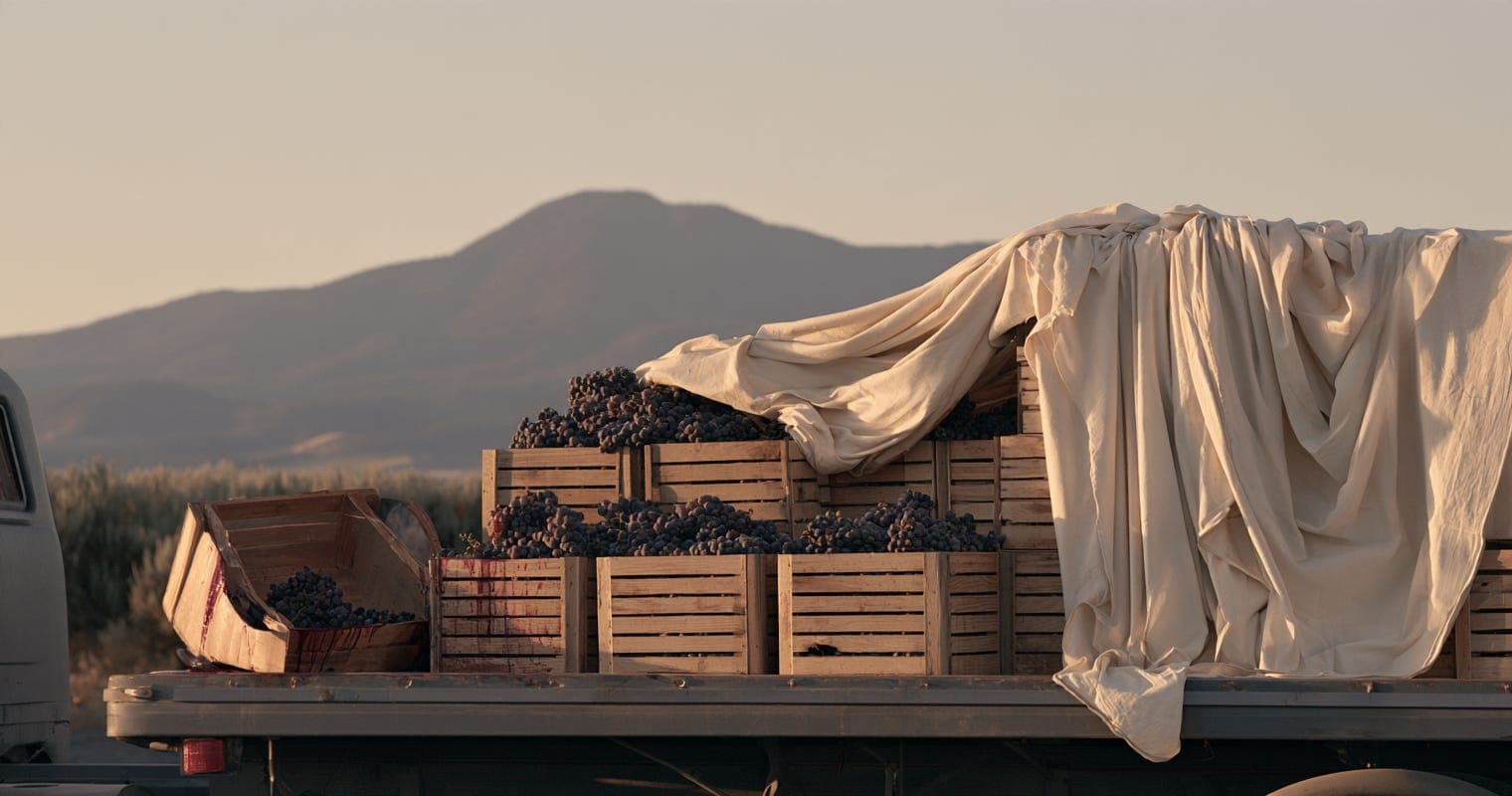
There is a decent chance you have walked past this bottle. Château Musar shows up at serious wine shops across the United States, usually somewhere between $50 and $90, wearing an old-fashioned label that gives nothing away. Most shoppers drift past it toward a Napa Cabernet at the same price. Every vintage of that wine made between 1977 and 1990 crossed the front lines of a civil war to exist.
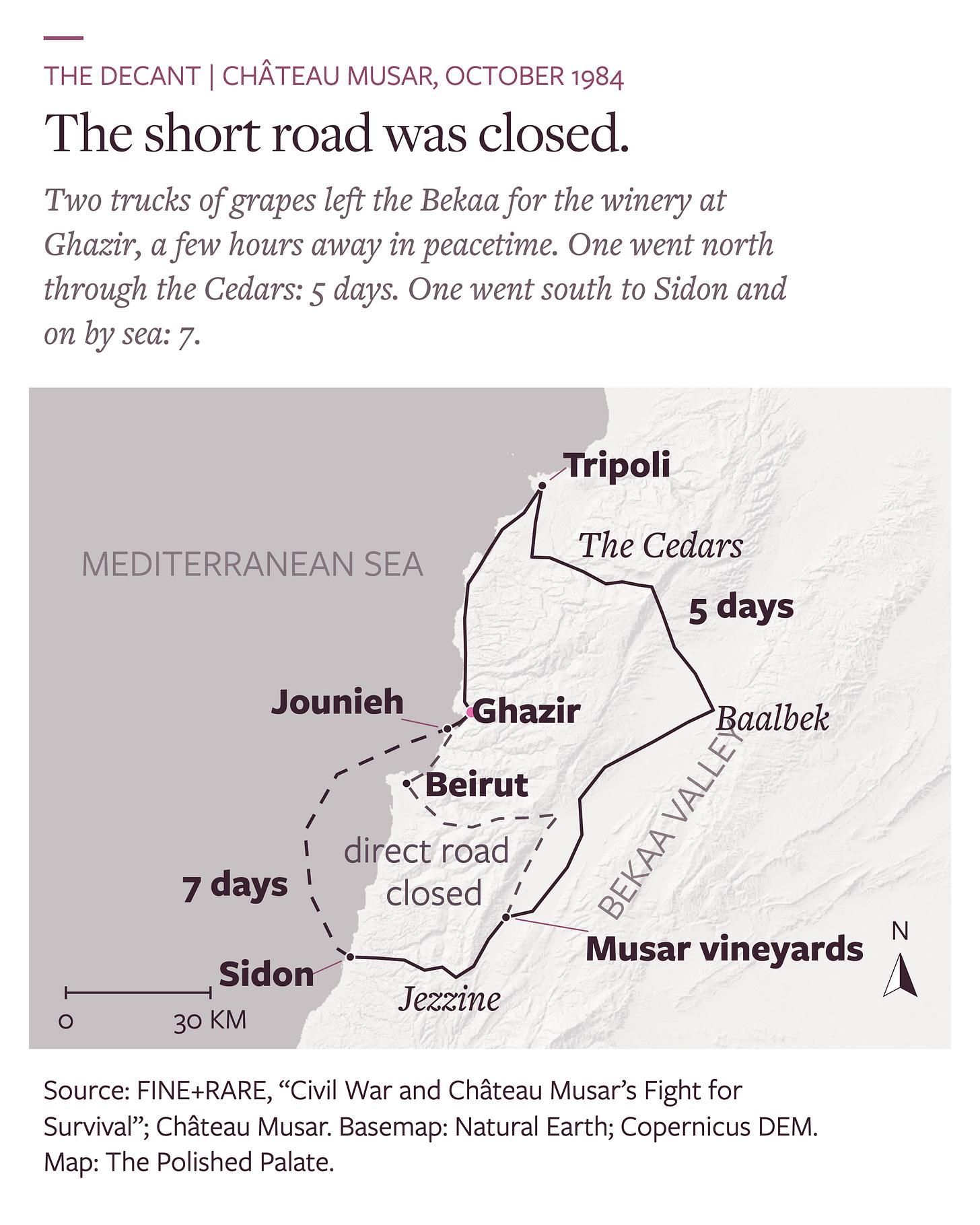
The geography explains the stakes. Musar’s vineyards sit in the Bekaa Valley, a high plateau at about 3,000 feet on the eastern side of Mount Lebanon. The winery sits in Ghazir, a hillside town north of Beirut, roughly 70 kilometers of mountain road away. When Lebanon’s civil war began in 1975, the line dividing the country ran between the two. For the next 15 years, making wine meant picking grapes on one side of that line and trucking them to the other, through militia checkpoints, past artillery positions, on whatever roads were open that week.
More than 100,000 people were killed in that war. It divided Beirut along the Green Line and drew the Syrian and Israeli armies onto Lebanese soil, including into the Bekaa itself. Wine is a small thing to hold against that, and this story stays small on purpose: one family, one road, one harvest a year.
Serge Hochar, the man who ran Musar through all of it, described his own position this way: “If you ask me on which side I fought during these 15 years, I can only tell you that I was fighting for my wines.”
What follows is the documented record of how those wines got made, and why the wine that survived is one critics have argued about for 40 years. The argument is the part that concerns you directly. Musar breaks most of the rules a wine gets scored on, and it has outlasted nearly every wine that followed them. If you have ever wondered whether your own read on a bottle can be trusted when the experts disagree with it, and with each other, this is the cleanest test case wine has produced.
A Bordeaux idea in the mountains above Beirut
Gaston Hochar founded Château Musar in 1930, after time in Bordeaux convinced him Lebanon could make wine in that image. He built the winery in Ghazir and planted his vines in the Bekaa. During the Second World War, Ronald Barton of Bordeaux’s Château Langoa-Barton was stationed in Lebanon, befriended the family, and deepened the estate’s Bordeaux orientation.
His son Serge, born in 1939, started working at Musar in 1958 and made his first vintage in 1959, while still a student. He went on to study oenology in Bordeaux under Émile Peynaud and Pascal Ribéreau-Gayon, two of the most influential wine scientists of the century, finishing in 1964. In 1974 he took control of the estate.
The war began the following spring.
Fifteen harvests inside a war
The 1975 harvest still made it over the mountain. The next one did not. “In 1976 there was total war in Lebanon,” Hochar said later. “We had no electricity. No fuel. No transport. No harvest.” It remains the only year since 1930 that Musar made no wine. In a strange twist of the same calendar, 1976 was also the year a blind tasting in Paris put Napa Cabernet above Bordeaux and redrew the wine map. I wrote about that tasting in What Napa Actually Won at the Judgment of Paris. While the industry argued over scores in a Paris hotel, Lebanon’s most famous estate could not get a single grape over the mountain.
Hochar’s own summary of the years that followed was characteristically blunt: “When the war started, I didn’t stop making wine. War does not kill yeasts.”
Every vintage from 1977 to 1990 was made. The record preserves what that sentence cost. In 1982, the summer of the Israeli invasion, Syrian and Israeli tank lines faced each other across the Bekaa, and 80 hectares of Musar’s vineyards sat between them. Hochar calculated he would not harvest again until 1985. The Bedouin crews who worked the vineyards went in anyway, picked what could be reached, and the trucks got through. He later called the 1982 “a pure wine of war.”
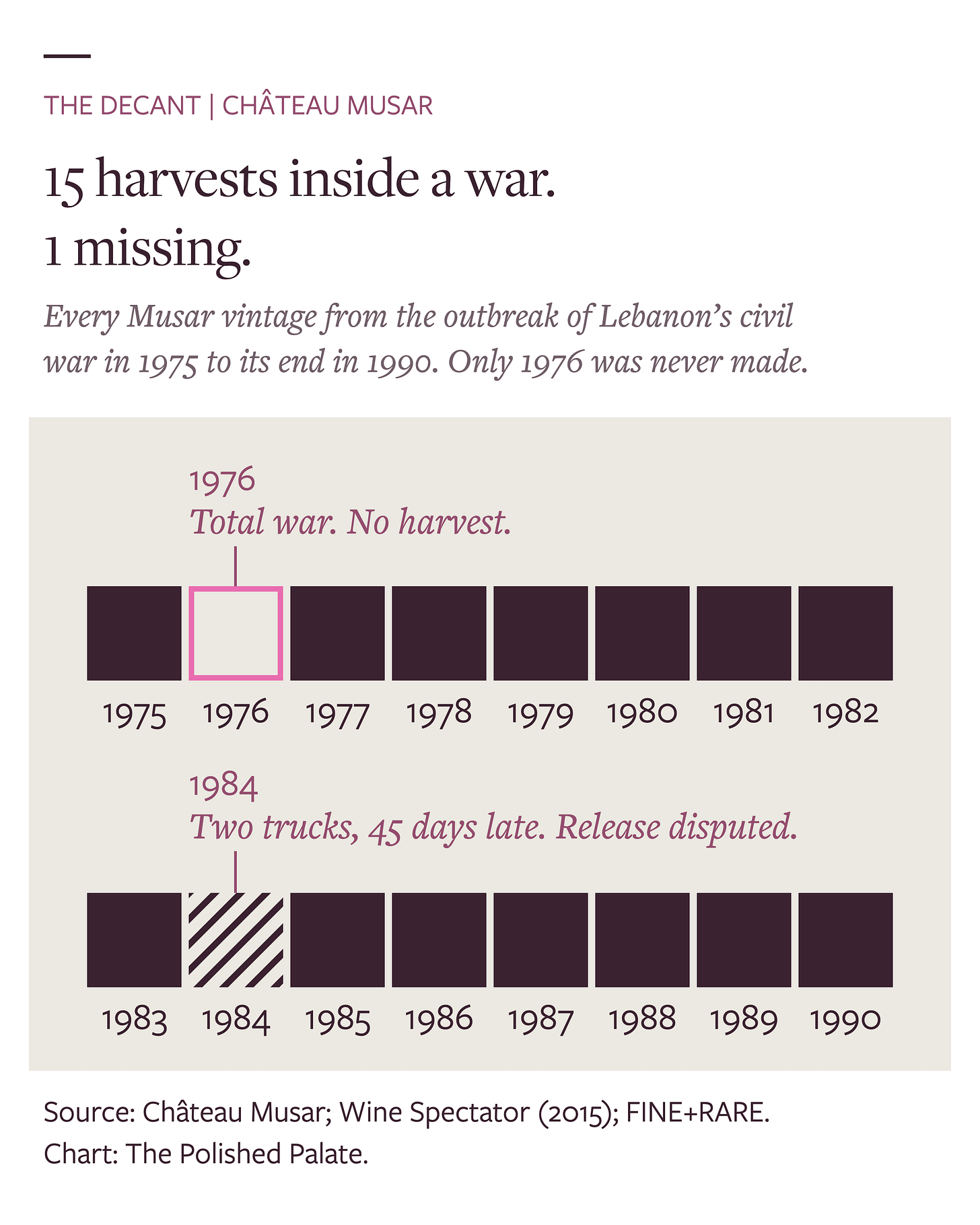
In 1983 the fighting cut the estate off from its own fruit until a lull let the vineyard manager smuggle sample grape bunches into Beirut for inspection. Hochar, stuck in Cyprus, came back by hovercraft, a six-hour crossing; rockets hit the coast road he had just driven. The harvest came in 40 days late, hauled over back roads by drivers who knew from memory which militia held which checkpoint. His verdict afterward was flat: “What can I say? We had problems with transporting our grapes overland and we had trouble shipping our wines overseas. That is war.”
Through those same years, the cellars at Ghazir doubled as bomb shelters, with families from the area sheltering among the barrels during bombardments. Across all 15 years of war, no Musar employee was killed.
The commercial lifeline had arrived in 1979, at the Bristol Wine Fair, where Michael Broadbent of Christie’s tasted the Musar 1967 and named it the discovery of the fair. “The 1967 was outstanding,” he wrote in Decanter. With the home market collapsing, export became survival: over the following two decades Musar went from selling 75 percent of its wine in Lebanon to selling 75 percent abroad.
Two trucks in October
Then came 1984, the year the roads closed at exactly the wrong time. Fighting severed the routes between the Bekaa and the coast during harvest, and in the end only two truckloads of grapes could even attempt the trip. Two drivers agreed to try, by different routes. One went north through the cedar country of the upper Bekaa to Tripoli, then down the coast: five days. The other went south through Jezzine to catch a ferry up to Jounieh; a storm held the boat, and his trip took seven.
The grapes reached Ghazir on October 20, about 45 days after the harvest should have ended: hot, bruised, and already fermenting in the trucks. Any oenology textbook says you discard that fruit. Hochar vinified it. “I made the 1984 to declare war against war,” he said.
What became of the wine depends on which account you read. Wine Spectator’s obituary counts 1984 alongside 1976 as the war’s two lost vintages. The merchant FINE+RARE records that the wine was made and held back for 30 years before release. The accounts agree on the part that matters: almost nothing survived that October, and what did survive became wine.
That same year, Decanter magazine created its Man of the Year award and gave the first one to Serge Hochar, for continuing to make wine through the war. He accepted, and told interviewers the recognition belonged to the quality of the wines.
The wrong wine by every rubric
So what is this wine that crossed the checkpoints? The red is a blend of Cabernet Sauvignon, Cinsault, and Carignan, with Grenache and Mourvèdre appearing in varying amounts by year. Hochar had a formula for it: “the Cabernet is the skeleton, the Carignan the flesh and the Cinsault the perfume.” The ferments run on wild yeasts with little sulfur, the wine goes unfined and unfiltered, and a vintage waits about 7 years before release. The whites come from Obaideh and Merwah, indigenous Lebanese varieties growing on vines a century old and more.
And here the war story hands off to the argument that has followed Musar ever since. The wines carry volatile acidity at levels a technical tasting panel marks as a fault, along with Brettanomyces and vintage-to-vintage swings that make consistency impossible. Critics have called them tired and old-fashioned. Devotees call them extraordinary.
Hochar sat in the middle of that fight, cheerfully, for decades. Asked the secret to how his wines age: “You really want to know my secret? Volatile acidity.” Pressed on whether that was a defect: “Wine is such a complex thing, and V.A. is part of wine. If you have none, it’s a flaw. It’s part of fermentation. It’s a question of balance.” And once: “I once produced a technically perfect wine, but it lacked the charms of imperfection.”
Serge Hochar died on December 31, 2014, in a swimming accident off Acapulco while on holiday with his family. He was 75. His sons Gaston and Marc, the third generation, run the estate today.
Pocket Palate: Château Musar
The save-worthy version of this issue.
- The estate: founded 1930 by Gaston Hochar in Ghazir, Lebanon; vineyards in the Bekaa Valley at about 3,000 feet.
- The war record: a vintage nearly every year of the 1975-1990 civil war; 1976 was lost, and the 1984, made from two truckloads that took 5 and 7 days to arrive, may never have been commercially released.
- The red blend: Cabernet Sauvignon, Cinsault, Carignan; wild yeasts, minimal sulfur, unfined, unfiltered, about 7 years before release.
- The controversy: volatile acidity and Brett at levels conventional scoring calls faulty; Serge Hochar kept both by choice.
- The buy: current releases run roughly $50 to $90 at US retail; taste it before you read anyone’s note on it.
The Finish
By every convention that scores wine, Musar is wrong. The volatile acidity runs past textbook limits, the Brett is unapologetic, and no two vintages resemble each other. Yet the wines from the war years are collector pieces, the estate is still family-run after 96 years, and the man who made them was the first person Decanter ever named Man of the Year.
The conventions measure how closely a wine matches a style the industry agreed on. Your palate measures what is actually in your glass. Those are different instruments, and only one of them belongs to you.
So run the test this story sets up. Find a wine critics disagree about (Musar is the easiest to find), taste it, and write your own note, three sentences, before you look up a single review. Then read the reviews and notice which parts of your note you feel tempted to cross out. Discernment grows every time you commit to your own read before borrowing someone else’s.
Go Deeper
If this week’s idea stuck with you, these take it further.
- Civil War and Chateau Musar’s Fight for Survival (FINE+RARE): The fullest year-by-year account of the war harvests, including the 1983 hovercraft crossing and the two 1984 truck routes.
- Serge Hochar, Famed Proprietor of Lebanon’s Chateau Musar, Dies at 75 (Wine Spectator, 2015): The obituary of record, with the full biography, the export numbers, and the “war does not kill yeasts” quote in context.
- Serge Hochar: The Chateau Musar Winemaker’s Legacy (Club Oenologique, 2024): A ten-years-on assessment of his influence, with Michael Broadbent’s original 1979 Bristol Wine Fair note.
- Alder Yarrow, Losing a Legend in Serge Hochar (Vinography, 2015): A personal remembrance from one of America’s longest-running wine writers, useful for how tasters who loved the wines described them.